An X-ray tube is operated at \( 1.24 \) million volt. The shortest wavelength of the produced photon will be:
\( 10^{-1} \, \text{nm} \)
\( 10^{-3} \, \text{nm} \)
\( 10^{-4} \, \text{nm} \)
\( 10^{-2} \, \text{nm} \)
The decay constant for a radioactive nuclide is \( 1.5\times 10^{-5} \, \text{s}^{-1} \). Atomic weight of the substance is \( 60 \, \text{g mole}^{-1} \), \( (N_A=6\times 10^{23}) \). The activity of \( 1.0 \, \mu \text{g} \) of the substance is __________ \( \times 10^{10} \, \text{Bq} \).
When a light of a given wavelength falls on a metallic surface the stopping potential for photoelectrons is \( 3.2 \, \text{V} \). If a second light having wavelength twice of first light is used, the stopping potential drops to \( 0.7 \, \text{V} \). The wavelength of first light is __________ m. \( (h = 6.63 \times 10^{-34} \, \text{J}\cdot\text{s}, \; e = 1.6 \times 10^{-19} \, \text{C}, \; c = 3 \times 10^{8} \, \text{m/s}) \)
Statement I: By doping silicon semiconductor with pentavalent material, the electrons density increases.Statement II: The \( n \)-type semiconductor has net negative charge.In the light of the above statements, choose the most appropriate answer from the options given below:
The work function of a metal is \( 3 \ \text{eV} \). The color of the visible light that is required to cause emission of photoelectrons is:
Assume that protons and neutrons have equal masses. Mass of a nucleon is \( 1.6 \times 10^{-27} \, \text{kg} \) and radius of nucleus is \( 1.5 \times 10^{-15} A^{1/3} \, \text{m} \). The approximate ratio of the nuclear density and water density is \( n \times 10^{13} \). The value of \( n \) is ________.
The half-life of \( \mathrm{Au}^{198} \) is \( 2.7 \) days. The activity of \( 1.50 \, \text{mg} \) of \( \mathrm{Au}^{198} \) if its atomic weight is \( 198 \, \text{g mol}^{-1} \), is, \( (N_A = 6 \times 10^{23} / \text{mol}) \).
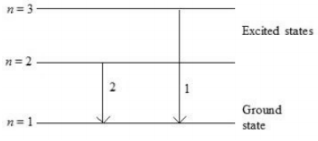
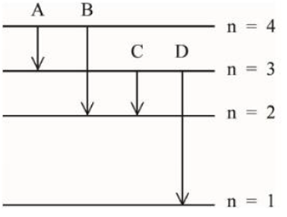
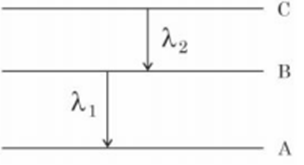
For hydrogen atom, \( \lambda_1 \) and \( \lambda_2 \) are the wavelengths corresponding to the transitions \( 1 \) and \( 2 \) respectively as shown in figure. The ratio of \( \lambda_1 \) and \( \lambda_2 \) is \( \dfrac{x}{32} \). The value of \( x \) is _____.
If \( 2.5 \times 10^{-6} \, \text{N} \) average force is exerted by a light wave on a non-reflecting surface of \( 30 \, \text{cm}^2 \) area during \( 40 \) minutes of time span, the energy flux of light just before it falls on the surface is ______ \( \text{W/cm}^2 \). (Round off to the Nearest Integer) (Assume complete absorption and normal incidence conditions are there)
An \( \alpha \) particle and a proton are accelerated from rest through the same potential difference. The ratio of linear momenta acquired by above two particles will be:
An electron projected perpendicular to a uniform magnetic field \( B \) moves in a circle. If Bohr's quantization is applicable, then the radius of the electronic orbit in the first excited state is:
The de Broglie wavelength for an electron accelerated through the potential difference of \( V_1 \) volt is \( \lambda_1 \). When the potential difference is changed to \( V_2 \) volt, the associated de Broglie wavelength is increased by \( 50\% \). If \( (V_1/V_2) = (9/\alpha) \), then the value of \( \alpha \) is ________.
A freshly prepared radioactive source of half life \( 2 \, \text{hours} \, 30 \, \text{minutes} \) emits radiation which is \( 64 \) times the permissible safe level. The minimum time, after which it would be possible to work safely with source, will be ________ \( \text{hours} \).
The half-life of a radioactive nucleus is \( 5 \, \text{years} \). The fraction of the original sample that would decay in \( 15 \, \text{years} \) is:
For a hydrogen atom, the ratio of the largest wavelength of Lyman series to that of the Balmer series is:
An electron in a hydrogen atom revolves around its nucleus with a speed of \( 6.76 \times 10^{6} \, \text{m s}^{-1} \) in an orbit of radius \( 0.52 \, A^{\circ} \). The magnetic field produced at the nucleus of the hydrogen atom is _______ \( \text{T} \).
A star has \( 100\% \) helium composition. It starts to convert three \( ^4\text{He} \) into one \( ^{12}\text{C} \) via triple alpha process as \( ^4\text{He} + ^4\text{He} + ^4\text{He} \rightarrow ^{12}\text{C} + Q \). The mass of the star is \( 2.0 \times 10^{32} \, \text{kg} \) and it generates energy at the rate of \( 5.808 \times 10^{30} \, \text{W} \). The rate of converting these \( ^4\text{He} \) to \( ^{12}\text{C} \) is \( n \times 10^{42} \, \text{s}^{-1} \), where \( n \) is _______.[Take, mass of \( ^4\text{He} = 4.0026 \, \text{u} \) , mass of \( ^{12}\text{C} = 12 \, \text{u} \) ]
The de Broglie wavelength associated with an electron accelerated through a potential difference \( V \) is \( \lambda_e \), and the de Broglie wavelength associated with a proton accelerated through the same potential difference is \( \lambda_p \). If their corresponding masses are \( m_e \) and \( m_p \), respectively, then the ratio of their de-Broglie wavelengths \( \left( \frac{\lambda_e}{\lambda_p} \right) \) is _____.
Speed of an electron in Bohr’s \( 7^{\text{th}} \) orbit for hydrogen atom is \( 3.6 \times 10^{6} \, \text{m/s} \). The corresponding speed of the electron in \( 3^{\text{rd}} \) orbit, in \( \text{m/s} \) is:
Given below are two statements:Statement (I): The dimensions of Planck's constant and angular momentum are same.Statement (II): In Bohr's model electron revolve around the nucleus only in those orbits for which angular momentum is integral multiple of Planck's constant.In the light of the above statements, choose the most appropriate answer from the options given below:
The activity of a radioactive material is \( 2.56 \times 10^{-3} \, \text{Ci} \). If the half life of the material is \( 5 \, \text{days} \), after how many days the activity will become \( 2 \times 10^{-5} \, \text{Ci} \) ?
What should be the order of arrangement of de-Broglie wavelength of electron \( (\lambda_e) \), an \( \alpha \)-particle \( (\lambda_\alpha) \) and proton \(( \lambda_p) \) given that all have the same kinetic energy?
A hydrogen atom changes its state from \( n = 3 \) to \( n = 2 \). Due to recoil, the percentage change in the wavelength of emitted light is approximately \( 1 \times 10^{-n} \). The value of \( n \) is _______________.[Given \( R h c = 13.6 \, \text{eV} \), \( h c = 1242 \, \text{eV}\,\text{nm} \), \( h = 6.6 \times 10^{-34} \, \text{J}\,\text{s} \), mass of the hydrogen atom \( = 1.6 \times 10^{-27} \, \text{kg} \)]
The ratio of momentum of the photons of the \( 1^{\text{st}} \) and \( 2^{\text{nd}} \) line of Balmer series of Hydrogen atoms is \( \alpha / \beta \). The possible values of \( \alpha \) and \( \beta \) are:
If a radioactive element having half-life of \( 30 \, \text{min} \) is undergoing beta decay, the fraction of radioactive element remains undecayed after \( 90 \, \text{min} \). will be:
Assuming the validity of Bohr's atomic model for hydrogen like ions the radius of \( \text{Li}^{++} \) ion in its ground state is given by \( \frac{1}{X} a_{0} \), where \( X = \) _____________. (Where \( a_{0} \) is the first Bohr's radius.)
A hydrogen atom in ground state is given an energy of \( 10.2\,\text{eV} \). How many spectral lines will be emitted due to transition of electrons?
A certain metallic surface is illuminated by monochromatic radiation of wavelength \( \lambda \). The stopping potential for photoelectric current for this radiation is \( 3V_0 \). If the same surface is illuminated with a radiation of wavelength \( 2\lambda \), the stopping potential is \( V_0 \). The threshold wavelength of this surface for photoelectric effect is __________ \( \lambda \).
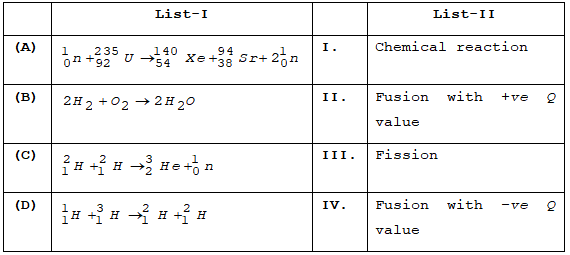
Match List –I with List II
Choose the correct answer from the options given below:
Two radioactive materials \( A \) and \( B \) have decay constant \( 25\lambda \) and \( 16\lambda \) respectively. If initially they have the same number of nuclei, then the ratio of the number of nuclei of \( B \) to that of \( A \) will be " \( e \) " after a time \( \dfrac{1}{a\lambda} \). The value of \( a \) is ______.
An electron and proton are separated by a large distance. The electron starts approaching the proton with energy \( 3 \, \text{eV} \). The proton captures the electron and forms a hydrogen atom in second excited state. The resulting photon is incident on a photosensitive metal of threshold wavelength \( 4000 \, \text{Å} \). What is the maximum kinetic energy of the emitted photoelectron?
Consider the following radioactive decay process\( {}^{218}_{84}A \xrightarrow{\alpha} A_1 \xrightarrow{\beta^{-}} A_2 \xrightarrow{\gamma} A_3 \xrightarrow{\alpha} A_4 \xrightarrow{\beta^{+}} A_5 \xrightarrow{\gamma} A_6 \)The mass number and the atomic number of \( A_6 \) are given by:
A point source of light is placed at the centre of curvature of a hemispherical surface. The source emits a power of \( 24 \, \text{W} \). The radius of curvature of hemisphere is \( 10 \, \text{cm} \) and the inner surface is completely reflecting. The force on the hemisphere due to the light falling on it is _______ \( \times 10^{-8} \, \text{N} \).
The threshold wavelength for photoelectric emission from a material is 5500 Å. Photoelectrons will be emitted, when this material is illuminated with monochromatic radiation from aA. \( 75 \, \text{W} \) infra-red lampB. \( 10 \, \text{W} \) infra-red lampC. \( 75 \, \text{W} \) ultra-violet lampD. \( 10 \, \text{W} \) ultra-violet lampChoose the correct answer from the options given below:
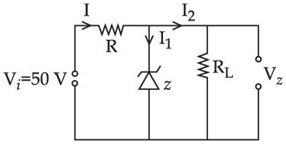
In a given circuit diagram, a \( 5 \, \text{V} \) Zener diode along with a series resistance is connected across a \( 50 \, \text{V} \) power supply. The minimum value of the resistance required, if the maximum Zener current is \( 90 \, \text{mA} \) will be _______ \( \Omega \).
Match List I with List II:
The ratio of de Broglie wavelength of a deutron with kinetic energy $E$ to that of an alpha particle with kinetic energy $2E$, is $n : 1$. The value of $n$ is ______________.
(Assume mass of proton = mass of neutron) :
Hydrogen atom from excited state comes to the ground state by emitting a photon of wavelength \( \lambda \). The value of principal quantum number ‘\( n \)’ of the excited state will be: \( (R:\; \text{Rydberg constant}) \)
An \( \alpha \) – particle, a proton and an electron have the same kinetic energy. Which one of the following is correct in case of their de-Broglie wavelength:
A beam of monochromatic light is used to excite the electron in \( \text{Li}^{++} \) from the first orbit to the third orbit. The wavelength of monochromatic light is found to be \( x \times 10^{-10} \, \text{m} \). The value of \( x \) is ______.[Given \( hc = 1242 \, \text{eV} \, \text{nm} \)]
A light source of wavelength \( \lambda \) illuminates a metal surface and electrons are ejected with maximum kinetic energy of \( 2\,\text{eV} \). If the same surface is illuminated by a light source of wavelength \( \frac{\lambda}{2} \), then the maximum kinetic energy of ejected electrons will be: (The work function of metal is \( 1\,\text{eV} \))
From the photoelectric effect experiment, following observations are made. Identify which of these are correct.I. The stopping potential depends only on the work function of the metalII. The saturation current increase as the intensity of incident light increasesIII. The maximum kinetic energy of a photo electron depends on the intensity of the incident lightIV. Photoelectric effect can be explained using wave theory of lightChoose the correct answer from the options given below:
A monochromatic source of light operating at \( 15 \ \text{kW} \) emits \( 2.5 \times 10^{22} \) photons/s. The region of an electromagnetic spectrum to which the emitted electromagnetic radiation belongs to ______.[Take \( h = 6.6 \times 10^{-34} \ \text{J}\!\cdot\!\text{s} \) and \( c = 3 \times 10^{8} \ \text{m/s} \)]
In a hypothetical fission reaction \( {_{92}X^{236}} \rightarrow {_{56}Y^{141}} + {_{36}Z^{92}} + 3R \) The identity of emitted particle \( (R) \) is:
A common example of alpha decay is: \( {}^{238}_{92}\text{U} \longrightarrow {}^{234}_{90}\text{Th} + {}^{4}_{2}\text{He} + Q \).Given:\( {}^{238}_{92}\text{U} = 238.05060\,\text{u}, \)\( {}^{234}_{90}\text{Th} = 234.04360\,\text{u}, \)\( {}^{4}_{2}\text{He} = 4.00260\,\text{u} \) and\( 1\,\text{u} = 931.5\,\dfrac{MeV}{{C}^{2}} \).The energy released \( (Q) \) during the alpha decay of \( {}^{238}_{92}\text{U} \) is _____ \( \text{MeV} \).
Given below are two statements: one is labelled as Assertion \( (A) \) and the other is labelled as Reason \( (R) \).Assertion \( (A) \): Number of photons increases with increase in frequency of light.Reason \( (R) \): Maximum kinetic energy of emitted electrons increases with the frequency of incident radiation.In the light of the above statements, choose the most appropriate answer from the options given below:
An \( \alpha \) particle and a carbon \( 12 \) atom has same kinetic energy \( K \). The ratio of their de-Broglie wavelengths \( \left( \lambda_{\alpha} : \lambda_{C_{12}} \right) \) is:
Match the List-I with List-II:
A particular hydrogen-like ion emits the radiation of frequency \( 3 \times 10^{15} \, \text{Hz} \) when it makes transition from \( n=2 \) to \( n=1 \). The frequency of radiation emitted in transition from \( n=3 \) to \( n=1 \) is \( \dfrac{x}{9} \times 10^{15} \, \text{Hz} \), when \( x = \) ____________.
A proton moving with one tenth of velocity of light has a certain de Broglie wavelength of \( \lambda \). An alpha particle having certain kinetic energy has the same de-Broglie wavelength \( \lambda \). The ratio of kinetic energy of proton and that of alpha particle is:
\( \dfrac{x}{x+4} \) is the ratio of energies of photons produced due to transition of an electron of hydrogen atom from its (i) Third permitted energy level to the second level and(ii) The highest permitted energy level to the second permitted level. The value of \( x \) will be _______.
Given below are two statements: one is labelled as Assertion A and other is labelled as Reason R.Assertion A: EM waves used for optical communication have longer wavelengths than that of microwave, employed in Radar technology.Reason R: Infrared EM waves are more energetic than microwaves, (used in Radar)In the light of given statements, choose the correct answer from the options given below.
The radius of a nucleus of mass number \( 64 \) is \( 4.8 \) fermi. Then the mass number of another nucleus having radius of \( \frac{1000}{x} \) \( 4 \) fermi is ______, where \( x \) is ______.
Hydrogen atom is bombarded with electrons accelerated through a potential difference of \( V \), which causes excitation of hydrogen atoms. If the experiment is being performed at \( T = 0 \, \text{K} \), the minimum potential difference needed to observe any Balmer series lines in the emission spectra will be \( \dfrac{\alpha}{10} \, \text{V} \), where \( \alpha = \) _______.
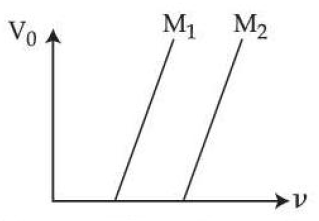
Given below are two statements:Statement I: Figure shows the variation of stopping potential the frequency \( (\nu) \) for the two photosensitive materials \( M_1 \) and \( M_2 \). The slope gives value of \( \frac{h}{e} \), where \( h \) is Planck’s constant, \( e \) is the charge of electron.Statement II: \( M_2 \) will emit photoelectrons of greater kinetic energy for the incident radiation having same frequency.In the light of the above statements, choose the most appropriate answer from the options given below.
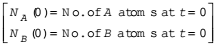
At time \( t = 0 \), a material is composed of two radioactive atoms A and B, where \( N_{A}(0) = 2N_{B}(0) \). The decay constant of both kind of radioactive atoms is \( \lambda \). However, A disintegrates to B and B disintegrates to C. Which of the following figures represents the evolution of \( \dfrac{N_{B}(t)}{N_{B}(0)} \) with respect to time \( t \)?
The ratio for the speed of the electron in the \( 3\text{rd} \) orbit of \( \text{He}^+ \) to the speed of the electron in the \( 3^{rd} \) orbit of hydrogen atom will be:
For a certain metal, when monochromatic light of wavelength \( \lambda \) is incident, the stopping potential for photoelectrons is \( 3V_{0} \). When the same metal is illuminated by light of wavelength \( 2\lambda \), then the stopping potential becomes \( V_{0} \). The threshold wavelength for photoelectric emission for the given metal is \( \alpha \lambda \). The value of \( \alpha \) is________.
With reference to the observations in photo-electric effect, identify the correct statements from below:(A) The square of maximum velocity of photoelectrons varies linearly with frequency of incident light.(B) The value of saturation current increases on moving the source of light away from the metal surface.(C) The maximum kinetic energy of photo-electrons decreases on decreasing the power of LED (light emitting diode) source of light.(D) The immediate emission of photo-electrons out of metal surface can not be explained by particle nature of light/electromagnetic waves.(E) Existence of threshold wavelength can not be explained by wave nature of light/electromagnetic waves.Choose the correct answer from the options given below:
From the statements given below:(A) The angular momentum of an electron in \( n^{\text{th}} \) orbit is an integral multiple of \( \hbar \).(B) Nuclear forces do not obey inverse square law.(C) Nuclear forces are spin dependent.(D) Nuclear forces are central and charge independent.(E) Stability of nucleus is inversely proportional to the value of packing fraction.Choose the correct answer from the options given below:
The light of two different frequencies whose photons have energies \( 3.8 \,\text{eV} \) and \( 1.4 \,\text{eV} \) respectively, illuminate a metallic surface whose work function is \( 0.6 \,\text{eV} \) successively. The ratio of maximum speeds of emitted electrons for the two frequencies respectively will be:
A photoemissive substance is illuminated with a radiation of wavelength \( \lambda_i \) so that it releases electrons with de-Broglie wavelength \( \lambda_e \). The longest wavelength of radiation that can emit photoelectron is \( \lambda_0 \). Expression for de-Broglie wavelength is given by:(\( m \) : mass of the electron, \( h \) : Planck’s constant and \( c \) : speed of light)
A nucleus with mass number \( 184 \) initially at rest emits an \( \alpha \)-particle. If the Q value of the reaction is \( 5.5 \, \text{MeV} \), calculate the kinetic energy of the \( \alpha \)-particle.
In a photoelectric experiment, increasing the intensity of incident light:
How many alpha and beta particles are emitted when uranium $_{92}\text{U}^{238}$ decays to lead $_{82}\text{Pb}^{206}$?
Given below are two statements:Statement I : Most of the mass of the atom and all its positive charge are concentrated in a tiny nucleus and the electrons revolve around it, is Rutherford's model.Statement II : An atom is a spherical cloud of positive charges with electrons embedded in it, is a special case of Rutherford's model.In the light of the above statements, choose the most appropriate from the options given below.
In a photoelectric effect experiment a light of frequency \( 1.5 \) times the threshold frequency is made to fall on the surface of photosensitive material. Now if the frequency is halved and intensity is doubled, the number of photo electron emitted will be:
Imagine that the electron in a hydrogen atom is replaced by a muon \( (\mu) \). The mass of muon particle is \( 207 \) times that of an electron and charge is equal to the charge of an electron. The ionization potential of this hydrogen atom will be:
The kinetic energy of emitted electron is \( E \) when the light incident on the metal has wavelength \( \lambda \). To double the kinetic energy, the incident light must have wavelength:
The de-Broglie wavelength of an oxygen molecule at \( 27^\circ \text{C} \) is \( x \times 10^{-12} \, \text{m} \). The value of \( x \) is: [Take Planck’s constant \( = 6.63 \times 10^{-34} \, \text{J}\cdot\text{s} \), Boltzmann constant \( = 1.38 \times 10^{-23} \, \text{J K}^{-1} \), mass of oxygen molecule \( = 5.31 \times 10^{-26} \, \text{kg} \)]
The atomic hydrogen emits a line spectrum consisting of various series. Which series of hydrogen atomic spectra is lying in the visible region?
In a photoelectric experiment ultraviolet light of wavelength \( 280 \, \text{nm} \) is used with lithium cathode having work function \( \phi = 2.5 \, \text{eV} \). If the wavelength of incident light is switched to \( 400 \, \text{nm} \), find out the change in the stopping potential.\( (h = 6.63 \times 10^{-34} \, \text{J s}, \, c = 3 \times 10^{8} \, \text{m s}^{-1}) \).
The half-life of \( ^{198}\mathrm{Au} \) is \( 3 \, \text{days} \). If atomic weight of \( ^{198}\mathrm{Au} \) is \( 198 \, \text{g/mol} \) then the activity of \( 2 \, \text{mg} \) of \( ^{198}\mathrm{Au} \) is [in disintegration/second]:
A sample of a radioactive nucleus A disintegrates to another radioactive nucleus B, which in turn disintegrates to some other stable nucleus C. Plot of a graph showing the variation of number of atoms of nucleus B versus time is: (Assume that at \( t = 0 \), there are no B atoms in the sample)
A particular hydrogen like ion emits radiation of frequency \( 2.92 \times 10^{15} \, \text{Hz} \) when it makes transition from \( n = 3 \) to \( n = 1 \). The frequency in \( \text{Hz} \) of radiation emitted in transition from \( n = 2 \) to \( n = 1 \) will be:
If a nuclear fission reaction of an isotope of mass \( M \), three similar daughter nuclei of same mass are formed. The speed of a daughter nuclei in terms of mass defect \( \Delta M \) will be:
Substance A has atomic mass number \( 16 \) and half life of \( 1 \, \text{day} .\) Another substance B has atomic mass number \( 32 \) and half life of \( \frac{1}{2} \, \text{day} .\) If both A and B simultaneously start undergo radio activity at the same time with initial mass \( 320 \, \text{g} \) each, how many total atoms of A and B combined would be left after \( 2 \, \text{days} .\)
The energy \( E \) and momentum \( p \) of a moving body of mass \( m \) are related by some equation. Given that \( c \) represents the speed of light, identify the correct equation
Given below are two statements. One is labelled as Assertion (A) and the other is labelled as Reason (R).Assertion (A): The binding energy per nucleon is found to be practically independent of the atomic number \( A \), for nuclei with mass numbers between \( 30 \) and \( 170 \).Reason (R): Nuclear force is long range.In the light of the above statements, choose the correct answer from the options given below:
The ratio of wavelength of spectral line \( H_{\alpha} \) and \( H_{\beta} \) in the Balmer series is \( \dfrac{x}{20} \). The value of \( x \) is ________.
The amplitude of \( 15\sin(1000\pi t) \) is modulated \( 10\sin(4\pi t) \) signal. The amplitude modulated signal contains frequencies ofA \( 500 \,\text{Hz} \) B. \( 2 \,\text{Hz} \) C. \( 250 \,\text{Hz} \) D. \( 498 \,\text{Hz} \) E. \( 502 \,\text{Hz} \).Choose the correct answer from the option given below:
In a hydrogen like ion, the energy difference between the \( 2^{\text{nd}} \) excitation energy state and ground is \( 108.8 \, \text{eV} \). The atomic number of the ion is:
Electron beam used in an electron microscope, when accelerated by a voltage of \( 20 \, \text{kV} \), has a de-Broglie wavelength of \( \lambda_0 \). If the voltage is increased to \( 40 \, \text{kV} \), then the de-Broglie wavelength associated with the electron beam would be:
Given below are two statements: one is labelled as Assertion (A) and the other is labelled as Reason (R).Assertion (A): Emission of electrons in photoelectric effect can be suppressed by applying a sufficiently negative electron potential to the photoemissive substance.Reason (R): A negative electric potential, which stops the emission of electrons from the surface of a photoemissive substance, varies linearly with frequency of incident radiation.In the light of the above statements, choose the most appropriate answer from the options given below:
An electron is released from rest near an infinite non-conducting sheet of uniform charge density '- \( \sigma \)'. The rate of change of de-Broglie wave length associated with the electron varies inversely as \( n^{\text{th}} \) power of time. The numerical value of \( n \) is _______.
Nucleus \( A \) having \( Z = 17 \) and equal number of protons and neutrons has \( 1.2 \, \text{MeV} \) binding energy per nucleon. Another nucleus \( B \) of \( Z = 12 \) has total \( 26 \) nucleon and \( 1.8 \, \text{MeV} \) binding energy per nucleons. The difference of binding energy of \( B \) and \( A \) will be _______ \( \text{MeV} \).
The decay of a proton to neutron is:
The average energy released per fission for the nucleus of \( {}^{235}_{92}\text{U} \) is \( 190 \, \text{MeV} \). When all the atoms of \( 47 \, \text{g} \) pure \( {}^{235}_{92}\text{U} \) undergo fission process, the energy released is \( a \times 10^{23} \, \text{MeV} \). The value of \( a \) is ______.(Avogadro Number \( = 6 \times 10^{23} \) per mole)
An electron is travelling with a velocity \( v \) in free space and when it enters a medium, its velocity is reduced by \( 20\% \). The de Broglie wavelength of electron in the medium is \( \alpha \lambda_0 \), where \( \lambda_0 \) is its de Broglie wavelength in free space. The value of \( \alpha \) is ________________ .
A small mirror of mass \( m \) is suspended by a massless thread of length \( l \), then the small angle through which the thread will be deflected when a short pulse of laser of energy \( E \) falls normal on the mirror: \( ( c = \) speed of light in vacuum and \( g = \) acceleration due to gravity \( ) \)
An electron of mass \( m \) is moving in an electric field \( \vec{E} = -2E_0 \, \hat{j} \) \( (E_0 = \text{constant} > 0) \), with an initial velocity \( \vec{V} = v_0 \, \hat{i} \) \( (v_0 = \text{constant} > 0) \). If \( \lambda_0 = \dfrac{h}{4 m v_0} \), its de Broglie wavelength at time \( t \) is ______; \( (e = \text{charge of electron}) \).
A light beam of wavelength \( 500 \, \text{nm} \) is incident on a metal having work function of \( 1.25 \, \text{eV} \), placed in a magnetic field of intensity \( B \). The electrons emitted perpendicular to the magnetic field \( B \), with maximum kinetic energy are bent into circular arc of radius \( 30 \, \text{cm} \). The value of \( B \) is ________ \( \times 10^{-7} \, \text{T} \).Given \( hc = 20 \times 10^{-26} \, \text{J m} \), mass of electron \( = 9 \times 10^{-31} \, \text{kg} \).
The Q-value of a nuclear reaction and kinetic energy of the projectile particle, \( K_p \) are related as:
A proton, a neutron, an electron and an \( \alpha \) – particle have same energy. If \( \lambda_p, \lambda_n, \lambda_e \) and \( \lambda_{\alpha} \) are the de Broglie’s wavelengths of proton, neutron, electron and \( \alpha \) particle respectively, then choose the correct relation from the following:
The atomic mass of \( _{6}\mathrm{C}^{12} \) is \( 12.000000 \, \text{u} \) and that of \( _{6}\mathrm{C}^{13} \) is \( 13.003354 \, \text{u} \). The required energy to remove a neutron from \( _{6}\mathrm{C}^{13} \), if mass of neutron is \( 1.008665 \, \text{u} \), will be:
An electron in the hydrogen atom initially in the fourth excited state makes a transition to \( n^{\text{th}} \) energy state by emitting a photon of energy \( 2.86 \, \text{eV} \). The integer value of \( n \) will be __________.
Find the ratio of energies of photons produced due to transition of an electron of hydrogen atom from its (i) second permitted energy level to the first level, and (ii) the highest permitted energy level to the first permitted level.
The de Broglie wavelength of a molecule in a gas at room temperature \( (300 \, \text{K}) \) is \( \lambda_1 \). If the temperature of the gas is increased to \( 600 \, \text{K} \), then the de Broglie wavelength of the same gas molecule becomes.
A radioactive sample disintegrates via two independent decay processes having half lives \( T_{1/2}^{(1)} \) and \( T_{1/2}^{(2)} \) respectively. The effective half-life, \( T_{1/2} \) of the nuclei is:
Using Bohr’s model, calculate the ratio of the magnetic fields generated due to the motion of the electrons in the 2nd and \( 4 \)th orbits of hydrogen atom __________.
The magnetic moment of an electron (\( e \)) revolving in an orbit around nucleus with an orbital angular momentum is given by :
A particle having electric charge \( 3 \times 10^{-19} \; \text{C} \) and mass \( 6 \times 10^{-27} \; \text{kg} \) is accelerated by applying an electric potential of \( 1.21 \; \text{V} \). Wavelength of the matter wave associated with the particle is \( \alpha \times 10^{-12} \; \text{m} \). The value of \( \alpha \) is __________. (Take Planck’s constant \( = 6.6 \times 10^{-34} \; \text{J, s} \))
An atom \( {}^{8}_{3}X \) is bombarded by shower of fundamental particles and in \( 10 \, \text{s} \) this atom absorbed \( 10 \) electrons, \( 10 \) protons and \( 9 \) neutrons. The percentage growth in the surface area of the nucleons is recorded by:
Which of the following nuclear fragments corresponding to nuclear fission between neutron \(( ^{1}_{0}\mathrm{n}) \) and uranium isotope \(( ^{235}_{92}\mathrm{U} \)) is correct:
Given below are two statements: One is labelled as Assertion A and the other is labelled as Reason R.Assertion A: The binding energy per nucleon is practically independent of the atomic number for nuclei of mass number in the range \( 30 \) to \( 170 \).Reason R: Nuclear force is short ranged.In the light of above statements, choose the correct answer from the options given below:
Given below are two statements : one is labelled as Assertion (A) and the other is labelled as Reason (R).Assertion (A) : The density of the copper \(( {}^{64}_{29}\text{Cu} )\) nucleus is greater than that of the carbon \(( {}^{12}_{6}\text{C}) \) nucleus.Reason (R) : The nucleus of mass number \( A \) has radius proportional to \( A^{1/3} \). In the light of the above statements, choose the most appropriate answer from the options given below :
If three helium nuclei combine to form a carbon nucleus then the energy released in this reaction is ________ \( \times 10^{-2} \, \text{MeV} \). (Given \( 1 \, u = 931 \, \text{MeV} / c^{2} \), atomic mass of helium = \( 4.002603 \, u \).)
Consider a situation in which reverse biased current of a particular \( P-\!N \) junction increases when it is exposed to a light of wavelength \( \leq 621 \, \text{nm} \). During this process, enhancement in carrier concentration takes place due to generation of hole-electron pairs. The value of band gap is nearly.
A free neutron decays into a proton but a free proton does not decay into neutron. This is because
The equation \( \lambda = \dfrac{1.227}{x} \, \text{nm} \) can be used to find the de-Brogli wavelength of an electron. In this equation \( x \) stands forWhere \( m = \) mass of electron\( P = \) momentum of electron\( K = \) Kinetic energy of electron\( V = \) Accelerating potential in volts for electron
\( X \) different wavelengths may be observed in the spectrum from a hydrogen sample if the atoms are exited to states principal quantum number \( n = 6 \)? The value of \( X \) is _______.
The angular momentum for the electron in Bohr’s orbit is \( L \). If the electron in assumed to revolve in second orbit of hydrogen atom, then the change in angular momentum will be:
Proton \( (P) \) and electron \( (e) \) will have same de-Broglie wavelength when the ratio of their momentum is (assume, \( m_p = 1849\, m_e \) ):
In photo electric effectA. The photocurrent is proportional to the intensity of the incident radiation.B. Maximum Kinetic energy with which photoelectrons are emitted depends on the intensity of incident light.C. Max. K.E. with which photoelectrons are emitted depends on the frequency of incident light.D. The emission of photoelectrons requires a minimum threshold intensity of incident radiation.E. Max. K.E. of the photoelectrons is independent of the frequency of the incident lightChoose the correct answer from the options given below:
The energy released in the fusion of \( 2 \, \text{kg} \) of hydrogen deep in the sun is \( E_H \) and the energy released in the fission of \( 2 \, \text{kg} \) \( {}^{235}\!U \) is \( E_U \). The ratio \( \dfrac{E_H}{E_U} \) is approximately: (Consider the fusion reaction as \( 4\,{}^{1}_{1}\!H + 2e^{-} \rightarrow {}^{4}_{2}\!He + 2\nu + 6\gamma + 26.7 \, \text{MeV} \) , energy released in the fission reaction of \( {}^{235}\!U \) is \( 200 \, \text{MeV} \) per fission nucleus and \( N_A = 6.023 \times 10^{23} \))
When UV light of wavelength \( 300 \, \text{nm} \) is incident on the metal surface having work function \( 2.13 \, \text{eV} \), electron emission takes place. The stopping potential is:(Given \( hc = 1240 \, \text{eV nm} \))
A light of energy \( 12.75 \, \text{eV} \) is incident on a hydrogen atom in its ground state. The atom absorbs the radiation and reaches to one of its excited states. The angular momentum of the atom in the excited state is \( \frac{x}{\pi}\times 10^{-17}\, \text{eV}\,\text{s} \). The value of \( x \) is _______. (use \( h=4.14\times 10^{-15}\, \text{eV}\,\text{s},\, c=3\times 10^{8}\, \text{m}\,\text{s}^{-1} \)).
Choose the correct option from the following options given below:
Consider the following statements:A. Atoms of each element emit characteristics spectrum.B. According to Bohr’s Postulate, an electron in a hydrogen atom, revolves in a certain stationary orbit.C. The density of nuclear matter depends on the size of the nucleus.D. A free neutron is stable but a free proton decay is possible.E. Radioactivity is an indication of the instability of nuclei.Choose the correct answer from the options given below:
A radioactive nucleus \( n_{2} \) has \( 3 \) times the decay constant as compared to the decay constant of another radioactive nucleus \( n_{1} \). If initial number of both nuclei are the same, what is the ratio of number of nuclei of \( n_{2} \) to the number of nuclei of \( n_{1} \), after one half-life of \( n_{1} \)?
The ratio of the de-Broglie wavelengths of proton and electron having same Kinetic energy :(Assume \( m_{p} = m_{e} \times 1849 \) )
A electron of hydrogen atom on an excited state is having energy \( E_n = -0.85 \, \text{eV} \). The maximum number of allowed transitions to lower energy level is________.
In photoelectric experiment energy of \( 2.48 \, \text{eV} \) irradiates a photo sensitive material. The stopping potential was measured to be \( 0.5 \, \text{V} \). Work function of the photo sensitive material is:
An electron of mass \( m \) and a photon have same energy \( E \). The ratio of wavelength of electron to that of photon is: (\( c \) being the velocity of light)
Consider two separate ideal gases of electrons and protons having same number of particles. The temperature of both the gases are same. The ratio of the uncertainty in determining the position of an electron to that of a proton is proportional to:
The de-Broglie wavelength associated with an electron and a proton were calculated by accelerating them through same potential of \( 100 \, \text{V} \). What should nearly be the ratio of their wavelengths? \( m_{p} = 1.00727 \, u,\; m_{e} = 0.00055 \, u \)
An electron with speed \( v \) and a photon with speed \( c \) have the same de-Broglie wavelength. If the kinetic energy and momentum of electron are \( E_{e} \) and \( p_{e} \) and that of photon are \( E_{ph} \) and \( p_{ph} \) respectively. Which of the following is correct?
An electron rotates in a circle around a nucleus having positive charge \( Ze \). Correct relation between total energy \( E \) of electron to its potential energy \( U \) is:
In an alpha particle scattering experiment distance of closest approach for the \( \alpha \) particle is \( 4.5 \times 10^{-14} \, \text{m} \). If target nucleus has atomic number \( 80 \), then maximum velocity of \( \alpha \)-particle is ______ \( \times 10^{5} \, \text{m} / \text{s} \) approximately.[\( \dfrac{1}{4\pi \varepsilon_{0}} = 9 \times 10^{9} \) SI unit, mass of \( \alpha \) particle \( = 6.72 \times 10^{-27} \, \text{kg} \)]
An electron in the ground state of the hydrogen atom has the orbital radius of \( 5.3 \times 10^{-11} \, \text{m} \) while that for the electron in third excited state is \( 8.48 \times 10^{-10} \, \text{m} \). The ratio of the de Broglie wavelengths of electron in the ground state to that in the excited state is:
A particle of mass \( 4M \) at rest disintegrates into two particles of mass \( M \) and \( 3M \) respectively having non zero velocities. The ratio of de-Broglie wavelength of particle of mass \( M \) to that of mass \( 3M \) will be:
If ‘\( f \)’ denotes the ratio of the number of nuclei decayed \( (N_{d}) \) to the number of nuclei at \( t = 0 \) \( (N_{0}) \) then for a collection of radioactive nuclei, the rate of change of ‘\( f \)’ with respect to time is given as: [\( \lambda \) is the radioactive decay constant]
From the given data, the amount of energy required to break the nucleus of aluminium \( ^{27}_{13}\text{Al} \) is ______ \(x \times 10^{-3} \, \text{J} \).Mass of neutron = \( 1.00866 \, \text{u} \)Mass of proton = \( 1.00726 \, \text{u} \)Mass of Aluminium nucleus = \( 27.18846 \, \text{u} \)(Assume \( 1 \, \text{u} \) corresponds to \( x \, \text{J} \) of energy)(Round off to the nearest integer)
A moving proton and electron have the same de-Broglie wavelength. If \( K \) and \( P \) denote the K.E. and momentum respectively. Then choose the correct option:
A nucleus of mass \( M \) emits \( \gamma \)-ray photon of frequency ‘\( v \)’. The loss of internal energy by the nucleus is: [Take ‘\( c \)’ as the speed of electromagnetic wave]
The kinetic energy of an electron, \( \alpha \) – particle and a proton are given as \( 4K \), \( 2K \) and \( K \) respectively. The de-Broglie wavelength associated with electron \( (\lambda_{e}) \), \( \alpha \) – particle \( (\lambda_{\alpha}) \) and the proton \( (\lambda_{p}) \) are as follows:
Choose the correct nuclear process from the below options:
[$p$ : proton, $n$ : neutron, $e^-$ : electron, $e^+$ : positron, $\nu$ : neutrino, $\bar{\nu}$ : antineutrino]
In the following nuclear reaction,Mass number of \( D \) is \( 182 \) and atomic number is \( 74 \). Mass number and atomic number of \( D_{4} \) respectively will be:
A small object rest, absorbs a light pulse of power \( 20 \, \text{mW} \) and duration \( 30 \, \text{ns} \). Assuming speed of light as \( 3 \times 10^{8} \, \text{m/s} \), the momentum of the object becomes equal to:
There are \( 10^{10} \) radioactive nuclei in a given radioactive element. Its half-life time is \( 1 \) minute. How many nuclei will remain after \( 30 \) seconds? \( (\sqrt{2} = 1.414) \)
\( {}^{238}_{92}A \rightarrow {}^{234}_{90}B + {}^{4}_{2}D + Q \) In the given nuclear reaction, the approximate amount of energy released will be: [Given, mass of \( {}^{238}_{92}A = 238.05079 \times 931.5 \, \text{MeV}/c^{2} \), Mass of \( {}^{234}_{90}B = 234.04363 \times 931.5 \, \text{MeV}/c^{2} \), Mass of \( {}^{4}_{2}D = 4.00260 \times 931.5 \, \text{MeV}/c^{2} \)]
Experimentally it is found that \( 12.8 \, \text{eV} \) energy is required to separate a hydrogen atom into a proton and an electron. So the orbital radius of the electron in a hydrogen atom is \( \dfrac{9}{x} \times 10^{-10} \, \text{m} \). The value of the \( x \) is __________.(\( 1 \, \text{eV} = 1.6 \times 10^{-19} \, \text{J} \), \( \dfrac{1}{4 \pi \epsilon_{0}} = 9 \times 10^{9} \, \text{N m}^{2} / \text{C}^{2} \) and electronic charge \( = 1.6 \times 10^{-19} \, \text{C} \).)
A nucleus disintegrates into two smaller parts, which have their velocities in the ratio \( 3 : 2 \). The ratio of their nuclear sizes will be \( \left( \dfrac{x}{3} \right)^{\tfrac{1}{3}} \). The value of ‘\( x \)’ is:
Read the following statements:(A) Volume of the nucleus is directly proportional to the mass number.(B) Volume of the nucleus is independent of mass number.(C) Density of the nucleus is directly proportional to the mass number.(D) Density of the nucleus is directly proportional to the cube root of the mass number.(E) Density of the nucleus is independent of the mass number.Choose the correct option from the following options.
The acceptor level of a p-type semiconductor is \( 6 \, \text{eV} \). The maximum wavelength of light which can create a hole would be:Given \( hc = 1242 \, \text{eV nm} \).
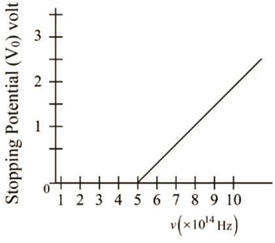
The variation of stopping potential \( (V_0) \) as a function of the frequency \( (v) \) of the incident light for a metal is shown in figure. The work function of the surface is:
The de-Broglie wavelengths of a proton and an \( \alpha \) particle are \( \lambda \) and \( 2\lambda \) respectively. The ratio of the velocities of proton and \( \alpha \) particle will be:
During the transition of electron from state A to state C of a Bohr atom, the wavelength of emitted radiation is \( 2000 \, Å \) and it becomes \( 6000 \, Å \) when the electron jumps from state B to state C. Then the wavelength of the radiation emitted during the transition of electrons from state A to state B is:
Two nuclei of mass number \( 3 \) combine with another nucleus of mass number \( 4 \) to yield a nucleus of mass number \( 10 \). If the binding energy per nucleon for the mass numbers \( 3 \), \( 4 \) and \( 10 \) are \( 5.6 \, \text{MeV} \), \( 7.4 \, \text{MeV} \) and \( 6.1 \, \text{MeV} \), respectively, then in the process,
The work function of a substance is \( 3.0 \, \text{eV} \). The longest wavelength of light that can cause the emission of photoelectrons from this substance is approximately.
The disintegration energy \( Q \) for the nuclear fission of \( {}^{235}\!U \rightarrow {}^{140}\!Ce + {}^{94}\!Zr + n \) is ____________ \( \text{MeV} \).Given atomic masses of \( {}^{235}\!U : 235.0439 \, u \); \( {}^{140}\!Ce : 139.9054 \, u \), \( {}^{94}\!Zr : 93.9063 \, u \); \( n : 1.0086 \, u \),Value of \( c^{2} = 931 \, \text{MeV} / u \).
What is the half-life period of a radioactive material if its activity drops to \( {1}/{16}^{th} \) of its initial value in \( 30 \) years?
An object is placed in a medium of refractive index \( 3 \). An electromagnetic wave of intensity \( 6 \times 10^{8} \ \text{W}/\text{m}^{2} \) falls normally on the object and it is absorbed completely. The radiation pressure on the object would be (speed of light in free space \( 3 \times 10^{8} \ \text{m}/\text{s} \) ):
The ratio of the magnitude of the kinetic energy to the potential energy of an electron in the \( 5^{\text{th}} \) excited state of a hydrogen atom is:
Which of the following figure represents the variation of \( l_n\!\left(\dfrac{R}{R_{0}}\right) \) with \( l_n A \) (if \( R = \) radius of a nucleus and \( A = \) its mass number)
If Rydberg’s constant is \( R \), the longest wavelength of radiation in Paschen series will be \( \dfrac{\alpha}{7R} \), where \( \alpha = \) ________________ .
A nucleus with mass number \( 242 \) and binding energy per nucleon as \( 7.6 \, \text{MeV} \) breaks into two fragment each with mass number \( 121 \). If each fragment nucleus has binding energy per nucleon as \( 8.1 \, \text{MeV} \), the total gain in binding energy is ______ \( \text{MeV} \).
In a nuclear fission process, a high mass nuclide \( (A \approx 236) \) with binding energy \( 7.6 \, \text{MeV/Nucleon} \) dissociated into middle mass nuclides \( (A \approx 118) \), having binding energy of \( 8.6 \, \text{MeV/Nucleon} \). The energy released in the process would be __________ \( \text{MeV} \).
A radioactive nucleus decays by two different process. The half life of the first process is \( 5 \, \text{minutes} \) and that of the second process is \( 30 \, \text{s} \). The effective half-life of the nucleus is calculated to be \( \frac{\alpha}{11} \, \text{s} \). The value of \( \alpha \) is __________.
The wavelength of the radiation emitted is \( \lambda_{0} \) when an electron jumps from the second excited state to the first excited state of hydrogen atom. If the electron jumps from the third excited state to the second orbit of the hydrogen atom, the wavelength of the radiation emitted will be \( \frac{20}{x} \lambda_{0} \). the value of \( x \) is ________
If an electron is moving in the \( n^{th} \) orbit of the hydrogen atom, then its velocity \( (v_{n}) \) for the \( n^{th} \) orbit is given as:
The threshold frequency of a metal is \( f_0 \). When the light of frequency \( 2 f_0 \) is incident on the metal plate, the maximum velocity of photoelectrons is \( v_1 \). When the frequency of incident radiation is increased to \( 5 f_0 \), the maximum velocity of photoelectrons emitted is \( v_2 \). The ratio of \( v_1 \) and \( v_2 \) is:
The work functions of Aluminium and Gold are \( 4.1 \, \text{eV} \) and \( 5.1 \, \text{eV} \) respectively. The ratio of the slope of the stopping potential versus frequency plot for Gold to that of Aluminium is:
Which level of the single ionized carbon has the same energy as the ground state energy hydrogen atom?
The binding energy per nucleon of \( ^{209}_{83}\mathrm{Bi} \) is ________ \( \text{MeV} \).[Take \( m\!\left(^{209}_{83}\mathrm{Bi}\right) = 208.980388\,\text{u} \), \( m_p = 1.007825\,\text{u} \), \( m_n = 1.008665\,\text{u} \), \( 1\,\text{u} = 931\,\text{MeV}/c^{2} \)]
A radioactive nucleus can decay by two different processes. Half-life for the first process is \( 3.0 \) hours while it is \( 4.5 \) hours for the second process. The effective half-life of the nucleus will be:
Which of the following pair of nuclei are isobars of the element?
An atom absorbs a photon of wavelength \( 500 \, \text{nm} \) and emits another photon of wavelength \( 600 \, \text{nm} \). The net energy absorbed by the atom in this process is \( n \times 10^{-4} \, \text{eV} \). The value of \( n \) is ________. [Assume the atom to be stationary during the absorption and emission process] (Take \( h=6.6\times 10^{-34} \, \text{J s} \) and \( c=3\times 10^{8} \, \text{m/s} \).)
If the wavelength of the first member of Lyman series of hydrogen is \( \lambda \). The wavelength of the second member will be:
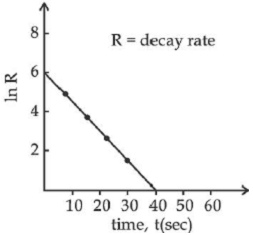
For a certain radioactive process the graph between \( \ln R \) and \( t \, (\text{sec}) \) is obtained as shown in the figure. Then the value of half life for the unknown radioactive material is approximately:
A particle of mass \( 9.1 \times 10^{-31} \, \text{kg} \) travels in a medium with a speed of \( 10^{6} \, \text{m} / \text{s} \) and a photon of a radioactive of linear momentum \( 10^{-27} \, \text{kg m} / \text{s} \) travels in vacuum. The wavelength of photon is _______ times the wavelength of the particle.
Mass numbers of two nuclei are in the ratio of \( 4:3 \). Their nuclear densities will be in the ratio of:
A nucleus at rest disintegrates into two smaller nuclei with their masses in the ratio of \( 2:1 \). After disintegration they will move:
A radioactive element \( {}^{242}_{92}X \) emits two \( \alpha \)-particles, one electron and two positrons. The product nucleus is represented by \( {}^{234}_{P}Y \). The value of \( P \) is ________.
The minimum frequency of photon required to break a particle of mass \( 15.348 \) amu into \( 4 \alpha \) particles is __________ kHz.[ mass of He nucleus \(=4.002\) amu, \(1\) amu \(=1.66\times 10^{-27}\) kg, \( h=6.6\times 10^{-34} \) J.s and \( c=3\times 10^{8} \) m/s ]
The activity of a radioactive material is \( 6.4 \times 10^{-4} \, \text{curie} \). Its half life is \( 5 \, \text{days} \). The activity will become \( 5 \times 10^{-6} \, \text{curie} \) after:
A particle is travelling \( 4 \) times as fast as an electron. Assuming the ratio of de-Broglie wavelength of a particle to that of electron is \( 2 : 1 \), the mass of the particle is:
The ratio of de-Broglie wavelength of an \( \alpha \) particle and a proton accelerated from rest by the same potential is \( \dfrac{1}{\sqrt{m}} \), the value of \( m \) is:
The momentum of an electron revolving in \( n^{\text{th}} \) orbit is given by: (Symbols have their usual meanings)
A small particle of mass \( m \) moves in such a way that its potential energy \( U = \dfrac{1}{2} m \omega^{2} r^{2} \) where \( \omega \) is constant and \( r \) is the distance of the particle from origin. Assuming Bohr’s quantization of momentum and circular orbit, the radius of \( n^{\text{th}} \) orbit will be proportional to:
When light of frequency twice the threshold frequency is incident on the metal plate, the maximum velocity of emitted electron is \( v_{1} \). When the frequency of incident radiation is increased to five times the threshold value, the maximum velocity of emitted electron becomes \( v_{2} \). If \( v_{2} = x \, v_{1} \), the value of \( x \) will be ______________.
Nucleus A is having mass number \( 220 \) and its binding energy per nucleon is \( 5.6 \, \mathrm{MeV} \). It splits in two fragments 'B' and 'C' of mass numbers \( 105 \) and \( 115 \). The binding energy of nucleons in 'B' and 'C' is \( 6.4 \, \mathrm{MeV} \) per nucleon. The energy \( Q \) released per fission will be:
UV light of \( 4.13 \, \text{eV} \) is incident on a photosensitive metal surface having work function \( 3.13 \, \text{eV} \). The maximum kinetic energy of ejected photoelectrons will be:
In Bohr’s atomic model, the electron is assumed to revolve in a circular orbit of radius \( \displaystyle 0.5 \, \overset{\circ}{\text{A}}. \). If the speed of electron is \( 2.2 \times 10^{6} \, \text{m} / \text{s} \), then the current associated with the electron will be _______ \( \times 10^{-2} \, \text{mA} \). [Take \( \pi \) as \( \dfrac{22}{7} \)]
A free electron of \( 2.6 \, \text{eV} \) energy collides with a \( H^{+} \) on. This result in the formation of a hydrogen atom in the first excited state and a photon is released. Find the frequency of the emitted photon.\( (h = 6.6 \times 10^{-34} \, \text{J s}) \)
The stopping potential for photoelectrons emitted from a surface illuminated by light of wavelength 6630 Å is \( 0.42 \, \text{V} \). If the threshold frequency is \( x \times 10^{13} \,/ \text{s}^{} \), where \( x \) is _______ (nearest integer).(Given, speed light \( 3 \times 10^{8} \, \text{m} \, /\text{s}^{} \), Planck’s constant \( = 6.63 \times 10^{-34} \, \text{J} \, \text{s} \))
A metallic surface is illuminated with radiation of wavelength \( \lambda \), the stopping potential is \( V_{0} \). If the same surface is illuminated with radiation of wavelength \( 2\lambda \), the stopping potential becomes \( \dfrac{V_{0}}{4} \). The threshold wavelength for this metallic surface will be:
Two identical photocathodes receive the light of frequencies \( f_1 \) and \( f_2 \) respectively. If the velocities of the photo-electrons coming out are \( v_1 \) and \( v_2 \) respectively, then:
Which of the following statement is not true about stopping potential \( (V_0) \)?
A proton of mass '$m_p$' has same energy as that of a photon of wavelength '$\lambda$'. If the proton is moving at non-relativistic speed, then ratio of its de Broglie wavelength to the wavelength of photon is:
The half-life of a radioactive substance is \( T \). The time taken for disintegrating \( {7}/{8}^{th} \) part of its original mass will be:
A convex lens of focal length \( 40 \, \text{cm} \) forms an image of an extended source of light on a photo electric cell. A current \( I \) is produced. The lens is replaced by another convex lens having the same diameter but focal length \( 20 \, \text{cm} \). The photoelectric current now is :
The work functions of cesium (Cs) and lithium (Li) metals are \( 1.9 \, \text{eV} \) and \( 2.5 \, \text{eV} \), respectively. If we incident a light of wavelength \( 550 \, \text{nm} \) on these two metal surfaces, then photo-electric effect is possible for the case of:
The energy of \( He^{+} \) ion in its first excited state is, (The ground state energy for the Hydrogen atom is: (\( -13.6 \, \text{eV} \)))
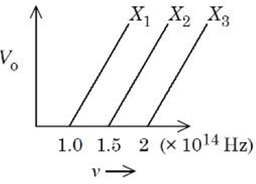
The graph shows variation of stopping potential \( V_0 \) with the frequency \( \nu \) of the incident radiation for three photosensitive metals \( X_1 \), \( X_2 \), and \( X_3 \). Which metal will give out electrons with greater kinetic energy, for the same wavelength of incident radiation?
The nuclear activity of a radioactive element becomes \( \left(\dfrac{1}{8}\right)^{\text{th}} \) of its initial value in \( 30 \) years. The half-life of radioactive element is ______ years.
If \( M_0 \) is the mass of isotope \( ^{12}_{5}B \), \( M_p \) and \( M_n \) are the masses of proton and neutron, the nuclear binding energy of isotope is:
In Frank-Hertz experiment, the first dip in the current-voltage graph for hydrogen is observed at \( 10.2 \, \text{V} \). The wavelength of light emitted by hydrogen atom when excited to the first excitation level is _______ \( \text{nm} \). (Given \( hc = 1245 \, \text{eV nm}, \, e = 1.6 \times 10^{-19} \, C \))
According to Bohr atom model, in which of the following transitions will the frequency be maximum?
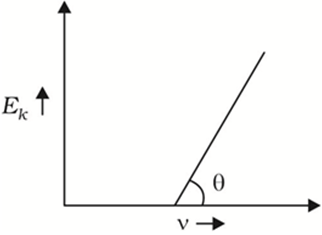
For the photoelectric effect, the maximum kinetic energy \( (E_k) \) of the photoelectrons is plotted against the frequency \( (v) \) of the incident photons as shown in figure. The slope of the graph gives
The radius of \( 2^{\text{nd}} \) orbit of \( \text{He}^{+} \) of Bohr’s model is \( r_{1} \) and that of fourth orbit of \( \text{Be}^{3+} \) is represented as \( r_{2} \). Now the ratio \( \dfrac{r_{2}}{r_{1}} \) is \( x : 1 \). The value of \( x \) is ________.
The explosive in a Hydrogen bomb is a mixture of ${}_1\text{H}^2$, ${}_1\text{H}^3$ and ${}_3\text{Li}^6$ in some condensed form. The chain reaction is given by:
${}_3\text{Li}^6 + {}_0\text{n}^1 \rightarrow {}_2\text{He}^4 + {}_1\text{H}^3$
${}_1\text{H}^2 + {}_1\text{H}^3 \rightarrow {}_2\text{He}^4 + {}_0\text{n}^1$
During the explosion the energy released is approximately:
[Given: $M(\text{Li}) = 6.01690\text{ amu}$, $M({}_1\text{H}^2) = 2.01471\text{ amu}$, $M({}_2\text{He}^4) = 4.00388\text{ amu}$ and $1\text{ amu} = 931.5\text{ MeV}$]
A light wave described by \( E = 60 \left[ \sin\!\left(3 \times 10^{15} \right) t+ \sin\!\left(12 \times 10^{15} \right)t \right] \) (in SI units) falls on a metal surface of work function \( 2.8 \, \text{eV} \). The maximum kinetic energy of ejected photoelectron is (approximately) ____________ \( \text{eV} \).\( ( h = 6.6 \times 10^{-34} \, \text{J}\!\cdot\!\text{s}, \text{ and } e = 1.6 \times 10^{-19} \, \text{C} ) \)
Let \( K_{1} \) and \( K_{2} \) be the maximum kinetic energies of photo-electrons emitted when two monochromatic beams of wavelength \( \lambda_{1} \) and \( \lambda_{2} \), respectively are incident on a metallic surface. If \( \lambda_{1} = 3 \lambda_{2} \) then:
The ratio of wavelengths of proton and deuteron accelerated by potential \( V_p \) and \( V_d \) is \( 1:\sqrt{2} \). Then, the ratio of \( V_p \) to \( V_d \) will be:
The radius of fifth orbit of the \( \mathrm{Li}^{++} \) is ________ \( \times 10^{-12} \, \text{m} \). Take: radius of hydrogen atom \( = 0.51 \, \mathring{A} \)
The half life period of a radioactive element \( x \) is same as the mean life time of another radioactive element \( y \). Initially they have the same number of atoms. Then:
The binding energy for the following nuclear reactions are expressed in \( \text{MeV} \).\( {}_{2}\mathrm{He}^{3} + {}_{0}\mathrm{n}^{1} \rightarrow {}_{2}\mathrm{He}^{4} + 20 \, \text{MeV} \)\( {}_{2}\mathrm{He}^{4} + {}_{0}\mathrm{n}^{1} \rightarrow {}_{2}\mathrm{He}^{5} - 0.9 \, \text{MeV} \)If \( x_{3}, x_{4}, x_{5} \) denote the stability of \( {}_{2}\mathrm{He}^{3}, {}_{2}\mathrm{He}^{4} \) and \( {}_{2}\mathrm{He}^{5} \), respectively, then the correct order is:
A metal exposed to light of wavelength \( 800\,\text{nm} \) and emits photoelectrons with a certain kinetic energy. The maximum kinetic energy of photo-electron doubles when light of wavelength \( 500\,\text{nm} \) is used. The workfunction of the metal is: (Take \( hc=1230\,\text{eV}\!\cdot\!\text{nm} \)).
The \( K_\alpha \) X-ray of molybdenum has wavelength \( 0.071 \, \text{nm} \). If the energy of a molybdenum atom with a K electron knocked out is \( 27.5 \, \text{keV} \), the energy of this atom when an L electron is knocked out will be ______ \( \text{keV} \). (Round off to the nearest integer) [\( h = 4.14 \times 10^{-15} \, \text{eVs} \), \( c = 3 \times 10^{8} \, \text{ms}^{-1} \)]
The radius of electron’s second stationary orbit in Bohr’s atom is \( R \). The radius of \( 3^{\text{rd}} \) orbit will be:
A radio active material is reduced to \( {1}/{8} \) of its original amount in \( 3 \, \text{days} \). If \( 8 \times 10^{-3} \, \text{kg} \) of the material is left after \( 5 \, \text{days} \) the initial amount of the material is:
The energy levels of an hydrogen atom are shown below. The transition corresponding to emission of shortest wavelength is:
Give below are two statements:Statement I : Out of microwaves, infrared rays and ultraviolet rays, ultraviolet rays are the most effective for the emission of electrons from a metallic surface.Statement II : Above the threshold frequency, the maximum kinetic energy of photoelectrons is inversely proportional to the frequency of the incident light.In the light of above statements, choose the correct answer from the options given below.
The electric field at a point associated with a light wave is given by \( E = 200 \left[\sin(6 \times 10^{15} )t + \sin(9 \times 10^{15} )t\right] \, \text{V m}^{-1} \)Given: \( h = 4.14 \times 10^{-15} \, \text{eV s} \)If this light falls on a metal surface having a work function of \( 2.50 \, \text{eV} \), the maximum kinetic energy of the photoelectrons will be:
Given below are two statements: Statement I: For all elements, greater the mass of the nucleus, greater is the binding energy per nucleon. Statement II: For all elements, nuclei with less binding energy per nucleon transform to nuclei with greater binding energy per nucleon. In the light of the above statements, choose the correct answer from the options given below.
If \( \lambda \) and \( K \) are de Broglie wavelength and kinetic energy, respectively, of a particle with constant mass. The correct graphical representation for the particle will be:
Given below are two statements:Statement I: In hydrogen atom, the frequency of radiation emitted when an electron jumps from lower energy orbit \( (E_1) \) to higher energy orbit \( (E_2) \), is given as \( h f = E_1 - E_2 \)Statement II: The jumping of electron from higher energy orbit \( (E_2) \) to lower energy orbit \( (E_1) \) is associated with frequency of radiation given as \( f = (E_2 - E_1)/h \). This condition is Bohr’s frequency condition. In the light of the above statements, choose the correct answer from the options given below:
The de Broglie wavelength of a proton and \( \alpha \)-particle are equal. The ratio of their velocities is:
An electron moving with speed \( v \) and a photon moving with speed \( c \), have same D-Broglie wavelength. The ratio of kinetic energy of electron to that of photon is:
A \( 12.5 \, \text{eV} \) electron beam is used to bombard gaseous hydrogen at room temperature. The number of spectral lines emitted will be:
An electron revolving in \( n^{\text{th}} \) Bohr orbit has magnetic moment \( \mu_n \). If \( \mu_n\) \( \\\alpha n^x \), the value of \( x \) is:
Assuming the experimental mass of \( ^{12}_{6}\mathrm{C} \) as \( 12\,u \), the mass defect of \( ^{12}_{6}\mathrm{C} \) atom is ____________ \( \text{MeV}/c^2 \).(Mass of proton \( = 1.00727\,u \). mass of neutron \( = 1.0866\,u \), \( 1\,u = 931.5\, \text{MeV}/c^2 \) and \( c \) is the speed of the light in vacuum).
In an experiment with photoelectric effect, the stopping potential.
A proton and an electron are associated with same de-Broglie wavelength. The ratio of their kinetic energies is: [Assume \( h = 6.63 \times 10^{-34} \, \text{J s} \), \( m_e = 9.0 \times 10^{-31} \, \text{kg} \) and \( m_p = 1836 \) times \( m_e \)]
A nucleus of mass \( M \) at rest splits into two parts having masses \( \dfrac{M'}{3} \) and \( \dfrac{2M'}{3} \) \( (M' < M) \). The ratio of de Broglie wavelength of two parts will be:
The minimum energy required by a hydrogen atom in ground state to emit radiation in Balmer series is nearly:
If the metals \( A \) and \( B \) are exposed to radiation of wavelength \( 350 \, \text{nm} \). The work functions of metals \( A \) and \( B \) are \( 4.8 \, \text{eV} \) and \( 2.2 \, \text{eV} \). The choose the correct option:
Considering Bohr's atomic model for hydrogen atom:(A) the energy of H atom in ground state is same as energy of \( \mathrm{He^{+}} \) ion in its first excited state.(B) the energy of H atom in ground state is same as that for \( \mathrm{Li^{++}} \) ion in its second excited state.(C) the energy of H atom in its ground state is same as that of \( \mathrm{He^{+}} \) ion for its ground state.(D) the energy of \( \mathrm{He^{+}} \) ion in its first excited state is same as that for \( \mathrm{Li^{++}} \) ion in its ground state.Choose the correct answer from the options given below:
When radiation of wavelength \( \lambda \) is incident on a metallic surface, the stopping potential of ejected photoelectrons is \( 4.8 \, \text{V} \). If the same surface is illuminated by radiation of double the previous wavelength, then the stopping potential becomes \( 1.6 \, \text{V} \). The threshold wavelength of the metal is:
The longest wavelength associated with Paschen series is: (Given \( R_H = 1.097 \times 10^{7} \) SI unit)
Some nuclei of a radioactive material are undergoing radioactive decay. The time gap between the instances when a quarter of the nuclei have decayed and when half of the nuclei have decayed is given as:(where \( \lambda \) is the decay constant)
A metal surface is illuminated by a radiation of wavelength 4500 Å The ejected photo-electron enters a constant magnetic field of \( 2 \, \text{mT} \) making an angle of \( 90^{\circ} \) with the magnetic field. If it starts revolving in a circular path of radius \( 2 \, \text{mm} \), the work function of the metal is approximately:
The half-life of a radioactive substance is \( 5 \, \text{years} \). After \( x \) years a given sample of the radioactive substance gets reduced to \( 6.25\% \) of its initial value. The value of \( x \) is ______.
Light source having wavelength \( 331 \, \text{nm} \) is used to generate photo-electrons whose stopping potential is \( 0.2 \, \text{V} \). The work function of the used metal in the experiment is \( \alpha \times 10^{-19} \, \text{J} \). The value of \( \alpha \) is ______. \( (h = 6.62 \times 10^{-34} \, \text{J s} , \, e = 1.6 \times 10^{-19} \, \text{C} \text{ and } c = 3 \times 10^{8} \, \text{m/s}) \)
The angular momentum of an electron in a hydrogen atom is proportional to: (Where \( r \) is the radius of orbit of electron)
A radioactive sample decays \( \dfrac{7}{8} \) times its original quantity in \( 15 \, \text{min} \). The half-life of the sample is:
The mass of proton, neutron and helium nucleus are respectively \( 1.0073 \ \text{u} \), \( 1.0087 \ \text{u} \) and \( 4.0015 \ \text{u} \). The binding energy of helium nucleus is:
Two streams of photons, possessing energies equal to five and ten times the work function of metal are incident on the metal surface successively. The ratio of maximum velocities of the photoelectron emitted, in the two cases respectively, will be:
Two lighter nuclei combine to form a comparatively heavier nucleus by the relation given below: \( \, ^{2}_{1}X + \, ^{2}_{1}X = \, ^{4}_{2}Y \) The binding energies per nucleon for \( \, ^{2}_{1}X \) and \( \, ^{4}_{2}Y \) are \( 1.1 \, \text{MeV} \) and \( 7.6 \, \text{MeV} \) respectively. The energy released in this process is ________ \( \text{MeV} \).
In photoelectric effect, the stopping potential \( (V_{0}) \) v/s frequency \( (\nu) \) curve is plotted. (\( h \) is the Planck’s constant and \( \phi_{0} \) is work function of metal)(A) \( V_{0} \,\text{v/s}\, \nu \) is linear(B) The slope of \( V_{0} \,\text{v/s}\, \nu \) curve \( = \dfrac{\phi_{0}}{h} \)(C) \( h \) constant is related to the slope of \( V_{0} \,\text{v/s}\, \nu \) line(D) The value of electric charge of electron is not required to determine \( h \) using the \( V_{0} \,\text{v/s}\, \nu \) curve(E) The work function can be estimated without knowing the value of \( h \).Choose the correct answer from the options given below:
Which figure shows the correct variation of applied potential difference \( V \) with photoelectric current \( I \) at two different intensities of light \( (I_{1} < I_{2}) \) of same wavelengths:
Energy released when two deuterons \( ({}_{1}H^{2})\) fuse to form a helium nucleus \( ({}_{2}He^{4}) \) is: (Given: Binding energy per nucleon of \( {}_{1}H^{2} = 1.1 \, \text{MeV} \) and binding energy per nucleon of \( {}_{2}He^{4} = 7.0 \, \text{MeV} \))
The number of spectral lines emitted by atomic hydrogen that is in the \( 4^{\text{th}} \) energy level, is:
A proton, an electron and an alpha particle have the same energies. Their de-Broglie wavelengths will be compared as:
A photon is emitted in transition from \( n = 4 \) to \( n = 1 \) level in hydrogen atom. The corresponding wavelength for this transition is: (given, \( h = 4 \times 10^{-15} \, \text{eVs} \))
In the hydrogen atom, the electron makes a transition from the higher orbit \( (i) \) to a lower orbit \( (f) \). The ratio of the radius of the orbits in given by \( r_i : r_f = 16 : 4 \). The wavelength of photon emitted due to this transition is _____ \( \text{nm} \).\( \text{(Given Rydberg constant} = 1.0973 \times 10^{7} / \text{m)} \)
A particle of mass \( m \) moves in a circular orbit in a central potential field \( U(r) = U_{0} r^{4} \). If Bohr’s quantization conditions are applied, radii of possible orbitals \( r_{n} \) vary with \( n^{1/\alpha} \), where \( \alpha \) is _______.
The energy equivalent of \( 1 \) \( \text{g} \) of substance is:
The de-Broglie wavelength of an electron is the same as that of a photon. If velocity of electron is \( 25\% \) of the velocity of light, then the ratio of K.E. of electron and K.E. of photon will be:
Following statements related to radioactivity are given below:(\( a \)) Radioactivity is a random and spontaneous process and is dependent on physical and chemical conditions.(\( b \)) The number of un-decayed nuclei in the radioactive sample decays exponentially with time.(\( c \)) Slope of the graph of \( \log_{e} \) (no. of undecayed nuclei) Vs. time represents the reciprocal of mean life time \( ( \tau ) \).(\( d \)) Product of decay constant \( ( \lambda ) \) and half-life time \( ( T_{1/2} ) \) is not constant.Choose the most appropriate answer from the options given below:
In Rutherford's alpha-particle scattering experiment, only a few alpha particles rebound back becauseA. The size of gold nucleus is very small as compared to the size of gold atom.B. Alpha particle and gold nucleus have equal charge.C. The impact parameter is minimum for a few alpha particles.D. A few alpha particles have very high kinetic energy.E. Only a few alpha particles undergo head-on collision with the nuclei.Choose the correct answer from the options given below:
The threshold frequency of a metal with work function \( 6.63 \, \text{eV} \) is:
The half life period of a radioactive substance is \( 60 \, \text{days} \). The time taken for \( \dfrac{7}{8} \) th of its original mass to disintegrate will be:
If a source of electromagnetic radiation having power \( 15 \, \text{kW} \) produces \( 10^{16} \) photons per second, the radiation belongs to a part of spectrum is: (Take constant \( h = 6 \times 10^{-34} \, \text{J s} \) )
Two electrons are moving in orbits of two hydrogen like atoms with speeds \( 3 \times 10^5 \, \text{m/s} \) and \( 2.5 \times 10^5 \, \text{m/s} \) respectively. If the radii of these orbits are nearly same then the possible order of energy states are ______ respectively.
For a nucleus of mass number \( A \) and radius \( R \), the mass density of nucleus can be represented as:
\( \sqrt{d_1} \) and \( \sqrt{d_2} \) are the impact parameters corresponding to scattering angles \( 60^\circ \) and \( 90^\circ \) respectively, when an \( \alpha \) particle is approaching a gold nucleus. For \( d_1 = x d_2 \), the value of \( x \) will be __________.
A nucleus has mass number \( A_{1} \) and volume \( V_{1} \). Another nucleus has mass number \( A_{2} \) and Volume \( V_{2} \). If relation between mass number is \( A_{2} = 4 A_{1} \) then \( \dfrac{V_{2}}{V_{1}} = \) ________.
Radius of a certain orbit of hydrogen atom is 8.48 Å . If energy of electron in this orbit is \( \frac{E}{x} \). then \( x = \) ________.$(\text{Given } a_0 = 0.529\text{Å}, E = \text{energy of electron in ground state}).$
The frequency of revolution of the electron in Bohr’s orbit varies with \( n \), the principal quantum number as:
Angular momentum of an electron in a hydrogen atom is \( \dfrac{3h}{\pi} \), then the energy of the electron is ______ \( \text{eV} \).
For a nucleus \( {}^{A}_{Z}X \) having mass number \( A \) and atomic number \( Z \).A. The surface energy per nucleon \( (b_s) = -a_1 A^{2/3} \)B. The Coulomb contribution to the binding energy \( b_c = -a_2 \dfrac{Z(Z-1)}{A^{4/3}} \)C. The volume energy \( b_v = a_3 A \)D. Decrease in the bonding energy is proportional to surface areaE. While estimating the surface energy, it is assumed that each nucleon interacts with \( 12 \) nucleons. \( (a_1, a_2 \text{ and } a_3 \text{ are constants}) \)Choose the most appropriate answer from the options given below:
A monochromatic light is incident on a metallic plate having work function \( \phi \). An electron, emitted normally to the plate from a point A with maximum kinetic energy, enters a constant magnetic field, perpendicular to the initial velocity of electron. The electron passes through a curve and hits back the plate at a point B. The distance between A and B is: \( \) (Given: The magnitude of charge of an electron is \( e \) and mass is \( m \), \( h \) is Planck's constant and \( c \) is velocity of light. Take the magnetic field exists throughout the path of electron)
\( K_1 \) and \( K_2 \) be the maximum kinetic energies of photoelectrons emitted from a surface of a given material for the light of wavelength \( \lambda_1 \) and \( \lambda_2 \), respectively. If \( \lambda_1 = 2\lambda_2 \) then the work function of material is given by:
The energy released per fission of nucleus of \( {}^{240}\mathrm{X} \) is \( 200 \, \text{MeV} \). The energy released if all the atoms in \( 120 \, \text{g} \) of pure \( {}^{240}\mathrm{X} \) undergo fission is ________ \( \times 10^{25} \, \text{MeV} \).(Given \( N_A = 6 \times 10^{23} \))
If an alpha particle with energy \( 7.7 \, \text{MeV} \) is bombarded on a thin gold foil, the closest distance from nucleus it can reach is ____________ \( \text{m} \). \( \text{(Atomic number of gold } = 79 \text{ and } \frac{1}{4 \pi \varepsilon_0} = 9 \times 10^{9} \text{ in SI units)} \)
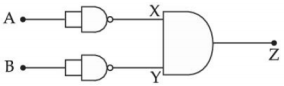
Identify the logic operation carried out by the given circuit:
An electron with mass ‘\( m \)’ with an initial velocity \( (t = 0) \, \vec{v} = -v_{0}\,\hat{i} \; (v_{0} > 0) \) enters a magnetic field \( \vec{B} = B_{0}\,\hat{j} \). If the initial de-Broglie wavelength at \( t = 0 \) is \( \lambda_{0} \) then its value after time ‘\( t \)’ would be:
When a hydrogen atoms going from \( n = 2 \) to \( n = 1 \) emits a photon, its recoil speed is \( \dfrac{x}{5} \, \text{m /s}^{} \). Where \( x = \) ________________. (Use, mass of hydrogen atom \( = 1.6 \times 10^{-27} \, \text{kg} \) )
The ratio of the density of oxygen nucleus \(( ^{16}_{8}\text{O} )\) and helium nucleus \(( ^{4}_{2}\text{He} )\) is:
Two sources of light emit with a power of \( 200 \, \text{W} \). The ratio of number of photons of visible light emitted by each source having wavelengths \( 300 \, \text{nm} \) and \( 500 \, \text{nm} \) respectively, will be:
Considering the Bohr model of hydrogen like atoms, the ratio of the radius of \( 5^{\text{th}} \) orbit of the electron in \( \mathrm{Li}^{2+} \) and \( \mathrm{He}^{+} \) is:
An oil drop of radius \( 2 \, \text{mm} \) with a density \( 3 \, \text{g} \, \text{cm}^{-3} \) is held stationary under a constant electric field \( 3.55 \times 10^{5} \, \text{V} \, \text{m}^{-1} \) in the Millikan’s oil drop experiment. What is the number of excess electrons that the oil drop will possess? Consider \( g = 9.81 \, \text{m} \, /\text{s}^{2} \)
In the hydrogen spectrum, \( \lambda \) be the wavelength of first transition line of Lyman series. The wavelength difference will be “\( a\lambda \)” between the wavelength of \( 3^\text{rd} \) transition line of Paschen series and that of \( 2^\text{nd} \) transition line of Balmer series where \( a = \) _______.
An electron of mass \( 'm' \) with an initial velocity \( \vec{v} = v_{0}\,\hat{i} \) (\( v_{0} > 0 \)) enters an electric field \( \vec{E} = -E_{0}\,\hat{k} \). If the initial de Broglie wavelength is \( \lambda_{0} \), the value after time \( t \) would be:
The mass number of nucleus having radius equal to half of the radius of nucleus with mass number \( 192 \) is:
Two radioactive substances \( A \) and \( B \) of mass numbers \( 200 \) and \( 212 \) respectively, shows spontaneous \( \alpha \)-decay with same \( Q \) value of \( 1 \, \text{MeV} \). The ratio of energies of \( \alpha \)-rays produced by \( A \) and \( B \) is ______.
A radioactive material decays by simultaneous emissions of two particle with half lives of \( 1400 \, \text{years} \) and \( 700 \, \text{years} \) respectively. What will be the time after which one third of the material remains? [ Take \( \ln 3 = 1.1 \) ]
The de Broglie wavelength of an electron having kinetic energy \( E \) is \( \lambda \). If the kinetic energy of electron becomes \( \dfrac{E}{4} \), then its de-Broglie wavelength will be:
Binding energy of a certain nucleus is \( 18 \times 10^{8} \, \text{J} \). How much is the difference between total mass of all the nucleons and nuclear mass of the given nucleus:
Given below are two statements: one is labelled as Assertion A and the other is labelled as Reason R.Assertion A : The photoelectric effect does not takes place, if the energy of the incident radiation is less than the work function of a metal.Reason R : Kinetic energy of the photoelectrons is zero, if the energy of the incident radiation is equal to the work function of a metal.In the light of the above statements, choose the most appropriate answer from the options given below.
Calculate the time interval between \( 33\% \) decay and \( 67\% \) decay if half-life of a substance is \( 20 \) minutes.
The electric field intensity produced by the radiation coming from a \( 100\,W \) bulb at a distance of \( 3\,m \) is \( E \). The electric field intensity produced by the radiation coming from \( 60\,W \) at the same distance is \( \sqrt{\dfrac{x}{5}}\,E \). Where the value of \( x = \) ________.
Average force exerted on a non-reflecting surface at normal incidence is \( 2.4 \times 10^{-4} \, \text{N} \). If \( 360 \, \text{W}/\text{cm}^{2} \) is the light energy flux during span of \( 1 \) hour \( 30 \) minutes. Then the area of the surface is:
In hydrogen atom spectrum, (\( R \rightarrow \) Rydberg's constant)A. the maximum wavelength of the radiation of Lyman series is \( \dfrac{4}{3R} \)B. the Balmer series lies in the visible region of the spectrumC. the minimum wavelength of the radiation of Paschen series is \( \dfrac{9}{R} \)D. the minimum wavelength of Lyman series is \( \dfrac{5}{4R} \)Choose the correct answer from the options given below:
Monochromatic light of frequency \( 6 \times 10^{14}\,\text{Hz} \) is produced by a laser. The power emitted is \( 2 \times 10^{-3}\,\text{W} \). How many photons per second on an average, are emitted by the source?
The radius of third stationary orbit of electron for Bohr's atom is \( R \). The radius of fourth stationary orbit will be:
If \( 917 \, \mathring{A}. \) be the lowest wavelength of Lyman series then the lowest wavelength of Balmer series will be ______ \( \mathring{A}. \).
Two radioactive elements \( A \) and \( B \) initially have same number of atoms. The half life of \( A \) is same as the average life of \( B \). If \( \lambda_A \) and \( \lambda_B \) are decay constants of \( A \) and \( B \) respectively, then choose the correct relation from the given options.
An electron accelerated through a potential difference \( V_{1} \) has a de-Broglie wavelength of \( \lambda \). When the potential is changed to \( V_{2} \), its de-Broglie wavelength increases by \( 50\% \). The value of \( \left( \frac{V_{1}}{V_{2}} \right) \) is equal to:
Given below are two statements: One is labelled as Assertion A and the other is labelled as Reason R.Assertion A: The nuclear density of nuclides \( {}^{10}_{5}\mathrm{B} \), \( {}^{6}_{3}\mathrm{Li} \), \( {}^{56}_{26}\mathrm{Fe} \), \( {}^{20}_{10}\mathrm{Ne} \) and \( {}^{209}_{83}\mathrm{Bi} \) can be arranged as \( \rho^{N}_{\mathrm{Bi}} > \rho^{N}_{\mathrm{Fe}} > \rho^{N}_{\mathrm{Ne}} > \rho^{N}_{\mathrm{B}} > \rho^{N}_{\mathrm{Li}} \).Reason R: The radius \( R \) of nucleus is related to its mass number \( A \) as \( R = R_{0} A^{1/3} \), where \( R_0 \) is a constant.In the light of the above statements, choose the correct answer from the options given below
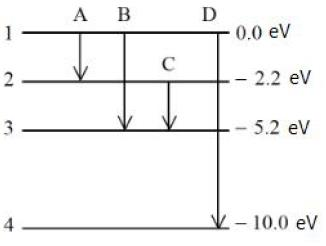
The energy levels of an atom is shown in figure.Which one of these transitions will result in the emission of a photon of wavelength \( 124.1 \, \text{nm} \)?Given \( ( \, h = 6.62 \times 10^{-34} \, \text{Js} \, ) \).
Given below are two statements:Statement I: Stopping potential in photoelectric effect does not depend on the power of the light source.Statement II: For a given metal, the maximum kinetic energy of the photoelectron depends on the wavelength of the incident light.In the light of above statements, choose the most appropriate answer from the options given below:
A radioactive substance decays to \( \left( \dfrac{1}{16} \right)^{\text{th}} \) of its initial activity in \( 80 \, \text{days} \). The half life of the radioactive substance expressed in days is __________ .
A proton and an \( \alpha \) – particle are accelerated from rest by \( 2V \) and \( 4V \) potentials, respectively. The ratio of their de-Broglie wavelength is:
The difference between threshold wavelengths for two metal surfaces \( A \) and \( B \) having work function \( \phi_A = 9 \, \text{eV} \) and \( \phi_B = 4.5 \, \text{eV} \) in \( \text{nm} \) is: {Given, \( hc = 1242 \, \text{eV} \, \text{nm} \)}
The de-Broglie wavelength of a particle having kinetic energy \( E \) is \( \lambda \). How much extra energy must be given to this particle so that the de-Broglie wavelength reduces to \( 75\% \) of the initial value?
An electron of a hydrogen like atom, having \( Z = 4 \), jumps from \( 4^{\text{th}} \) energy state to \( 2^{\text{nd}} \) energy state. The energy released in this process, will be: (Given \( R c h = 13.6 \, \text{eV} \)) Where \( R \) = Rydberg constant\( c \) = Speed of light in vacuum\( h \) = Plank’s constant
A sample contains \( 10^{-2} \) \( \text{kg} \) each of two substances \( A \) and \( B \) with half lives \( 4 \, \text{s} \) and \( 8 \, \text{s} \) respectively. The ratio of their atomic weights is \( 1:2 \). The ratio of the amounts of \( A \) and \( B \) after \( 16 \, \text{s} \) is \( \dfrac{x}{100} \). The value of \( x \) is ________.
The mass defect in a particular reaction is \( 0.4 \, \text{g} \). The amount of energy liberated is \( n \times 10^{7} \, \text{kWh} \), where \( n = \_\_\_\_\_\_\_\_ \). (speed of light \( = 3 \times 10^{8} \, \text{m/s} \))
When a metal surface is illuminated by light of wavelength \( \lambda \), the stopping potential is \( 8 \,\text{V} \). When the same surface is illuminated by light of wavelength \( 3\lambda \), stopping potential is \( 2 \,\text{V} \). The threshold wavelength for this surface is:
The energy released when \( \frac{7}{17.13} \) \( \text{kg} \) of \( {}^{7}_{3}\mathrm{Li} \) is converted into \( {}^{4}_{2}\mathrm{He} \) by proton bombardment is \( \alpha \times 10^{32} \) \( \text{eV} \). The value of \( \alpha \) is _______. (Nearest integer) (Mass of \( {}^{7}_{3}\mathrm{Li} = 7.0183\,u \), mass of \( {}^{4}_{2}\mathrm{He} = 4.0004\,u \), mass of proton \( = 1.008\,u \) and \( 1u = 931\,\mathrm{MeV}/c^{2} \) and Avogadro number \( = 6.0 \times 10^{23} \))
Given below are two statements: one is labelled as Assertion A and the other is labelled as Reason R.Assertion A: In photoelectric effect, on increasing the intensity of incident light the stopping potential increases.Reason R: Increase in intensity of light increases the rate of photoelectrons emitted, provided the frequency of incident light is greater than threshold frequency.In the light of the above statements, choose the correct answer from the options given below:
The temperature of an ideal gas in \( 3 \)-dimensional is \( 300 \, \text{K} \). The corresponding de-Broglie wavelength of the electron approximately at \( 300 \, \text{K} \), is: [ \( m_{e} = \) mass of electron \( = 9 \times 10^{-31} \, \text{kg} \) \( h = \) Planck constant \( = 6.6 \times 10^{-34} \, \text{J s} \) \( k_{B} = \) Boltzmann constant \( = 1.38 \times 10^{-23} \, \text{J K}^{-1} \) ]
An electron of mass \( m_e \) and a proton of mass \( m_p \) are accelerated through the same potential difference. The ratio of the de-Broglie wavelength associated with the electron to that with the proton is:
Given below are two statements :
In the light of the above statements choose the correct answer from the option given below :
As per given figure \( A \), \( B \) and \( C \) are the first, second and third excited energy levels of hydrogen atom respectively. If the ratio of the two wavelengths \( \left(\text{i.e. } \dfrac{\lambda_{1}}{\lambda_{2}}\right) \) is \( \dfrac{7}{4n} \), then the value of \( n \) will be _______.
The de Broglie wavelengths for an electron and a photon are \( \lambda_e \) and \( \lambda_p \) respectively. For the same kinetic energy of electron and photon, which of the following presents the correct relation between the de Broglie wavelengths of two?
A monochromatic neon lamp with wavelength of \( 670.5\,\text{nm} \) illuminates a photo-sensitive material which has a stopping voltage of \( 0.48\,\text{V} \). What will be the stopping voltage if the source light is changed with another source of wavelength of \( 474.6\,\text{nm} \)?
Given below are two statements: one is labelled as Assertion A and the other is labelled as Reason R.Assertion A: The Bohr model is applicable to hydrogen and hydrogen-like atoms only.Reason R: The formulation of Bohr model does not include repulsive force between electrons.In the light of the above statements, choose the correct answer from the options given below:
A monochromatic light is incident on a hydrogen sample in ground state. Hydrogen atoms absorb a fraction of light and subsequently emit radiation of six different wavelengths. The frequency of incident light is \( x \times 10^{15} \, \text{Hz} \). The value of \( x \) is ______. (Given \( h = 4.25 \times 10^{-15} \, \text{eV s} \))