\( \displaystyle \sum_{n=1}^{10} \left(\dfrac{528}{n(n+1)(n+2)}\right) \) is equal to:
\( 65 \)
\( 130 \)
\( 220 \)
\( 440 \)
If \( \dfrac{1}{(20-a)(40-a)}+\dfrac{1}{(40-a)(60-a)}+\ldots+\dfrac{1}{(180-a)(200-a)}=\dfrac{1}{256} \), then the maximum value of \( a \) is:
If the minimum value of \( f(x)=\dfrac{5x^2}{2}+\dfrac{\alpha}{x^5}, \; x>0 \), is \( 14 \), then the value of \( \alpha \) is equal to:
Let \( a_1,a_2,a_3,\ldots \) be an A.P. If \(\displaystyle \sum_{r=1}^{\infty}\frac{a_r}{2^r}=4 \), then \( 4a_2 \) is equal to __________.
The sum of the infinite series \( 1 + \frac{5}{6} + \frac{12}{6^2} + \frac{22}{6^3} + \frac{35}{6^4} + \frac{51}{6^5} + \frac{70}{6^6} + \cdots \) is equal to:
The sum \( \frac{1^3}{1} + \frac{1^3 + 2^3}{1 + 3} + \frac{1^3 + 2^3 + 3^3}{1 + 3 + 5} + \ldots \) up to \( 8 \) terms, is:
The sum of \( 10 \) terms of the series \( \dfrac{3}{1^{2}\times 2^{2}} + \dfrac{5}{2^{2}\times 3^{2}} + \dfrac{7}{3^{2}\times 4^{2}} + \ldots \) is:
The series of positive multiples of \( 3 \) is divided into sets: \( \{3\} \), \( \{6, 9, 12\} \), \( \{15, 18, 21, 24, 27\} \), .... Then the sum of the elements in the \( 11^{\text{th}} \) set is equal to ___________.
The sum of all the elements of the set \( \{\alpha\in\{1,2,\ldots,100\}\!:\ \mathrm{HCF}(\alpha,24)=1\} \) is ________.
Three numbers are in an increasing geometric progression with common ration \( r \). If the middle number is doubled, then the new numbers are in an arithmetic progression with common difference \( d \). If the fourth term of GP is \( 3r^2 \), then \( r^2 - d \) is equal to:
Let \( 3,\,7,\,11,\,15,\,\ldots,\,403 \) and \( 2,\,5,\,8,\,11,\,\ldots,\,404 \) be two arithmetic progressions. Then the sum, of the common terms in them, is equal to ______.
The sum of all the elements in the set \( \{ \, n \in \{1,2,\ldots,100\} \mid \text{H.C.F. of } n \text{ and } 2040 \text{ is } 1 \, \} \) is equal to _______.
\( 1 + 3 + 5^2 + 7 + 9^2 + \ldots \) upto \( 40 \) terms is equal to:
The number of terms of an A.P. is even; the sum of all the odd terms is \( 24 \), the sum of all the even terms is \( 30 \) and the last term exceeds the first by \( \frac{21}{2} \). Then the number of terms which are integers in the A.P. is:
Let \( a, b, c \) and \( d \) be positive real numbers such that \( a+b+c+d=11 \). If the maximum value of \( a^5 b^3 c^2 d \) is \( 3750\beta \), then the value of \( \beta \) is:
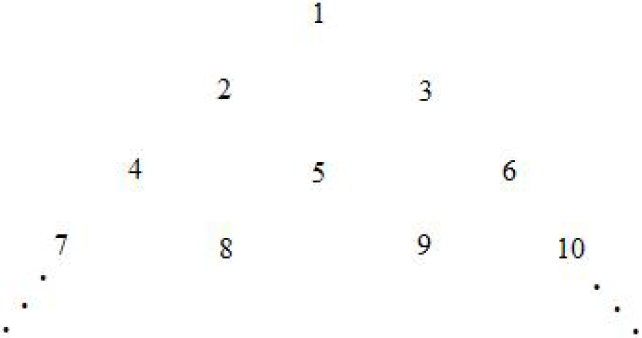
Let the positive integers be written in the form: If the \( k^{\text{th}} \) row contains exactly \( k \) numbers for every natural number \( k \), then the row in which the number \( 5310 \) will be, is _______.
If the first term of an A.P. is \( 3 \) and the sum of its first four terms is equal to one-fifth of the sum of the next four terms, then the sum of the first \( 20 \) terms is equal to:
The sum \( \displaystyle\sum_{n=1}^{21}\frac{3}{(4n-1)(4n+3)} \) is equal to:
\( \left( \frac{1}{3} + \frac{4}{7} \right) + \left( \frac{1}{3^2} + \frac{1}{3} \times \frac{4}{7} + \frac{4^2}{7^2} \right) + \left( \frac{1}{3^3} + \frac{1}{3^2} \times \frac{4}{7} + \frac{1}{3} \times \frac{4^2}{7^2} + \frac{4^3}{7^3} \right) + \ldots \) upto infinite terms, is equal to:
For the two positive numbers \( a, b \), if \( a, b \) and \( \frac{1}{18} \) are in a geometric progression, while \( \frac{1}{a} , 10 \) and \( \frac{1}{b} \) are in an arithmetic progression, then \( 16a + 12b \) is equal to ____.
Let \( C_r \) denote the binomial coefficient of \( x^r \) in the expansion of \( (1+x)^{10} \). If for \( \alpha, \beta \in \mathbb{R} \)\( C_1 + 3\cdot 2\, C_2 + 5\cdot 3\, C_3 + \ldots \text{ up to } 10 \text{ terms} = \dfrac{\alpha \times 2^{11}}{2^{\beta}-1}\left( C_0 + \dfrac{C_1}{2} + \dfrac{C_2}{3} + \ldots \text{ up to } 10 \text{ terms} \right) \)then value of \( \alpha + \beta \) is equal to ______.
Suppose \( a_{1}, a_{2}, 2, a_{3}, a_{4} \) be in an arithmetico-geometric progression. If the common ratio of the corresponding geometric progression is \( 2 \) and the sum of all \( 5 \) terms of the arithmetico-geometric progression is \( {49}/{2} \), then \( a_{4} \) is equal to ______.
Let \( S_n \) denote the sum of the first \( n \) terms of an arithmetic progression. If \( S_{10} = 390 \) and the ratio of the tenth and the fifth terms is \( 15 : 7 \), then \( S_{15} - S_{5} \) is equal to:
If the sum of the first \( 10 \) terms of the series \( \dfrac{1}{1+1^{4}\times 4}+\dfrac{2}{1+2^{4}\times 4}+\dfrac{3}{1+3^{4}\times 4}+\dfrac{4}{1+4^{4}\times 4}+\cdots \) is \( \dfrac{m}{n} \), \( \gcd(m,n)=1 \), then \( m+n \) is equal to:
If the sum of the second, fourth and sixth terms of a G.P. of positive terms is \( 21 \) and the sum of its eighth, tenth and twelfth terms is \( 15309 \), then the sum of its first nine terms is:
The sum of all those terms, of the arithmetic progression \( 3,\,8,\,13,\,\ldots,\,373 \), which are not divisible by \( 3 \), is equal to ________.
The sum of series \( \frac{1}{x+1}+\frac{2}{x^{2}+1}+\frac{2^{2}}{x^{4}+1}+\ldots+\frac{2^{100}}{x^{2^{100}}+1} \) when \( x=2 \) is:
The value of \( \displaystyle \sum_{k=1}^{\infty} (-1)^{k+1} \, \left( \frac{k(k+1)}{k!} \right) \) is:
If \( x = \displaystyle \sum_{n=0}^{\infty} a^n \), \( y = \displaystyle \sum_{n=0}^{\infty} b^n \), \( z = \displaystyle \sum_{n=0}^{\infty} c^n \), where \( a, b, c \) are in A.P. and \( |a| < 1 \), \( |b| < 1 \), \( |c| < 1 \), \( abc \neq 0 \), then:
Let \( a_1, \frac{a_2}{2}, \frac{a_3}{2^2}, \ldots, \frac{a_{10}}{2^9} \) be a G.P. of common ratio \( \frac{1}{\sqrt{2}} \). If \( a_1+a_2+\cdots +a_{10}=62 \), then \( a_1 \) is equal to:
Let \( S_{n} \) be the sum to \( n \)-terms of an arithmetic progression \( 3, \, 7, \, 11, \, \ldots \). If \( 40 < \left( \dfrac{6}{n(n+1)} \displaystyle\sum_{k=1}^{n} S_{k} \right) < 42 \), then \( n \) equals ______.
Let \( S_n = 1 \cdot (n - 1) + 2 \cdot (n - 2) + 3 \cdot (n - 3) + \ldots + (n - 1) \cdot 1, \; n \ge 4. \) The sum \( \displaystyle \sum_{n=4}^{\infty}\left( \frac{2 S_n}{n!} - \frac{1}{(n-2)!} \right) \) is equal to:
If sum of the first \(21\) terms of the series \( \displaystyle \log_{9^{1/2}} x + \log_{9^{1/3}} x + \log_{9^{1/4}} x + \dots, \), where \( x>0 \), is \(504\), then \(x\) is equal to:
The value of \( \dfrac{1\times 2^2 + 2\times 3^2 + \dots + 100\times (101)^2}{1^2\times 2 + 2^2\times 3 + \dots + 100^2\times 101} \) is:
If the sum of the first four terms of an A.P. is \( 6 \) and the sum of its first six terms is \( 4 \), then the sum of its first twelve terms is
Suppose \( a_{1},a_{2},\ldots ,a_{n},\ldots \) be an arithmetic progression of natural numbers. If the ratio of the sum of first five terms to the sum of first nine terms of the progression is \( 5:17 \) and \( 110 < a_{15}<120\), then the sum of the first ten terms of the progression is equal to:
Let \( \dfrac{1}{16}, \, a \) and \( b \) be in G.P. and \( \dfrac{1}{a}, \, \dfrac{1}{b}, \, 6 \) be in A.P., where \( a, b > 0 \). Then \( 72(a+b) \) is equal to ________.
Let \( S_n = \frac{1}{2} + \frac{1}{6} + \frac{1}{12} + \frac{1}{20} + \ldots \) upto \( n \) terms. If the sum of the first six terms of an A.P. with first term \( -p \) and common difference \( p \) is \( \sqrt{2026\, S_{2025}} \), then the absolute difference between \( 20^{\text{th}} \) and \( 15^{\text{th}} \) terms of the A.P. is:
For the function \( f(\theta)=\alpha \tan^2\theta+\beta \cot^2\theta \), and \( g(\theta)=\alpha \sin^2\theta+\beta \cos^2\theta, \ \alpha,\beta>0 \), let If the first terms of a G.P. is \( \left(\frac{\alpha}{2\beta}\right) \), its common ratio is \( \left(\frac{2\beta}{\alpha}\right) \) and the sum of its first \( 10 \) terms is \( \frac{m}{n} \), \( \gcd(m,n)=1 \), then \( m+n \) is equal to ______.
Let the first term \( a \) and the common ratio \( r \) of a geometric progression be positive integers. If the sum of squares of its first three terms is \( 33033 \), then the sum of these three terms is equal to:
Let \( S = \mathbb{N} \cup \{0\} \). Define a relation \( R \) from \( S \) to \( \mathbb{R} \) by: \(\displaystyle R = \{(x,y) : \log_{e} y = x \log_{e}\!\left(\frac{2}{5}\right),\, x \in S, Y \in \mathbb{R}\} \). Then, the sum of all the elements in the range of \( R \) is equal to:
The greatest integer less than or equal to the sum of first \( 100 \) terms of the sequence \( \frac{1}{3},\ \frac{5}{9},\ \frac{19}{27},\ \frac{65}{81},\ \ldots \) is equal to ________.
The sum of first four terms of a geometric progression (G.P.) is \( \dfrac{65}{12} \) and the sum of their respective reciprocals is \( \dfrac{65}{18} \). If the product of first three terms of the G.P. is \( 1 \), and the third term is \( \alpha \), then \( 2\alpha \) is ______________.
Let \( a_1,a_2,\ldots,a_{2024} \) be an Arithmetic Progression such that \( a_1+(a_5+a_{10}+a_{15}+\cdots+a_{2020})+a_{2024}=2233 \). Then \( a_1+a_2+a_3+\cdots+a_{2024} \) is equal to ________.
Let \( \{a_k\} \) and \( \{b_k\} , \ k \in e , \) be two G.P.s with common ratios \( r_1 \) and \( r_2 \) respectively such that \( a_1 - b_1 = 4 \) and \( r_1 < r_2 \). Let \( c_k = a_k + b_k , \ k \in \)\(\mathbb{N}\). If \( c_2 = 5 \) and \( c_3 = \frac{13}{4} \) then \( \displaystyle \sum_{k=1}^{\infty} c_k - (12a_6 + 8b_4) \) is equal to ________.
For \( k\in\mathbb{N} \), let \( \dfrac{1}{\alpha(\alpha+1)(\alpha+2)\ldots(\alpha+20)}=\displaystyle\sum_{k=0}^{20}\dfrac{A_{k}}{\alpha+k} \), where \( \alpha>0 \). Then the value of \( 100\left(\dfrac{A_{14}+A_{15}}{A_{13}}\right)^{2} \) is equal to ________.
In the expansion of \( \left( \sqrt[3]{2} + \frac{1}{\sqrt[3]{3}} \right)^{n} \), \( n \in \mathbb{N} \), if the ratio of \( 15^{\text{th}} \) term from the beginning to the \( 15^{\text{th}} \) term from the end is \( \frac{1}{6} \), then the value of \( {}^{n}C_{3} \) is:
Let \( a_1, a_2, a_3, \ldots \) be a G.P. of increasing positive terms such that \( a_2 \cdot a_3 \cdot a_4 = 64 \) and \( a_1 + a_3 + a_5 = \frac{813}{7} \). Then \( a_3 + a_5 + a_7 \) is equal to:
Let \( 3, 6, 9, 12, \ldots \) upto \( 78 \) terms and \( 5, 9, 13, 17, \ldots \) upto \( 59 \) terms be two series. Then, the sum of the terms common to both the series is equal to ______.
The \( 8^{\text{th}} \) common term of the series \(S_{1}=3+7+11+15+19+\ldots \), \( S_{2}=1+6+11+16+21+\ldots \) is __________.
Let \( < a_n > \)be a sequence such that \( a_1 + a_2 + \ldots + a_n = \dfrac{n^2 + 3n}{(n+1)(n+2)} \). If \( 28 \displaystyle\sum_{k=1}^{10} \dfrac{1}{a_k} = p_1 p_2 p_3 \ldots p_m \), where \( p_2, p_2, \ldots , p_m \) are the first \( m \) prime numbers, then \( m \) is equal to:
The \( 4^{\text{th}} \) term of GP is \( 500 \) and its common ratio is \( \frac{1}{m} \), \( m \in \mathbb{N} \). Let \( S_n \) denote the sum of the first \( n \) terms of this GP. If \( S_6 > S_5 + 1 \) and \( S_7 < S_6 + \frac{1}{2} \), then the number of possible values of \( m \) is ______.
Let \( 729, 81, 9, 1, \ldots \) be a sequence and \( P_n \) denote the product of the first \( n \) terms of this sequence.If \( 2\sum\limits_{n=1}^{40} (P_n)^{\frac{1}{n}} = \frac{3^{\alpha} - 1}{3^{\beta}} \) and \( \gcd(\alpha, \beta) = 1 \), then \( \alpha + \beta \) is equal to:
The sum \( 1+3+11+25+45+71+\cdots \) upto \( 20 \) terms, is equal to:
Let \( a_1, a_2, a_3, \ldots \) be a G.P. of increasing positive numbers. If \( a_3 a_5 = 729 \) and \( a_2 + a_4 = \frac{111}{4} \), then \( 24(a_1 + a_2 + a_3) \) is equal to:
Let \( \alpha, \beta \) and \( \gamma \) be three positive real numbers. Let \( f(x)=\alpha x^5+\beta x^3+\gamma x, \, x\in \mathbb{R} \) and \( g:\mathbb{R}\to\mathbb{R} \) be such that \( g\big(f(x)\big)=x \) for all \( x\in \mathbb{R} \). If \( a_1,a_2,a_3,\ldots,a_n \) be in arithmetic progression with mean zero, then the value of \( f\!\left(g\!\left(\dfrac{1}{n}\displaystyle\sum_{r=1}^{n} f(a_i)\right)\right) \) is equal to:
The sum of the first ten terms of an A.P. is \( 160 \) and the sum of the first two terms of a G.P. is \( 8 \). If the term of the A.P. is equal to the common ratio of the G.P. and the first term of the G.P. is equal to common difference of the A.P., then the sum of all possible values of the first term of the G.P. is:
Let the first three terms \( 2 \), \( p \) and \( q \), with \( q \neq 2 \), of a G.P. be respectively the \( 7^{\text{th}} \), \( 8^{\text{th}} \) and \( 13^{\text{th}} \) terms of an A.P. If the \( 5^{\text{th}} \) term of the G.P. is the \( n^{\text{th}} \) term of the A.P., then \( n \) is equal to:
Let \( a_1, a_2, a_3, \ldots, a_n \) be \( n \) positive consecutive terms of an arithmetic progression. If \( d > 0 \) is its common difference, then: \( \displaystyle \lim_{n \to \infty} \sqrt{\frac{d}{n}} \left( \frac{1}{\sqrt{a_1}+\sqrt{a_2}} + \frac{1}{\sqrt{a_2}+\sqrt{a_3}} + \ldots + \frac{1}{\sqrt{a_{n-1}}+\sqrt{a_n}} \right) \) is:
Let \( x_1, x_2, x_3, x_4 \) be in a geometric progression, If \( 2, 7, 9, 5 \) are subtracted respectively from \( x_1, x_2, x_3, x_4 \), then the resulting numbers are in an arithmetic progression. Then the value of \( \dfrac{1}{24} (x_1 x_2 x_3 x_4) \) is:
If each term of a geometric progression \( a_{1},a_{2},a_{3},\ldots \) with \( a_{1}=\dfrac{1}{8} \) and \( a_{2}\neq a_{1} \), is the arithmetic mean of the next two terms and \( S_{n}=a_{1}+a_{2}+\cdots +a_{n} \), then \( S_{20}-S_{18} \) is equal to:
If \( 2\tan^2\theta-5\sec\theta-1 \) has exactly \( 7 \) solutions in the interval \(\displaystyle \left[0,\frac{n\pi}{2}\right] \) for the least value of \( n\in \mathbb{N} \), then \(\displaystyle \sum_{k=1}^{n} \frac{k}{2^{k}} \) is equal to:
The sum of the series \( \frac{1}{1-3\cdot 1^{2}+1^{4}} + \frac{2}{1-3\cdot 2^{2}+2^{4}} + \frac{3}{1-3\cdot 3^{2}+3^{4}} + \ldots \) up to \( 10 \) terms is:
Let\( 0 < z < y < x\) be three real numbers such that $\dfrac{1}{x}, \dfrac{1}{y}, \dfrac{1}{z}$ are in an arithmetic progression and $x, \sqrt{2}y, z$ are in a geometric progression. If $xy + yz + zx = \dfrac{3}{\sqrt{2}} xyz$, then $3(x + y + z)^2$ is equal to________.
Let \( S_n \) be the sum of the first \( n \) terms of an arithmetic progression. If \( S_{3n}=3S_{2n} \) then the value of \( \dfrac{S_{4n}}{S_{2n}} \) is:
The sum of the first \( 20 \) terms of the series \( 5 + 11 + 19 + 29 + 41 + \ldots \) is:
Let \( a_{1}, a_{2}, \ldots, a_{n} \) be in A.P. If \( a_{5} = 2a_{7} \) and \( a_{11} = 18 \), then \( 12\!\left(\dfrac{1}{\sqrt{a_{10}}+\sqrt{a_{11}}} + \dfrac{1}{\sqrt{a_{11}}+\sqrt{a_{12}}} + \ldots + \dfrac{1}{\sqrt{a_{17}}+\sqrt{a_{18}}}\right) \) is equal to _____.
The value of \( 1^{3}-2^{3}+3^{3}-\cdots+15^{3} \) is:
Let \( a_1,a_2,a_3,\ldots \) be an A.P. If \( a_7=3 \), the product \( a_1a_4 \) is minimum and the sum of its first \( n \) terms is zero, then \( n!-4a_{n(n+2)} \) is equal to:
If the sum of the series \( \left( \dfrac{1}{2} - \dfrac{1}{3} \right) + \left( \dfrac{1}{2^2} - \dfrac{1}{2 \cdot 3} + \dfrac{1}{3^2} \right) + \left( \dfrac{1}{2^3} - \dfrac{1}{2^2 \cdot 3} + \dfrac{1}{2 \cdot 3^2} - \dfrac{1}{3^3} \right) + \left( \dfrac{1}{2^4} - \dfrac{1}{2^3 \cdot 3} + \dfrac{1}{2^2 \cdot 3^2} - \dfrac{1}{2 \cdot 3^3} + \dfrac{1}{3^4} \right) + \ldots \) is \( \dfrac{\alpha}{\beta} \) , where \( \alpha \) and \( \beta \) are co-prime, then \( \alpha + 3\beta \) is equal to _________.
For three positive integers \( p,q,r \), \( x^{pq^{2}} = y^{qr} = z^{p^{2}r} \) and \( r=pq+1 \) such that \( 3, \; 3\log_{y}x, \; 3\log_{z}y, \; 7\log_{x}z \) are in A.P. with common difference \( \dfrac{1}{2} \). Then \( r-p-q \) is equal to:
Let \(\displaystyle f(x)=\lim_{n\to\infty}\sum_{r=0}^{n}\left(\dfrac{\tan\left(\frac{x}{2^{r+1}}\right)+\tan^{3}\left(\frac{x}{2^{r+1}}\right)}{1-\tan^{2}\left(\frac{x}{2^{r+1}}\right)}\right) \). Then \(\displaystyle \lim_{x\to 0}\dfrac{e^{x}-e^{f(x)}}{(x-f(x))} \) is equal to __________________.
If \( a_1(>0), a_2, a_3, a_4, a_5 \) are in a G.P., \( a_2 + a_4 = 2a_3 + 1 \) and \( 3a_2 + a_3 = 2a_4 \), then \( a_2 + a_4 + 2a_5 \) is equal to _______.
For \( x \ge 0 \) the least value of \( K \), for which \( 4^{1+x}+4^{1-x},\; \dfrac{K}{2},\; 16^{x}+16^{-x} \) are three consecutive terms of an A.P., is equal to:
If \( \frac{1}{2\cdot 3^{10}} + \frac{1}{2^{2}\cdot 3^{9}} + \ldots + \frac{1}{2^{10}\cdot 3} = \frac{K}{2^{10}\cdot 3^{10}} \) then the remainder when \( K \) is divded by \( 6 \) is:
If the sum and product of four positive consecutive terms of a G.P., are \( 126 \) and \( 1296 \), respectively, then the sum of common ratios of all such GPs is:
Let \( A = \{1,a_1,a_2,\ldots,a_{18},77\} \) be a set of integers with \( 1 < a_1 < a_2 < \ldots < a_{18} < 77 \).Let the set \( A + A = \{ x + y : x, y \in A \} \) contain exactly \( 39 \) elements. Then, the value of \( a_1 + a_2 + \ldots + a_{18} \) is equal to ________.
Let \( a, b, c \) be in arithmetic progression. Let the centroid of the triangle with vertices \( (a, c) \), \( (2, b) \) and \( (a, b) \) be \( \left( \frac{10}{3}, \frac{7}{3} \right) \). If \( \alpha, \beta \) are the roots of the equation \( a x^2 + b x + 1 = 0 \), then the value of \( \alpha^2 + \beta^2 - \alpha \beta \) is:
If \( a_n = \frac{-2}{4n^2 - 16n + 15} \), then \( a_1 + a_2 + \ldots + a_{25} \) is equal to:
In an arithmetic progression, if \( S_{40} = 1030 \) and \( S_{12} = 57 \), then \( S_{30} - S_{10} \) is equal to:
The sum of all \( 3 \)-digit numbers less than or equal to \( 500 \), that are formed without using the digit ''\( 1 \)'' and they all are multiple of \( 11 \), is __________.
Let \( a_{1},a_{2},a_{3},\ldots \) be a G.P. of increasing positive numbers. Let the sum of its \( 6^{\text{th}} \) and \( 8^{\text{th}} \) terms be \( 2 \) and the product of its \( 3^{\text{rd}} \) and \( 5^{\text{th}} \) terms be \( \dfrac{1}{9} \). Then \( 6(a_{2}+a_{4})(a_{4}+a_{6}) \) is equal to:
Let \( \alpha, \beta \) be the roots of the equation \( x^2 - x + p = 0 \) and \( \gamma, \delta \) be the roots the equation \( x^2 - 4x + q = 0; \ p, q \in \mathbb{Z} \). If \( \alpha, \beta, \gamma, \delta \) are in G.P., then \( |p+q| \) equals:
Let \( A(4,-2) \), \( B(1,1) \) and \( C(9,-3) \) be the vertices of a triangle \( ABC \). Then the maximum area of the parallelogram \( AFDE \), formed with vertices \( D \), \( E \) and \( F \) on the sides \( BC \), \( CA \) and \( AB \) of the triangle \( ABC \) respectively, is __________________.
Let \( S_n \) denote the sum of first \( n \) terms of an arithmetic progression. If \( S_{20} = 790 \) and \( S_{10} = 145 \), then \( S_{15} - S_{5} \) is:
Let \( A \) be the set of first \( 101 \) terms of an A.P., whose first term is \( 1 \) and the common difference is \( 5 \) and let \( B \) be the set of first \( 71 \) terms of an A.P., whose first term is \( 9 \) and the common difference is \( 7 \). Then the number of elements in \( A \cap B \), which are divisible by \( 3 \), is:
Let \(\displaystyle S_n(x) = \log_{a^{1/2}} x + \log_{a^{1/3}} x + \log_{a^{1/6}} x + \log_{a^{1/11}} x + \log_{a^{1/18}} x + \log_{a^{1/27}} x + \dots\dots \) upto \( n \)-terms, where \( a>1 \). If \( S_{24}(x)=1093 \) and \( S_{12}(2x)=265 \), then value of \( a \) is equal to __________.
Consider two G. Ps. \( 2,\,2^{2},\,2^{3},\ldots \) and \( 4,\,4^{2},\,4^{3},\ldots \) of \( 60 \) and \( n \) terms respectively. If the geometric mean of all the \( 60+n \) terms is \( (2)^{\dfrac{225}{8}} \), then \( \displaystyle \sum_{k=1}^{n} k\,(n-k) \) is equal to:
Let \( a_{n} \) be the \( n^{\text{th}} \) term of an A.P. If \( S_{n}=a_{1}+a_{2}+a_{3}+\cdots +a_{n}=700 \), \( a_{6}=7 \) and \( S_{7}=7 \) then \( a_{n} \) is equal to:
If \( \dfrac{1}{1^4} + \dfrac{1}{2^4} + \dfrac{1}{3^4} + \ldots \infty = \dfrac{\pi^4}{90} \), \( \dfrac{1}{1^4} + \dfrac{1}{3^4} + \dfrac{1}{5^4} + \ldots \infty = \alpha \), \( \dfrac{1}{2^4} + \dfrac{1}{4^4} + \dfrac{1}{6^4} + \ldots \infty = \beta \), then \( \dfrac{\alpha}{\beta} \) is equal to:
Let \( T_r \) be the \( r^{th} \) term A.P. If for some, \( m \), \( T_m = \frac{1}{25} \), \( T_{25} = \frac{1}{20} \) and \( 20 \displaystyle \sum_{r=1}^{25} T_r = 13 \), then \( 5m \displaystyle \sum_{r=m}^{2m} T_r \) is equal to:
Let \( a_1 = 1 \) and for \( n \ge 1 \), \( a_{n+1} = \frac{1}{2} a_n + \frac{n^2 - 2n - 1}{n^2 (n+1)^2} \). Then \( \left| \sum_{n=1}^{\infty} \left( a_n - \frac{2}{n^2} \right) \right| \) is equal to _________.
If \( \alpha, \beta \) are natural numbers such that \( 100^\alpha - 199^\beta = (100)(100) + (99)(101) + (98)(102) + \ldots + (1)(199) \), then the slope of the line passing through \( (\alpha, \beta) \) and origin is:
If \( 1 + \frac{\sqrt{3}-\sqrt{2}}{\sqrt{3}} + \frac{5-2\sqrt{6}}{18} + \frac{9\sqrt{3}-11\sqrt{2}}{36\sqrt{3}} + \frac{49-20\sqrt{6}}{180} + \ldots \) upto \( \infty = 2 + \left( \sqrt{\frac{b}{a}} + 1 \right) \log_{e}\!\left( \frac{a}{b} \right) \), where \( a \) and \( b \) are integers with \( \gcd(a,b)=1 \), then \( 11a + 18b \) is equal to \( \_\_\_\_\_\_\_\_ \).
\(\displaystyle \sum_{r=1}^{20} (r^2 + 1)(r!) \) is equal to
Let \( a_{1},a_{2},a_{3},\ldots \) be in an A.P. such that \( \displaystyle \sum_{k=1}^{12} 2a_{2k-1} = -\frac{72}{5} a_{1},\ a_{1} \ne 0 \). If \( \displaystyle \sum_{k=1}^{n} a_{k} = 0 \), then \( n \) is:
If \( \sum_{k=1}^{n} a_{k}=6n^{3} \), then \( \sum_{k=1}^{6}\left(\frac{a_{k+1}-a_{k}}{36}\right)^{2} \) is equal to _________.
If \( \log_{e}a, \log_{e}b, \log_{e}c \) are in an A.P. and \( \log_{e}a-\log_{e}2b, \log_{e}2b-\log_{e}3c, \log_{e}3c-\log_{e}a \) are also in an A.P., then \( a:b:c \) is equal to:
If three successive terms of G.P. with common ratio \( r\,(r>1) \) are the lengths of the sides of a triangle and \( [r] \) denotes the greatest integer less than or equal to \( r \), then \( 3[r]+[-r] \) is equal to __________.
If \( \frac{1}{\sqrt{1}+\sqrt{2}}+\frac{1}{\sqrt{2}+\sqrt{3}}+\ldots+\frac{1}{\sqrt{99}+\sqrt{100}} = m \) and \( \frac{1}{1\cdot 2}+\frac{1}{2\cdot 3}+\ldots+\frac{1}{99\cdot 100} = n \) then the point \( (m,n) \) lies on the line:
Let \( a_{1}, a_{2}, \ldots, a_{21} \) be an AP such that \( \displaystyle \sum_{n=1}^{20} \frac{1}{a_{n} a_{n+1}} = \frac{4}{9} \). If the sum of this AP is \( 189 \), then \( a_{6} \cdot a_{16} \) is equal to:
Let \( a_1, a_2, a_3, \ldots \) be an A.P. If \( \dfrac{a_1+a_2+\ldots+a_{10}}{a_1+a_2+\ldots+a_p}=\dfrac{100}{p^2},\; p\neq 10 \), then \( \dfrac{a_{11}}{a_{10}} \) is equal to:
Let \( A_1, A_2, A_3, \ldots \) be an increasing geometric progression of positive real numbers. If \( A_1 A_3 A_5 A_7 = \frac{1}{1296} \) and \( A_2 + A_4 = \frac{7}{36} \), then, the value of \( A_6 + A_8 + A_{10} \) is equal to:
Let \( a_1, a_2, a_3, \ldots \) be a G.P. of increasing positive terms. If \( a_1 a_5 = 28 \) and \( a_2 + a_4 = 29 \), then \( a_6 \) is equal to:
Let \( a_1,\, a_2,\, a_3, \ldots \) be a GP of increasing positive numbers. If the product of fourth and sixth terms is \( 9 \) and the sum of fifth and seventh terms is \( 24 \), then \( a_1 a_9 + a_2 a_4 a_9 + a_5 + a_7 \) is equal to ________.
\(\displaystyle \frac{2^{3}-1^{3}}{1\times 7}+\frac{4^{3}-3^{3}+2^{3}-1^{3}}{2\times 11}+\frac{6^{3}-5^{3}+4^{3}-3^{3}+2^{3}-1^{3}}{3\times 15}+ \ldots + \frac{30^{3}-29^{3}+28^{3}-27^{3}+\ldots +2^{3}-1^{3}}{15\times 63} \) is equal to ____.
If \( S_n = 4 + 11 + 21 + 34 + 50 + \dots \) to \( n \) terms, then \( \dfrac{1}{60}\,(S_{29} - S_{9}) \) is equal to:
The sum \( \displaystyle \sum_{n=1}^{\infty} \frac{2n^2 + 3n + 4}{(2n)!} \) is equal to:
Let \( a_{1},a_{2},\ldots,a_{10} \) be an AP with common difference \( -3 \) and \( b_{1},b_{2},\ldots,b_{10} \) be a GP with common ratio \( 2 \). Let \( c_{k}=a_{k}+b_{k},\, k=1,2,\ldots,10 \). If \( c_{2}=12 \) and \( c_{3}=13 \), then \( \displaystyle \sum_{k=1}^{10}c_{k} \) is equal to __________.
Let \( \{a_n\}_{n=1}^{\infty} \) be a sequence such that \( a_1=1,\, a_2=1 \) and \( a_{n+2}=2a_{n+1}+a_n \) for all \( n\ge 1 \). Then the value of \( 47\displaystyle\sum_{n=1}^{\infty}\frac{a_n}{2^{3n}} \) is equal to ____________.
The total number of \( 3 \)-digit numbers, whose greatest common divisor with \( 36 \) is \( 2 \), is _______.
Let \( \{a_n\}_{n,0}^{\infty} \) be a sequence such that \( a_0 = a_1 = 0 \) and \( a_{n+2} = 2a_{n+1} - a_n + 1 \) for all \( n \ge 0 \). Then, \( \displaystyle \sum_{n=2}^{\infty} \dfrac{a_n}{7^n} \) is equal to:
If \(\displaystyle \frac{6}{3^{12}} + \frac{10}{3^{11}} + \frac{20}{3^{10}} + \frac{40}{3^{9}} + \ldots + \frac{10240}{3} = 2^{n} \cdot m \) , where \( m \) is odd, then \( m \cdot n \) is equal to _______________.
The sum \( 1^{2}-2\cdot 3^{2}+3\cdot 5^{2}-4\cdot 7^{2}+5\cdot 9^{2}-\cdots+15\cdot 29^{2} \) is ________.
If \( \log_3 2, \ \log_3(2^x-5), \ \log_3\!\left(2^x-\dfrac{7}{2}\right) \) are in an arithmetic progression, then the value of \( x \) is equal to \( \underline{\quad} \).
The interior angles of a polygon with \( n \) sides, are in A.P. with common difference \( 6^\circ \). If the largest interior angle of the polygon is \( 219^\circ \), then \( n \) is equal to __________________.
If \( [x] \) be the greatest integer less than or equal to \( x \), then \( \displaystyle\sum_{n=8}^{100} \left[ \frac{(-1)^{n} \, n}{2} \right] \) is equal to:
Let \( A_1, A_2, A_3 \) be the three A.P. with the same common difference \( d \) and having their first terms as \( A, A+1, A+2 \) respectively. Let \( a, b, c \) be the \( 7^{\text{th}}, 9^{\text{th}}, 17^{\text{th}} \) terms of \( A_1, A_2, A_3 \), respectively such that. If \( a = 29 \), then the sum of first \( 20 \) terms of an AP whose first term is \( c-a-b \) and common difference is \( \frac{d}{12} \), is equal to ________.
Let \( x, y > 0 \). If \( x^3 y^2 = 2^{15} \), then the least value of \( 3x + 2y \) is:
Let \( a_1 = 8 , a_2 , a_3 , \ldots , a_n \) be an A.P. If the sum of its first four terms is \( 50 \) and the sum of its last four terms is \( 170 \), then the product of its middle two terms is ________.
Let $A = \{n \in [100, 700] \cap \mathbb{N} : n \text{ is neither a multiple of } 3 \text{ nor a multiple of } 4\}$. Then the number of elements in $A$ is:
Number of \( 4 \)-digit numbers that are less than or equal to \( 2800 \) and either divisible by \( 3 \) or by \( 11 \), is equal to ____.
Consider an A.P. of positive integers, whose sum of the first three terms is \( 54 \) and the sum of the first twenty terms lies between \( 1600 \) and \( 1800 \). Then its \( 11^{\text{th}} \) term is:
Let \( S_{1} \) be the sum of first \( 2n \) terms of an arithmetic progression. Let \( S_{2} \) be the sum of first \( 4n \) terms of the same arithmetic progression. If \( (S_{2} - S_{1} )\) is \( 1000 \), then the sum of the first \( 6n \) terms of the arithmetic progression is equal to:
If the sum of the series \( \frac{1}{1 \cdot (1 + d)} + \frac{1}{(1 + d)(1 + 2d)} + \ldots + \frac{1}{(1 + 9d)(1 + 10d)} \) is equal to \( 5 \), then \( 50d \) is equal to:
If \( 0 < x < 1 \) and \( y = \frac{1}{2} x^{2} + \frac{2}{3} x^{3} + \frac{3}{4} x^{4} + \ldots \), then the value of \( e^{\,1 + y} \) at \( x = \frac{1}{2} \) is:
An arithmetic progression is written in the following way The sum of all the terms of the \( 10^{\text{th}} \) row is __________.
Let \( a \) and \( b \) be two distinct positive real numbers. Let \( 11^{\text{th}} \) term of a GP, whose first term is \( a \) and third term is \( b \), is equal to \( p^{\text{th}} \) term of another GP, whose first term is \( a \) and fifth term is \( b \). Then \( p \) is equal to:
$\displaystyle \lim_{x \to 2} \left( \displaystyle \sum_{n=1}^{9} \frac{x}{n (n + 1)x^2 + 2 (2n + 1)x + 4} \right) \text{ is equal to:}$
Different A.P.'s are constructed with the first term \( 100 \), the last term \( 199 \), and integral common differences. The sum of the common differences of all such A.P.'s having at least \( 3 \) terms and at most \( 33 \) terms is _________.
If $ \displaystyle \sum_{r=1}^{n} T_r = \frac{(2n - 1)(2n + 1)(2n + 3)(2n + 5)}{64}$$, \: then\:\: $$ \displaystyle \lim_{n \to \infty} \displaystyle \sum_{r=1}^{n} \left( \frac{1}{T_r} \right)$ is equal to:
If \( 0 < x < 1 \), then \( \frac{3}{2} x^2 + \frac{5}{3} x^3 + \frac{7}{4} x^4 + \ldots \), is equal to:
If the value of \( \left(1+\dfrac{2}{3}+\dfrac{6}{3^{2}}+\dfrac{10}{3^{3}}+\ldots \text{ up to } \infty \right)^{\log_{(0.25)}\!\left(\dfrac{1}{3}+\dfrac{1}{3^{2}}+\dfrac{1}{3^{3}}+\ldots \text{ up to } \infty \right)} \) is \( l \) then \( l^{2} \) is equal to __________ .
Let \( 3, a, b, c \) be in A.P. and \( 3, a - 1, b + 1, c + 9 \) be in G.P. Then, the arithmetic mean of \( a, b \) and \( c \) is:
The sum \( 1 + \frac{1+3}{2!} + \frac{1+3+5}{3!} + \frac{1+3+5+7}{4!} + \ldots \) upto \( \infty \) terms, is equal to:
The sum to \( 10 \) terms of the series \( \dfrac{1}{1+1^{2}+1^{4}}+\dfrac{2}{1+2^{2}+2^{4}}+\dfrac{3}{1+3^{2}+3^{4}}+\ldots \) is:
If \(\displaystyle \frac{1}{2 \times 3 \times 4} + \frac{1}{3 \times 4 \times 5} + \frac{1}{4 \times 5 \times 6} + \ldots + \frac{1}{100 \times 101 \times 102} = \frac{k}{101} \), then \( 34k \) is equal to__________.
If \( ^{20}C_{r} \) is the co-efficient of \( x^{r} \) in the expansion of \( (1+x)^{20} \), then the value of \( \displaystyle \sum_{r=0}^{20} r^{2}\,^{20}C_{r} \) is equal to:
Let \( a_{1}, a_{2}, a_{3}, \ldots \) be in an arithmetic progression of positive terms.Let \( A_{k} = a_{1}^{2} - a_{2}^{2} + a_{3}^{2} - a_{4}^{2} + \cdots + a_{2k-1}^{2} - a_{2k}^{2} \) If \( A_{3} = -153 \), \( A_{5} = -435 \) and \( a_{1}^{2} + a_{2}^{2} + a_{3}^{2} = 66 \), then \( a_{17} - A_{7} \) is equal to ____________.
Let \( A_1, A_2, A_3, \ldots, A_{39} \) be \( 39 \) arithmetic means between the numbers \( 59 \) and \( 159 \). Then the mean of \( A_{25}, A_{28}, A_{31} \) and \( A_{36} \) is equal to:
Let \( a_{n} \) be the \( n \)th term of the series \( 5+8+14+23+35+50+\ldots \) and \( s_{n}=\displaystyle\sum_{k=1}^{n}a_{k} \). Then \( S_{30}-a_{40} \) is equal to:
\( \dfrac{1}{3^2 - 1} + \dfrac{1}{5^2 - 1} + \dfrac{1}{7^2 - 1} + \ldots + \dfrac{1}{(201)^2 - 1} \) is equal to:
If \( \gcd(m,n)=1 \) and \( 1^2-2^2+3^2-4^2+\ldots+(2021)^2-(2022)^2+(2023)^2=1012\, m^2 n \) then \( m^2-n^2 \) is equal to:
Let \( a_1 = b_1 = 1, \ a_n = a_{n-1} + 2 \ \& \ b_n = a_n + b_{n-1} \) for every natural number \( n \ge 2 \). Then \( \displaystyle\sum_{n=1}^{15} a_n \cdot b_n \) is equal to ________.
Consider two sets \( A \) and \( B \), each containing three numbers in A.P. Let the sum and the product of the elements of \( A \) be \( 36 \) and \( p \) respectively and the sum and the product of the elements of \( B \) be \( 36 \) and \( q \) respectively. Let \( d \) and \( D \) be the common differences of AP's in \( A \) and \( B \) respectively such that \( D = d + 3 \) and \( d > 0 \). If \( \dfrac{p+q}{p-q} = \dfrac{19}{5} \), then \( p - q \) is equal to
Consider the sequence \( a_1, a_2, a_3, \ldots \) such that \( a_1 = 1, a_2 = 2 \) and \( a_{n+2} = \dfrac{2}{a_{n+1}} + a_n \) for \( n = 1, 2, 3, \ldots \). If \( \left( \dfrac{a_1 + \dfrac{1}{a_2}}{a_3} \right)\left( \dfrac{a_2 + \dfrac{1}{a_3}}{a_4} \right)\left( \dfrac{a_3 + \dfrac{1}{a_4}}{a_5} \right) \ldots \left( \dfrac{a_{30} + \dfrac{1}{a_{31}}}{a_{32}} \right) = 2^{\alpha}\left( {}^{61}C_{31} \right) \) , then \( \alpha \) is equal to:
Let ⟨ \( a_n \) ⟩ be a sequence such that \( a_0 = 0 \), \( a_1 = \frac{1}{2} \) and \( 2a_{n+2} = 5a_{n+1} - 3a_n \), \( n = 0, 1, 2, 3, \ldots \).Then \( \displaystyle \sum_{k=1}^{100} a_k \) is equal to:
Let the first term of a series be \( T_1 = 6 \) and its \( r^{\text{th}} \) term \( T_r = 3T_{r-1} + 6^r, \; r = 2, 3, \ldots, n \). If the sum of the first \( n \) terms of this series is \( \frac{1}{5}\left(n^2 - 12n + 39\right)\!\left(4\cdot 6^n - 5\cdot 3^n + 1\right) \), then \( n \) is equal to ________.
Let \( \alpha = 3 + 4 + 8 + 9 + 13 + 14 + \ldots \) upto \( 40 \) terms. If \( (\tan \beta)^{\frac{\alpha}{1020}} \) is a root of the equation \( x^2 + x - 2 = 0 \), \( \beta \in \left(0, \frac{\pi}{2}\right) \), then \( \sin^2 \beta + 3 \cos^2 \beta \) is equal to:
Let \( S_n \) denote the sum of first \( n \)-terms of an arithmetic progression. If \( S_{10}=530, S_{5}=140 \), then \( S_{20}-S_{6} \) is equal to:
Let \( s_1, s_2, s_3, \ldots, s_{10} \) respectively be the sum to \( 12 \) terms of \( 10 \) A.P.s whose first terms are \( 1, 2, 3, \ldots, 10 \) and the common differences are \( 1, 3, 5, \ldots, 19 \) respectively. Then \( \displaystyle\sum_{i=1}^{10} s_i \) is equal to:
Let \( 2^{\text{nd}},8^{\text{th}} \) and \( 44^{\text{th}} \) terms of a non-constant A.P. be respectively the \( 1^{\text{st}},2^{\text{nd}} \) and \( 3^{\text{rd}} \) terms of a G.P.. If the first term of the A.P. is \( 1 \), then the sum of its first \( 20 \) terms is equal to:
If \( a_1, a_2, a_3, \ldots \) and \( b_1, b_2, b_3, \ldots \) are A.P., and \( a_1 = 2, \; a_{10} = 3, \; a_1 b_1 = 1 = a_{10} b_{10} \), then \( a_4 b_4 \) is equal to
Suppose that the number of terms in an A.P. is \( 2k , \; k \in \mathbb{N} \). If the sum of all odd terms of the A.P. is \( 40 \), the sum of all even terms is \( 55 \) and the last term of the A.P. exceeds the first term by \( 27 \), then \( k \) is equal to:
The sum of the common terms of the following three arithmetic progressions.\( 3, 7, 11, 15, \ldots, 399, \)\( 2, 5, 8, 11, \ldots, 359 \) and\( 2, 7, 12, 17, \ldots, 197, \)is equal to ______.
If \( {}^{1}P_{1}+2\cdot {}^{2}P_{2}+3\cdot {}^{3}P_{3}+\ldots+15\cdot {}^{15}P_{15}={}^qP_{r-s},\; 0\le s\le 1 \), then \( {}^{\,q+s}C_{\,r-s} \) is equal to ________.
Let \( \alpha = 1^2 + 4^2 + 8^2 + 13^2 + 19^2 + 26^2 + \ldots \) up to \( 10 \) terms and \( \beta = \displaystyle \sum_{n=1}^{10} n^4 \). If \( 4\alpha - \beta = 55k + 40 \), then \( k \) is equal to ________.
Among \( (S1) = \displaystyle\lim_{n \to \infty} \frac{1}{n^{2}} (2 + 4 + 6 + \ldots + 2n) = 1 \)\( (S2) =\displaystyle \lim_{n \to \infty} \frac{1}{n^{16}} (1^{15} + 2^{15} + 3^{15} + \ldots + n^{15}) = \frac{1}{16} \)
Let \( S = 2 + \frac{6}{7} + \frac{12}{7^{2}} + \frac{20}{7^{3}} + \frac{30}{7^{4}} + \ldots \). Then \( 4S \) is equal to
If \( A = \displaystyle \sum_{n=1}^{\infty} \frac{1}{\left(3 + (-1)^n\right)^n} \) and \( B = \displaystyle \sum_{n=1}^{\infty} \frac{(-1)^n}{\left(3 + (-1)^n\right)^n} \) then \( \frac{A}{B} \) is equal to:
Let \( a, b, c>1 \), \( a^{3}, b^{3} \) and \( c^{3} \) be in A.P., and \( \log_{a} b, \log_{c} a \) and \( \log_{b} c \) be in G.P. If the sum of first \( 20 \) terms of an A.P., whose first term is \( \dfrac{a+4b+c}{3} \) and the common difference is \( \dfrac{a-8b+c}{10} \) is \( -444 \), then \( abc \) is equal to:
If \( 8 = 3 + \frac{1}{4}(3 + p) + \frac{1}{4^{2}}(3 + 2p) + \frac{1}{4^{3}}(3 + 3p) + \ldots , \; \infty \) , then the value of \( p \) is ________.
Let \( A = \displaystyle \sum_{i=1}^{10}\ \displaystyle \sum_{j=1}^{10} \min\{i, j\} \) and \( B =\displaystyle \sum_{i=1}^{10}\ \displaystyle \sum_{j=1}^{10} \max\{i, j\} \). Then \( A + B \) is equal to ____________ .
If \( \{a_i\}_{i=1}^{n} \), where \( n \) is an even integer, is an arithmetic progression with common difference \( 1 \), and \(\displaystyle \sum_{i=1}^{n} a_i = 192 \), \(\displaystyle \sum_{i=1}^{n/2} a_{2i} = 120 \), then \( n \) is equal to:
If the sum of the first ten terms of the series \( \dfrac{1}{5} + \dfrac{2}{65} + \dfrac{3}{325} + \dfrac{4}{1025} + \dfrac{5}{2501} + \ldots \) is \( \dfrac{m}{n} \), where \( m \) and \( n \) are co-prime numbers, then \( m + n \) is equal to _______.
The number of common terms in the progressions \( 4, 9, 14, 19, \ldots \), up to \( 25^{\text{th}} \) term and \( 3, 6, 9, 12, \ldots \), up to \( 37^{\text{th}} \) term is:
If \( 7 = 5 + \frac{1}{7}(5 + \alpha) + \frac{1}{7^2}(5 + 2\alpha) + \frac{1}{7^3}(5+ 3\alpha) + \ldots \\infty \), then the value of \( \alpha \) is:
The sum to \( 20 \) terms of the series \( 2\cdot 2^{2}-3^{2}+2\cdot 4^{2}-5^{2}+2\cdot 6^{2}-\ldots \) is equal to _____.
The \( 20^{\text{th}} \) term from the end of the progression \(\displaystyle 20,\, 19\frac{1}{4},\, 18\frac{1}{2},\, 17\frac{3}{4},\, \ldots ,\, -129\frac{1}{4} \) is:
A software company sets up \( m \) number of computer systems to finish an assignment in \( 17 \) days. If \( 4 \) computer systems crashed on the start of the second day, \( 4 \) more computer systems crashed on the start of the third day and so on, then it took \( 8 \) more days to finish the assignment. The value of \( m \) is equal to:
Let \( a, b \) and \( c \) be distinct positive numbers. If the vectors \( a\hat{i} + a\hat{j} + c\hat{k} \), \( \hat{i} + \hat{k} \) and \( c\hat{i} + c\hat{j} + b\hat{k} \) are co-planar, then \( c \) is equal to:
If \( S(x)=(1+x)+2(1+x)^{2}+3(1+x)^{3}+\ldots+60(1+x)^{60},\; x\neq 0 \), where \( a,\; b\in \mathbb{N} \) then \( (a+b) \) equal to ______.
Let the sum of the first \( n \) terms of an A.P. be \( 3n^2 + 5n \). Then the sum of squares of the first \( 10 \) terms of the A.P. is:
Let \( a_1,a_2,a_3,a_4 \) be an A.P. of four terms such that each term of the A.P. and its common difference \( l \) are integers. If \( a_1+a_2+a_3+a_4=48 \) and \( a_1 a_2 a_3 a_4 + l^4 = 361 \), then the largest term of A.P. is equal to:
If \( S=\dfrac{7}{5}+\dfrac{9}{5^{2}}+\dfrac{13}{5^{3}}+\dfrac{19}{5^{4}}+\ldots \), then \( 160S \) is equal to ______.
If the sum of an infinite GP \( a, ar, ar^{2}, ar^{3}, \ldots \) is \( 15 \) and the sum of the squares of its each term is \( 150 \), then the sum of \( ar^{2}, ar^{4}, ar^{6}, \ldots \) is:
If \( n \) arithmetic means are inserted between \( a \) and \( 100 \) such that the ratio of the first mean to the least mean is \( 1:7 \) and \( a + n = 33 \), then the value of \( n \) is:
Let \( x_{1}, x_{2}, \ldots, x_{100} \) be in an arithmetic progression, with \( x_{1} = 2 \) and their mean equal to \( 200 \). If \( y_{i} = i(x_{i}-i), 1 \le i \le 100 \), then the mean of \( y_{1}, y_{2}, \ldots, y_{100} \) is:
If in a G.P. of \( 64 \) terms, the sum of all the terms is \( 7 \) times the sum of the odd terms of the G.P., then the common ratio of the G.P. is equal to:
If for \( x, y \in \mathbb{R} , \ x > 0 \), \( y = \log_{10} x + \log_{10} x^{1/3} + \log_{10} x^{1/9} + \ldots \) upto \( \infty \) terms and \( \dfrac{2 + 4 + 6 + \ldots + 2y}{3 + 6 + 9 + \ldots + 3y} = \dfrac{4}{\log_{10} x} \), then the ordered pair \( (x, y) \) is equal to:
If \( a_{\alpha} \) is the greatest term in the sequence \( a_n=\dfrac{n^{3}}{n^{4}+147} \), \( n=1,2,3,\ldots \), then \( \alpha \) is equal to ________.
Consider an A.P.: \( a_{1}, a_{2}, \ldots , a_{n} ;\ a_{1}, > 0 \). If \( a_{2} - a_{1} = -\dfrac{3}{4} \), \( a_{n} = \dfrac{1}{4} a_{1} \), and \( \displaystyle \sum_{i=1}^{n} a_{i} = \dfrac{525}{2} \), then \( \displaystyle \sum_{i=1}^{17} a_{i} \) is equal to:
If \( (20)^{19} + 2(21)(20)^{18} + 3(21)^{2}(20)^{17} + \ldots + 20(21)^{19} = k(20)^{19} \), then \( k \) is equal to ______.
The sum \( 1+\dfrac{1}{2}(1^2+2^2)+\dfrac{1}{3}(1^2+2^2+3^2)+\ldots \) upto \( 10 \) terms is equal to:
The first term of an A.P. of \( 30 \) non-negative terms is \( \frac{10}{3} \). If the sum of this A.P. is the cube of its last term, then its common difference is:
Let \( a, ar, ar^{2},\ldots \) be an infinite G.P. If \( \sum\limits_{n=0}^{\infty}ar^{n}=57 \) and \( \sum\limits_{n=0}^{\infty}a^{3}r^{3n}=9747 \), then \( a+18r \) is equal to
If the sum of the first \( 10 \) terms of the series \( \dfrac{4 \cdot 1}{1 + 4 \cdot 1^{4}} + \dfrac{4 \cdot 2}{1 + 4 \cdot 2^{4}} + \dfrac{4 \cdot 3}{1 + 4 \cdot 3^{4}} + \ldots \) is \( \dfrac{m}{n} \), where \( \gcd(m, n) = 1 \), then \( m + n \) is equal to __________.
In a G.P., if the product of the first three terms is \( 27 \) and the set of all possible values for the sum of its first three terms is \( \mathbb{R} - (a, b) \), then \( a^2 + b^2 \) is equal to __________.
The common difference of the A.P.: \( a_1, a_2, \ldots, a_m \) is \( 13 \) more than the common difference of the A.P.: \( b_1, b_2, \ldots, b_n \). If \( b_{31} = -277 \), \( b_{43} = -385 \) and \( a_{78} = 327 \), then \( a_1 \) is equal to:
Let \( a_1, a_2, a_3, \ldots \) be an A.P. and \( g_1 = a_1, g_2, g_3, \ldots \) be an increasing G.P. If \( a_1 = a_2 + g_2 = 1 \) and \( a_3 + g_3 = 4 \), then \( a_{10} + g_5 \) is equal to:
For positive integers \( n \), if \( 4a_n=(n^2+5n+6 )\) and \(\displaystyle S_n=\sum_{k=1}^{n}\left(\frac{1}{a_k}\right) \), then the value of \( 507\,S_{2025} \) is:
The mean of \( 10 \) numbers \( 7 \times 8, 10 \times 10, 13 \times 12, 16 \times 14, \ldots \) is __________ .
Let three real numbers \( a, b, c \) be in arithmetic progression and \( a + 1, b, c + 3 \) be in geometric progression. If \( a > 10 \) and the arithmetic mean of \( a, b \) and \( c \) is \( 8 \), then the cube of the geometric mean of \( a, b \) and \( c \) is:
Let and Then the value of is equal to:
Let \( A = \{ n \in \mathbb{N} : H.C.F.(n, 45) = 1 \} \) and Let \( B = \{ 2k : k \in \{ 1, 2, \ldots , 100 \} \} \). Then the sum of all the elements of \( A \cap B \) is ____________ .
Let the positive numbers \( a_1,a_2,a_3,a_4 \) and \( a_5 \) be in a G.P. Let their mean and variance be \( \dfrac{31}{10} \) and \( \dfrac{m}{n} \) respectively, where \( m \) and \( n \) are co-prime. If the mean of their reciprocals is \( \dfrac{31}{40} \) and \( a_3+a_4+a_5=14 \), then \( m+n \) is equal to ____.
Let \( S_{K}=\dfrac{1+2+\ldots +K}{K} \) and \(\displaystyle \sum_{j=1}^{n} S_{j}^{2}=\dfrac{n}{A}(Bn^{2}+Cn+D) \), where \( A, B, C, D\in \mathbb{N} \) and \( A \) has least value. Then:
If \(\displaystyle \left( \frac{1}{\alpha+1} + \frac{1}{\alpha+2} + \cdots + \frac{1}{\alpha+1012} \right) - \left( \frac{1}{2\cdot 1} + \frac{1}{4\cdot 3} + \frac{1}{6\cdot 5} + \cdots + \frac{1}{2024\cdot 2023} \right) = \frac{1}{2024} \), then \( \alpha \) is equal to _________.
In an increasing geometric progression of positive terms, the sum of the second and sixth terms is \( \frac{70}{3} \) and the product of the third and fifth terms is \( 49 \). Then the sum of the \( 4^{\text{th}} \), \( 6^{\text{th}} \) and \( 8^{\text{th}} \) terms is equal to:

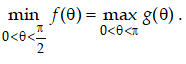 If the first terms of a G.P. is \( \left(\frac{\alpha}{2\beta}\right) \), its common ratio is \( \left(\frac{2\beta}{\alpha}\right) \) and the sum of its first \( 10 \) terms is \( \frac{m}{n} \), \( \gcd(m,n)=1 \), then \( m+n \) is equal to ______.
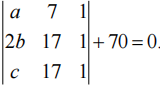 . If \( a = 29 \), then the sum of first \( 20 \) terms of an AP whose first term is \( c-a-b \) and common difference is \( \frac{d}{12} \), is equal to ________.
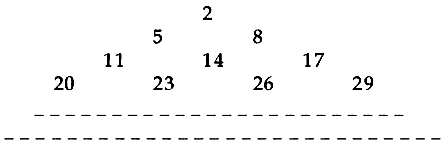 The sum of all the terms of the \( 10^{\text{th}} \) row is __________.
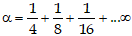 and
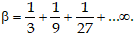 Then the value of
 is equal to: