Let \( T_r \) be the \( r^{th} \) term A.P. If for some, \( m \), \( T_m = \frac{1}{25} \), \( T_{25} = \frac{1}{20} \) and \( 20 \displaystyle \sum_{r=1}^{25} T_r = 13 \), then \( 5m \displaystyle \sum_{r=m}^{2m} T_r \) is equal to:
If \( \dfrac{1}{(20-a)(40-a)}+\dfrac{1}{(40-a)(60-a)}+\ldots+\dfrac{1}{(180-a)(200-a)}=\dfrac{1}{256} \), then the maximum value of \( a \) is:

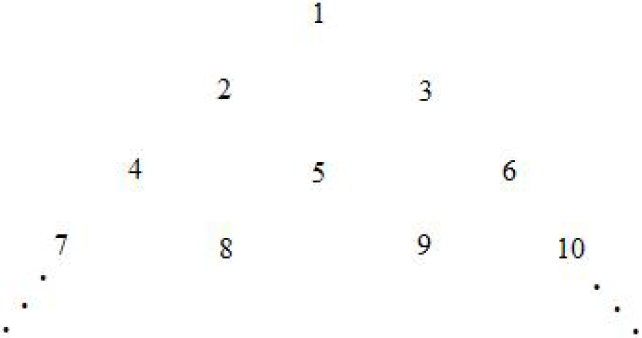
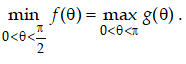 If the first terms of a G.P. is \( \left(\frac{\alpha}{2\beta}\right) \), its common ratio is \( \left(\frac{2\beta}{\alpha}\right) \) and the sum of its first \( 10 \) terms is \( \frac{m}{n} \), \( \gcd(m,n)=1 \), then \( m+n \) is equal to ______.
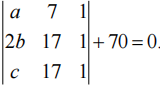 . If \( a = 29 \), then the sum of first \( 20 \) terms of an AP whose first term is \( c-a-b \) and common difference is \( \frac{d}{12} \), is equal to ________.
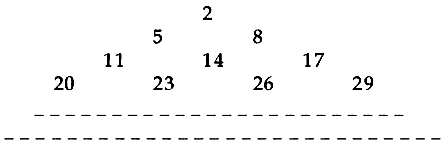 The sum of all the terms of the \( 10^{\text{th}} \) row is __________.
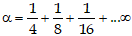 and
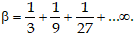 Then the value of
 is equal to: