The area enclosed by the curves \( y^{2}+4x=4 \) and \( y-2x=2 \) is:
\( 9 \)
\( \dfrac{23}{3} \)
\( \dfrac{22}{3} \)
\( \dfrac{25}{3} \)
The area of the region \( \{(x,y): x^{2}\le y\le |x^{2}-4|,\, y\ge 1\} \) is:
Let \( f \) be a continuous function satisfying \(\displaystyle \int_{0}^{t^{2}} \left( f(x)+x^{2} \right) \, dx = \frac{4}{3} t^{3}, \, \forall \, t>0 \). Then \(\displaystyle f\!\left( \frac{\pi^{2}}{4} \right) \) is equal to:
The area of the region in the first quadrant inside the circle \( x^2+y^2=8 \) and outside the parabola \( y^2=2x \) is equal to:
The value of the integral \( \displaystyle \int_{0}^{1}\frac{\sqrt{x}\,dx}{(1+x)(1+3x)(3+x)} \) is:
The value of the integral \( \displaystyle \int_{0}^{2}\dfrac{\sqrt{x(x^{2}+x+1)}}{\sqrt{x+1}\left(\sqrt{x^{4}+x^{2}+1}\right)}\,dx \) is equal to:
Let \( [x] \) denote the greatest integer \( \leq x \). Consider the function \( f(x) = \max\{x^2,\, 1 + [x]\} \). Then the value of the integral \( \int_{0}^{2} f(x)\,dx \) is:
Let the area of region \( \{(x, y) : 2y \le x^2 + 3,\; y + |x| \le 3,\; y \ge0| x - 1|\} \) be \( A \). Then \( 6A \) is equal to:
\(\displaystyle \lim_{n \to \infty} \frac{1}{2^n} \left( \frac{1}{\sqrt{1-\dfrac{1}{2^n}}} + \frac{1}{\sqrt{1-\dfrac{2}{2^n}}} + \frac{1}{\sqrt{1-\dfrac{3}{2^n}}} + \ldots + \frac{1}{\sqrt{1-\dfrac{2^n-1}{2^n}}} \right) \) is equal to:
If the area of the region bounded by the curves \( y^2-2y=-x \), \( x+y=0 \) is \( A \), then \( 8A \) is equal to:
Let \( I_n(x)=\displaystyle\int\limits_{0}^{x}\dfrac{1}{(t^2+5)^n}\,dt,\ n=1,2,3,\ldots \). Then:
The area bounded by the curves \( y = \left|x^{2}-1\right| \) and \( y = 1 \) is:
Let \( [t] \) denote the greatest integer less than or equal to \( t \). Then, the value of the integral \( \int_{0}^{1} \left[ -8x^2 + 6x - 1 \right] dx \) is equal to:
Let \( f(x) = \max\{\, |x+1|, |x+2|, \ldots, |x+5| \,\} \). Then \( \int_{-6}^{0} f(x)\,dx \) is equal to______________.
Let \( I_{n}=\displaystyle\int_{1}^{e}x^{19}(\log |x|)^{n}\,dx \), where \( n\in \mathbb{N} \). If \( (20)\,I_{10}= \alpha I_{9}+\beta I_{8} \) for natural numbers \( \alpha \) and \( \beta \), then \( \alpha-\beta \) equals to ________.
If \( x = x(y) \) is the solution of the differential equation \( y\,\frac{dx}{dy} = 2x + y^3 (y+1) e^{y} \), \( x(1) = 0 \); then \( x(e) \) is equal to:
Let \( f:[0,\infty)\rightarrow [0,\infty) \) be defined as \( f(x)=\displaystyle\int\limits_{0}^{x}[ y]r \,dy \), where \( [ x] \) is the greatest integer less than or equal to \( x \). Which of the following is true?
If \( \displaystyle \int_{0}^{{\pi}{}} (\sin^{3}x )\, e^{-\sin^{2}x}\,dx = \alpha - \dfrac{\beta}{e}\displaystyle \int_{0}^{1} \sqrt{t}\,e^{t}\,dt \), then \( \alpha + \beta \) is equal to ____________.
If \(\displaystyle \int\limits_{0}^{1} \dfrac{1}{(5+2x-2x^2)\left(1+e^{(2-4x)}\right)}\,dx=\frac{1}{\alpha}\log_e\left(\dfrac{\alpha+1}{\beta}\right),\ \alpha,\beta>0 \), then \( \alpha^4-\beta^4 \) is equal to:
The value o the integral \( \int_{-\pi/4}^{\pi/4} \left( \frac{32\cos^4 x}{1+e^{\sin x}} \right) dx \) is:
If the area of the region \( \left\{(x,y): x^{\frac{2}{3}}+y^{\frac{2}{3}} \le 1, \; x+y \ge 0, \; y \ge 0 \right\} \) is \( A \), then \( \frac{256A}{\pi} \) is equal to __________.
The value of $\int\limits_{-1}^{1} \frac{(1 + \sqrt{|x| - x})e^x + (\sqrt{|x| - x})e^{-x}}{e^x + e^{-x}} dx$ is equal to:
For real numbers \( \alpha, \beta, \gamma \) and \( \delta \), if \( \int \dfrac{(x^{2}-1) + \tan^{-1}\!\left(\dfrac{x^{2}+1}{x}\right)}{(x^{4}+3x^{2}+1)\,\tan^{-1}\!\left(\dfrac{x^{2}+1}{x}\right)} \, dx = \alpha \log_{e}\!\left( \tan^{-1}\!\left(\dfrac{x^{2}+1}{x}\right) \right) + \beta \tan^{-1}\!\left( \dfrac{\gamma (x^{2}-1)}{x} \right) + \delta \tan^{-1}\!\left( \dfrac{x^{2}+1}{x} \right) + C \) where \( C \) is an arbitrary constant, then the value of \( 10(\alpha+\beta\gamma+\delta) \) is equal to ________.
Let a differentiable function \( f \) satisfy \( f(x)+\int_{3}^{x}\frac{f(t)}{t}\,dt=\sqrt{x+1}, \, x\geq 3 \). Then \( 12f(8) \) is equal to:
If \(\displaystyle \int_{0}^\dfrac{\pi}{3} \cos^4 x \, dx = a\pi + b\sqrt{3} \), where \( a \) and \( b \) are rational numbers, then \( 9a + 8b \) is equal to:
$\text{The value of } \int_{-\frac{\pi}{2}}^{\frac{\pi}{2}} \left(\frac{1 + \sin^2 x}{1 + \pi^{\sin x}}\right) dx \text{ is:}$
The area of the region \( \left\{(x,y):\, y^{2}\le 4x,\; x<4,\; \frac{xy(x-1)(x-2)}{(x-3)(x-4)}>0,\; x\neq 3\right\} \) is:
and $h(x) = f(|x|) + |f(x)|$. Then $\int_{-2}^{2} h(x) \, dx$ is equal to:
Let \( q \) be the maximum integral value of \( p \) in \([0,10]\) for which the roots of the equation \( x^{2}-px+\dfrac{5}{4}p=0 \) are rational. Then the area of the region \( \{(x,y): 0\le y \le (x-q)^{2},\ 0\le x \le q\} \) is :
If \( \int_{-\pi/2}^{\pi/2} \frac{96 x^{2}\cos^{2}x}{(1+e^{x})} \, dx = \pi(\alpha \pi^{2} + \beta), \\ \alpha, \beta \in \mathbb{Z}, \) then \( (\alpha + \beta)^{2} \) equals:
Let \( p(x)=x^{2}+bx+c \) be a quadratic polynomial with real coefficients such that \( \int\limits_{0}^{1} p(x)\,dx = 1 \) and \( p(x) \) leaves remainder \( 5 \) when it is divided by \( (x-2) \). Then the value of \( 9(b+c) \) is equal to:
Let \( [ t ]\) denote the greatest integer less than or equal to \( t \). Then the value of the integral \( \displaystyle\int\limits_{-3}^{101} \left( \big[ \sin(\pi x) \big] + e^{[\cos(2\pi x) ]} \right) dx \) is equal to:
For \( 0 < a < 1, \) the value of the integral \( \displaystyle\int_{0}^{\pi} \frac{dx}{1 - 2a \cos x + a^2}\) is:
\( f(x)=\dfrac{x}{(1+x^n)^\dfrac{1}{n}}, \ x \in \mathbb{R}-\{-1\}, \ n \in \mathbb{N}, \ n>2. \) If \( f^{n}(x)=(f \circ f \circ \ldots f \ \text{upto } n \ \text{times})(x) \), then let \(\displaystyle \lim\limits_{n \to \infty}\int_{0}^{1} x^{\,n-2}\big(f^{n}(x)\big)\,dx \) is equal to ________.
If \([t]\) denotes the greatest integer \(\le t\), then the value of \(\dfrac{3(e-1)}{e}\displaystyle \int_{1}^{2} x^{2} e^{[x]+[x^{3}]} dx\) is:
The area, enclosed by the curves \( y = \sin x + \cos x \) and \( y = |\cos x - \sin x| \) and the lines \( x = 0 \), \( x = \frac{\pi}{2} \), is:
$\text{If } \int_{0}^{\pi} \frac{5^{\cos x} (1 + \cos x \cos 3x + \cos^2 x + \cos^3 x \cos 3x) dx}{1 + 5^{\cos x}} = \frac{k\pi}{16}, \text{ then } k \text{ is equal to } \_\_\_\_\_\_\_\_.$
The area of the region given by \( A=\{(x,y): x^2 \leq y \leq \min\{x+2,\, 4-3x\}\} \) is :
$\displaystyle \lim_{n\to\infty} \left[ \frac{1}{1+n} + \frac{1}{2+n} + \frac{1}{3+n} + \ldots + \frac{1}{2n} \right] \text{ is equal to :}$
Let for \( x \in \mathbb{R} \), \( S_0(x) = x \), \( S_k(x) = C_k x + k \displaystyle\int_0^x S_{k-1}(t)dt \), where \( C_0 = 1, \; C_k = 1 - \displaystyle\int_0^1 S_{k-1}(x)dx, \; k = 1, 2, 3, \ldots \) Then \( S_2(3) + 6C_3 \) is equal to _____.
If a curve \( y = f(x) \) passes through the point \( (1, 2) \) and satisfies \( x \, \frac{dy}{dx} + y = b x^4 \), then for what value of \( b \), \( \int\limits_{1}^{2} f(x) \, dx = \frac{62}{5} \)?
Let \( f \) be a polynomial function such that \( f(x^{2}+1)=x^{4}+5x^{2}+2 \), for all \( x \in \mathbb{R} \). Then \( \displaystyle \int_{0}^{3} f(x) \, dx \) is equal to:
The area (in sq. units) of the region described by \( \{(x,y): y^{2} \le 2x, \text{ and } y \ge 4x - 1\} \) is:
If the value of the integral \( \displaystyle \int_{-1}^{1} \frac{\cos\alpha x}{1 + 3^{x}} \, dx \) is \( \dfrac{2}{\pi} \). Then, a value of \( \alpha \) is:
A line passing through the point \( A(-2,0) \), touches the parabola \( P: y^{2}=x-2 \) at the point \( B \) in the first quadrant. The area, of the region bounded by the line \( AB \), parabola \( P \) and the x-axis is:
Three points \( O(0,0), P(a,a^{2}), Q(-b,b^{2}), a>0, b>0 \), are on the parabola \( y=x^{2} \). Let \( S_{1} \) be the area of the region bounded by the line \( PQ \) and the parabola, and \( S_{2} \) be the area of the triangle \( OPQ \). If the minimum value of \( \dfrac{S_{1}}{S_{2}} \) is \( \dfrac{m}{n} \), \( \gcd(m,n)=1 \), then \( m+n \) is equal to ________.
The area of the region bounded by the curves \( x(1+y^2)=1 \) and \( y^2=2x \) is:
The value of $\int_{e^2}^{e^4} \frac{1}{x} \left( \frac{e^{\left((\log_e x)^2 + 1\right)^{-1}}}{e^{\left((\log_e x)^2 + 1\right)^{-1}} + e^{\left((6 - \log_e x)^2 + 1\right)^{-1}}} \right) dx$ is :
Let \( [\,\cdot\,] \) be the greatest integer function. If \( \alpha = \int_{0}^{64} \left(x^{1/3} - \left[x^{1/3}\right]\right) dx \), then \( \displaystyle \frac{1}{\pi} \int_{0}^{\alpha \pi} \left(\frac{\sin^2 \theta}{\sin^6 \theta + \cos^6 \theta}\right) d\theta \) is equal to
The value of \( 12\!\int_{0}^{3} \left| x^{2}-3x+2 \right| dx \) is _______.
The area of the region \( A = \{(x, y): |\cos x - \sin x| \le y \le \sin x, \, 0 \le x \le \frac{\pi}{2}\} \) is:
Let \( A \) be the region enclosed by the parabola \( y^2=2x \) and the line \( x=24 \). Then the maximum area of the rectangle inscribed in the region \( A \) is __________.
If \( f(x) \) satisfies the relation \( f(x)=e^x+\int_{0}^{1}(y+x e^x)\,f(y)\,dy \), then \( e+f(0) \) is equal to _______________.
The value of the integral \( \displaystyle \int_{\frac{\pi}{24}}^{\frac{5\pi}{24}} \frac{dx}{1 + \sqrt[3]{\tan 2x}} \) is:
Let the area enclosed by the lines \( x+y=2 \), \( y=0 \), \( x=0 \) and the curve \( f(x)=\min\!\left\{x^{2}+\dfrac{3}{4},\,1+[ x ] \right\} \) where \( [ x ] \) denotes the greatest integer \( \le x \), be \( A \). Then the value of \( 12A \) is ________.
The integral \(\displaystyle \int\limits_{0}^{\dfrac{\pi}{2}} \frac{1}{3 + 2\sin x + \cos x} \, dx \) is equal to:
Let \( [t] \) denote the greatest integer \( \leq t \). Then the value of \( 8 \cdot \int_{-1/2}^{1} \big([2x] + |x|\big)\,dx \) is __________ .
The area of the region \( \left\{(x,y): x^2 \leq y \leq 8 - x^2,\; y \leq 7 \right\} \) is:
The value of \( k \in \mathbb{N} \) for which the integral \( I_{n} = \int_{0}^{1} (1 - x^{k})^{n} \, dx, \ n \in \mathbb{N}, \) satisfies \( 147 I_{20} = 148 I_{21} \) is:
\( \displaystyle \lim_{x\to 0} \dfrac{48}{x^{4}}\int_{0}^{x}\dfrac{t^{3}}{t^{6}+1}\,dt \) is equal to \( \_\_\_\_\_ \).
Let \( a_n =\displaystyle\int\limits_{-1}^{n} \left( 1 + \frac{x}{2} + \frac{x^2}{3} + \ldots + \frac{x^{n-1}}{n} \right) dx \) for every \( n \in \mathbb{N} \). Then the sum of all the elements of the set \( \{ n \in \mathbb{N} : a_n \in (2, 30) \} \) is ____________ .
Let \( y=f(x) \) be a thrice differentiable function in \( (-5,5) \). Let the tangents to the curve \( y=f(x) \) at \( (1,f(1)) \) and \( (3,f(3)) \) make angles \( \dfrac{\pi}{6} \) and \( \dfrac{\pi}{4} \), respectively with positive \( x \)-axis. If \( 27 \int_{1}^{3} ( (f'(t))^{2} + 1 )\, f''(t) \, dt = \alpha + \beta \sqrt{3} \) where \( \alpha,\beta \) are integers, then the value of \( \alpha + \beta \) equals.
A point \( P \) moves so that the sum of squares of its distances from the points \( (1, 2) \) and \( (-2, 1) \) is \( 14 \). Let \( f(x,y)=0 \) be the locus of \( P \), which intersects the x-axis at the points \( A, B \) and the y-axis at the points \( C, D \). Then the area of the quadrilateral \( ACBD \) is equal to:
The area of the smaller region enclosed by the curves \( y^{2}=8x+4 \) and \( x^{2}+y^{2}+4\sqrt{3}x-4=0 \) is equal to:
The value of \( \displaystyle \int_{0}^{20\pi}\left(\sin^{4}x+\cos^{4}x\right)dx \) is equal to:
If the area enclosed by the parabolas \( P_1:2y=5x^2 \) and \( P_2:x^2-y+6=0 \) is equal to the area enclosed by \( P_1 \) and \( y=ax,\,a>0 \), then \( a^3 \) is equal to ________.
If the area of the region \( \{(x,y): 0 \le y \le m \) \(in \{2x,\, 6x - x^{2}\}\} \) is \( A \), then \( 12A \) is equal to __________.
The area (in sq. units) of the region \( \{(x, y) : 0 \le y \le 2|x| + 1, \ 0 \le y \le x^2 + 1, \ |x| \le 3\} \) is:
Let [.] denote the greatest integer function. Then the value of \( \int_{0}^{3} (\frac{e^{x}+e^{-x}}{[x]!} \, dx \)) is:
Let \( F:(3,5)\to \mathbb{R} \) be a twice differentiable function on \( (3,5) \) such that \( F(x)=e^{-x}\displaystyle \int_{3}^{x}\big(3t^{2}+2t+4F'(t)\big)\,dt \). If \( F'(4)=\dfrac{\alpha e^{\beta}-224}{\left(e^{\beta}-4\right)^{2}} \), then \( \alpha+\beta \) is equal to _________.
Let \( x = x(y) \) be the solution of the differential equation \( y = \left(x - y \frac{dx}{dy}\right) \sin \left(\frac{x}{y}\right) \), \( y > 0 \) and \( x(1) = \frac{\pi}{2} \). Then \( \cos x(2) \) is equal to:
If \( \displaystyle \int_{\pi/6}^{\pi/3} \sqrt{\,1-\sin 2x\,}\,dx = \alpha + \beta\sqrt{2} + \gamma\sqrt{3} \), where \( \alpha, \beta \) and \( \gamma \) are rational numbers, then \( 3\alpha + 4\beta - \gamma \) is equal to _________.
Consider the integral \( I=\displaystyle\int\limits_{0}^{10}\dfrac{[x] \, e^{[x]}}{e^{x-1}}\,dx \), where \( [x] \) denotes the greatest integer less than or equal to \( x \). Then the value of \( I \) is equal to:
For \( m,n>0 \), let \( \alpha(m,n) = \displaystyle\int_{0}^{2} t^{m}(1+3t)^{n} dt \) .If \( 11\alpha(10,6)+18\alpha(11,5)=p(14)^{6} \), then \( p \) is equal to ______.
The area of the region enclosed between the circles \( x^2 + y^2 = 4 \) and \( x^2 + (y-2)^2 = 4 \) is:
The value of \(\displaystyle \dfrac{e^{-\dfrac{\pi}{4}} + \displaystyle\int\limits_{0}^{\dfrac{\pi}{4}} e^{-x} \tan^{50}x \, dx}{\displaystyle\int\limits_{0}^{\pi/4} e^{-x} \left(\tan^{49}x + \tan^{51}x\right) dx}\) is :
Let \( f(x) = \displaystyle\int_{0}^{x}\!\left(t + \sin\!\left(1 - e^{t}\right)\right)\,dt, \; x \in \mathbb{R} \). Then, \(\displaystyle \lim_{x \to 0} \frac{f(x)}{x^{3}} \) is equal to:
\( a=\displaystyle\lim_{n\to\infty}\sum_{k=1}^{n}\dfrac{2n}{n^{2}+k^{2}} \) and \( f(x)=\sqrt{\dfrac{1-\cos x}{1+\cos x}},\, x\in(0,1), \) then:
Let \( f \) be a real valued continuous function on \( [0,1] \) and \( f(x)=x+\int_{0}^{1}(x-t)f(t)\,dt \). Then, which of the following points \( (x,y) \) lies on the curve \( y=f(x) \)?
The value of \( \displaystyle\lim_{n \to \infty} \dfrac{1}{n} \sum\limits_{j=1}^{n} \dfrac{(2{\,j-1)} + 8n}{(2{\,j-1)} + 4n} \) is equal to:
Let the area of the region \( \{(x,y): 0 \leq x \leq 3,\; 0 \leq y \leq \min\{x^{2}+2,\; 2x+2\}\} \) be \( A \). The \( 12A \) is equal to ______.
If the area of the region \( \{(x,y): |4-x^{2}|\le y \le x^{2},\, y\le 4,\, x\ge 0\} \) is \( \left(\frac{80\sqrt{2}}{\alpha}-\beta\right) \), \( \alpha, \beta \in \mathbb{N} \), then \( \alpha+\beta \) is equal to __________.
If the value of the integral \( \int_{-\pi/2}^{\pi/2} \left( \frac{x^2 \cos x}{1 + \pi^x} + \frac{1 + \sin^2 x}{1 + e^{\sin x^{2023}}} \right) \, dx = \frac{\pi}{4} (\pi + a) - 2 \), then the value of \( a \) is:
The value of \( 8\int_{0}^{\frac{\pi}{2}} \frac{(\cos x)^{2023}}{(\sin x)^{2023}+(\cos x)^{2023}} \, dx \) is ______.
Let \( f \) be a twice differentiable function such that \( f(x)=\int_{0}^{x}\tan(t-x)\,dt-\int_{0}^{x}f(t)\tan t\,dt \), \( x \in \left(-\dfrac{\pi}{2},\dfrac{\pi}{2}\right) \). Then \( f'\!\left(\dfrac{\pi}{6}\right)+12f'\!\left(-\dfrac{\pi}{6}\right)+f\!\left(\dfrac{\pi}{6}\right) \) is equal to ________.
Let \( f : R \to R \) be a continuous function satisfying \( f(x) + f(x + k) = n \), for all \( x \in R \) where \( k > 0 \) and \( n \) is a positive integer. If \( I_{1} = \int_{0}^{4nk} f(x) \, dx \) and \( I_{2} = \int_{-k}^{3k} f(x) \, dx \), then:
Let the area of the region \( \{(x,y): |2x-1|\le y \le |x^2-x|,\, 0\le x \le 1\} \) be \( A \). Then \( (6A+11)^2 \) is equal to ________.
Let \( f : \mathbb{R} \to (0,\infty) \) be a twice differentiable function such that \( f(3)=18 \), \( f'(3)=0 \) and \( f''(3)=4 \). Then
The sum of squares of all possible values of \( k \), for which area of the region bounded by the parabolas \( 2y^{2}=kx \) and \( 2y^{2}=2(y-x) \) is maximum, is equal to __________.
The integral \(\displaystyle \int_{1/4}^{3/4} \, \cos\!\left( 2\cot^{-1}\!\sqrt{\frac{1-x}{1+x}} \right) \, dx \) is equal to
The area of the region \( S = \{(x, y) : 3x^{2} \le 4y \le 6x + 24\} \) is ________.
The value of the integral \( \displaystyle \int\limits_{-1}^{1}\log\!\left(x+\sqrt{x^{2}+1}\right)\,dx \) is:
Let \(\displaystyle 5f(x)+4f\!\left(\frac{1}{x}\right)=\frac{1}{x}+3,\, x>0 \). Then \(\displaystyle 18\!\int_{1}^{2} f(x)\,dx \) is equal to:
The value of is -----------.
The value of the integral \(\displaystyle\int_{-1}^{2} \log_e \left( x + \sqrt{x^2 + 1} \right) dx \) is
The value of the integral \( \displaystyle \int\limits_{-1}^{1}\log_{e}\!\left(\sqrt{1-x}+\sqrt{1+x}\right)\,dx \) is equal to:
Let \( f(x) \) be a differentiable function defined on \( [0,2] \) such that \( f'(x)=f'(2-x) \) for all \( x \in (0,2) \), \( f(0)=1 \) and \( f(2)=e^{2} \). Then the value of \( \int\limits_{0}^{2} f(x)\,dx \) is:
The area of the region enclosed by the parabolas \( y=4x-x^2 \) and \( 3y=(x-4)^2 \) is equal to:
Let \( [t] \) denote the greatest integer \( \le t \). Then \( \dfrac{2}{\pi}\displaystyle\int_{\pi/6}^{5\pi/6}\big(8[\operatorname{cosec}x]-5[\cot x]\big)\,dx \) is equal to ________.
The area of the region, inside the circle \( (x - 2\sqrt{3})^{2} + y^{2} = 12 \) and outside the parabola \( y^{2} = 2\sqrt{3}\,x \) is:
Let \( f:\mathbb{R}\to\mathbb{R} \) be a function defined by \( f(x)=\dfrac{x}{\left(1+x^{4}\right)^{1/4}} \), and \( g(x)=f\!\left(f\!\left(f\!\left(f(x)\right)\right)\right) \). Then, \( \displaystyle18 \int_{0}^{\sqrt{2\sqrt{5}}} x^2 g(x) \, dx\) is equal to:
The area of the region \( R = \{(x, y) : xy \le 27,\, 1 \le y \le x^{2}\} \) is equal to:
If \( f(t) =\displaystyle \int_{0}^{\pi} \frac{2x \, dx}{1 - \cos^{2} t \, \sin^{2} x} \), \( 0 < t < \pi \), then the value of \(\displaystyle \int_{0}^{\pi/2} \frac{\pi^{2} \, dt}{f(t)} \) equals \( \_\_\_\_\_\_ \).
If \( \int_{\frac{1}{3}}^{3} |\log_{e} x| \, dx = \frac{m}{n} \log_{e}\!\left(\frac{n^{2}}{e}\right) \), where \( m \) and \( n \) are coprime natural numbers, then \( m^{2} + n^{2} - 5 \) is equal to ____.
Let \( \alpha > 0 \). If \( \displaystyle \int_{0}^{\alpha} \dfrac{x}{\sqrt{x+\alpha} - \sqrt{x}} \, dx = \dfrac{16 + 20\sqrt{2}}{15} \), then \( \alpha \) is equal to:
The area (in sq. units) of the region, given by the set \( \{(x,y) \in R \times R \mid x \ge 0, 2x^2 \le y \le 4 - 2x\} \) is:
Let \( f : \mathbb{R} \to \mathbb{R} \) be a function defined as \( f(x) = a\sin\!\left(\dfrac{\pi [x]}{2}\right) + [2-x],\, a \in \mathbb{R} \), where \( [t] \) is the greatest integer less than or equal to \( t \). If \( \displaystyle\lim_{x\to -1} f(x) \) exists, then the value of \( \displaystyle\int\limits_{0}^{4} f(x)\,dx \) is equal to:
The area of the region, inside the ellipse \( x^2 + 4y^2 = 4 \) and outside the region bounded by the curves \( y = |x| - 1 \) and \( y = 1 - |x| \), is:
Let \( \displaystyle \int_{\alpha}^{\log_{e}4}\frac{dx}{\sqrt{e^{x}-1}}=\frac{\pi}{6} \). Then \( e^{\alpha} \) and \( e^{-\alpha} \) are the roots of the equation:
The area of the region bounded by the curves \( x+3y^{2}=0 \) and \( x+4y^{2}=1 \) is equal to:
\( \displaystyle \lim_{n \to \infty} \left( \frac{n^{2}}{(n^{2}+1)(n+1)} + \frac{n^{2}}{(n^{2}+4)(n+2)} + \frac{n^{2}}{(n^{2}+9)(n+3)} + \ldots + \frac{n^{2}}{(n^{2}+n^{2})(n+n)} \right) \) is equal to:
The area enclosed by \( y^{2}=8x \) and \( y=\sqrt{2x} \) that lies outside the triangle formed by \( y=\sqrt{2x}, \ x=1, \ y=2\sqrt{2} \) is equal to:
If \( f:\mathbb{R}\to\mathbb{R} \) be a continuous function satisfying \(\displaystyle \int_{0}^\dfrac{\pi}{2} f(\sin 2x)\sin x \, dx + \alpha \int_{0}^\dfrac{\pi}{4} f(\cos 2x)\cos x \, dx = 0 \), then the value of \( \alpha \) is:
If the area of the region \( \{(x,y): \frac{a}{x^2} \le y \le \frac{1}{x}, \, 1 \le x \le 2, \, 0 <a<1\}\) is (log\(_e2\))\(-\frac{1}{7}\) then the value of \(7a-3 \)is equal to:
\(\displaystyle \Big|\frac{120}{\pi^{2}} \int_{0}^{\pi} \dfrac{x^{2}\sin x \cos x}{\sin^{4}x+\cos^{4}x}\,dx\Big| \) is equal to ________.
\( \displaystyle \int\limits_{0}^{\infty}\frac{6}{e^{3x}+6e^{2x}+11e^{x}+6}\,dx = \)
Let $[\cdot]$ denote the greatest integer function. If $\int_{0}^{e^3} \left[\frac{1}{e^{x-1}}\right] dx = \alpha - \log_e 2$, then $\alpha^3$ is equal to _______.
Area of the region \( \{(x,y): x^{2}+(y-2)^{2}\le 4,\; x^{2}\ge 2y\} \) is:
\( \displaystyle \int_{0}^{\pi/4} \frac{\cos^2 x \,\sin^2 x}{\left(\cos^3 x + \sin^3 x\right)^2}\, dx \) is equal to:
The area of the region \( \{(x,y) : 0 \le y \le 6 - x, \, y^{2} \ge 4x - 3, \, x \ge 0 \} \) is:
If the line \( y = mx \) bisects the area enclosed by the lines \( x = 0 \), \( y = 0 \), \( x = \tfrac{3}{2} \) and the curve \( y = 1 + 4x - x^2 \), then \( 12m \) is equal to ________.
If $[x]$ is the greatest integer $\le x$, then $\pi^2 \int_{0}^{2} \left(\sin \frac{\pi x}{2}\right) (x - [x])^{[x]} dx$ is equal to:
Let \([t]\) denote the largest integer less than or equal to \( t \). If \( \displaystyle \int_{0}^{3}\Big(\,[x^{2}] + \Big[\dfrac{x^{2}}{2}\Big] \,\Big)dx = a + b\sqrt{2} - \sqrt{3} - \sqrt{5} + c\sqrt{6} - \sqrt{7} \), where then \( a,b,c \in \mathbb{Z} \), then \( a+b+c \) is equal to ______.
The value of the integral \( \displaystyle \int_{-2}^{2}\dfrac{|x^{3}+x|}{e^{x|x|}+1}\,dx \) is equal to:
The value of \( \displaystyle \int_{0}^{\pi} \frac{e^{\cos x}\sin x}{\left(1+\cos^2 x\right)\left(e^{\cos x}+e^{-\cos x}\right)}\,dx \) is equal to:
The value of $9 \int_{0}^{9} \left[ \sqrt{\frac{10x}{x+1}} \right] dx$, where $[t]$ denotes the greatest integer less than or equal to $t$, is
The area bounded by the curve \( y=|x^{2}-9| \) and the line \( y=3 \) is:
Let for \( x \in \mathbb{R} \),Then area bounded by the curve \( y = (fog)(x) \) and the lines \( y = 0 \), \( 2y - x = 15 \) is equal to _____.
The area of the region bounded by \( y^2 = 8x \) and \( y^2 = 16(3 - x) \) is equal to:
If the area of the region \( \{(x,y): 1-2x \le y \le 4 - x^{2}, \ x \ge 0, \ y \ge 0\} \) is \( \frac{\alpha}{\beta} \), \( \alpha,\beta \in \mathbb{N}, \ \gcd(\alpha,\beta)=1 \), then the value of \( (\alpha + \beta) \) is:
$\int_{0}^{5} \cos \left( \pi \left( x - \left[ \frac{x}{2} \right] \right) \right) \, dx$ , Where $[t]$ denotes greatest integer less than or equal to $t$, is equal to:
The value of the integral \( \int_{0}^{\infty} \frac{\log_{e}(x)}{x^{2}+4} \, dx \) is:
Let the area of the bounded region \( \{(x, y) : 0 \leq 9x \leq y^2, \, y \geq 3x - 6\} \) be \( A \). Then \( 6A \) is equal to ______.
Let \( f(x)=x+\dfrac{a}{\pi^2-4}\sin x+\dfrac{b}{\pi^2-4}\cos x, \; x\in \mathbb{R} \) be a function which satisfies\( f(x)=x+\displaystyle \int_{0}^{\pi/2}\sin(x+y)f(y)\,dy \). Then \( (a+b) \) is equal to:
If the value of the integral \( \displaystyle \int_{0}^{5} \frac{x + \lfloor x \rfloor}{e^{\,x - \lfloor x \rfloor}} \, dx = \alpha e^{-1} + \beta \), where \( \alpha, \beta \in \mathbb{R} \), \( 5\alpha + 6\beta = 0 \), and \( \lfloor x \rfloor \) denotes the greatest integer less than or equal to \( x \); then the value of \( (\alpha + \beta)^{2} \) is equal to:
The area bounded by the curves \( y = |x - 1| + |x - 2| \) and \( y = 3 \) is equal to:
The value of the integral $\int_{1}^{2}\left(\frac{t^{4} + 1}{t^{6} + 1}\right) dt$ is:
If \(\displaystyle \lim_{t \to 0} \left[ \int_{0}^{1} (3x+5)^{t} \, dx \right]^\dfrac{1}{t} = \frac{\alpha}{5e}\left(\frac{8}{5}\right)^\dfrac{2}{3} \), then \( \alpha \) is equal to ________.
The value of \( b > 3 \) for which \( 12 \int_{3}^{b} \frac{1}{(x^2 - 1)(x^2 - 4)} \, dx = \log_e \!\left( \frac{49}{40} \right) \) is equal to ________.
If \( b_n = \int_{0}^{\pi/2} \frac{\cos^2(nx)}{\sin x} \, dx , \, n \in \mathbb{N} , \) then
The area bounded by the curve \( 4y^2 = x^2 (4 - x)(x - 2) \) is equal to:
The area of the region enclosed by the curve \( f(x) = \max\{\sin x, \cos x\} ,\ -\pi \le x \le \pi \) and the x-axis is:
Let \( \Delta \) be the area of the region \( \{(x,y)\in \mathbb{R}^{2}: x^{2}+y^{2}\leq 21,\; y^{2}\leq 4x,\; x\geq 1\} \). Then \( \dfrac{1}{2}\!\left(\Delta - 21\sin^{-1}\!\dfrac{2}{\sqrt{7}}\right) \) is equal to:
The area enclosed by the curves \( xy + 4y = 16 \) and \( x + y = 6 \) is equal to:
For any real number \( x \), let \( [x] \) denote the largest integer less than equal to \( x \). Let \( f \) be a real valued function defined on the interval \( [-10,10] \) by . Then the value of \( \dfrac{\pi^{2}}{10}\displaystyle\int\limits_{-10}^{10} f(x)\cos \pi x \, dx \) is :
Let \( f \) be a differentiable function in \( \left(0, \frac{\pi}{2}\right) \). If \( \int_{\cos x}^{1} t^{2} f(t)\, dt = \sin^{3} x + \cos x \), then \( \frac{1}{\sqrt{3}} \, f^{\prime}\!\left(\frac{1}{\sqrt{3}}\right) \) is equal to
The integral $\int_{0}^{1} \frac{1}{7^{\left[\frac{1}{x}\right]}} dx$, where $[\,.\,]$ denotes the greatest integer function, is equal to
Let \(\displaystyle f(x)=\int_{0}^{x} g(t)\,\log_{e}\!\left(\dfrac{1-t}{1+t}\right)\,dt \), where \( g \) is a continuous odd function.If \(\displaystyle \int_{-\pi/2}^{\pi/2} \left( f(x) + \dfrac{x^{2}\cos x}{1+e^{x}} \right) dx = \left(\dfrac{\pi}{\alpha}\right)^{2}-\alpha \), then \( \alpha \) is equal to __________ .
If \( n(2n+1)\displaystyle\int\limits_{0}^{1}(1-x^{n})^{2n}\,dx=1177\int\limits_{0}^{1}(1-x^{n})^{2n+1}\,dx \), then \( n\in\mathbb{N} \) is equal to ___________.
The value of the integral \( \frac{48}{\pi^{4}} \int_{0}^{{\pi}{}} \left(\frac{3\pi x^{2}}{2}-x^{3}\right)^{}\frac{\sin x}{1+\cos^{2}x}\,dx \) is equal to ____________ .
The area of the region bounded by the parabola \( (y - 2)^2 = (x - 1) \), the tangent to it at the point whose ordinate is \( 3 \) and the \( x \)-axis is :
Let \( A = \{(x,y) \in \mathbb{R}^2 : y \ge 0, \; 2x \le y \le \sqrt{4-(x-1)^2} \} \) and\( B = \{(x,y) \in \mathbb{R} \times \mathbb{R} : 0 \le y \le \min\{2x,\; \sqrt{4-(x-1)^2}\}\}\)Then the ratio of the area of \( A \) to the area of \( B \) is:
Let \( f(x) \) be a positive function and \( I_1 = \int_{-1/2}^{1} 2x\, f\!\big(2x(1-2x)\big)\,dx \) and \( I_2 = \int_{-1}^{2} f\!\big(x(1-x)\big)\,dx \). Then the value of \( \dfrac{I_2}{I_1} \) is equal to ______.
Let \( f:(1,\infty)\to \mathbb{R} \) be a function defined as \( f(x)=\dfrac{x-1}{x+1} \). Let \( f^{\,i+1}(x)=f\!\left(f^{\,i}(x)\right),\ i=1,2,\ldots,25 \), where \( f^{1}(x)=f(x) \). If \( g(x)+f^{26}(x)=0,\ x\in(1,\infty) \), then the area of the region bounded by the curves \( y=g(x) \), \( 2y=2x-3 \), \( y=0 \) and \( x=4 \) is:
Let $r_k = \frac{\int_{0}^{1}\left(1-x^7\right)^k dx}{\int_{0}^{1}\left(1-x^7\right)^{k+1} dx}, k \in \mathbb{N}$. Then the value of $\displaystyle \sum_{k=1}^{10}\frac{1}{7\left(r_k-1\right)}$ is equal to:
The value of \( \displaystyle \int_{-\pi}^{\pi} \frac{2y(1+\sin y)}{1+\cos^2 y}\,dy \) is:
The area of the region \( R = \{ (x, y) : xy \le 8,\, 1 \le y \le x^2,\, x \ge 0 \} \) is:
If \( (a, b) \) be the orthocentre of the triangle whose vertices are \( (1, 2) \), \( (2, 3) \) and \( (3, 1) \), and \( I_1 = \int_a^b x \sin(4x - x^2)\, dx \), \( I_2 = \int_a^b \sin(4x - x^2)\, dx \), then \( 36 \dfrac{I_1}{I_2} \) is equal to:
If the area of the region \( \{(x,y): -1 \le x \le 1,\, 0 \le y \le a + e^{|x|} - e^{-x},\, a > 0\} \) is \( \frac{e^2 + 8e + 1}{e} \), then the value of \( a \) is:
If the area of the region bounded by \( 16x^2 - 9y^2 = 144 \) and \( 8x - 2y = 24 \) is \( A \), then \( 3(A + 6\log_e(3)) \) is equal to ________.
One of the points of intersection of the curves $y = 1 + 3x - 2x^2$ and $y = \frac{1}{x}$ is $\left(\frac{1}{2}, 2\right)$. Let the area of the region enclosed by these curves be $\frac{1}{24}\left(l\sqrt{5} + m\right) - n \log_e(1 + \sqrt{5})$, where $l, m, n \in \mathbb{N}$. Then $l + m + n$ is equal to:
\( 6 \displaystyle \int_{0}^{\pi} \left| (sin 3x + \sin 2x + \sin x) \right| dx \) is equal to __________.
The area (in sq. units) of the region bounded by the curves \( x^2 + 2y - 1 = 0 \), \( y^2 + 4x - 4 = 0 \) and \( y^2 - 4x - 4 = 0 \), in the upper half plane is _______.
Let \( a \) be a positive real number such that \( \displaystyle\int\limits_{0}^{a} e^{\,x-[x]}\,dx = 10e - 9 \) Where \( [x] \) is the greatest integer less than or equal to \( x \). Then \( a \) is equal to:
The value of the definite integral \( \displaystyle \int\limits_{-\pi/4}^{\pi/4} \frac{{d x}}{(1 + e^{x \cos x})(\sin^4 x + \cos^4 x)} \, dx \) is equal to:
Let \( a \) and \( b \) respectively be the points of local maximum and local minimum of the function \( f(x)=2x^{3}-3x^{2}-12x \). If \( A \) is the total area of the region bounded by \( y=f(x) \), the \( x \)-axis and the lines \( x=a \) and \( x=b \), then \( 4A \) is equal to __________.
Let \( \alpha \in (0,1) \) and \( \beta = \log_{e}(1-\alpha) \). Let \( P_{n}(x) = x + \frac{x^{2}}{2} + \frac{x^{3}}{3} + \ldots + \frac{x^{n}}{n},\; x\in(0,1) \).Then the integral \( \displaystyle \int_{0}^{\alpha} \frac{t^{50}}{1-t}\,dt \) is equal to:
The integral \( 16 \int_{1}^{2} \frac{dx}{x^{3}(x^{2}+2)^{2}} \) is equal to:
The value of \( \displaystyle \lim_{n \to \infty} \dfrac{1}{n} \displaystyle \sum_{r=0}^{2n-1} \dfrac{n^{2}}{n^{2}+4 r^{2}} \) is:
Let \( a \) and \( b \) be real constants such that the function \( f \) defined by be differentiable on \( \mathbb{R} \). Then, the value of \( \displaystyle \int_{-2}^{2} f(x)\,dx \) equals.
Let the slope of the line \( 45x + 5y + 3 = 0 \) be \( 27r_1 + \dfrac{9r_2}{2} \) for some \( r_1, r_2 \in \mathbb{R} \). Then \(\displaystyle\lim_{x \to 3} \left( \int_{3}^{x} \dfrac{8t^2}{\dfrac{3r_2 x}{2} - r_2 x^2 - r_1 x^3 - 3x} dt \right)\) is equal to __________.
Let \( f:\mathbb{R}\to\mathbb{R} \) be a twice differentiable function such that \( f(2)=1 \). If \( F(x)=x f(x) \) for all \( x\in\mathbb{R} \), \(\displaystyle \int_{0}^{2} xF'(x)\,dx = 6 \) and \(\displaystyle \int_{0}^{2} x^{2}F''(x)\,dx = 40 \), then \(\displaystyle F'(2)+\int_{0}^{2} F(x)\,dx \) is equal to:
If \([\,\cdot\,]\) represents the greatest integer function, then the value of \( \left|\displaystyle \int_{0}^{\sqrt{\pi/2}}\!\big[[x^{2}] - \cos x\big]\,dx \right| \) is __________.
The area (in sq. units) of the part of the circle \( x^2 + y^2 = 169 \) which is below the line \( 5x - y = 13 \) is \( \frac{\pi \alpha}{2\beta} - \frac{65}{2} + \frac{\alpha}{\beta} \sin^{-1}\!\left(\frac{12}{13}\right) \), where \( \alpha , \beta \) are coprime numbers. Then \( \alpha + \beta \) is equal to __________.
If \( A \) is the area in the first quadrant enclosed by the curve \( C : 2x^{2} - y + 1 = 0 \), the tangent to \( C \) at the point \( (1,3) \) and the line \( x + y = 1 \), then the value of \( 60A \) is _______.
Let \( A \) be the area of the region \( \left\{ (x,y) : y \ge x^{2},\ y \ge (1-x)^{2},\ y \le 2x(1-x) \right\} \). Then \( 540A \) is equal to ________.
Let \( I=\displaystyle \int\limits_{\pi/4}^{\pi/3}\left(\frac{8\sin x-\sin 2x}{x}\right)\,dx \). Then
The integral \( \displaystyle \int_{0}^{\pi/4} \dfrac{136\sin x}{3\sin x + 5\cos x} \, dx \) is equal to:
If \( \alpha = \int_{0}^{2\sqrt{3}} \log_2 ({x^{2}+4}\,) dx + \int_{2}^{4} \sqrt{x^{2}-4}\, dx \), then \( \alpha^{2} \) is equal to ________.
Let the domain of the function \( f(x) = \log_{2} \log_{4} \log_{6} (3 + 4x - x^2) \) be \( (a, b) \). If \( \int_{0}^{b-a} [x^2] \, dx = p - \sqrt{q} - \sqrt{r}, \, p, q, r \in \mathbb{Z}, \, \gcd(p,q,r) = 1 \), where \( [\cdot] \) is the greatest integer function, then \( p + q + r \) is equal to:
The value of integral \(\displaystyle \int\limits_{0}^{\pi/2} 60\,\frac{\sin(6x)}{\sin x}\,dx \) is equal to __________________.
The area of the region given by \( \{(x, y) : xy \le 8, \, 1 \le y \le x^2\} \) is:
The area of the region enclosed between the parabolas \( y^{2} = 2x - 1 \) and \( y^{2} = 4x - 3 \) is
Let \( f : \mathbb{R} \to \mathbb{R} \) be a twice differentiable function such that \( f(x+y)=f(x)f(y) \) for all \( x,y \in \mathbb{R} \). If \( f'(0)=4a \) and \( f \) satisfies \( f''(x)-3a f'(x)-f(x)=0, \, a>0 \), then the area of the region \( R=\{(x,y)\mid 0\le y\le f(ax),\,0\le x\le 2\} \) is:
Let \( f : \mathbb{R} \to \mathbb{R} \) be defined as \( f(x) = e^{-x} \sin x \). If \( F : [0,1] \to \mathbb{R} \) is a differentiable function such that \( F(x) = \displaystyle\int\limits_{0}^{x} f(t)\, dt \), the value of \( \displaystyle \int\limits_{0}^{1} \left(F^{\prime}(x) + f(x)\right)e^{x} dx \) lies in the interval.
Let \( [t] \) denote the greatest integer function. If \( \displaystyle \int_{0}^{2.4}\!\!\left[\!x^{2}\!\right] \,dx=\alpha+\beta\sqrt{2}+\gamma\sqrt{3}+\delta\sqrt{5} \), then \( \alpha+\beta+\gamma+\delta \) is equal to ________.
The value of the integral \( \int_{\pi/6}^{\pi/3} (\frac{4-cosec^{2}x}{\cos^{4}x})\, dx \) is:
Let the area enclosed between the curves \( |y| = 1 - x^2 \) and \( x^2 + y^2 = 1 \) be \( \alpha \). If \( 9\alpha = \beta \pi + \gamma \); \(\beta,\gamma\) are integers, then the value of \( |\beta - \gamma| \) equals.
Let the domain of the function \( f(x)=\log_4\!\Big(\log_5\!\big(\log_3(18x-x^2-77)\big)\Big) \) be \( (a,b) \). Then the value of the integral \( \displaystyle \int_a^b \frac{\sin^3 x}{(\sin^3 x+\sin^3(a+b-x))}\,dx \) is equal to \( \underline{\quad} \).
The integral \( \displaystyle \int_{0}^{1} \cot^{-1}(1 + x + x^{2}) \, dx \) is equal to:
The function \( f(x) \), that satisfies the condition \( f(x) = x + \int_{0}^{\pi/2} \sin x \cdot \cos y \; f(y)\, dy \), is:
Let the area of the region \( \{(x, y) : x - 2y + 4 \ge 0, \, x + 2y^{2} \ge 0, \, x + 4y^{2} \le 8, \, y \ge 0\} \) be \( \dfrac{m}{n} \), where \( m \) and \( n \) are coprime numbers. Then \( m + n \) is equal to ______________.
The value of the integral \( \displaystyle \int_{0}^{\pi/4} \dfrac{x\,dx}{\sin^{4}(2x)+\cos^{4}(2x)} \) equals:
In the integral \( \displaystyle \int_{0}^{10} \frac{[\sin 2\pi x]}{e^{\,x-[ x ]}} \, dx = \alpha e^{-1} + \beta e^{-1/2} + \gamma \), where \( \alpha, \beta, \gamma \) are integer and \( [x] \) denotes the greatest integer less than or equal to \( x \), then the value of \( \alpha + \beta + \gamma \) is equal to:
If \( \int_{0}^{\pi/4} \frac{\sin^{2} x}{1 + \sin x \cos x} \, dx = \frac{1}{a} \log_{e}\!\left(\frac{a}{3}\right) + \frac{\pi}{b\sqrt{3}} \) where \( a, b \in \mathbb{N} \), then \( a + b \) is equal to __________.
The area of the region enclosed by \( y \le 4x^{2} \), \( x^{2} \le 9y \) and \( y \le 4 \), is equal to:
Let the area of the region bounded by the curve \( y = \max\{\sin x , \cos x\} \), lines \( x = 0 \), \( x = \frac{3\pi}{2} \), and the x-axis be \( A \). Then, \( A + A^2 \) is equal to \( \_\_\_\_\_ \).
If the area of the bounded region \( R = \left\{ (x,y) : \max \{0, \log_e x \}\le y \le 2^x, \ \dfrac{1}{2} \le x \le 2 \right\} \) is, \( \alpha (\log_e 2)^{-1} + \beta \log_e 2 + \gamma \), then the value of \( (\alpha + \beta - 2\gamma)^2 \) is equal to:
The integral \( \int_{-1}^{3/2} \big(| \pi^{2} x \sin(\pi x) \big|) \, dx \) is equal to:
If the area of the region \( S = \{(x, y) : 2y - y^2 \leq x^2 \leq 2y, \, x \geq y\} \) is equal to \( \dfrac{n+2}{n+1} - \dfrac{\pi}{n-1} \), then the natural number \( n \) is equal to ____________.
Let \( f:[0,\infty) \to \mathbb{R} \) be a differentiable function such that \( f(x)=1-2x+\int_{0}^{x} e^{x-t}f(t)\,dt \) for all \( x \in [0,\infty) \). Then the area of the region bounded by \( y=f(x) \) and the coordinate axes is:
Let \( \alpha |x|=|y|e^{xy-\beta},\ \alpha,\beta\in \mathbb{N} \) be the solution of the differential equation \( x\,dy-y\,dx+xy(x\,dy+y\,dx)=0,\ y(1)=2 \). Then \( \alpha+\beta \) is equal to _________.
Let \( (a,b) \) be the point of intersection of the curve \( x^{2} = 2y \) and the straight line \( y - 2x - 6 = 0 \) in the second quadrant. Then the integral \( I = \int_{a}^{b} \dfrac{9x^{2}}{1 + 5^{x}} \, dx \) is equal to:
The area of the region \( \{(x,y): |x - y| \le y \le 4\sqrt{x} \} \) is:
Let \( f : (0,\infty) \to \mathbb{R} \) be a twice differentiable function. If for some \( a \ne 0 \), \( \displaystyle \int_{0}^{1} f(\lambda x)\, d\lambda = a f(x) \) and \( f(1) = 1 \) and \( f(16) = \frac{1}{8} \) then \( 16 - f'\!\left(\frac{1}{16}\right) \) is equal to ______.
Let \( \mathrm{\beta}(m,n) =\displaystyle \int_{0}^{1} x^{m-1}(1-x)^{\,n-1}\,dx ; \, m,n>0 \). If \( \displaystyle \int_{0}^{1} (1-x^{10})^{20}\,dx = a \times \mathrm{\beta}(b,c) \), then \( 100(a+b+c) \) equals ______.
If \(\displaystyle \int \frac{2x^2 + 5x + 9}{\sqrt{x^2 + x + 1}} \, dx = x\sqrt{x^2 + x + 1} + \alpha \sqrt{x^2 + x + 1} + \beta \log_{e}\left| x + \frac{1}{2} + \sqrt{x^2 + x + 1} \right| + C \), where \( C \) is the constant of integration, then \( \alpha + 2\beta \) is equal to ____________.
The number of elements in the set \( S = \{ x : x \in [0, 100] \text{ and } \int_{0}^{x} t^{2}\sin(x-t)\,dt = x^{2} \} \) is _________.
Let $\displaystyle \max_{0 \le x \le 2} \left\{ \frac{9-x^2}{5-x} \right\} = \alpha$ and $\displaystyle \min_{0 \le x \le 2} \left\{ \frac{9-x^2}{5-x} \right\} = \beta$.If $\int_{\beta - \frac{8}{3}}^{2\alpha - 1} max \left\{ \frac{9-x^2}{5-x}, x \right\} dx = \alpha_1 + \alpha_2 \log_e \left( \frac{8}{15} \right)$ then $\alpha_1 + \alpha_2$ is equal to __________.
Let a curve \( y=y(x) \) pass through the point \( (3,3) \) and the area of the region under this curve, above the \( x \)-axis and between the abscissae \( 3 \) and \( x(>3) \) be \( \left(\dfrac{y}{x}\right)^{3} \). If this curve also passes through the point \( (\alpha,6\sqrt{10}) \) in the first quadrant, then \( \alpha \) is equal to ______.
The integral \( 80 \int_{0}^{\pi/4} (\frac{\sin \theta+\cos \theta}{9+16\sin 2\theta})\, d\theta \)is equal to:
Which of the following statements is incorrect for the function \( g(\alpha) \) for \( \alpha \in \mathbb{R} \) such that\( g(\alpha) = \int_{\pi/6}^{\pi/3} \frac{\sin^{\alpha} x}{\cos^{\alpha} x + \sin^{\alpha} x} \, dx \)
The value of \( \displaystyle \lim_{n \to \infty} \sum_{k=1}^{n} \dfrac{n^3}{(n^2 + k^2)(n^2 + 3k^2)} \) is:
$\text{The value of the integral } \int_{-\pi/4}^{\pi/4} \frac{x + \frac{\pi}{4}}{2 - \cos 2x} \, dx \text{ is:}$
Let \( f(x)+2f\!\left(\dfrac{1}{x}\right)=x^2+5 \) and \( 2g(x)-3g\!\left(\dfrac{1}{2}\right)=x,\; x>0 \). If \( \alpha=\displaystyle \int_{1}^{2} f(x)\,dx \) and \( \beta=\displaystyle \int_{1}^{2} g(x)\,dx \), then the value of \( 9\alpha+\beta \) is:
If the area of the region bounded by the curves \( y = 4 - \frac{x^2}{4} \) and \( y = \frac{x - 4}{2} \) is equal to \( \alpha \), then \( 6\alpha \) equals:
The area of the region enclosed by the curves \( y=e^{x} \), \( y=|e^{x}-1| \) and y-axis is:
If \( U_n=\left(1+\frac{1}{n^2}\right)^1\left(1+\frac{2^2}{n^2}\right)^2\cdots\left(1+\frac{n^2}{n^2}\right)^n \), then \( \displaystyle \lim_{n\to \infty}(U_n)^{-\frac{4}{n^2}} \) is equal to:
If the area bounded by the curve \( 2y^2=3x \), lines \( x+y=3 \), \( y=0 \) and outside the circle \( (x-3)^2+y^2=2 \) is \( A \), then \( 4(\pi+4A) \) is equal to:
Let \( f:\mathbb{R}\to\mathbb{R} \) be defined as \( f(x)=a e^{2x}+b e^{x}+c x \). If \( f(0)=-1 \), \( f'(\log_e 2)=21 \) and \(\displaystyle \int_{0}^{\log_e 4}\big(f(x)-c x\big)\,dx=\dfrac{39}{2} \), then the value of \( |a+b+c| \) equals.
If the integral $525 \int_{0}^{\frac{\pi}{2}} \sin 2x \cos^{\frac{11}{2}} x \left( 1 + \cos^{\frac{5}{2}} x \right)^{\frac{1}{2}} dx$ is equal to $(n\sqrt{2} - 64)$, then $n$ is equal to _________.
If the area of the larger portion bounded between the curves \( x^{2} + y^{2} = 25 \) and \( y = |x - 1| \) is \( \dfrac{1}{4}(b\pi + c), \; b, c \in \mathbb{N} \), then \( b + c \) is equal to ________.
If \( \int_{0}^{2}\left(\sqrt{2x}-\sqrt{2x-x^{2}}\right)dx=\int_{0}^{1}\left(1-\sqrt{1-y^{2}}-\frac{y^{2}}{2}\right)dy+\int_{1}^{2}\left(2-\frac{y^{2}}{2}\right)dy+I \) then \( I \) equals:
The value of \( \displaystyle \int_{0}^{1} \left( 2x^3 - 3x^2 - x + 1 \right)^\dfrac{1}{3} dx \) is equal to:
The area enclosed between the curves \( y = x|x| \) and \( y = x - |x| \) is:
The value of \( \displaystyle \int_{\pi/3}^{\pi/2} \frac{2 + 3\sin x}{\sin x (1 + \cos x)} \, dx \) is equal to:
Let \( f(x) \) and \( g(x) \) be two functions satisfying \( f(x^2) + g(4 - x) = 4x^3 \) and \( g(4 - x) + g(x) = 0 \), then the value of \( \displaystyle \int_{-4}^{4} f(x^2) \, dx \) is ____________.
The integral $\int\limits_{0}^{\pi} \frac{(x + 3) \sin x}{1 + 3\cos^2 x} dx$ is equal to:
The area (in square units) of the region bounded by the parabola \( y^{2} = 4(x - 2) \) and the line \( y = 2x - 8 \), is:
Let \( A_1 \) be the bounded area enclosed by the curves \( y = x^2 + 2 \), \( x + y = 8 \) and y-axis that lies in the first quadrant. Let \( A_2 \) be the bounded area enclosed by the curves \( y = x^2 + 2 \), \( y^2 = x \), \( x = 2 \), and y-axis that lies in the first quadrant. Then \( A_1 - A_2 \) is equal to:
The value of the integral \( \displaystyle \int_{-\pi/2}^{\pi/2} \frac{dx}{(1+e^{x})(\sin^{6}x+\cos^{6}x)} \) is equal to:
Let \( f:[-3,1]\to R \) be given as If the area bounded by \( y=f(x) \) and x-axis \( A \), then the value of \( 6A \) is equal to _______.
The value of the integral, \( \int_{1}^{3} [x^{2}-2x-2] \, dx \), when \([x]\) denotes the greatest integer less than or equal to \( x \), is:
Let the line \( x = -1 \) divide the area of the region \( \{(x,y) : 1 + x^2 \le y \le 3 - x\} \) in the ratio \( m : n \), \( \gcd(m,n) = 1 \). Then \( m + n \) is equal to:
\( \displaystyle \int\limits_{0}^{20\pi} (|\sin x|+|\cos x|)^2 \, dx \) is equal to
Let \( f(\theta) = \sin \theta + \displaystyle \int_{-\pi/2}^{\pi/2} (\sin \theta + t \cos \theta)\, f(t)\, dt \). Then the value of \( \left| \displaystyle \int_{0}^{\pi/2} f(\theta)\, d\theta \right| \) is ____________.
The area of the region \( \{(x,y): y\le \pi-|x|,\, |y|\le |\sin x|,\, y\ge 0\} \) is:
The value of the integral \( \displaystyle \int_{1/2}^{2} \frac{\tan^{-1} x}{x} \, dx \) is equal to:
The value of $\int_{-1/\sqrt{2}}^{1/\sqrt{2}} \left( \left(\frac{x+1}{x-1}\right)^2 + \left(\frac{x-1}{x+1}\right)^2 - 2 \right)^{1/2} dx$ is:
The odd natural number \( a \), such that the area of the region bounded by \( y=1 \), \( y=3 \), \( x=0 \), \( x=y^{a} \) is \( \dfrac{364}{3} \), is equal to:
The value of the definite integral \( \displaystyle\int\limits_{\pi/24}^{5\pi/24} \frac{dx}{1+\sqrt[3]{\tan 2x}} \) is:
Let the area of the region enclosed by the curves \( y = 3x \), \( 2y = 27 - 3x \) and \( y = 3x - x\sqrt{x} \) be \( A \). Then \( 10A \) is equal to:
If \( \int_{0}^{1} (x^{21} + x^{14} + x^{7}) (2x^{14} + 3x^{7} + 6)^{1/7} \, dx = \frac{1}{l} (11)^{m/n} \) where \( l, m, n \in \mathbb{N} \), \( m \) and \( n \) are coprime then \( l + m + n \) is equal to _______.
If \( I(m, n) = \int_{0}^{1} x^{m-1} (1 - x)^{n-1} \, dx, \ m, n > 0 \), then \( I(9, 14) + I(10, 13) \) is:
Let \( A \) be the area bounded by the curve \( y = x|x-3| \), the \( x \)-axis and the ordinates \( x = -1 \) and \( x = 2 \). Then \( 12A \) is equal to __________.
The area of the region : \( R=\{(x.y):5x^2 \le y \le 2x^2+9\} \) is:
Let \( f_n=\displaystyle\int\limits_{0}^{\pi/2}\left(\sum_{k=1}^{n}\sin^{k-1}x\right)\left(\sum_{k=1}^{n}(2k-1)\sin^{k-1}x\right)\cos x \, dx,\; n\in \mathbb{N} \). Then \( f_{21}-f_{20} \) is equal to ______.
Let \( \int_{-2}^{2} \left(|\sin x| + [x\sin x]\right)\,dx = 2(3-\cos 2)+\beta \), where \( [\cdot] \) is the greatest integer function. Then \( \beta \sin\!\left(\dfrac{\beta}{2}\right) \) equals:
The area of the region enclosed by the parabola \( (y-2)^2=x-1 \), the line \( x-2y+4=0 \) and the positive coordinate axes is ________.
The area of the region \( \{(x,y): |x-1| \le y \le \sqrt{5-x^2}\} \) is equal to:
The area of the region bounded by the curve \( y = \max\{ |x|,x |x - 2| \} \), the \( x \)-axis and the lines \( x = -2 \) and \( x = 4 \) is equal to _________.
The value of \( \int_{-\pi/2}^{\pi/2}\frac{1}{[x]+4}\,dx \), where \( [ \, \cdot \, ] \) denotes the greatest integer function, is:
Let the area of the region enclosed by the curve \( y = \min(\sin x, \cos x) \) and the x-axis between \( x = -\pi \) to \( x = \pi \) be \( A \). Then \( A^{2} \) is equal to _______.
The area (in square units) of the region enclosed by the ellipse \( x^{2}+3y^{2}=18 \) in the first quadrant below the line \( y=x \) is
If \( 24\displaystyle\int_{0}^\frac{\pi}{4}\!\left(\sin\left|4x-\dfrac{\pi}{12}\right|+[ 2\sin x]\right)dx=2\pi+\alpha \), where \( [.]\) denotes the greatest integer function, then \( \alpha \) is equal to _________.
The area of the region enclosed by the curve \( y = x^3 \) and its tangent at the point \( (-1,-1) \) is:
The value of the integral \( \displaystyle\int_{-1}^{1}\left(\dfrac{x^{3}+|x|+1}{x^{2}+2|x|+1}\right)dx \) is equal to:
Let \( A_1 = \{(x,y): |x| \le y^{2}, |x| + 2y \le 8\} \) and \( A_2 = \{(x,y): |x| + |y| \le k\} \). If \( 27(\text{Area } A_1) = 5(\text{Area } A_2) \) then \( k \) is equal to:
If \( \alpha=1 \) and \( \beta=1+i\sqrt{2} \), where \( i=\sqrt{-1} \) are two roots of the equation \( x^3+ax^2+bx+c=0,\, a,b,c \in \mathbb{R} \), then is equal to:
The area of the region \( S = \{(x,y) : y^2 \le 8x,\, y \ge \sqrt{2}x,\, x \ge 1\} \) is:
Let for \( f(x) = 7 \tan^{8} x + 7 \tan^{6} x - 3 \tan^{4} x - 3 \tan^{2} x \), \( I_{1} = \int_{0}^{\pi/4} f(x) \, dx \) and \( I_{2} = \int_{0}^{\pi/4} x \, f(x) \, dx \). Then \( 7 I_{1} + 12 I_{2} \) is equal to:
Let \( S \) be the region bounded by the curves \( y = x^{3} \) and \( y^{2} = x \). The curve \( y = 2|x| \) divides \( S \) into two regions of areas \( R_{1} \) and \( R_{2} \). If \( \max\{R_{1}, R_{2}\} = R_{2} \), then \( \dfrac{R_{2}}{R_{1}} \) is equal to ______________.
The value of integral \( \displaystyle \int_{-\log_e 2}^{\log_e 2} e^x \Big( \log_e( e^x + \sqrt{1 + e^{2x}} ) \Big) \, dx \) is equal to:
Let the function,be differentiable for all \( x\in \mathbb{R} \), where \( a>1, b\in \mathbb{R} \). If the area of the region enclosed by \( y=f(x) \) and the line \( y=-20 \) is \( \alpha+\beta\sqrt{3} \), \( \alpha,\beta\in \mathbb{Z} \), then the value of \( \alpha+\beta \) is ______.
The area of the region \( \{(x,y): x^{2}+4x+2 \le y \le |x+2|\} \) is equal to:
Let \( e \) be the base of natural logarithm and let \(\alpha/\beta\) and \( g : \{1 \), \( e \), \( e^2 \), \( e^3 \} \to \{ 1 \), \( \tfrac{1}{2} \), \( \tfrac{1}{3} \), \( \tfrac{1}{4} \} \) be two bijective functions such that \( f \) is strictly decreasing and \( g \) is strictly increasing. If \( \phi(x)=\left[ f^{-1}\!\left\{\,g^{-1}\!\left( \tfrac{1}{2} \right)\!\right\}\right]^x \), then the area of the region \( R=\{(x,y): x^2 \le y \le \phi(x),\; 0 \le x \le 1\} \) is:
The value of is equal to:
Let a differentiable function \( f \) satisfy the equation. If \( \int_{0}^{36} f\!\left(\frac{t x}{36}\right) dt = 4 \alpha \, f(x) \). If \( y = f(x) \) is a standard parabola passing through the points \( (2, 1) \) and \( (-4, \beta) \), then \( \beta^{\alpha} \) is equal to _____.
If \( \int_{-\pi/2}^{\pi/2}\frac{8\sqrt{2}\cos \,dx}{(1+e^{\sin x})(1+\sin^4 x)}=\alpha\pi+\beta\log_e(3+2\sqrt{2}) \), where \( \alpha,\,\beta \) are integers, then \( \alpha^2+\beta^2 \) equals ______.
\( \displaystyle \int_{6}^{16} \dfrac{\log_{e} x^{2}}{\log_{e} x^{2} + \log_{e}(x^{2} - 44x + 484)} \, dx \) is equal to:
Let \( f:\mathbb{R}\to\mathbb{R} \) be a function defined by \( f(x)=\frac{4^x}{4^x+2} \) and \( M=\int_{f(a)}^{f(1-a)} x \sin^4(x(1-x))\,dx \) , \( N=\int_{f(a)}^{f(1-a)} \sin^4(x(1-x))\,dx \) ; \( a \ne \frac{1}{2} \). If \( \alpha M=\beta N \), \( \alpha,\beta \in \mathbb{N} \), then the least value of \( \alpha^2+\beta^2 \) is equal to ______
The area of the region enclosed by the parabolas \( y = x^{2} - 5x \) and \( y = 7x - x^{2} \) is ____________.
If \(\displaystyle I = \int_{0}^{\frac{\pi}{2}} \frac{\sin^{\frac{3}{2}} x}{\sin^{\frac{3}{2}} x + \cos^{\frac{3}{2}} x} \, dx \) then \(\displaystyle \int_{0}^{2I} \frac{x \sin x \cos x}{\sin^{4} x + \cos^{4} x} \, dx \) equals:
Let \( f \) be a non-negative function in \( [0,1] \) and twice differentiable in \( (0,1) \). If \( \int_{0}^{x} \sqrt{1-(f'(t))^{2}} \, dt = \int_{0}^{x} f(t)\, dt, \; 0 \le x \le 1 \) and \( f(0)=0 \), then \( \displaystyle \lim_{x \to 0} \dfrac{1}{x^{2}} \int_{0}^{x} f(t)\, dt \):
Let \( y=y(x) \) be the solution curve of the differential equation \( \sec y\,\dfrac{dy}{dx}+2x\sin y=x^{3}\cos y,\; y(1)=0 \). Then \( y(\sqrt{3}) \) is equal to:
Let \( f \) be a differentiable function defined on \( \left[0,\frac{\pi}{2}\right] \) such that \( f(x) > 0 \) and \( f(x) + \int_{0}^{x} f(t)\sqrt{1-(\log_{e} f(t))^{2}}\,dt = e, \ \forall x \in \left[0,\frac{\pi}{2}\right] \). Then \( \left(6 \log_{e} f\!\left(\frac{\pi}{6}\right)\right)^{2} \) is equal to ________.
The area of the region bounded by \( y - x = 2 \) and \( x^{2} = y \) is equal to:
Let \( f : \mathbb{R} \to \mathbb{R} \) be a function such that \( f(x) + 3 f\!\left(\frac{\pi}{2} - x\right) = \sin x, \; x \in \mathbb{R} \). Let the maximum value of \( f \) on \( \mathbb{R} \) be \( \alpha \). If the area of the region bounded by the curves \( g(x) = x^2 \) and \( h(x) = \beta x^3, \; \beta > 0 \), is \( \alpha^2 \), then \( 30\beta^3 \) is equal to ________.
If the area of the region \( \{(x,y) : |x - 5| \le y \le 4\sqrt{x} \} \) is \( A \), then \( 3A \) is equal to ______.
Let \( f : R \to R \) be a differentiable function such that \( f\!\left(\frac{\pi}{4}\right) = \sqrt{2} , \ f\!\left(\frac{\pi}{2}\right) = 0 \) and \( f'\!\left(\frac{\pi}{2}\right) = 1 \) and let\( g(x) = \int_{x}^{\pi/4} \left( f'(t)\sec t + \tan t \sec t \ f(t) \right) dt \) for \( x \in \left[ \frac{\pi}{4}, \frac{\pi}{2} \right) \). Then \( \displaystyle \lim_{x \to \left(\frac{\pi}{2}\right)^{-}} g(x) \) is equal to

 and $h(x) = f(|x|) + |f(x)|$. Then $\int_{-2}^{2} h(x) \, dx$ is equal to:


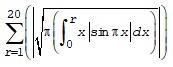 is -----------.
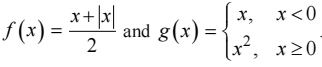
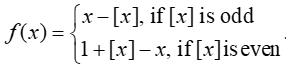 . Then the value of \( \dfrac{\pi^{2}}{10}\displaystyle\int\limits_{-10}^{10} f(x)\cos \pi x \, dx \) is :
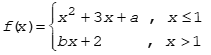 be differentiable on \( \mathbb{R} \). Then, the value of \( \displaystyle \int_{-2}^{2} f(x)\,dx \) equals.
 If the area bounded by \( y=f(x) \) and x-axis \( A \), then the value of \( 6A \) is equal to _______.
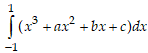 is equal to:
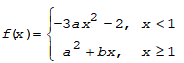
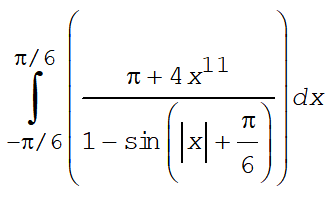 is equal to: