9 questions
A soft plastic bottle, filled with water of density \( 1 \, \text{gm/cc} \), carries an inverted glass test-tube with some air (ideal gas) trapped as shown in the figure. The test-tube has a mass of \( 5 \, \text{gm} \), and it is made of a thick glass of density \( 2.5 \, \text{gm/cc} \). Initially the bottle is sealed at atmospheric pressure \( P_0 = 10^{5} \, \text{Pa} \) so that the volume of the trapped air is \( V_0 = 3.3 \, \text{cc} \). When the bottle is squeezed from outside at constant temperature, the pressure inside rises and the volume of the trapped air reduces. It is found that the test-tube begins to sink at pressure \( P_0 + \Delta p \) without changing its orientation. At this pressure, the volume of the trapped air is \( V_0 - \Delta v \).
Let \( \Delta v = x \, \text{cc} \) and \( \Delta p = y \times 10^{3} \, \text{Pa} \).
The value of \( X \) is _______. 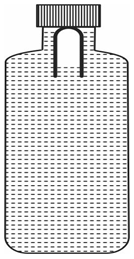
A cylindrical tube, with its base as shown in the figure, is filled with water. It is moving down with a constant acceleration \( a \) along a fixed inclined plane with angle \( \theta = 45^{\circ} \). \( P_{1} \) and \( P_{2} \) are pressures at points \( 1 \) and \( 2 \), respectively located at the base of the tube. Let \( \beta = (P_{1} - P_{2}) / (\rho g d) \), where \( \rho \) is density of water, \( d \) is the inner diameter of the tube and \( g \) is the acceleration due to gravity. Which of the following statement(s) is(are) correct? 
A container of height \( 2\,\text{m} \), length \( 2\,\text{m} \) and breadth \( 1\,\text{m} \) is made of insulating vertical walls and two large area horizontal metal plates (\( M_1 \) and \( M_2 \)) which extend far beyond the vertical walls in all directions. The container is partitioned into two equal chambers with a thin insulating vertical wall. The partition wall contains a small hole of cross-sectional area \( \sqrt{10}\,\text{cm}^2 \) near its bottom edge. Initially the hole is closed and the left chamber of the container is completely filled with a liquid of dielectric constant \( \varepsilon_r = 15 \) and the right chamber is empty (\( \varepsilon_r = 1 \)). At time \( t = 0 \), the hole is opened and the liquid flows from the left chamber to the right chamber. In both the chambers, the space above the liquid has \( \varepsilon_r = 1 \) and is maintained at atmospheric pressure. The schematic of the container at a time \( t > 0 \) is shown in the figure. [Given: acceleration due to gravity is \( 10\,\text{m s}^{-2} \).]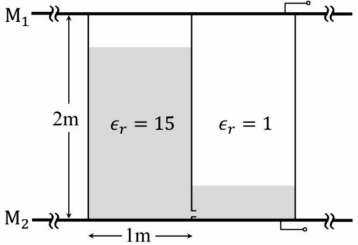
The height (in \( \text{m} \)) of the liquid in left chamber at \( t = 500\,\text{s} \) is ________.
Paragraphs-2
A cylindrical furnace has height \( H \) and diameter \( D \) both \( 1 \, \text{m} \). It is maintained at temperature \( 360 \, \text{K} \). The air gets heated inside the furnace at constant pressure \( P_a \) and its temperature becomes \( T = 360 \, \text{K} \). The hot air with density \( \rho \) rises up a vertical chimney of diameter \( d = 0.1 \, \text{m} \) and height \( h = 9 \, \text{m} \) above the furnace and exits the chimney (see figure). As a result, atmospheric air of density \( \rho_a = 1.2 \, \text{kg m}^{-3} \), pressure \( P_a \) and temperature \( T_a = 300 \, \text{K} \) enters the furnace. Assume air as an ideal gas, neglect the variations in \( \rho \) and \( T \) inside the chimney and the furnace. Also ignore the viscous effects.
[Given :The acceleration due to gravity \( g = 10 \, \text{ms}^{-2} \) and \( \pi = 3.14 \)]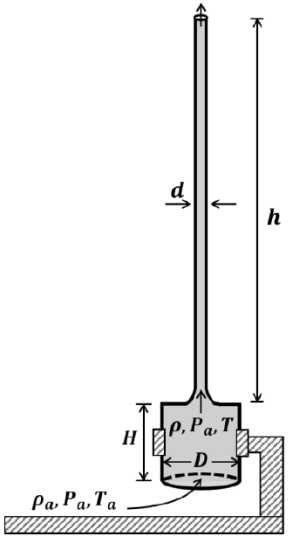
Considering the air flow to be streamline, the steady mass flow rate of air exiting the chimney is ______ \( \text{gm s}^{-1} \).
A container of height \( 2\,\text{m} \), length \( 2\,\text{m} \) and breadth \( 1\,\text{m} \) is made of insulating vertical walls and two large area horizontal metal plates (\( M_1 \) and \( M_2 \)) which extend far beyond the vertical walls in all directions. The container is partitioned into two equal chambers with a thin insulating vertical wall. The partition wall contains a small hole of cross-sectional area \( \sqrt{10}\,\text{cm}^2 \) near its bottom edge. Initially the hole is closed and the left chamber of the container is completely filled with a liquid of dielectric constant \( \varepsilon_r = 15 \) and the right chamber is empty (\( \varepsilon_r = 1 \)). At time \( t = 0 \), the hole is opened and the liquid flows from the left chamber to the right chamber. In both the chambers, the space above the liquid has \( \varepsilon_r = 1 \) and is maintained at atmospheric pressure. The schematic of the container at a time \( t > 0 \) is shown in the figure. [Given: acceleration due to gravity is \( 10\,\text{m s}^{-2} \).]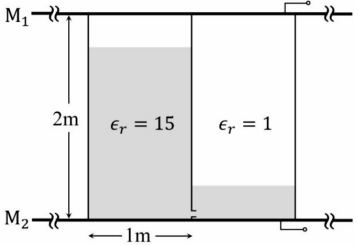
The difference in the capacitance (in \( \text{F} \)) between the metal plates at \( t = 0 \) and that at \( t = 500\,\text{s} \) is \( (8 - n)\,\varepsilon_0 \), where \( \varepsilon_0 \) is the permittivity of free space. The value of \( n \) is ________.
A soft plastic bottle, filled with water of density \( 1 \, \text{gm/cc} \), carries an inverted glass test-tube with some air (ideal gas) trapped as shown in the figure. The test-tube has a mass of \( 5 \, \text{gm} \), and it is made of a thick glass of density \( 2.5 \, \text{gm/cc} \). Initially the bottle is sealed at atmospheric pressure \( P_0 = 10^{5} \, \text{Pa} \) so that the volume of the trapped air is \( V_0 = 3.3 \, \text{cc} \). When the bottle is squeezed from outside at constant temperature, the pressure inside rises and the volume of the trapped air reduces. It is found that the test-tube begins to sink at pressure \( P_0 + \Delta p \) without changing its orientation. At this pressure, the volume of the trapped air is \( V_0 - \Delta v \).
Let \( \Delta v = x \, \text{cc} \) and \( \Delta p = y \times 10^{3} \, \text{Pa} \).
The value of \( Y \) is _______. 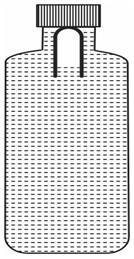
A tank contains two immiscible liquids of densities \( 6\rho \) and \( 2\rho \). The higher density liquid is filled up to a height \( L/2 \) from the bottom. A thin rod of density \( \rho \) and length \( L \) is fully immersed and hinged at the bottom so that it can oscillate freely, as shown in the figure. If the rod is slightly disturbed from its equilibrium, the time period of small oscillations is \( \dfrac{2\pi}{n}\sqrt{\dfrac{L}{g}} \), where \( g \) is the acceleration due to gravity.
The value of \( n \) is: 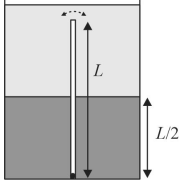
Paragraphs-2
A cylindrical furnace has height \( H \) and diameter \( D \) both \( 1 \, \text{m} \). It is maintained at temperature \( 360 \, \text{K} \). The air gets heated inside the furnace at constant pressure \( P_a \) and its temperature becomes \( T = 360 \, \text{K} \). The hot air with density \( \rho \) rises up a vertical chimney of diameter \( d = 0.1 \, \text{m} \) and height \( h = 9 \, \text{m} \) above the furnace and exits the chimney (see figure). As a result, atmospheric air of density \( \rho_a = 1.2 \, \text{kg m}^{-3} \), pressure \( P_a \) and temperature \( T_a = 300 \, \text{K} \) enters the furnace. Assume air as an ideal gas, neglect the variations in \( \rho \) and \( T \) inside the chimney and the furnace. Also ignore the viscous effects.
[Given :The acceleration due to gravity \( g = 10 \, \text{ms}^{-2} \) and \( \pi = 3.14 \)]
When the chimney is closed using a cap at the top, a pressure difference \( \Delta P \) develops between the top and the bottom surfaces of the cap. If the changes in the temperature and density of the hot air, due to the stoppage of air flow, are negligible then the value of \( \Delta P \) is ______ \( \text{N m}^{-2} \).
Two large, identical water tanks, \( 1 \) and \( 2 \), kept on the top of a building of height \( H \), are filled with water up to height \( h \) in each tank. Both the tanks contain an identical hole of small radius on their sides, close to their bottom. A pipe of the same internal radius as that of the hole is connected to tank \( 2 \), and the pipe ends at the ground level. When the water flows from the tanks \( 1 \) and \( 2 \) through the holes, the times taken to empty the tanks are \( t_1 \) and \( t_2 \), respectively. If \( H = \left( \frac{16}{9} \right) h \), then the ratio \( \frac{t_1}{t_2} \) is ________.
