19 questions
A bar of mass \( M = 1.00 \, \text{kg} \) and length \( L = 0.20 \, \text{m} \) is lying on a horizontal frictionless surface. One end of the bar is pivoted at a point about which it is free to rotate. A small mass \( m = 0.10 \, \text{kg} \) is moving on the same horizontal surface with \( 5.00 \, \text{m s}^{-1} \) speed on a path perpendicular to the bar. It hits the bar at a distance \( L/2 \) from the pivoted end and returns back on the same path with speed \( v \). After this elastic collision, the bar rotates with an angular velocity \( \omega \). Which of the following statement is correct?
A pendulum consists of a bob of mass \( m = 0.1 \, \text{kg} \) and a massless inextensible string of length \( L = 1.0 \, \text{m} \). It is suspended from a fixed point at height \( H = 0.9 \, \text{m} \) above a frictionless horizontal floor. Initially, the bob of the pendulum is lying on the floor at rest vertically below the point of suspension. A horizontal impulse \( P = 0.2 \, \text{kg}\!\cdot\!\text{m/s} \) is imparted to the bob at some instant. After the bob slides for some distance, the string becomes taut and the bob lifts off the floor. The magnitude of the angular momentum of the pendulum about the point of suspension just before the bob lifts off is \( J \, \text{kg}\!\cdot\!\text{m}^2/\text{s} \). The kinetic energy of the pendulum just after the lift off is \( K \) Joules.
The value of \( K \) is _______.
List-I shows four planar structures made of uniform solid rods each of mass \( m \) and length \( l \). In the List-II the possible moment of inertia of these structure about an axis \( OCO' \), which lies in the plane of the structures, are given. Choose the option which describes the correct match between the entries in List-I to those in List-II. 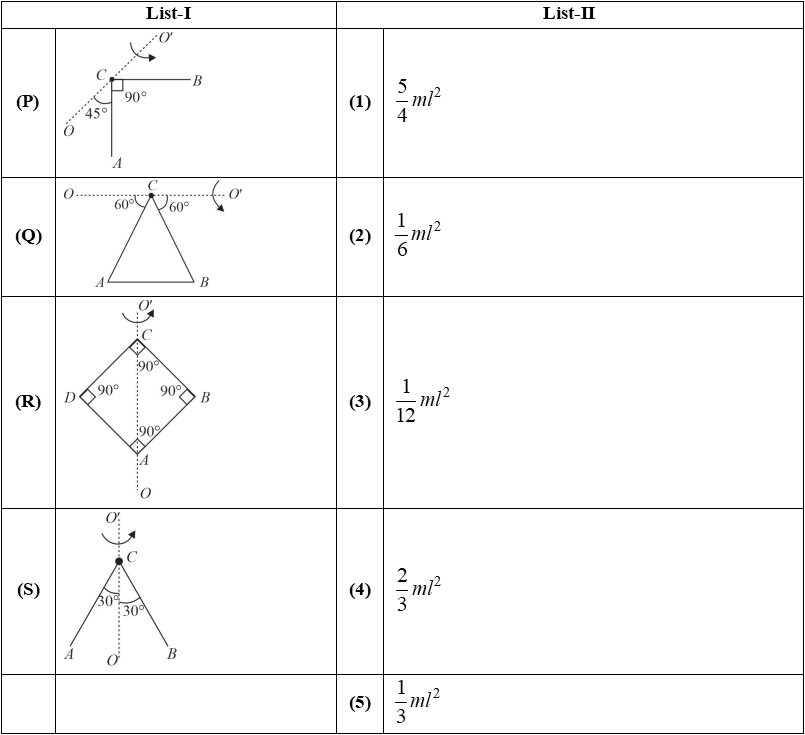
A particle of mass \( M = 0.2 \, \text{kg} \) is initially at rest in the \( xy \)-plane at a point \( (x = -l, \; y = -h) \), where \( l = 10 \, \text{m} \) and \( h = 1 \, \text{m} \). The particle is accelerated at time \( t = 0 \) with a constant acceleration \( a = 10 \, \text{m} \,/ \text{s}^{2} \) along the positive \( x \)-direction. Its angular momentum and torque with respect to the origin, in SI units, are represented by \( \vec{L} \) and \( \vec{\tau} \), respectively. \( \hat{i} \), \( \hat{j} \) and \( \hat{k} \) are unit vectors along the positive \( x \), \( y \) and \( z \)-directions, respectively. If \( \hat{k} = \hat{i} \times \hat{j} \) then which of the following statement(s) is(are) correct?
A thin rod of mass \( M \) and length \( a \) is free to rotate in horizontal plane about a fixed vertical axis passing through point \( O \). A thin circular disc of mass \( M \) and of radius \( \frac{a}{4} \) is pivoted on this rod with its center at a distance \( \frac{a}{4} \) from the free end so that it can rotate freely about its vertical axis, as shown in the figure. Assume that both the rod and the disc have uniform density and they remain horizontal during the motion. An outside stationary observer finds the rod rotating with an angular velocity \( \Omega \) and the disc rotating about its vertical axis with angular velocity \( 4 \Omega \). The total angular momentum of the system about the point \( O \) is \( \left( \frac{M a^{2} \Omega}{48} \right) n \). The value of \( n \) is _____ 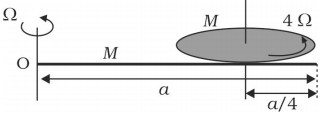
A horizontal force \( F \) is applied at the center of mass of a cylindrical object of mass \( m \) and radius \( R \), perpendicular to its axis as shown in the figure. The coefficient of friction between the object and the ground is \( \mu \). The center of mass of the object has an acceleration \( a \). The acceleration due to gravity is \( g \). Given that the object rolls without slipping, which of the following statement(s) is(are) correct? 
A disc of mass \( M \) and radius \( R \) is free to rotate about its vertical axis as shown in the figure. A battery operated motor of negligible mass is fixed to this disc at a point on its circumference. Another disc of the same mass \( M \) and radius \( \frac{R}{2} \) is fixed to the motor’s thin shaft. Initially, both the discs are at rest. The motor is switched on so that the smaller disc rotates at a uniform angular speed \( \omega \). If the angular speed at which the large disc rotates is \( \frac{\omega}{n} \), then the value of \( n \) is __________. 
A solid sphere of mass \( 1 \, \text{kg} \) and radius \( 1 \, \text{m} \) rolls without slipping on a fixed inclined plane with an angle of inclination \( \theta = 30^\circ \) from the horizontal. Two forces of magnitude \( 1 \, \text{N} \) each parallel to the incline, act on the sphere, both at distance \( r = 0.5 \, \text{m} \) from the centre of the sphere, as shown in the figure. The acceleration of the sphere down the plane is ______ \( \text{m s}^{-2} \). (Take \( g = 10 \, \text{m s}^{-2} \).) 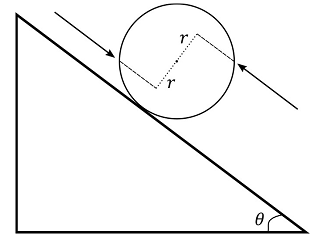
A thin circular coin of mass \( 5 \, \text{gm} \) and radius \( \dfrac{4}{3} \, \text{cm} \) is initially in a horizontal xy-plane. The coin is tossed vertically up (\( +z \) direction) by applying an impulse of \( \sqrt{\dfrac{\pi}{2}} \times 10^{-2} \, \text{N- s} \) at a distance \( \dfrac{2}{3} \, \text{cm} \) from its centre. The coin spins about its diameter and moves along the \( +z \) direction. By the time the coin reaches back to its initial position, it completes \( n \) rotations. The value of \( n \) is ________.
[Given the acceleration due to gravity \( g = 10 \, \text{m s}^{-2} \)] 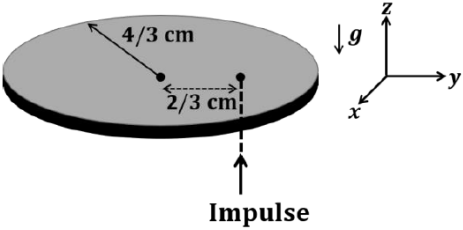
Consider a large disk of radius \( R \) and two smaller disks, each of radius \( r = \frac{R}{50} \), lying on its circumference, as shown in the figure. The smaller disks are initially in contact with each other, with an angular separation \( \Delta \theta \) between their centers. They are made to roll without slipping in opposite directions, with constant angular velocities \( \omega \) and \( 2\omega \) while the large disk is held stationary. The time \( \tau \) at which the smaller disks are again in contact is:
[Use \( \sin(\Delta \theta = \Delta \theta) \) an ignore gravity.]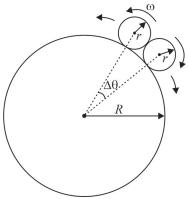
One end of a horizontal uniform beam of weight \( W \) and length \( L \) is hinged on a vertical wall at point \( O \) and its other end is supported by a light inextensible rope. The of the end of the rope is fixed at point \( Q \), at a height \( L \) above the hinge at pint \( O \). A block of weight \( \alpha W \) is attached at the point \( P \) of the beam, as shown in the figure (not to scale). The rope can sustain a maximum tension of \( (2\sqrt{2}\,)W \). Which of the following statement(s) is (are correct? 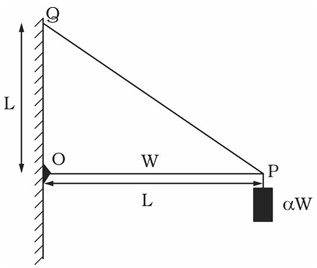
An annular disk of mass \( M \), inner radius \( a \) and outer radius \( b \) is placed on a horizontal surface with coefficient of friction \( \mu \), as shown in the figure. At some time, an impulse \( J_0 \, \hat{x} \) is applied at a height \( h \) above the centre of the disk. If \( h = h_m \) then the disk rolls without slipping along the x-axis. Which of the following statement(s) is (are) correct? 
A thin uniform rod of length \( L \) and certain mass is kept on a frictionless horizontal table with a massless string of length \( L \) fixed to one end (top view is shown in the figure). The other end of the string is pivoted to a point \( O \). If a horizontal impulse \( P \) is imparted to the rod at a distance \( x=\frac{L}{n} \) from the midpoint of the rod (see figure), then the rod and string revolve together around the point \( O \), with the rod remaining aligned with the string. In such a case, the value of \( n \) is ________.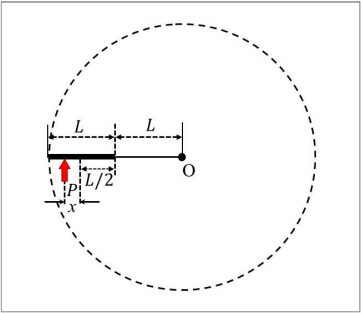
A solid cylinder of radius \( R \) rolls without slipping with a center of mass speed \( v_{0} = \sqrt{\dfrac{gR}{3}} \) on a horizontal surface with a vertical edge, as shown in the figure. Here, \( g \) is the acceleration due to the gravity. At the moment when the cylinder loses contact with the surface due to rotation around the corner, the speed of its center of mass is: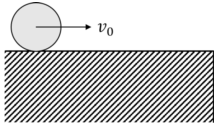
A uniform circular disk of radius \( 0.2 \, \text{m} \) and mass \( 1 \, \text{kg} \) is pivoted at its top point C such that it can rotate freely around C in the XY plane, as shown in the figure. Initially, when the disk is at rest, a particle of mass \( 20 \, \text{g} \), travelling along negative \( x \) direction in the XY plane with speed \( 100 \, \text{ms}^{-1} \), hits the circumference of the disk at a point P. After collision the particle moves along negative \( y \) direction at a speed of \( 90 \, \text{ms}^{-1} \).
[Given: the acceleration due to gravity \( (g) = -10 \, \hat{\jmath} \, \text{ms}^{-2} \)]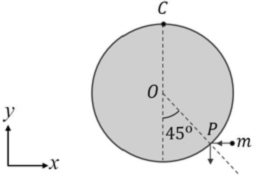
After the collision the disk starts to rotate around point C in the XY plane. The maximum change in the height (in \( \text{m} \)) of its centre O is _______.
A pendulum consists of a bob of mass \( m = 0.1 \, \text{kg} \) and a massless inextensible string of length \( L = 1.0 \, \text{m} \). It is suspended from a fixed point at height \( H = 0.9 \, \text{m} \) above a frictionless horizontal floor. Initially, the bob of the pendulum is lying on the floor at rest vertically below the point of suspension. A horizontal impulse \( P = 0.2 \, \text{kg}\!\cdot\!\text{m/s} \) is imparted to the bob at some instant. After the bob slides for some distance, the string becomes taut and the bob lifts off the floor. The magnitude of the angular momentum of the pendulum about the point of suspension just before the bob lifts off is \( J \, \text{kg}\!\cdot\!\text{m}^2/\text{s} \). The kinetic energy of the pendulum just after the lift off is \( K \) Joules.
The value of \( J \) is _______.
At time \( t = 0 \), a disk of radius \( 1 \, \text{m} \) starts to roll without slipping on a horizontal plane with an angular acceleration of \( \alpha = \dfrac{2}{3} \, \text{rad s}^{-2} \). A small stone is stuck to the disk. At \( t = 0 \), it is at the contact point of the disk and the plane. Later, at time \( t = \sqrt{\pi} \, \text{s} \), the stone detaches itself and flies off tangentially from the disk. The maximum height (in \( \text{m} \)) reached by the stone measured from the plane is \( \dfrac{1}{2} + \dfrac{x}{10} \). The value of \( x \) is ________. [Take \( g = 10 \, \text{m s}^{-2} \)]
A uniform circular disk of radius \( 0.2 \, \text{m} \) and mass \( 1 \, \text{kg} \) is pivoted at its top point C such that it can rotate freely around C in the XY plane, as shown in the figure. Initially, when the disk is at rest, a particle of mass \( 20 \, \text{g} \), travelling along negative \( x \) direction in the XY plane with speed \( 100 \, \text{ms}^{-1} \), hits the circumference of the disk at a point P. After collision the particle moves along negative \( y \) direction at a speed of \( 90 \, \text{ms}^{-1} \).
[Given: the acceleration due to gravity \( (g) = -10 \, \hat{\jmath} \, \text{ms}^{-2} \)]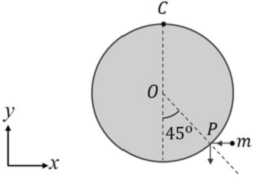
Amount of energy loss (in \( \text{J} \)) in the collision is _______.
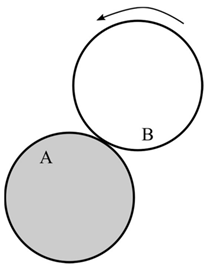
A flat surface of a thin uniform disk \( A \) of radius \( R \) is glued to a horizontal table. Another thin uniform disk \( B \) of mass \( M \) and with the same radius \( R \) rolls without slipping on the circumference of \( A \), as shown in the figure. A flat surface of \( B \) also lies on the plane of the table. The center of mass of \( B \) has fixed angular speed \( \omega \) about the vertical axis passing through the center of \( A \). The angular momentum of \( B \) is \( n M \omega R^2 \) with respect to the center of \( A \). Which of the following is the value of \( n \)?