20 questions
When light of a given wavelength is incident on a metallic surface, the minimum potential needed to stop the emitted photoelectrons is \( 6.0 \, \text{V} \). This potential drops to \( 0.6 \, \text{V} \) if another source with wavelength four times that of the first one and intensity half of the first one is used. What are the wavelength of the first source and the work function of the metal, respectively? [Take \( \dfrac{hc}{e} = 1.24 \times 10^{-6} \, \text{J m C}^{-1} \)].
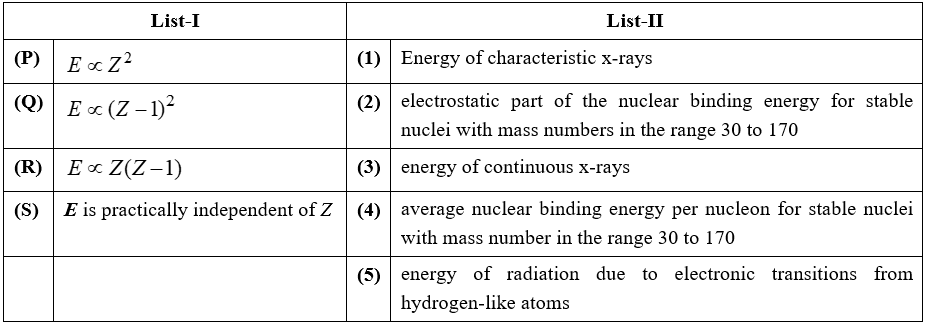
A metal target with atomic number \( Z = 46 \) is bombarded with a high energy electron beam. The emission of X-rays from the target is analyzed. The ratio \( r \) of the wavelengths of the \( K_{\alpha} \)-line and the cut-off is found to be \( r = 2 \). If the same electron beam bombards another metal target with \( Z = 41 \), the value of \( r \) will be