11 questions
An audio transmitter (\( T \)) and a receiver (\( R \)) are hung vertically from two identical massless strings of length \( 8 \, \text{m} \) with their pivots well separated along the \( X \) axis. They are pulled from the equilibrium position in opposite directions along the \( X \) axis by a small angular amplitude \( \theta_0 = \cos^{-1}(0.9) \) and released simultaneously. If the natural frequency of the transmitter is \( 660 \, \text{Hz} \) and the speed of sound in air is \( 330 \, \text{m/s} \), the maximum variation in the frequency (in \( \text{Hz} \)) as measured by the receiver (Take the acceleration due to gravity \( g = 10 \, \text{m/s}^2 \)) is ______. 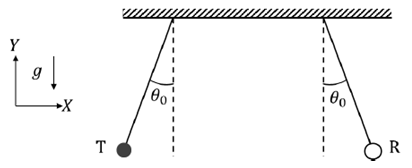
In a single slit diffraction experiment, a slit of width \( (0.016 \pm 0.002) \, \text{mm} \) is used to measure the wavelength of a monochromatic light source. In the diffraction pattern, the angular distance between the central maximum and first minimum is measured to be \( (2^\circ \pm 40') \). The value of the fractional error in the measurement of wavelength is _______. [Given: \( \sin(2^\circ) = 0.035 \)]