3 questions from 2021
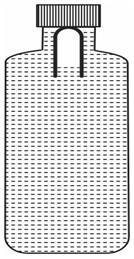
A soft plastic bottle, filled with water of density \( 1 \, \text{gm/cc} \), carries an inverted glass test-tube with some air (ideal gas) trapped as shown in the figure. The test-tube has a mass of \( 5 \, \text{gm} \), and it is made of a thick glass of density \( 2.5 \, \text{gm/cc} \). Initially the bottle is sealed at atmospheric pressure \( P_0 = 10^{5} \, \text{Pa} \) so that the volume of the trapped air is \( V_0 = 3.3 \, \text{cc} \). When the bottle is squeezed from outside at constant temperature, the pressure inside rises and the volume of the trapped air reduces. It is found that the test-tube begins to sink at pressure \( P_0 + \Delta p \) without changing its orientation. At this pressure, the volume of the trapped air is \( V_0 - \Delta v \).
Let \( \Delta v = x \, \text{cc} \) and \( \Delta p = y \times 10^{3} \, \text{Pa} \).
The value of \( X \) is _______. 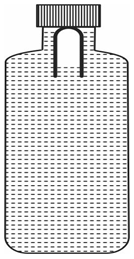
A cylindrical tube, with its base as shown in the figure, is filled with water. It is moving down with a constant acceleration \( a \) along a fixed inclined plane with angle \( \theta = 45^{\circ} \). \( P_{1} \) and \( P_{2} \) are pressures at points \( 1 \) and \( 2 \), respectively located at the base of the tube. Let \( \beta = (P_{1} - P_{2}) / (\rho g d) \), where \( \rho \) is density of water, \( d \) is the inner diameter of the tube and \( g \) is the acceleration due to gravity. Which of the following statement(s) is(are) correct? 
A soft plastic bottle, filled with water of density \( 1 \, \text{gm/cc} \), carries an inverted glass test-tube with some air (ideal gas) trapped as shown in the figure. The test-tube has a mass of \( 5 \, \text{gm} \), and it is made of a thick glass of density \( 2.5 \, \text{gm/cc} \). Initially the bottle is sealed at atmospheric pressure \( P_0 = 10^{5} \, \text{Pa} \) so that the volume of the trapped air is \( V_0 = 3.3 \, \text{cc} \). When the bottle is squeezed from outside at constant temperature, the pressure inside rises and the volume of the trapped air reduces. It is found that the test-tube begins to sink at pressure \( P_0 + \Delta p \) without changing its orientation. At this pressure, the volume of the trapped air is \( V_0 - \Delta v \).
Let \( \Delta v = x \, \text{cc} \) and \( \Delta p = y \times 10^{3} \, \text{Pa} \).
The value of \( Y \) is _______.