A container of height \( 2\,\text{m} \), length \( 2\,\text{m} \) and breadth \( 1\,\text{m} \) is made of insulating vertical walls and two large area horizontal metal plates (\( M_1 \) and \( M_2 \)) which extend far beyond the vertical walls in all directions. The container is partitioned into two equal chambers with a thin insulating vertical wall. The partition wall contains a small hole of cross-sectional area \( \sqrt{10}\,\text{cm}^2 \) near its bottom edge. Initially the hole is closed and the left chamber of the container is completely filled with a liquid of dielectric constant \( \varepsilon_r = 15 \) and the right chamber is empty (\( \varepsilon_r = 1 \)). At time \( t = 0 \), the hole is opened and the liquid flows from the left chamber to the right chamber. In both the chambers, the space above the liquid has \( \varepsilon_r = 1 \) and is maintained at atmospheric pressure. The schematic of the container at a time \( t > 0 \) is shown in the figure. [Given: acceleration due to gravity is \( 10\,\text{m s}^{-2} \).]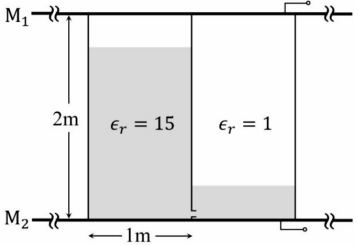
The difference in the capacitance (in \( \text{F} \)) between the metal plates at \( t = 0 \) and that at \( t = 500\,\text{s} \) is \( (8 - n)\,\varepsilon_0 \), where \( \varepsilon_0 \) is the permittivity of free space. The value of \( n \) is ________.
