11 questions
A rectangular conducting loop of length \( 4 \, \text{cm} \) and width \( 2 \, \text{cm} \) is in the xy-plane, as shown in the figure. It is being moved away from a thin and long conducting wire along the direction \( \dfrac{\sqrt{3}}{2} \, \hat{x} + \dfrac{1}{2} \, \hat{y} \) with a constant speed \( v \). The wire is carrying a steady current \( I = 10 \, \text{A} \) in the positive x-direction. A current of \( 10 \, \mu\text{A} \) flows through the loop when it is at a distance \( d = 4 \, \text{cm} \) from the wire. If the resistance of the loop is \( 0.1 \, \Omega \) then the value of \( v \) ________ \( \text{m s}^{-1} \).
[Given: The permeability of the free space \( \mu_0 = 4\pi \times 10^{-7} \, \text{N A}^{-2} \)] 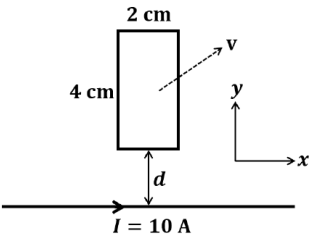
A conducting square loop initially lies in the XZ plane with its lower edge hinged along the X-axis. Only in the region \( y \ge 0 \), there is a time dependent magnetic field pointing along the Z-direction, \( \vec{B}(t)=B_{0}(\cos \omega t)\,\hat{k} \), where \( B_{0} \) is a constant. The magnetic field is zero everywhere else. At time \( t=0 \), the loop starts rotating with constant angular speed \( \omega \) about the X axis in the clockwise direction as viewed from the \( +X \) axis (as shown in the figure). Ignoring self-inductance of the loop and gravity, which of the following plots correctly represents the induced e.m.f. (\( V \)) in the loop as a function of time: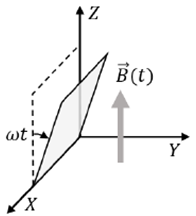
List-I contains four conducting loops lying in the \( XY \) plane, as shown in the figures. The loops are rotating about \( Z \) axis passing through the point \( O \) with time period \( T \) in clockwise direction. The region \( x > 0 \) contains a uniform magnetic field \( B \) in the \( +z \) direction. List-II contains the qualitative variation of the induced current \( i(t) \) for each of these loops. Choose the option which describes the correct match between the entries in List-I to those in List-II. 
Consider an LC circuit, with inductance \( L = 0.1 \, \text{H} \) and capacitance \( C = 10^{-3} \, \text{F} \), kept on a plane. The area of the circuit is \( 1 \, \text{m}^2 \). It is placed in a constant magnetic field of strength \( B_0 \) which is perpendicular to the plane of the circuit. At time \( t = 0 \), the magnetic field strength starts increasing linearly as \( B = B_0 + \beta t \) with \( \beta = 0.04 \, \text{T s}^{-1} \). The maximum magnitude of the current in the circuit is ____ \( \text{mA} \).
A long straight wire carries a current, \( I = 2 \, \text{ampere} \). A semi-circular conducting rod is placed beside it on two conducting parallel rails of negligible resistance. Both the rails are parallel to the wire. The wire, the rod and the rails lie in the same horizontal plane, as shown in the figure. Two ends of the semi-circular rod are at distances \( 1 \, \text{cm} \) and \( 4 \, \text{cm} \) from the wire. At time \( t = 0 \), the rod starts moving on the rails with a speed \( v = 3.0 \, \text{m/s} \) (see the figure). A resistor \( R = 1.4 \, \Omega \) and a capacitor \( C_{0} = 5.0 \, \mu \text{F} \) are connected in series between the rails. At time \( t = 0 \), \( C_{0} \) is uncharged. Which of the following statement(s) is(are) correct? \( [ \mu_{0} = 4 \pi \times 10^{-7} \, \text{SI units}. \, \text{Take } \ln 2 = 0.7 ] \) 
A conducting square loop of side \( L \), mass \( M \) and resistance \( R \) is moving in the \( XY \) plane with its edges parallel to the \( X \) and \( Y \) axes. The region \( y \ge 0 \) has a uniform magnetic field, \( \vec{B} = B_{0}\,\hat{k} \). The magnetic field is zero everywhere else. At time \( t = 0 \), the loop starts to enter the magnetic field with an initial velocity \( v_{0}\hat j \, \text{m/s} \), as shown in the figure. Considering the quantity \( K = \dfrac{B_{0}^{2}L^{2}}{RM} \) in appropriate units, ignoring self-inductance of the loop and gravity, which of the following statements is/are correct: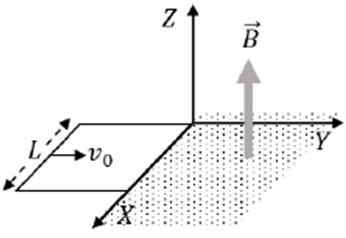
A thin conducting rod MN of mass \( 20 \, \text{gm} \), length \( 25 \, \text{cm} \) and resistance \( 10 \, \Omega \) is held on frictionless, long, perfectly conducting vertical rails as shown in the figure. There is a uniform magnetic field \( B_{0} = 4 \, \text{T} \) directed perpendicular to the plane of the rod-rail arrangement. The rod is released from rest at time \( t = 0 \) and it moves down along the rails. Assume air drag is negligible. Match each quantity in List-I with an appropriate value from List-II, and choose the correct option.
[Given: The acceleration due to gravity \( g = 10 \, \text{m} \, \text{s}^{-2} \) and \( e^{-1} = 0.4 \)]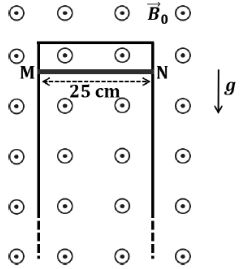

The circuit shown in the figure contains an inductor \( L \), a capacitor \( C_0 \), a resistor \( R_0 \) and an ideal battery. The circuit also contains two keys \( K_1 \) and \( K_2 \). Initially, both the keys are open and there is no charge on the capacitor. At an instant, key \( K_1 \) is closed and immediately after this the current in \( R_0 \) is found to be \( I_1 \). After a long time, the current attains a steady state value \( I_2 \). Thereafter, \( K_2 \) is closed and simultaneously \( K_1 \) is opened and the voltage across \( C_0 \) oscillates with amplitude \( V_0 \) and angular frequency \( \omega_0 \).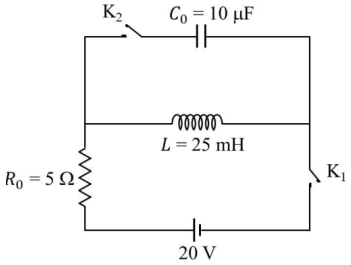
Match the quantities mentioned in List-I with their values in List-II and choose the correct option. 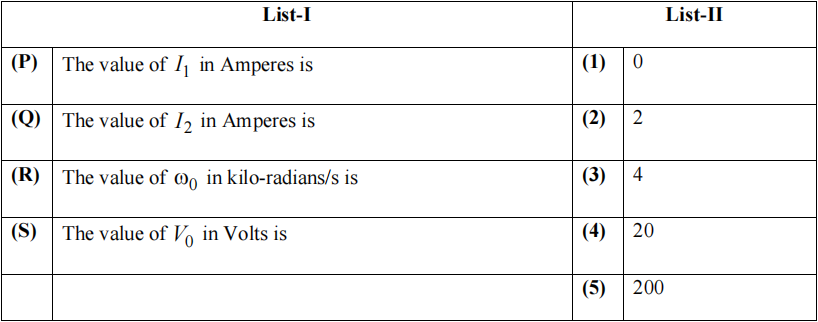
Consider a circuit consisting of a capacitor of capacitance \( C \) and a coil with \( N \) turns per unit length, cross sectional area \( S \) and length \( d \), where \( d^{2} \gg S \). There is another coil of length \( \dfrac{d}{2} \), cross sectional area \( \dfrac{S}{2} \) and \( 2N \) turns per unit length completely inside the larger coil, as shown in the figure. The ends of this smaller coil are connected with each other by an insulated conducting wire. The self-inductance of the larger coil is \( L \). Neglecting edge effects and all the Ohmic resistances, the resonant frequency of the circuit is: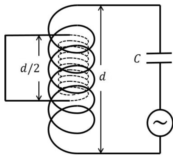
A small circular loop of area \( A \) and resistance \( R \) is fixed on a horizontal \( xy \)-plane with the centre of the loop always on the axis \( \,\hat{n} \, \) of a long solenoid. The solenoid has \( m \) turns per unit length and carries current \( I \) counterclockwise as shown in the figure. The magnetic field due to the solenoid is in \( \,\hat{n} \, \) direction. List-I gives time dependences of \( \,\hat{n} \, \) in terms of a constant angular frequency \( \omega \). List-II gives the torques experienced by the circular loop at time \( t=\dfrac{\pi}{6\omega} \). Let \( \alpha=\dfrac{A^{2}\mu_{0}^{2}m^{2}I^{2}\omega}{2R} \). 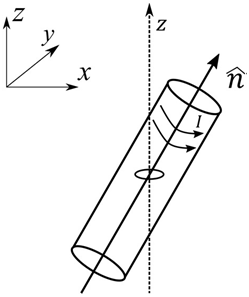
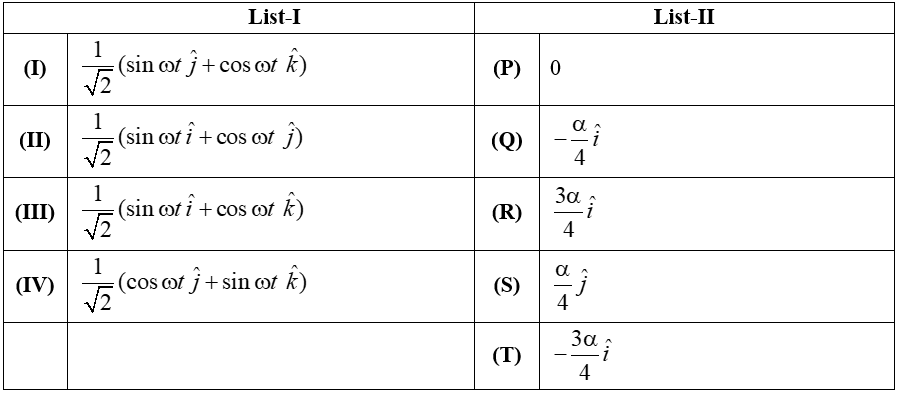
Which one of the following options is correct?
A region in the form of an equilateral triangle (in \( x\text{-}y \) plane) of height \( L \) has a uniform magnetic field \( \\vec{B} \) pointing in the \( +z \)-direction. A conducting loop \( PQR \), in the form of an equilateral triangle of the same height \( L \), is placed in the \( x\text{-}y \) plane with its vertex \( P \) at \( x = 0 \) in the orientation shown in the figure. At \( t = 0 \), the loop starts entering the region of the magnetic field with a uniform velocity \( \\vec{v} \) along the \( +x \)-direction. The plane of the loop and its orientation remain unchanged throughout its motion.
Which of the following graph best depicts the variation of the induced emf \( (E) \) in the loop as a function of the distance \( (x) \) starting from \( x = 0 \)?
