9 questions
List-I shows four configurations made of straight and semi-circular narrow tubes containing air. A sound wave of wavelength \( \lambda = 0.29 \, \text{m} \) enters these structures at the point \( S \) and a sound detector is placed at \( D \). Between the points \( S \) and \( D \), the sound travels only through the tubes. List-II contains the possible smallest values of \( l \) (refer to the figures) for which the detector \( D \) records maximum amplitude. Ignore effects of sharp corners. [Given \( \cos(15^\circ) = 0.97 \)]
Choose the option that best describes the match between the entries in List-I to those in List-II.
PARAGRAPH – 1
In a young’s double slit experiment, each of the two slits \( A \) and \( B \), as shown in the figure, are oscillating about their fixed center and with a mean separation of \( 0.8 \,\text{mm} \). The distance between the slits at time \( t \) is given by \( d = (0.8 + 0.04 \sin \omega t)\,\text{mm} \), where \( \omega = 0.08 \,\text{rad s}^{-1} \). The distance of the screen from the slits is \( 1 \,\text{m} \) and the wavelength of the light used to illuminate the slits is 6000Å. The interference pattern on the screen changes with time, while the central bright fringe (zeroth fringe) remains fixed at point \( O \).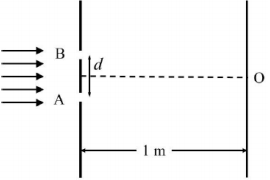
The maximum speed in \( \mu m / s \) at which the \( 8^{\text{th}} \) bright fringe will move is ___________.
The electric field associated with an electromagnetic wave propagating in a dielectric medium is given by \( \vec{E} = 30 ( 2\hat{x} + \hat{y} ) \sin \left[ 2\pi \left( 5\times 10^{14} t - \dfrac{10^{7}}{3} z \right) \right] \, \text{V m}^{-1} \). Which of the following option(s) is (are) correct?
[Given: The speed of light in vacuum, \( c = 3 \times 10^{8} \, \text{m s}^{-1} \)]
A double slit setup is shown in the figure. One of the slits is in medium \( 2 \) of refractive index \( n_{2} \). The other slit is at the interface of this medium with another medium \( 1 \) of refractive index \( n_{1}( \neq n_{2}) \). The line joining the slits is perpendicular to the interface and the distance between the slits is \( d \). The slit widths are much smaller than \( d \). A monochromatic parallel beam of light is incident on the slits from medium \( 1 \). A detector is placed in medium \( 2 \) at a large distance from the slits, and at an angle \( \theta \) from the line joining them, so that \( \theta \) equals the angle of refraction of the beam. Consider two approximately parallel rays from the slits received by the detector. 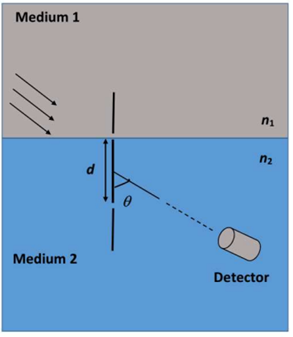
Which of the following statement(s) is(are) correct?
A monochromatic light wave is incident normally on a glass slab of thickness \( d \), as shown in the figure. The refractive index of the slab increases linearly from \( n_{1} \) to \( n_{2} \) over the height \( h \). Which of the following statement(s) is (are) true about the light wave emerging out of the slab?
In a Young’s double slit experiment, a combination of two glass wedges \( A \) and \( B \), having refractive indices \( 1.7 \) and \( 1.5 \), respectively, are placed in front of the slits, as shown in the figure. The separation between the slits is \( d = 2 \, \text{mm} \) and the shortest distance between the slits and the screen is \( D = 2 \, \text{m} \). Thickness of the combination of the wedges is \( t = 12 \, \mu \text{m} \). The value of \( l \) as shown in the figure is \( 1 \, \text{mm} \). Neglect any refraction effect at the slanted interface of the wedges. Due to the combination of the wedges, the central maximum shifts (in \( \text{mm} \)) with respect to \( 0 \) by ____.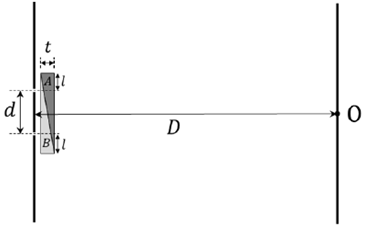
A solid glass sphere of refractive index \( n = \sqrt{3} \) and radius \( R \) contains a spherical air cavity of radius \( \dfrac{R}{2} \), as shown in the figure. A very thin glass layer is present at the point \( O \) so that the air cavity (refractive index \( n = 1 \) ) remains inside the glass sphere. An unpolarized, unidirectional and monochromatic light source \( S \) emits a light ray from a point inside the glass sphere towards the periphery of the glass sphere. If the light is reflected from the point \( O \) and is fully polarized, then the angle of incidence at the inner surface of the glass sphere is \( \theta \). The value of \( \sin \theta \) is__________.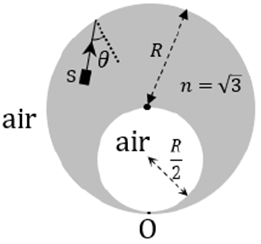
PARAGRAPH – 1
In a young’s double slit experiment, each of the two slits \( A \) and \( B \), as shown in the figure, are oscillating about their fixed center and with a mean separation of \( 0.8 \,\text{mm} \). The distance between the slits at time \( t \) is given by \( d = (0.8 + 0.04 \sin \omega t)\,\text{mm} \), where \( \omega = 0.08 \,\text{rad s}^{-1} \). The distance of the screen from the slits is \( 1 \,\text{m} \) and the wavelength of the light used to illuminate the slits is 6000Å. The interference pattern on the screen changes with time, while the central bright fringe (zeroth fringe) remains fixed at point \( O \).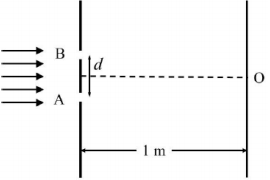
The \( 8^{\text{th}} \) bright fringe above the point \( O \) oscillates with time between two extreme positions. The separation between these two extreme positions, in micrometer \( (\mu m) \), is _______.
A plane polarized blue light ray is incident on a prism such that there is no reflection from the surface of the prism. The angle of deviation of the emergent ray is \( \delta = 60^\circ \) (see Figure-\( 1 \)). The angle of minimum deviation for red light from the same prism is \( \delta_{\min} = 30^\circ \) (see Figure-\( 2 \)). The refractive index of the prism material for blue light is \( \sqrt{3} \). Which of the following statement(s) is(are) correct?
