17 questions
A double convex lens made of glass of refractive index \( 1.5 \) and radii of curvature of the curved surfaces \( 20 \text{cm} \) each is immersed in a liquid of refractive index \( n_{L} \). The correct plot showing the variation of the power, in the units of diopter \( (D) \), as a function of \( n_{L} \) is:
A light ray is incident on the surface of a sphere of refractive index \( n \) at an angle of incidence \( \theta_0 \). The ray partially refracts into the sphere with angle of refraction \( \phi_0 \) and then partially reflects from the back surface. The reflected ray then emerges out of the sphere after a partial refraction. The total angle of deviation of the emergent ray with respect to the incident ray is \( \alpha \). Match the quantities mentioned in List-I with their values in List-II and choose the correct option.
As shown in the figure, a ray \( AB \) of unpolarized light enters from water of refractive index \( n_w = \frac{4}{3} \) into a medium of refractive index \( n_p = \frac{4}{\sqrt{3}} \) after passing through a glass plate of refractive index \( n_g = 1.5 \) and a layer of water. At a particular incident angle \( i \) the reflected ray \( CD \) is polarized in the direction as shown in the figure. The value of \( i \) (in degrees) is ________. 
An optical arrangement consists of two concave mirrors \( M_1 \) and \( M_2 \), and a convex lens \( L \) with a common principal axis, as shown in the figure. The focal length of \( L \) is \( 10 \, \text{cm} \). The radii of curvature of \( M_1 \) and \( M_2 \) are \( 20 \, \text{cm} \) and \( 24 \, \text{cm} \), respectively. The distance between \( L \) and \( M_2 \) is \( 20 \, \text{cm} \). A point object \( S \) is placed at the mid-point between \( L \) and \( M_2 \) on the axis. When the distance between \( L \) and \( M_1 \) is \( n/7 \, \text{cm} \), one of the images coincides with \( S \). The value of \( n \) is _______. 
For a prism of prism angle \( \theta = 60^\circ \), the refractive indices of the left half and the right half are, respectively, \( n_{1} \) and \( n_{2} \) \( (n_{2} \ge n_{1}) \), as shown in the figure. The angle of incidence \( i \) is chosen such that the incident light rays will have minimum deviation in \( n_{1} = n_{2} = n = 1.5 \). For the case of unequal refractive indices, \( n_{1} = n \) and \( n_{2} = n + \Delta n \) (where \( \Delta n \ll n \)) the angle of emergence \( e = i + \Delta e \). Which of the following statement(s) is (are) correct? 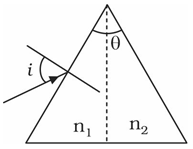
Two identical concave mirrors each of focal length \( f \) are facing each other as shown in the schematic diagram. The focal length \( f \) is much larger than the size of the mirrors. A glass slab of thickness \( t \) and refractive index \( n_{0} \) is kept equidistant from the mirrors and perpendicular to their common principal axis. A monochromatic point light source \( S \) is embedded at the center of the slab on the principal axis, as shown in the schematic diagram. For the image to be formed on \( S \) itself, which of the following distance between the two mirrors is/are correct: 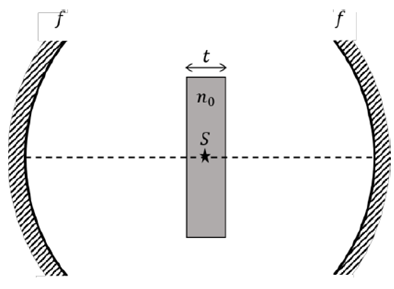
Two equilateral-triangular prisms \( P_1 \) and \( P_2 \) are kept with their sides parallel to each other, in vacuum, as shown in the figure. A light ray enters prism \( P_1 \) at an angle of incidence \( \theta \) such that the outgoing ray undergoes minimum deviation in prism \( P_2 \). If the respective refractive indices of \( P_1 \) and \( P_2 \) are \( \sqrt{\frac{3}{2}} \) and \( \sqrt{3} \), then \( \theta = \sin^{-1}\!\left[ \sqrt{\frac{3}{2}} \sin\!\left( \frac{\pi}{\beta} \right) \right] \), where the value of \( \beta \) is _______.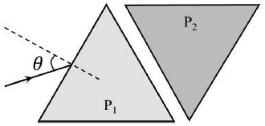
A wide slab consisting of two media of refractive indices \( n_{1} \) and \( n_{2} \) is placed in air as shown in the figure. A ray of light is incident from medium \( n_{1} \) to \( n_{2} \) at an angle \( \theta \), where \( \sin \theta \) is slightly larger than \( \frac{1}{n_{1}} \). Take refractive index of air as \( 1 \). Which of the following statement(s) is(are) correct? 
Three plane mirrors form an equilateral triangle with each side of length \( L \). There is a small hole at a distance \( l > 0 \) from one of the corners as shown in the figure. A ray of light is passed through the hole at an angle \( \theta \) and can only come out through the same hole. The cross section of the mirror configuration and the ray of light lie on the same plane.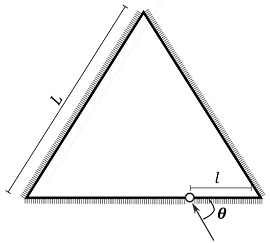
Which of the following statement(s) is(are) correct?
An object and a concave mirror of focal length \( f = 10\,\text{cm} \) both move along the principal axis of the mirror with constant speeds. The object moves with speed \( V_0 = 15\,\text{cm}\,\text{s}^{-1} \) towards the mirror with respect to a laboratory frame. The distance between the object and the mirror at a given moment is denoted by \( u \). When \( u = 30\,\text{cm} \), the speed of the mirror \( V_m \) is such that the image is instantaneously at rest with respect to the laboratory frame, and the object forms a real image. The magnitude of \( V_m \) is ____ \( \text{cm}\,\text{s}^{-1} \). 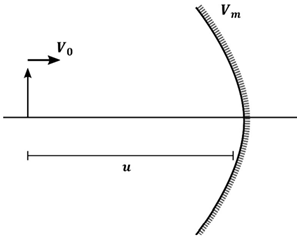
A rod of length \( 2 \, \mathrm{cm} \) makes an angle \( \dfrac{2\pi}{3} \) rad with the principal axis of a thin convex lens. The lens has a focal length of \( 10 \, \mathrm{cm} \) and is placed at a distance of \( \dfrac{40}{3} \, \mathrm{cm} \) from the object as shown in the figure. The height of the image is \( \dfrac{30\sqrt{3}}{13} \, \mathrm{cm} \) and the angle made by it with respect to the principal axis is \( \alpha \) rad. The value of \( \alpha \) is \( \dfrac{\pi}{n} \) rad, where \( n \) is _______. 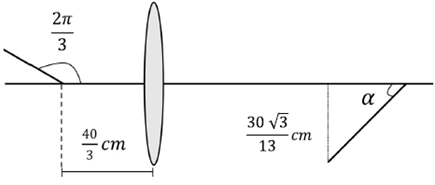
Consider two isosceles prisms \( 1 \) and \( 2 \) with prism angles \( A_1 \) and \( A_2 \) and refractive indices \( n_1 \) and \( n_2 \), respectively, as shown in the figure. The faces \( a_1 b_1 \) and \( a_2 b_2 \) are parallel to each other and perpendicular to the mirror \( M \). If a ray of light is incident on the face \( a_1 c_1 \) and emerges from the face \( a_2 c_2 \), then the correct statement(s) is/are: 
List I contains four combinations of two lenses \( (1 \text{ and } 2) \) whose focal lengths (in \( \text{cm} \)) are indicated in the figures. In all cases, the object is placed \( 20 \, \text{cm} \) from the first lens on the left, and the distance between the two lenses is \( 5 \, \text{cm} \). List II contains the positions of the final images.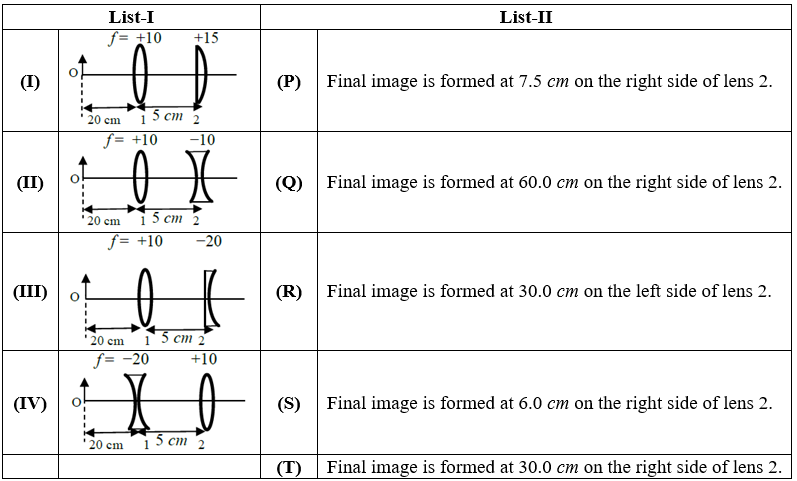
Which one of the following options is correct?
A glass beaker has a solid, plano-convex base of refractive index \( 1.60 \), as shown in the figure. The radius of curvature of the convex surface (SPU) is \( 9 \, \text{cm} \), while the planar surface (STU) acts as a mirror. This beaker is filled with a liquid of refractive index \( n \) up to the level QPR. If the image of a point object \( O \) at a height of \( h \) (\( OT \) in the figure) is formed onto itself, then, which of the following option(s) is(are) correct?
An extended object is placed at point \( O \), \( 10 \, \text{cm} \) in front of a convex lens \( L_{1} \) and a concave lens \( L_{2} \) is placed \( 10 \, \text{cm} \) behind it, as shown in the figure. The radii of curvature of all the curved surfaces in both the lenses are \( 20 \, \text{cm} \). The refractive index of both the lenses is \( 1.5 \). The total magnification of this lens system is : 
A beam of polychromatic light passes through a thin prism of prism angle \(6^\circ\). The refractive index of the material of the prism varies with wavelength \((\lambda)\) as \(n(\lambda) = \alpha \lambda + \dfrac{\beta}{\lambda^{2}}\) where \(\alpha = 3 \, \mu \text{m}^{-1}\) and \(\beta = 0.096 \, \mu \text{m}^{2}\). If \(\lambda_{\min}\) is the wavelength at which the angle of minimum deviation \(D_{m}\) is smallest, then the correct value of \(D_{m}\) at \(\lambda_{\min}\) is:
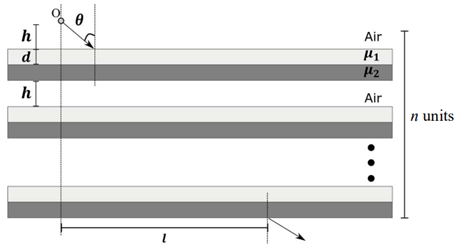
Consider a configuration of \( n \) identical units, each consisting of three layers. The first layer is a column of air of height \( h = \dfrac{1}{3} \, \text{cm} \), and the second and third layers are of equal thickness \( d = \dfrac{\sqrt{3}-1}{2} \, \text{cm} \), and refractive indices \( \mu_1 = \sqrt{\dfrac{3}{2}} \) and \( \mu_2 = \sqrt{3} \), respectively. A light source O is placed on the top of the first unit, as shown in the figure. A ray of light from O is incident on the second layer of the first unit at an angle of \( \theta = 60^{\circ} \) to the normal. For a specific value of \( n \), the ray of light emerges from the bottom of the configuration at a distance \( l = \dfrac{8}{\sqrt{3}} \, \text{cm} \), as shown in the figure. The value of \( n \) is ____.