5 questions from 2026
List-I shows four planar structures made of uniform solid rods each of mass \( m \) and length \( l \). In the List-II the possible moment of inertia of these structure about an axis \( OCO' \), which lies in the plane of the structures, are given. Choose the option which describes the correct match between the entries in List-I to those in List-II. 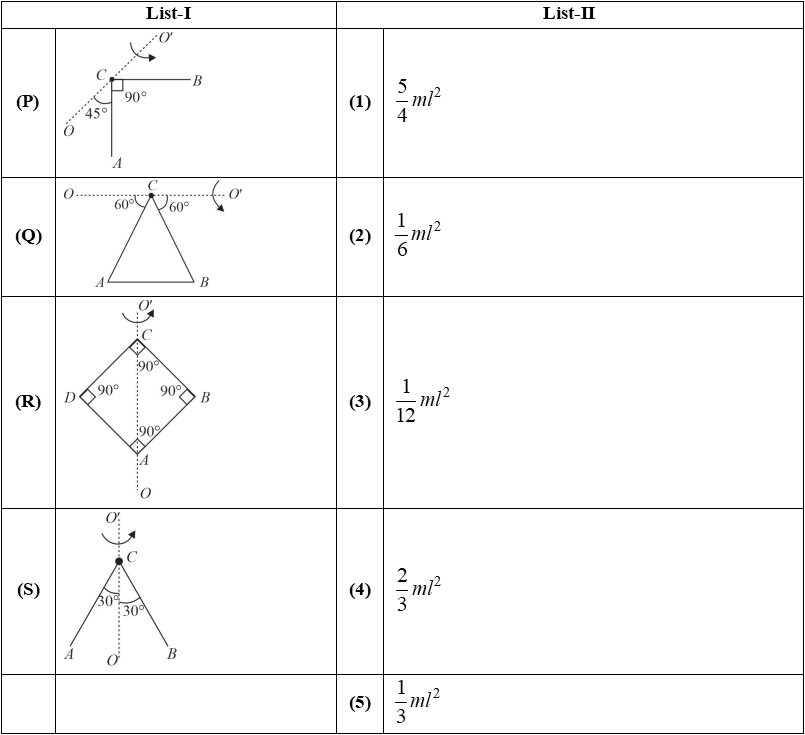
Consider a large disk of radius \( R \) and two smaller disks, each of radius \( r = \frac{R}{50} \), lying on its circumference, as shown in the figure. The smaller disks are initially in contact with each other, with an angular separation \( \Delta \theta \) between their centers. They are made to roll without slipping in opposite directions, with constant angular velocities \( \omega \) and \( 2\omega \) while the large disk is held stationary. The time \( \tau \) at which the smaller disks are again in contact is:
[Use \( \sin(\Delta \theta = \Delta \theta) \) an ignore gravity.]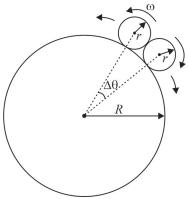
A solid cylinder of radius \( R \) rolls without slipping with a center of mass speed \( v_{0} = \sqrt{\dfrac{gR}{3}} \) on a horizontal surface with a vertical edge, as shown in the figure. Here, \( g \) is the acceleration due to the gravity. At the moment when the cylinder loses contact with the surface due to rotation around the corner, the speed of its center of mass is: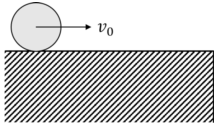
A uniform circular disk of radius \( 0.2 \, \text{m} \) and mass \( 1 \, \text{kg} \) is pivoted at its top point C such that it can rotate freely around C in the XY plane, as shown in the figure. Initially, when the disk is at rest, a particle of mass \( 20 \, \text{g} \), travelling along negative \( x \) direction in the XY plane with speed \( 100 \, \text{ms}^{-1} \), hits the circumference of the disk at a point P. After collision the particle moves along negative \( y \) direction at a speed of \( 90 \, \text{ms}^{-1} \).
[Given: the acceleration due to gravity \( (g) = -10 \, \hat{\jmath} \, \text{ms}^{-2} \)]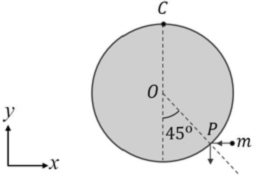
After the collision the disk starts to rotate around point C in the XY plane. The maximum change in the height (in \( \text{m} \)) of its centre O is _______.
A uniform circular disk of radius \( 0.2 \, \text{m} \) and mass \( 1 \, \text{kg} \) is pivoted at its top point C such that it can rotate freely around C in the XY plane, as shown in the figure. Initially, when the disk is at rest, a particle of mass \( 20 \, \text{g} \), travelling along negative \( x \) direction in the XY plane with speed \( 100 \, \text{ms}^{-1} \), hits the circumference of the disk at a point P. After collision the particle moves along negative \( y \) direction at a speed of \( 90 \, \text{ms}^{-1} \).
[Given: the acceleration due to gravity \( (g) = -10 \, \hat{\jmath} \, \text{ms}^{-2} \)]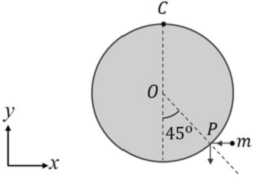
Amount of energy loss (in \( \text{J} \)) in the collision is _______.
