3 questions from 2023
A bar of mass \( M = 1.00 \, \text{kg} \) and length \( L = 0.20 \, \text{m} \) is lying on a horizontal frictionless surface. One end of the bar is pivoted at a point about which it is free to rotate. A small mass \( m = 0.10 \, \text{kg} \) is moving on the same horizontal surface with \( 5.00 \, \text{m s}^{-1} \) speed on a path perpendicular to the bar. It hits the bar at a distance \( L/2 \) from the pivoted end and returns back on the same path with speed \( v \). After this elastic collision, the bar rotates with an angular velocity \( \omega \). Which of the following statement is correct?
A thin circular coin of mass \( 5 \, \text{gm} \) and radius \( \dfrac{4}{3} \, \text{cm} \) is initially in a horizontal xy-plane. The coin is tossed vertically up (\( +z \) direction) by applying an impulse of \( \sqrt{\dfrac{\pi}{2}} \times 10^{-2} \, \text{N- s} \) at a distance \( \dfrac{2}{3} \, \text{cm} \) from its centre. The coin spins about its diameter and moves along the \( +z \) direction. By the time the coin reaches back to its initial position, it completes \( n \) rotations. The value of \( n \) is ________.
[Given the acceleration due to gravity \( g = 10 \, \text{m s}^{-2} \)] 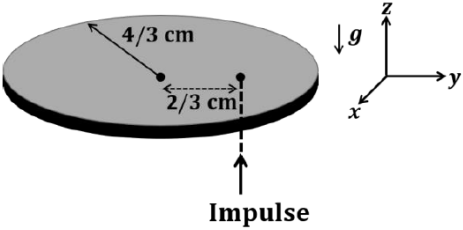
An annular disk of mass \( M \), inner radius \( a \) and outer radius \( b \) is placed on a horizontal surface with coefficient of friction \( \mu \), as shown in the figure. At some time, an impulse \( J_0 \, \hat{x} \) is applied at a height \( h \) above the centre of the disk. If \( h = h_m \) then the disk rolls without slipping along the x-axis. Which of the following statement(s) is (are) correct? 
