2 questions from 2025
A conducting square loop initially lies in the XZ plane with its lower edge hinged along the X-axis. Only in the region \( y \ge 0 \), there is a time dependent magnetic field pointing along the Z-direction, \( \vec{B}(t)=B_{0}(\cos \omega t)\,\hat{k} \), where \( B_{0} \) is a constant. The magnetic field is zero everywhere else. At time \( t=0 \), the loop starts rotating with constant angular speed \( \omega \) about the X axis in the clockwise direction as viewed from the \( +X \) axis (as shown in the figure). Ignoring self-inductance of the loop and gravity, which of the following plots correctly represents the induced e.m.f. (\( V \)) in the loop as a function of time: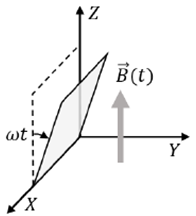
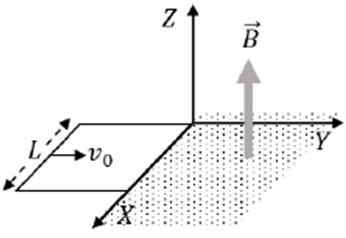
A conducting square loop of side \( L \), mass \( M \) and resistance \( R \) is moving in the \( XY \) plane with its edges parallel to the \( X \) and \( Y \) axes. The region \( y \ge 0 \) has a uniform magnetic field, \( \vec{B} = B_{0}\,\hat{k} \). The magnetic field is zero everywhere else. At time \( t = 0 \), the loop starts to enter the magnetic field with an initial velocity \( v_{0}\hat j \, \text{m/s} \), as shown in the figure. Considering the quantity \( K = \dfrac{B_{0}^{2}L^{2}}{RM} \) in appropriate units, ignoring self-inductance of the loop and gravity, which of the following statements is/are correct: