2 questions from 2023
A rectangular conducting loop of length \( 4 \, \text{cm} \) and width \( 2 \, \text{cm} \) is in the xy-plane, as shown in the figure. It is being moved away from a thin and long conducting wire along the direction \( \dfrac{\sqrt{3}}{2} \, \hat{x} + \dfrac{1}{2} \, \hat{y} \) with a constant speed \( v \). The wire is carrying a steady current \( I = 10 \, \text{A} \) in the positive x-direction. A current of \( 10 \, \mu\text{A} \) flows through the loop when it is at a distance \( d = 4 \, \text{cm} \) from the wire. If the resistance of the loop is \( 0.1 \, \Omega \) then the value of \( v \) ________ \( \text{m s}^{-1} \).
[Given: The permeability of the free space \( \mu_0 = 4\pi \times 10^{-7} \, \text{N A}^{-2} \)] 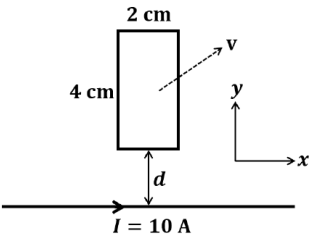
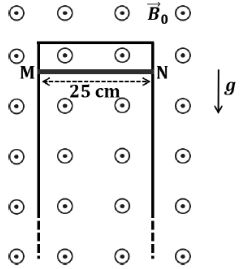
A thin conducting rod MN of mass \( 20 \, \text{gm} \), length \( 25 \, \text{cm} \) and resistance \( 10 \, \Omega \) is held on frictionless, long, perfectly conducting vertical rails as shown in the figure. There is a uniform magnetic field \( B_{0} = 4 \, \text{T} \) directed perpendicular to the plane of the rod-rail arrangement. The rod is released from rest at time \( t = 0 \) and it moves down along the rails. Assume air drag is negligible. Match each quantity in List-I with an appropriate value from List-II, and choose the correct option.
[Given: The acceleration due to gravity \( g = 10 \, \text{m} \, \text{s}^{-2} \) and \( e^{-1} = 0.4 \)]