4 questions from 2026
As shown in the figure, an insulated container is fitted with a thermally conducting but immovable partition \( (P_1) \) and a freely movable but thermally insulated piston \( (P_2) \). The partition \( P_1 \) with thermal conductivity \( K \), cross sectional area \( A \) and width \( x \) divides the container into two sections, \( S_1 \) and \( S_2 \), each containing one mole of a monoatomic gas. The piston \( P_2 \) moves freely such that the gas in \( S_2 \) is always at the atmospheric pressure. Initially, the difference between the temperatures of \( S_1 \) and \( S_2 \) is \( \Delta T_0 \). The time it takes for the temperature difference to become \( \dfrac{\Delta T_0}{2} \) is \( \dfrac{n x R}{K A} \), where \( R \) is the universal gas constant. The value of \( n \) is: [Given: \( \ln 2 \approx 0.7 \)] 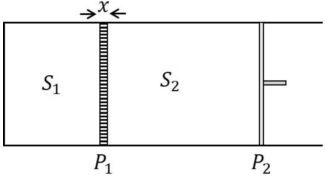
As shown in the figure, five Carnot engines, each with efficiency \( \eta \) and same number of cycles per unit time, are operating between six heat reservoirs. The amount of heat released per cycle by one engine is completely absorbed by the next engine. Consider \( Q_0 \) to be the amount of heat absorbed per cycle by the first engine and \( W \) as the amount of total work done by all the engines per cycle, then the net efficiency of the system is found to be \( \eta_{\text{net}} = \dfrac{W}{Q_0} = \dfrac{211}{243} \). The value of \( \eta \) is: 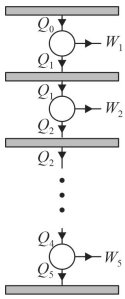
Ten moles of an ideal monoatomic gas, initially in state \( a \) at atmospheric pressure and temperature \( T_a = 27^\circ C \), is enclosed in a metal cylinder of volume \( V_0 \) fitted with a frictionless piston. The gas is suddenly compressed to state \( b \) with volume \( \frac{V_0}{3} \). Now, keeping the piston stationary, the cylinder is submerged in a water bath of temperature \( 11^\circ C \) until the gas reaches the temperature of the water bath, which is denoted as state \( c \). Finally, while still in the water bath, the piston is brought slowly to its initial position, which is denoted as state \( f \). If \( R \) is universal gas constant, then the correct option(s) is/are: [Given: \( 9^{1/3} = 2.08 \)]
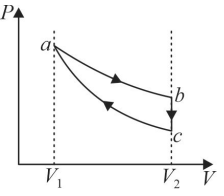
A quasi-static cycle of a monoatomic ideal gas contains an isothermal process \( (ab) \), followed by an isochoric process \( (bc) \) and an adiabatic process \( (ca) \) as shown in the figure. The volumes of the gas are \( V_{1} \) and \( V_{2} \) at \( a \) and \( b \), respectively. If the cycle has heat input \( Q_{\text{in}} \) and output \( Q_{\text{out}} \), then the efficiency of the cycle is defined as \( \eta = \frac{Q_{\text{in}} - Q_{\text{out}}}{Q_{\text{in}}} \). The correct statement(s) is/are: [Given: \( \ln 2 \approx 0.7 \) ]