3 questions from 2021
An ideal gas undergoes a four step cycle as shown in the \( P{-}V \) diagram below. During this cycle, heat is absorbed by the gas in 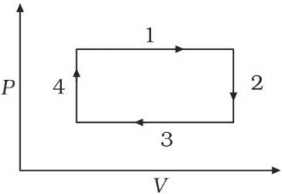
A thermally insulating cylinder has a thermally insulating and frictionless movable partition in the middle, as shown in the figure below. On each side of the partition, there is one mole of an ideal gas, with specific heat at constant volume, \( C_v = 2R \). Here, \( R \) is the gas constant. Initially, each side has a volume \( V_0 \) and temperature \( T_0 \). The left side has an electric heater, which is turned on at very low power to transfer heat \( Q \) to the gas on the left side. As a result the partition moves slowly towards the right reducing the right side volume to \( V_0/2 \). Consequently, the gas temperatures on the left and the right sides become \( T_L \) and \( T_R \), respectively. Ignore the changes in the temperatures of the cylinder, heater and the partition.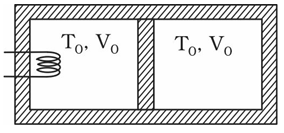
The value of \( \frac{T_R}{T_0} \) is:
A thermally insulating cylinder has a thermally insulating and frictionless movable partition in the middle, as shown in the figure below. On each side of the partition, there is one mole of an ideal gas, with specific heat at constant volume, \( C_v = 2R \). Here, \( R \) is the gas constant. Initially, each side has a volume \( V_0 \) and temperature \( T_0 \). The left side has an electric heater, which is turned on at very low power to transfer heat \( Q \) to the gas on the left side. As a result the partition moves slowly towards the right reducing the right side volume to \( V_0/2 \). Consequently, the gas temperatures on the left and the right sides become \( T_L \) and \( T_R \), respectively. Ignore the changes in the temperatures of the cylinder, heater and the partition.
The value of \( \frac{Q}{R T_0} \) is:
