Three rotten apples are accidently mixed with fifteen good apples. Assuming the random variable \( x \) to be the number of rotten apples in a draw of two apples, the variance of \( x \) is:
\( \frac{40}{153} \)
\( \frac{37}{153} \)
\( \frac{47}{153} \)
\( \frac{57}{153} \)
Let \( E_{1} \) and \( E_{2} \) be two events such that the conditional probabilities \( P(E_{1}\mid E_{2}) = \frac{1}{2} \), \( P(E_{2}\mid E_{1}) = \frac{3}{4} \) and \( P(E_{1}\cap E_{2}) = \frac{1}{8} \). Then:
A coin is biased so that the head is \( 3 \) times as likely to occur as tail. This coin is tossed until a head or three tails occur. If \( X \) denotes the number of tosses of the coin, then the mean of \( X \) is:
A bag contains six balls of different colours. Two balls are drawn in succession with replacement. The probability that both the balls are of the same colour is \( p \). Next four balls are drawn in succession with replacement and the probability that exactly three balls are of the same colour is \( q \). If \( p : q = m : n \), where \( m \) and \( n \) are coprime, then \( m + n \) is equal to ________.
An integer is chosen at random from the integers \( 1, 2, 3, \ldots, 50 \). The probability that the chosen integer is a multiple of atleast one of \( 4 \), \( 6 \) and \( 7 \) is:
A six faced die is biased such that \( 3\times P(\text{a prime number})=6\times P(\text{a composite number})=2\times P(1) \). Let \( X \) be a random variable that counts the number of times one gets a perfect square on some throws of this die. If the die is thrown twice, then the mean of \( X \) is:
If the probability that a randomly chosen \( 6 \)-digit number formed by using digits \( 1 \) and \( 8 \) only is a multiple of \( 21 \) is \( p \), then \( 96p \) is equal to _________.
Let a biased coin be tossed \( 5 \) times. If the probability of getting \( 4 \) heads is equal to the probability of getting \( 5 \) heads, then the probability of getting at most two heads is:
A fair die is tossed until six is obtained on it. Let \( X \) be the number of required tosses, then the conditional probability \( P(X \ge 5 \mid X > 2) \) is:
Bag A contains \( 3 \) white, \( 7 \) red balls and Bag B contains \( 3 \) white, \( 2 \) red balls. One bag is selected at random and a ball is drawn from it. The probability of drawing the ball from the bag A, if the ball drawn is white, is:
If an unbiased dice is rolled thrice, then the probability of getting a greater number in the \( i^{\text{th}} \) roll than the number obtained in the \( (i-1)^{\text{th}} \) roll, \( i = 2, 3 \) is equal to
A fair coin is tossed \( n \)-times such that the probability of getting at least one head is at least \( 0.9 \). Then the minimum value of \( n \) is _______.
A fair die is thrown until \( 2 \) appears. Then the probability, that \( 2 \) appears in even number of throws, is:
If the sum and the product of mean and variance of a binomial distribution are \( 24 \) and \( 128 \) respectively, then the probability of one or two successes is:
Bag A contains \( 2 \) white, \( 1 \) black and \( 3 \) red balls and bag B contains \( 3 \) black, \( 2 \) red and \( n \) white balls. One bag is chosen at random and \( 2 \) balls drawn from it at random, are found to be \( 1 \) red and \( 1 \) black. If the probability that both balls come from Bag A is \( \frac{6}{11} \), then \( n \) is equal to ________.
Bag \( 1 \) contains \( 4 \) white balls and \( 5 \) black balls, and Bag \( 2 \) contains \( n \) white balls and \( 3 \) black balls. One ball is drawn randomly from Bag \( 1 \) and transferred to Bag \( 2 \). A ball is then drawn randomly from Bag \( 2 \). If the probability, that the ball drawn is white, is \(\displaystyle \frac{29}{45} \), then \( n \) is equal to:
Let \( X \) have a binomial distribution \( B(n,p) \) such that sum and the product of the mean and variance of \( X \) are \( 24 \) and \( 128 \) respectively. If \( P(X>n-3)=\dfrac{k}{2^n} \), then \( k \) is equal to:
Three rotten apples are mixed accidently with seven good apples and four apples are drawn one by one without replacement. Let the random variable \( X \) denote the number of rotten apples. If \( \mu \) and \( \sigma^2 \) represent mean and variance of \( X \), respectively, then \( 10(\mu^2+\sigma^2) \) is equal to:
Let A and B two events such that \( P(B \mid A) = \dfrac{2}{5} \), \( P(A \mid B) = \dfrac{1}{7} \) and \( P(A \cap B) = \dfrac{1}{9} \). Consider: (S1) \( P(A \cup B) = \dfrac{5}{6} \), (S2) \( P(A' \cup B') = \dfrac{1}{18} \). Then:
A bag contains $10$ balls out of which $k$ are red and $(10 - k)$ are black, where $0 \leq k \leq 10$. If three balls are drawn at random without replacement and all of them are found to be black, then the probability that the bag contains $1$ red and $9$ black balls is:
Out of \( 60\% \) female and \( 40\% \) male candidates appearing in an exam, \( 60\% \) candidates qualify it. The number of females qualifying the exam is twice the number of males qualifying it. A candidate is randomly chosen from the qualified candidates. The probability, that the chosen candidate is a female, is:
Let $S=\{w_1,w_2,\dots\}$ be the sample space associated to a random experiment. Let $P(w_n)=\frac{P(w_{n-1})}{2},n\geq2$. Let $A=\{2k+3l:k,l\in\mathbb{N}\}$ and $B=\{w_n:n\in A\}$. Then $P(B)$ is equal to :
Let \( A, B \) and \( C \) be three events such that the probability that exactly one of \( A \) and \( B \) occurs is \( (1-k )\), the probability that exactly one of \( B \) and \( C \) occurs is \( 1-2k \), the probability that exactly one of \( C \) and \( A \) occurs is \( (1-k) \) and the probability of all \( A, B \) and \( C \) occur simultaneously is \( k^{2} \), where \( 0<k<1\).Then the probability that at least one of \(A\),\(B\) and \(C\) occur is :
The probability that a randomly selected \( 2 \)-digit number belongs to the set \( \{ n \in \mathbb{N} : (2^n - 2) \text{ is a multiple of } 3 \} \) is equal to:
Two marbles are drawn in succession from a box containing \( 10 \) red, \( 30 \) white, \( 20 \) blue and \( 15 \) orange marbles, with replacement being made after each drawing. Then the probability, that first drawn marble is red and second drawn marble is white, is:
Two distinct numbers \( a \) and \( b \) are selected at random from \( 1, 2, 3, \ldots, 50 \). The probability, that their product \( ab \) is divisible by \( 3 \), is:
Bag \( I \) contains \( 3 \) red, \( 4 \) black and \( 3 \) white balls and Bag \( II \) contains \( 2 \) red, \( 5 \) black and \( 2 \) white balls. One ball is transferred from Bag \( I \) to Bag \( II \) and then a ball is drawn from Bag \( II \). The ball so drawn is found to be black in colour. Then the probability, that the transferred ball is red, is:
Three distinct numbers are selected randomly from the set \( (1, 2, 3, \ldots, 40) \). If the probability, that the selected numbers are in an increasing G.P., \( \frac{m}{n} \), \( \gcd(m,n)=1 \), then \( m+n \) is equal to __________.
Three balls are drawn at random from a bag containing \( 5 \) blue and \( 4 \) yellow balls. Let the random variables \( X \) and \( Y \) respectively denote the number of blue and yellow balls. If \( \overline{X} \) and \( \overline{Y} \) are the means of \( X \) and \( Y \) respectively, then \( 7\overline{X} + 4\overline{Y} \) is equal to _______.
In a binomial distribution \( B(n,p) \), the sum and the product of the mean and the variance are \( 5 \) and \( 6 \) respectively, then \( 6(n+p-q) \) is equal to:
Let \( N \) denote the sum of the numbers obtained when two dice are rolled. If the probability that \( 2^N < N! \) is \( \dfrac{m}{n} \), where \( m \) and \( n \) are coprime, then \( 4m - 3n \) is equal to:
A candidate has to go to the examination centre to appear in an examination. The candidate uses only one means of transportation for the entire distance out of bus, scooter and car. The probabilities of the candidate going by bus, scooter and car, respectively, are \( \frac{2}{5} \), \( \frac{1}{5} \) and \( \frac{2}{5} \). The probabilities that the candidate reaches late at the examination centre are \( \frac{1}{5} \), \( \frac{1}{3} \) and \( \frac{1}{4} \) if the candidate uses bus, scooter and car, respectively. Given that the candidate reached late at the examination centre, the probability that the candidate travelled by bus is:
A biased die is marked with numbers \( 2,4,8,16,32,32 \) on its faces and the probability of getting a face with mark \( n \) is \( \frac{1}{n} \). If the die is thrown thrice, then the probability, that the sum of the numbers obtained is \( 48 \), is:
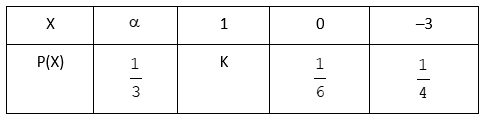
Let \( X \) be a random variable with distribution.
If the mean of \( X \) is \( 2.3 \) and variance of \( X \) is \( \sigma^2 \), then \( 100\,\sigma^2 \) is equal to:
A company has two plants \( A \) and \( B \) to manufacture motorcycles. 60% motorcycles are manufactured at plant \( A \) and the remaining are manufactured at plant \( B \). 80% of the motorcycle manufactured at plant \( A \) are rated of the standard quality, while 90% of the motorcycles manufactured at plant \( B \) are rated of the standard quality. A motorcycle picked up randomly from the total production is found to be of the standard quality. If \( p \) is the probability that it was manufactured at plant \( B \), then \( 126p \) is:
The probability, of forming a 12 persons committee from 4 engineers, 2 doctors and 10 professors containing at least 3 engineers and at least 1 doctor, is:
The probabilities that players \( A \) and \( B \) of a team are selected for the captaincy for a tournament are \( 0.6 \) and \( 0.4 \), respectively. If \( A \) is selected the captain, the probability that the team wins the tournament is \( 0.8 \) and if \( B \) is selected the captain, the probability that the team wins the tournament is \( 0.7 \). Then the probability that the team wins the tournament is:
A bag contains \( 6 \) balls. Two balls are drawn from it at random and both are found to be black. The probability that the bag contains at least \( 5 \) black balls is:
If an unbiased die, marked with \(-2, -1, 0, 1, 2, 3\) on its faces, is thrown five times, then the probability that the product of the outcomes is positive, is:
A box contains 10 pens of which 3 are defective. A sample of 2 pens is drawn at random and let $X$ denote the number of defective pens. Then the variance of $X$ is:
If a random variable \( x \) has the probability distribution
Then \( P(3 < x \le 6) \) is equal to:
Let the sum of two positive integers be \( 24 \). If the probability, that their product is not less than \( \frac{3}{4} \) times their greatest possible product, is \( \frac{m}{n} \), where \( \gcd(m,n) = 1 \), then \( n - m \) equals:
Let $\Omega$ be the sample space and $A \subseteq \Omega$ be an event. Given below are two statements:Statement I :If $\text{P}(A) = 0$, then $A = \phi$Statement II : If $\text{P}(A) = 1$, then $A = \Omega$Then
A bag contains \( 19 \) unbiased coins and one coin with head on both sides. One coin drawn at random is tossed and head turns up. If the probability that the drawn coin was unbiased, is \( \frac{m}{n} \), \( \gcd(m,n)=1 \), then \( n^{2}-m^{2} \) is equal to:
Let \( S=\{1,2,3,4,5,6\} \). Then the probability that a randomly chosen onto function \( g \) from \( S \) to \( S \) satisfies \( g(3)=2g(1) \) is:
From a month of \( 31 \) days, \( 3 \) different dates are selected at random. If the probability that these dates are in an increasing A.P. is equal to \( \dfrac{a}{b} \) where \( a, b \in \mathbb{N} \) and \( \gcd(a,b) = 1 \) then \( a + b \) is equal to ______.
In a tournament, a team plays \( 10 \) matches with probabilities of winning and losing each match as \( \tfrac{1}{3} \) and \( \tfrac{2}{3} \) respectively. Let \( x \) be the number of matches that the team wins, and \( y \) be the number of matches that team loses. If the probability \( P(|x-y|\le 2) \) is p , then \( 3^{9}p \) equals __________.
Fifteen football players of a club-team are given \( 15 \) T-shirts with their names written on the backside. If the players pick up the T-shirts randomly, then the probability that at least \( 3 \) players pick the correct T-shirt is:
There are three bags \( X \), \( Y \) and \( Z \). Bag \( X \) contains \( 5 \) one–rupee coins and \( 4 \) five-rupee coins; Bag \( Y \) contains \( 4 \) one-rupee coins and \( 5 \) five-rupee coins and Bag \( Z \) contains \( 3 \) one-rupee coins and \( 6 \) five-rupee coins. A bag is selected at random and a coin drawn from it at random is found to be a one-rupee coin. Then the probability, that it came from bag \( Y \), is:
A random variable \( X \) takes values \( 0, 1, 2, 3 \) with probabilities \( \frac{2a+1}{30}, \frac{8a-1}{30}, \frac{4a+1}{30}, b \) respectively, where \( a, b \in \mathbb{R} \). Let \( \mu \) and \( \sigma \) respectively be the mean and standard deviation of \( X \) such that \( \sigma^2 + \mu^2 = 2 \). Then \( \frac{a}{b} \) is equal to:
The probability that two randomly selected subsets of the set \( \{1,2,3,4,5\} \) have exactly two elements in their intersection, is:
Let in a Binomial distribution, consisting of \( 5 \) independent trials, probabilities of exactly \( 1 \) and \( 2 \) success be \( 0.4096 \) and \( 0.2048 \) respectively. Then the probability of getting exactly \( 3 \) successes is equal to:
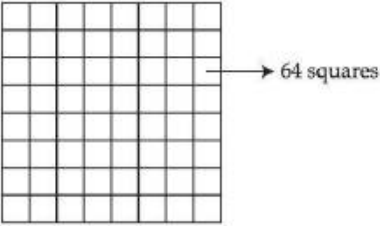
Two squares are chosen at random on a chessboard (see figure). The probability that they have a side in common is:
An electric instrument consists of two units. Each unit must function independently for the instrument to operate. The probability that the first unit functions is \( 0.9 \) and that of the second unit is \( 0.8 \). The instrument is switched on and it fails to operate. If the probability that only the first unit failed and second unit is functioning is \( p \), then \( 98p \) is equal to __________ .
Let \( E_1, E_2, E_3 \) be three mutually exclusive events such that \( P(E_1) = \dfrac{3+3p}{6} ,\ P(E_2) = \dfrac{2-p}{8} \) and \( P(E_3) = \dfrac{1-p}{2} \). If the maximum and minimum values of \( p \) are \( p_1 \) and \( p_2 \), then \( (p_1 + p_2) \) is equal to:
Let \( x \) be a random variable having binomial distribution \( B(7,p) \). If \( P(X = 3) = 5P(X = 4) \), then the sum of the mean and the variance of \( X \) is:
Two balls are selected at random one by one without replacement from a bag containing \( 4 \) white and \( 6 \) black balls. If the probability that the first selected ball is black, given that the second selected ball is also black, is \( \frac{m}{n} \), where \( \gcd(m,n) = 1 \), then \( m + n \) is equal to:
Four dice are thrown simultaneously and the numbers shown on these dice are recorded in \( 2 \times 2 \) matrices. The probability that such formed matrices have all different entries and are non-singular, is:
A bag contains \( 6 \) blue and \( 6 \) green balls. Pairs of balls are drawn without replacement until the bag is empty. The probability that each drawn pair consists of one blue and one green ball is:
Let \( S \) be a set of \( 5 \) elements and \( P(S) \) denote the power set of \( S \). Let \( E \) be an event of choosing an ordered pair \( (A,B) \) from the set \( P(S)\times P(S) \) such that \( A\cap B=\phi \). If the probability of the event \( E \) is \( \dfrac{3^{p}}{2^{q}} \), where \( p,q\in\mathbb{N} \), then \( p+q \) is equal to ____________ .
If three letters can be posted to any one of the \( 5 \) different addresses, then the probability that the three letters are posted to exactly two addresses is:
If \( A \) and \( B \) are two events such that \( P(A)=\dfrac{1}{3} \), \( P(B)=\dfrac{1}{5} \) and \( P(A \cup B)=\dfrac{1}{2} \) then \( P(A \mid B') + P(B \mid A') \) is equal to:
Let a die be rolled \( n \) times. Let the probability of getting odd numbers seven times be equal to the probability of getting even numbers twice is \( \dfrac{k}{2^{15}} \), then \( k \) is equal to:
The probability distribution of random variable \( X \) is given by:
Let \( p = P(1 < X < 4 \mid X < 3) \). If \( 5p = \lambda k \), then \( \lambda \) is equal to ________.
Two dice are thrown independently. Let \( A \) be the event that the number appeared on the \( 1^{\text{st}} \) die is less than the number appeared on the \( 2^{\text{nd}} \) die, \( B \) be the event that the number appeared on the \( 1^{\text{st}} \) die is even and that on the second die is odd, and \( C \) be the event that the number appeared on the \( 1^{\text{st}} \) die is odd and that on the \( 2^{\text{nd}} \) is even. Then:
Let the mean and the standard deviation of the probability distribution
be \( \mu \) and \( \sigma \), respectively. If \( \sigma - \mu = 2 \), then \( \sigma + \mu \) is equal to \( \_\_\_\_\_\_\_ \).
In an examination, there are \( 10 \) true-false type questions. Out of \( 10 \), a student can guess the answer of \( 4 \) questions correctly with probability \( \frac{3}{4} \) and the remaining \( 6 \) questions correctly with probability \( \frac{1}{4} \). If the probability that the student guesses the answers of exactly \( 8 \) questions correctly out of \( 10 \) is \( \frac{27k}{4^{10}} \), then \( k \) is equal to ________ .
Let there be three independent events \( E_1, E_2 \) and \( E_3 \). The probability that only \( E_1 \) occurs is \( \alpha \), only \( E_2 \) occurs is \( \beta \) and only \( E_3 \) occurs is \( \gamma \). Let ‘\( p \)’ denote the probability of none of events occurs that satisfies the equations \( (\alpha - 2\beta)p = \alpha \beta \) and \( (\beta - 3\gamma)p = 2\beta \gamma \). All the given probabilities are assumed to lie in the interval \( (0,1) \). Then \( \dfrac{\text{Probability of occurrence of }E_1}{\text{Probability of occurrence of }E_3} \) is equal to ________.
All five letter words are made using all the letters A, B, C, D, E and arranged as in an English dictionary with serial numbers. Let the word at serial number \( n \) be denoted by \( W_{n} \). Let the probability \( P(W_{n}) \) of choosing the word \( W_{n} \) satisfy \( P(W_{n}) = 2P(W_{n-1}), \ n > 1 \). If \( P(CDBEA) = \frac{2^{\alpha}}{2^{\beta} - 1}, \ \alpha, \beta \in \)\(\mathbb{N}\), then \( \alpha + \beta \) is equal to _________.
An urn contains \( 6 \) white and \( 9 \) black balls. Two successive draws of \( 4 \) balls are made without replacement. The probability, that the first draw gives all white balls and the second draw gives all black balls, is:
\( 25\% \) of the population are smokers. A smoker has \( 27 \) times more chances to develop lung cancer than a non smoker. A person is diagnosed with lung cancer and the probability that this person is a smoker is \( \frac{k}{10} \). Then the value of \( k \) is ____.
Two fair dice are thrown. The numbers on them are taken as \( \lambda \) and \( \mu \), and a system of linear equations\( x+y+z=5 \)\( x+2y+3z=\mu \)\( x+3y+\lambda z=1 \)is constructed. If \( p \) is the probability that the system has a unique solution and \( q \) is the probability that the system has no solution, then:
A bag contains \( 8 \) balls, whose colours are either white or black. \( 4 \) balls are drawn at random without replacement and it was found that \( 2 \) balls are white and other \( 2 \) balls are black. The probability that the bag contains equal number of white and black balls is:
Two dices are rolled. If both dices have six faces numbered \( 1, 2, 3, 5, 7 \) and \( 11 \), then the probability that the sum of the numbers on the top faces is less than or equal to \( 8 \) is:
A letter is known to have arrived by post either from KANPUR or from ANANTPUR. On the envelope just two consecutive letters AN are visible. The probability, that the letter came from ANANTPUR, is:
Three urns \( A \), \( B \) and \( C \) contain \( 7 \) red, \( 5 \) black; \( 5 \) red, \( 7 \) black and \( 6 \) red, \( 6 \) black balls, respectively. One of the urn is selected at random and a ball is drawn from it. If the ball drawn is black, then the probability that it is drawn from urn \( A \) is:
The probability that a randomly chosen one-one function form the set \( \{a,b,c,d\} \) to the set \( \{1,2,3,4,5\} \) satisfies \( f(a) + 2f(b) - f(c) = f(d) \) is:
Let \( A \) and \( B \) be independent events such that \( P(A)=p \), \( P(B)=2p \). The largest value of \( p \), for which \( P \) (exactly one of \( A, B \) occurs) \( = \frac{5}{9} \), is:
If the probability that the random variable \( X \) takes values \( x \) is given by \( P(X=x)=k(x+1)3^{-x},\; x=0,1,2,3,\ldots \), where \( k \) is a constant, then \( P(X \ge 2) \) is equal to:
Let \( 9 \) distinct balls be distributed among \( 4 \) boxes, \( B_1,B_2,B_3 \) and \( B_4 \). If the probability that \( B_3 \) contains exactly \( 3 \) balls is \( k\left(\dfrac{3}{4}\right)^{9} \) then \( k \) lies in the set:
If \( A \) and \( B \) are two events such that \( P(A \cap B)=0.1 \), and \( P(A|B) \) and \( P(B|A) \) are the roots of the equation \( 12x^{2}-7x+1=0 \), then the value of \(\displaystyle \frac{P(\bar{A}\cup \bar{B})}{P(\bar{A}\cap \bar{B})} \) is:
Five numbers \( x_1, x_2, x_3, x_4, x_5 \) are randomly selected from the numbers \( 1,2,3,\ldots,18 \) and are arranged in the increasing order \( (x_1 < x_2 < x_3 < x_4 < x_5) \). The probability that \( x_2 = 7 \) and \( x_4 = 11 \) is:
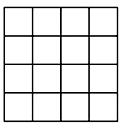
A board has \( 16 \) squares as shown in the figure: Out of these \( 16 \) squares, two squares are chosen at random. The probability that they have no side in common is:
Let \( S=\{1,2,3,\ldots,2022\} \). Then the probability, that a randomly chosen number \(n\) from the set \(S\) such that \(\mathrm{HCF}(n,2022)=1\), is:
A pair of dice is thrown \( 5 \) times. For each throw, a total of \( 5 \) is considered a success. If the probability of at least \( 4 \) successes is \( \dfrac{k}{3^{11}} \), then \( k \) is equal to:
If \( A \) and \( B \) are two events such that \( P(A) = 0.7 \), \( P(B) = 0.4 \) and \( P(A \cap \overline{B}) = 0.5 \), where \( \overline{B} \) denotes the complement of \( B \), then \( P\big(B \mid (A \cup \overline{B})\big) \) is equal to:
Let a computer program generate only the digits \( 0 \) and \( 1 \) to form a string of binary numbers with probability of occurrence of \( 0 \) at even places be \( \frac{1}{2} \) and probability of occurrence of \( 0 \) at the odd place be \( \frac{1}{3} \). Then the probability that '\( 10 \)' is followed by '\( 01 \)' is equal to:
Let the probability of getting head for a biased coin be \( \dfrac{1}{4} \). It is tossed repeatedly until a head appears. Let \( N \) be the number of tosses required. If the probability that the equation \( 64x^2 + 5Nx + 1 = 0 \) has no real root is \( \dfrac{p}{q} \), where \( p \) and \( q \) are coprime, then \( q - p \) is equal to _______.
If the numbers appeared on the two thrown of a fair six faced die are \( \alpha \) & \( \beta \), then the probability that \( x^{2}+\alpha x+\beta>0 \), for all \( x\in \mathbb{R} \) is:
\( A \) and \( B \) alternately throw a pair of dice. \( A \) wins if he throws a sum of \( 5 \) before \( B \) throws a sum of \( 8 \), and \( B \) wins if he throws a sum of \( 8 \) before \( A \) throws a sum of \( 5 \). The probability, that \( A \) wins if \( A \) makes the first throw, is:
Words with or without meaning are to be formed using all the letters of the word EXAMINATION. The probability that the letter \( M \) appears at the fourth position in any such word is:
The coefficients \( a,b,c \) in the quadratic equation \( ax^2 + bx + c = 0 \) are chosen from the set \( \{1,2,3,4,5,6,7,8\} \). The probability of this equation having repeated roots is:
Three dice are rolled. If the probability of getting different numbers on the three dice is \( \dfrac{p}{q} \), where \( p \) and \( q \) are co-prime, then \( q - p \) is equal to:
A fair \( n\ (n>1) \) faces die is rolled repeatedly until a number less than \( n \) appears. If the mean of the number of tosses required is \( \dfrac{n}{9} \), then \( n \) is equal to_____.
Two integers \( x \) and \( y \) are chosen with replacement from the set \( \{ 0, 1, 2, 3, \ldots, 10 \} \). Then the probability that \( |x - y| > 5 \), is:
Let \( a \), \( b \) and \( c \) denote the outcome of three independent rolls of a fair tetrahedral die, whose four faces are marked \( 1 \), \( 2 \), \( 3 \), \( 4 \). If the probability that \( ax^2 + bx + c = 0 \) has all real roots is \( \frac{m}{n} \), \( \gcd(m,n) = 1 \), then \( m + n \) is equal to ________.
Let \( N \) be the sum of the numbers appeared when two fair dice are rolled and let the probability that \( N-2, \sqrt{3N}, N+2 \) are in geometric progression be \( \frac{k}{48} \). Then the value of \( k \) is:
Let a random variable \( X \) take values \( 0, 1, 2, 3 \) with \( P(X=0)=P(X=1)=p \), \( P(X=2)=P(X=3)= \) and \( E(X^{2})=2E(X) \). Then the value of \( 8p-1 \) is:
A fair die is tossed repeatedly until a six is obtained. Let \( X \) denote the number of tosses required and let \( a = P(X = 3) \), \( b = P(X \ge 3) \) and \( c = P(X \ge 6 \mid X > 3) \). Then \( \frac{b + c}{a} \) is equal to __________.
A random variable \( X \) has the following probability distribution:
The value of \( P(1 < X < 4 \mid X \le 2) \) is equal to:
The probability of selecting integers \( a\in[-5,30] \) such that \( x^{2}+2(a+4)x-5a+64>0 \), for all \( x\in \mathbb{R} \), is:
A bag contains \( (N + 1) \) coins – \( N \) fair coins, and one coin with ‘Head’ on both sides. A coin is selected at random and tossed. If the probability of getting ‘Head’ is \( \frac{9}{16} \), then \( N \) is equal to:
If the probability that the random variable \( X \) takes the value \( x \) is given by \( P(X=x)=k(x+1)3^{-x} \), \( x = 0, 1, 2, 3, \ldots \) where \( k \) is a constant, then \( P(X \ge 3) \) is equal to:
Bag \( B_1 \) contains \( 6 \) white and \( 4 \) blue balls, Bag \( B_2 \) contains \( 4 \) white and \( 6 \) blue balls, and Bag \( B_3 \) contains \( 5 \) white and \( 5 \) blue balls. One of the bags is select at random and a ball is drawn from it. If the ball is white, then the probability, that the ball is drawn from Bag \( B_2 \), is:
The probability, that in a randomly selected \( 3 \)-digit number at least \( 2 \) digits are odd, is:
Let \( X \) be a random variable such that the probability function of a distribution is given by \( P(X = 0) = \dfrac{1}{2} , \; P(X = j) = \dfrac{1}{3^{j}} \; (j = 1, 2, 3, \ldots, \infty) \). Then the mean of the distribution and \( P(X \text{ is positive and even}) \) respectively are:
One die has two faces marked \( 1 \), two faces marked \( 2 \), one face marked \( 3 \) and one face marked \( 4 \). Another die has one face marked \( 1 \), two faces marked \( 2 \), two faces marked \( 3 \) and one face marked \( 4 \). The probability of getting the sum of numbers to be \( 4 \) or \( 5 \), when both the dice are thrown together, is:
A coin is biased so that a head is twice as likely to occur as a tail. If the coin is tossed \( 3 \) times, then the probability of getting two tails and one head is:
In a bolt factory, machines \( A \), \( B \) and \( C \) manufacture respectively \( 20\% \), \( 30\% \) and \( 50\% \) of the total bolts. Of their output \( 3 \), \( 4 \) and \( 2 \) percent are respectively defective bolts. A bolt is drawn at random from the product. If the bolt drawn is found the defective, then the probability that it is manufactured by the machine \( C \) is:
Bag A contains \( 9 \) white and \( 8 \) black balls, while bag B contains \( 6 \) white and \( 4 \) black balls. One ball is randomly picked up from the bag B and mixed up with the balls in the bag A. Then a ball is randomly drawn from the bag A. If the probability, that the ball drawn is white, is \( \dfrac{p}{q} \), \( \gcd(p,q)=1 \), then \( p+q \) is equal to:
A man throws a fair coin repeatedly. He gets \( 10 \) points for each head he throws and \( 5 \) points for each tail he throws. If the probability that he gets exactly \( 30 \) points is \( \frac{m}{n} \), \( \gcd(m,n)=1 \), then \( m+n \) is equal to:
From the first \( 100 \) natural numbers, two numbers first \( a \) and then \( b \) are selected randomly without replacement. If the probability that \( a - b \ge 10 \) is \( \frac{m}{n} \), \( \gcd(m, n) = 1 \), then \( m + n \) is equal to \( \_\_\_\_\_ \).
Three urns \( A \), \( B \) and \( C \) contain \( 4 \) red, \( 6 \) black; \( 5 \) red, \( 5 \) black; and \( \lambda \) red, \( 4 \) black balls respectively. One of the urns is selected at random and a ball is drawn. If the ball drawn is red and the probability that is drawn from urn \( C \) is \( 0.4 \) then the square of the length of the side of the largest equilateral triangle, inscribed in the parabola \( y^2=\lambda x \) with one vertex at the vertex of the parabola, is:
From a lot containing \( 10 \) defective and \( 90 \) non-defective bulbs, \( 8 \) bulbs are selected one by one with replacement. Then the probability of getting at least \( 7 \) defective bulbs is:
When a certain biased die is rolled, a particular face occurs with probability \( \dfrac{1}{6} - x \) and its opposite face occurs with probability \( \dfrac{1}{6} + x \). All other faces occur with probability \( \dfrac{1}{6} \). Note that opposite faces sum to \( 7 \) in any die. If \( 0 < x < \dfrac{1}{6} \), and the probability of obtaining total sum \( = 7 \), when such a die is rolled twice, is \( \dfrac{13}{96} \), then the value of \( x \) is:
Let $M$ be the maximum value of the product of two positive integers when their sum is 66. Let the sample space $S = \left\{ x \in \mathbb{Z} : x(66-x) \geq \frac{5}{9}M \right\}$ and the event $A = \{ x \in S : x \text{ is a multiple of } 3 \}$. Then $P(A)$ is equal to:
Let \( a,b,c \in \{1,2,3,4\} \). If the probability, that \( ax^{2}+2\sqrt{2}bx+c>0 \) for all \( x\in \mathbb{R} \), is \( \frac{m}{n} \), \( \gcd(m,n)=1 \), then \( m+n \) is equal to ______.
A coin is tossed \( 8 \) times. If the probability that exactly \( 4 \) heads appear in the first six tosses and exactly \( 3 \) heads appear in the last five tosses is \( p \), then \( 96p \) is equal to ________.
Let Ajay will not appear in JEE exam with probability \( p = \dfrac{2}{7} \), while both Ajay and Vijay will appear in the exam with probability \( q = \dfrac{1}{5} \). Then the probability, that Ajay will appear in the exam and Vijay will appear is:
Let \( A \) denote the event that a \( 6 \)-digit integer formed by \( 0,1,2,3,4,5,6 \) without repetitions, be divisible by \( 3 \). Then probability of event \( A \) is equal to:
A bag contains \( 6 \) white and \( 4 \) black balls. A die is rolled once and the number of balls equal to the number obtained on the die are drawn from the bag at random. The probability that all the balls drawn are white is:
Let \( A = [a_{ij}] \) be a square matrix of order \( 2 \) with entries either \( 0 \) or \( 1 \). Let \( E \) be the event that \( A \) is an invertible matrix. Then the probability \( P(E) \) is:
If a random variable \( X \) follows the Binomial distribution \( B(33,\ p) \) such that \( 3P(X=0) = P(X=1) \), then the value of \( \dfrac{P(X=15)}{P(X=18)} - \dfrac{P(X=16)}{P(X=17)} \) is equal to: