2 questions from 2026
Two thin wires, Wire-1 of diameter \( 0.650 \, \text{mm} \) and Wire-2 of unknown diameter \( d \) are given. To obtain the value of \( d \), the diameters of the two wires are measured with a screw gauge. The screw gauge has a pitch of \( 0.5 \, \text{mm} \) and there are \( 100 \) divisions on the circular scale (CS). The smallest division on the linear scale (LS) is \( 0.5 \, \text{mm} \). The table shows the readings of LS and CS for the measurements. The value of \( d \) (in \( \mu \text{m} \)) is ______.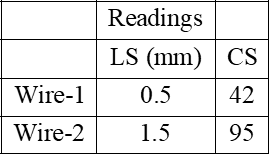
As shown in the figure, the resistance of a galvanometer \( G \) can be found by the half-deflection method. Here the resistance \( R_2 \) is adjusted such that when the key \( K \) is closed the deflection in the galvanometer becomes half of the value as compared to when \( K \) is open. Half-deflection is obtained at \( R_2 = 4\,\Omega \) and thus the galvanometer resistance is found to be \( 6\,\Omega \). In this half-deflection condition the current (in \( \text{mA} \)) through the resistor \( R_1 \) is ________. 
