3 questions from 2024
A light ray is incident on the surface of a sphere of refractive index \( n \) at an angle of incidence \( \theta_0 \). The ray partially refracts into the sphere with angle of refraction \( \phi_0 \) and then partially reflects from the back surface. The reflected ray then emerges out of the sphere after a partial refraction. The total angle of deviation of the emergent ray with respect to the incident ray is \( \alpha \). Match the quantities mentioned in List-I with their values in List-II and choose the correct option.
Two equilateral-triangular prisms \( P_1 \) and \( P_2 \) are kept with their sides parallel to each other, in vacuum, as shown in the figure. A light ray enters prism \( P_1 \) at an angle of incidence \( \theta \) such that the outgoing ray undergoes minimum deviation in prism \( P_2 \). If the respective refractive indices of \( P_1 \) and \( P_2 \) are \( \sqrt{\frac{3}{2}} \) and \( \sqrt{3} \), then \( \theta = \sin^{-1}\!\left[ \sqrt{\frac{3}{2}} \sin\!\left( \frac{\pi}{\beta} \right) \right] \), where the value of \( \beta \) is _______.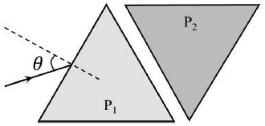
A glass beaker has a solid, plano-convex base of refractive index \( 1.60 \), as shown in the figure. The radius of curvature of the convex surface (SPU) is \( 9 \, \text{cm} \), while the planar surface (STU) acts as a mirror. This beaker is filled with a liquid of refractive index \( n \) up to the level QPR. If the image of a point object \( O \) at a height of \( h \) (\( OT \) in the figure) is formed onto itself, then, which of the following option(s) is(are) correct?
