2 questions from 2025
In a Young’s double slit experiment, a combination of two glass wedges \( A \) and \( B \), having refractive indices \( 1.7 \) and \( 1.5 \), respectively, are placed in front of the slits, as shown in the figure. The separation between the slits is \( d = 2 \, \text{mm} \) and the shortest distance between the slits and the screen is \( D = 2 \, \text{m} \). Thickness of the combination of the wedges is \( t = 12 \, \mu \text{m} \). The value of \( l \) as shown in the figure is \( 1 \, \text{mm} \). Neglect any refraction effect at the slanted interface of the wedges. Due to the combination of the wedges, the central maximum shifts (in \( \text{mm} \)) with respect to \( 0 \) by ____.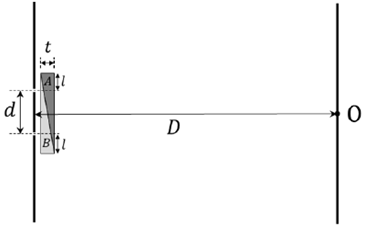
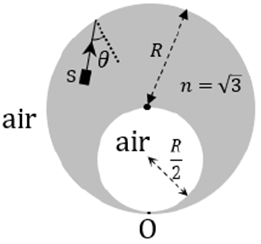
A solid glass sphere of refractive index \( n = \sqrt{3} \) and radius \( R \) contains a spherical air cavity of radius \( \dfrac{R}{2} \), as shown in the figure. A very thin glass layer is present at the point \( O \) so that the air cavity (refractive index \( n = 1 \) ) remains inside the glass sphere. An unpolarized, unidirectional and monochromatic light source \( S \) emits a light ray from a point inside the glass sphere towards the periphery of the glass sphere. If the light is reflected from the point \( O \) and is fully polarized, then the angle of incidence at the inner surface of the glass sphere is \( \theta \). The value of \( \sin \theta \) is__________.