4 questions from 2021
A special metal S conducts electricity without any resistance. A closed wire loop , made of S, does not allow any chnage in flux through itself by inducing a suitable current to generate a compensating flux. The induced current in the loop cannot decay due to its zero resistance. This current gives rise to a magnetic moment which in turn repels the source of magnetic field or flux. Consider such a loop, of radius \( a \), with its center at the origin. A magnetic dipole of moment \( m \) is brought along the axis of this loop from infinity to a point at distance \( r \, (\gg a) \) from the center of the loop with its north pole always facing the loop, as shown in the figure below.
The magnitude of magnetic field of a dipole \( m \), at a point on its axis at distance \( r \), is \( \dfrac{\mu_{0} m}{2\pi r^{3}} \), where \( \mu_{0} \) is the permeability of free space. The magnitude of the force between two magnetic dipoles with moments, \( m_{1} \) and \( m_{2} \), separated by a distance \( r \) on the common axis, with their north poles facing each other, is \( \dfrac{k\, m_{1} m_{2}}{r^{4}} \), where \( k \) is a constant of appropriate dimensions. The direction of this force is along the line joining the two dipoles.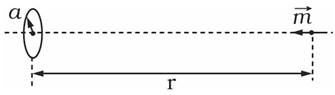
When the dipole \( m \) is placed at a distance \( r \) from the centre of the loop (as shown in the figure), the current induced in the loop will be proportional to:
Two concentric circular loops, one of radius \( R \) and the other of radius \( 2R \), lie in the \( xy \)-plane with the origin as their common centre, as shown in the figure. The smaller loop carries current \( I_1 \) in the anti-clockwise direction and the larger loop carries current \( I_2 \) in the clockwise direction, with \( I_2 > 2I_1 \). \( \vec{B}(x, y) \) denotes the magnetic field at a point \( (x, y) \) in the \( xy \)-plane. Which of the following statement(s) is (are) correct? 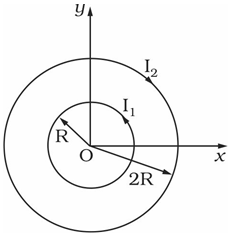
An \( \alpha \)-particle (mass \( 4 \, \text{amu} \)) and a singly charged sulfur ion (mass \( 32 \, \text{amu} \)) are initially at rest. They are accelerated through a potential \( V \) and then allowed to pass into a region of uniform magnetic field which is normal to the velocities of the particles. Within this region, the \( \alpha \)-particle and the sulfur ion move in circular orbits of radii \( r_{\alpha} \) and \( r_{s} \), respectively. The ratio \( ( \frac{r_{s}}{r_{\alpha}} ) \) is _____
A special metal \( S \) conducts electricity without any resistance. A closed wire loop, made of \( S \), does not allow any change in flux through itself by inducing a suitable current to generate a compensating flux. The induced current in the loop cannot decay due to its zero resistance. This current gives rise to a magnetic moment which in turn repels the source of magnetic field or flux. Consider such a loop, of radius \( a \), with its center at the origin. A magnetic dipole of moment \( m \) is brought along the axis of this loop from infinity to a point at distance \( r \, (\gg a) \) from the center of the loop with its north pole always facing the loop, as shown in the figure below.
The magnitude of magnetic field of a dipole \( m \), at a point on its axis at distance \( r \), is \( \dfrac{\mu_{0} m}{2\pi r^{3}} \), where \( \mu_{0} \) is the permeability of free space. The magnitude of the force between two magnetic dipoles with moments, \( m_{1} \) and \( m_{2} \), separated by a distance \( r \) on the common axis, with their north poles facing each other, is \( \dfrac{k\, m_{1} m_{2}}{r^{4}} \), where \( k \) is a constant of appropriate dimensions. The direction of this force is along the line joining the two dipoles.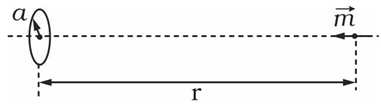
The work done in bringing the dipole from infinity to a distance \( r \) from the center of the loop by the given process is proportional to:
