4 questions from 2024
Two beads, each with charge \( q \) and mass \( m \), are on a horizontal, frictionless, non-conducting, circular hoop of radius \( R \). One of the beads is glued to the hoop at some point, while the other one performs small oscillations about its equilibrium position along the hoop. The square of the angular frequency of the small oscillations is given by: \([ \varepsilon_{0} \text{ is the permittivity of free space.}]\)
An infinitely long thin wire, having a uniform charge density per unit length of \( 5 \,\text{nC/m} \), is passing through a spherical shell of radius \( 1 \,\text{m} \), as shown in the figure. A \( 10 \,\text{nC} \) charge is distributed uniformly over the spherical shell. If the configuration of the charges remains static, the magnitude of the potential difference between points \( P \) and \( R \), in Volt, is ____.
[Given: In SI units \( \frac{1}{4\pi \epsilon_0} = 9 \times 10^{9} \), \( \ln 2 = 0.7 \). Ignore the area pierced by the wire.]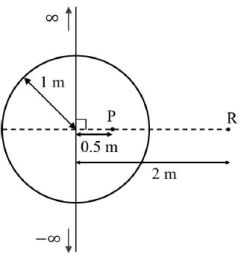
A charge is kept at the central point \( P \) of a cylindrical region. The two edges subtend a half-angle \( \theta \) at \( P \), as shown in the figure. When \( \theta = 30^{\circ} \), then the electric flux through the curved surface of the cylinder is \( \Phi \). If \( \theta = 60^{\circ} \), then the electric flux through the curved surface becomes \( \Phi / \sqrt{n} \), where the value of \( n \) is ______. 
A small electric dipole \( \vec{p}_0 \), having a moment of inertia \( I \) about its center, is kept at a distance \( r \) from the center of a spherical shell of radius \( R \). The surface charge density \( \sigma \) is uniformly distributed on the spherical shell. The dipole is initially oriented at a small angle \( \theta \) as shown in the figure. While staying at a distance \( r \), the dipole is free to rotate about its center.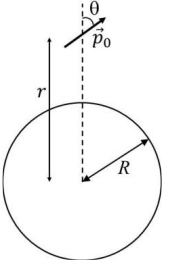
If released from rest, then which of the following statement(s) is(are) correct? \([ \varepsilon_0 \text{ is the permittivity of free space}]\)
