3 questions from 2025
A person sitting inside an elevator performs a weighing experiment with an object of mass \( 50 \, \text{kg} \). Suppose that the variation of the height \( y \) (in \( \text{m} \)) of the elevator, from the ground, with time \( t \) (in \( \text{s} \)) is given by \( y = 8 \left[ 1 + \sin\!\left( \dfrac{2\pi t}{T} \right) \right] \), where \( T = 40\pi \, \text{s} \). Taking acceleration due to gravity, \( g = 10 \, \text{m} / \text{s}^2 \), the maximum variation of the object’s weight (in \( \text{N} \)) as observed in the experiment is ___.
The center of a disk of radius \( r \) and mass \( m \) is attached to a spring of spring constant \( k \), inside a ring of radius \( R > r \) as shown in the figure. The other end of the spring is attached on the periphery of the ring. Both the ring and the disk are in the same vertical plane. The disk can only roll along the inside periphery of the ring, without slipping. The spring can only be stretched or compressed along the periphery of the ring, following the Hooke’s law. In equilibrium, the disk is at the bottom of the ring. Assuming small displacement of the disc, the time period of oscillation of center of mass of the disk is written as \( T = \dfrac{2\pi}{\omega} \). The correct expression for \( \omega \) is (\( g \) is the acceleration due to gravity):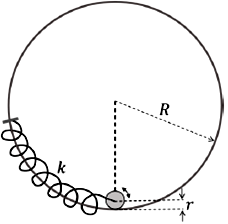
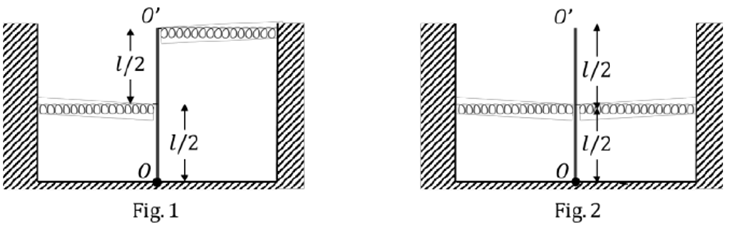
As shown in in the figures, a uniform rod \( OO' \) of length \( l \) is hinged at the point \( O \) and held in place vertically two walls using two massless springs of same spring constant. The springs are connected at the midpoint and at the top-end (\( O' \)) of the rod, as shown in Figure \( 1 \) and the rod is made to oscillate by a small angular displacement. The frequency of oscillation of the rod is \( f_{1} \). On the other hand, if both the springs are connected at the midpoint of the rod, as shown in Figure \( 2 \) and the rod is made to oscillate by a small angular displacement, then the frequency of oscillation is \( f_{2} \). Ignoring gravity and assuming motion only in the plane of the diagram, the value of \( \dfrac{f_{1}}{f_{2}} \) is: