3 questions from 2025
List-I shows various functional dependencies of energy \( (E) \) on the atomic number \( (Z) \). Energies associated with certain phenomena are given in List-II.
Choose the option that describes the correct match between the entries in List-I to those in List-II.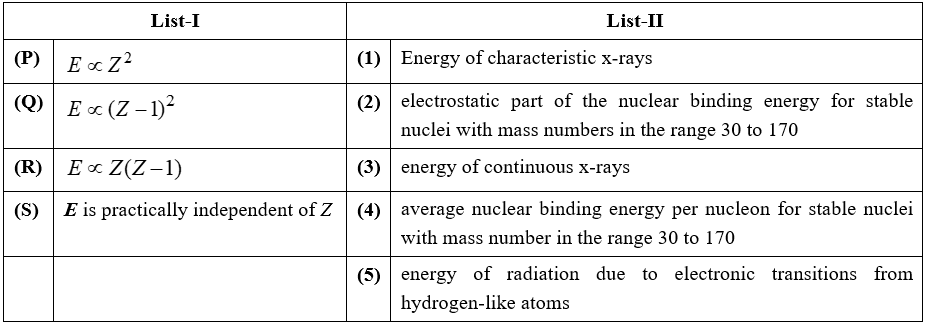
Consider an electron in the \( n = 3 \) orbit of a hydrogen-like atom with atomic number \( Z \). At absolute temperature \( T \), a neutron having thermal energy \( k_B T \) has the same de Broglie wavelength as that of this electron. If this temperature is given by \( T = \dfrac{Z^2 h^2}{\alpha \pi^2 a_0^2 m_N k_B} \), (where \( h \) is the Planck’s constant, \( k_B \) is the Boltzmann constant, \( m_N \) is the mass of the neutron and \( a_0 \) is the first Bohr radius of hydrogen atom) then the value of \( \alpha \) is ________.
A hydrogen atom, initially at rest in its ground state, absorbs a photon of frequency \( v_{1} \) and ejects the electron with a kinetic energy of \( 10 \, \text{eV} \). The electron then combines with a positron at rest to form a positronium atom in its ground state and simultaneously emits a photon of frequency \( v_{2} \). The center of mass of the resulting positronium atom moves with a kinetic energy of \( 5 \, \text{eV} \). It is given that positron has the same mass as that of electron and the positronium atom can be considered as a Bohr atom, in which the electron and the positron orbit around their center of mass. Considering no other energy loss during the whole process, the difference between the two photon energies (in eV) is ______.
