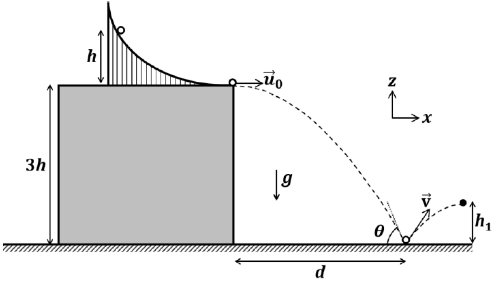
A slide with a frictionless curved surface, which becomes horizontal at its lower end, is fixed on the terrace of a building of height \( 3h \) from the ground, as shown in the figure. A spherical ball of mass \( m \) is released on the slide from rest at a height \( h \) from the top of the terrace. The ball leaves the slide with a velocity \( \,\vec{u}_0 = u_0 \hat{x} \, \) and falls on the ground at a distance \( d \) from the building making an angle \( \theta \) with the horizontal. It bounces off with a velocity \( \vec{v} \) and reaches a maximum height \( h_1 \). The acceleration due to gravity is \( g \) and the coefficient of restitution of the ground is \( \dfrac{1}{\sqrt{3}} \). Which of the following statement(s) is(are) correct?