If \( \alpha \), \( -\frac{\pi}{2} < \alpha < \frac{\pi}{2} \) is the solution of \( 4\cos\theta + 5\sin\theta = 1 \), then the value of \( \tan \alpha \) is:
Consider the function \( f : \left[ -\frac{1}{2}, 1 \right] \to \)ℝ defined by \( f(x) = 4\sqrt{2}\,x^3 - 3\sqrt{2}\,x - 1 \). Consider the statements:(I) The curve \( y = f(x) \) intersects the \( x \)-axis exactly at one point(II) The curve \( y = f(x) \) intersects the \( x \)-axis at \( x = \cos\frac{\pi}{12} \)Then:
A function \( y = f(x) \) satisfies \( f(x)\sin 2x + \sin x - (1+\cos^2 x)f'(x) = 0 \) with condition \( f(0) = 0 \). Then, \( f\!\left(\frac{\pi}{2}\right) \) is equal to:
Let \( R \) be a relation on \( \mathbb{Z} \times \mathbb{Z} \) defined by \( (a,b)\,R\,(c,d) \) if and only if \( ad-bc \) is divisible by \( 5 \). Then \( R \) is:
and \( |2A|^{3}=2^{21} \) where \( \alpha,\beta \in \mathbb{Z} \), then a value of \( \alpha \) is:
Let \( PQR \) be a triangle with \( R(-1, 4, 2) \). Suppose \( M(2, 1, 2) \) is the mid point of \( PQ \). The distance of the centroid of \( \Delta PQR \) from the point of intersection of the lines \( \frac{x-2}{0} = \frac{y}{2} = \frac{z+3}{-1} \) and \( \frac{x-1}{1} = \frac{y+3}{-3} = \frac{z+1}{1} \) is:
Let \( A \) be a square matrix such that \( AA^{T} = I \). Then \( \frac{1}{2} A \left[ (A + A^{T})^{2} + (A - A^{T})^{2} \right] \) is equal to:
A fair die is thrown until \( 2 \) appears. Then the probability, that \( 2 \) appears in even number of throws, is:
Let \( \left(5, \frac{a}{4}\right) \) be the circumcenter of a triangle with vertices \( A(a, -2) \), \( B(a, 6) \) and \( C\!\left(\frac{a}{4}, -2\right) \). Let \( \alpha \) denote the circumradius, \( \beta \) denote the area and \( \gamma \) denote the perimeter of the triangle. Then \( \alpha + \beta + \gamma \) is:
In a \( \triangle ABC \), suppose \( y = x \) is the equation of the bisector of the angle \( B \) and the equation of the side \( AC \) is \( 2x - y = 2 \). If \( 2AB = BC \) and the points \( A \) and \( B \) are respectively \( (4, 6) \) and \( (\alpha, \beta) \), then \( \alpha + 2\beta \) is equal to:
Let \( \vec{a}, \vec{b} \) and \( \vec{c} \) be three non-zero vectors such that \( \vec{b} \) and \( \vec{c} \) are non-collinear. If \( \vec{a} + 5\vec{b} \) is collinear with \( \vec{c} \), \( \vec{b} + 6\vec{c} \) is collinear with \( \vec{a} \) and \( \vec{a} + \alpha \vec{b} + \beta \vec{c} = \vec{0} \), then \( \alpha + \beta \) is equal to:
If the value of the integral \( \int_{-\pi/2}^{\pi/2} \left( \frac{x^2 \cos x}{1 + \pi^x} + \frac{1 + \sin^2 x}{1 + e^{\sin x^{2023}}} \right) \, dx = \frac{\pi}{4} (\pi + a) - 2 \), then the value of \( a \) is:
If \( z = \frac{1}{2} - 2i \) is such that \( |z + 1| = \alpha z + \beta (1 + i) \), \( i = \sqrt{-1} \) and \( \alpha, \beta \in \mathbb{R} \), then \( \alpha + \beta \) is equal to:
For \( x \in \left( -\frac{\pi}{2}, \frac{\pi}{2} \right) \), if \( y(x) = \int \frac{cosec x + \sin x}{cosec x \sec x + \tan x \sin^2 x} \, dx \), and \( \displaystyle \lim_{x \to \left( \frac{\pi}{2} \right)^{-}} y(x) = 0 \) then \( y\left( \frac{\pi}{4} \right) \) is equal to:
then range of \( (f og)(x) \) is:
Suppose $f(x) = \frac{(2^x + 2^{-x})\tan x\sqrt{\tan^{-1}(x^2 - x + 1)}}{(7x^2 + 3x + 1)^3}$. Then the value of $f'(0)$ is equal to:
Let $O$ be the origin and the position vectors of $A$ and $B$ be $2\hat{i} + 2\hat{j} + \hat{k}$ and $2\hat{i} + 4\hat{j} + 4\hat{k}$ respectively. If the internal bisector of $\angle AOB$ meets the line $AB$ at $C$, then the length of $OC$ is:
In an A.P., the sixth term \( a_6 = 2 \). If the product \( a_1 a_4 a_5 \) is the greatest, then the common difference of the A.P. is equal to:
If in a G.P. of \( 64 \) terms, the sum of all the terms is \( 7 \) times the sum of the odd terms of the G.P., then the common ratio of the G.P. is equal to:
Let \( \alpha, \beta \) be the roots of the equation \( x^2 - x + 2 = 0 \) with \( \operatorname{Im}(\alpha) > \operatorname{Im}(\beta) \). Then \( \alpha^6 + \alpha^4 + \beta^4 - 5\alpha^2 \) is equal to __________.
If the points of intersection of two distinct conics \( x^2 + y^2 = 4b \) and \( \dfrac{x^2}{16} + \dfrac{y^2}{b^2} = 1 \) lie on the curve \( y^2 = 3x^2 \), then \( 3\sqrt{3} \) times the area of the rectangle formed by intersection points is __________.
Equations of two diameters of a circle are \( 2x - 3y = 5 \) and \( 3x - 4y = 7 \). The line joining the points \( \left(-\frac{22}{7}, -4 \right) \) and \( \left( -\frac{1}{7}, 3 \right) \) intersects the circle at only one point \( P(\alpha,\beta) \). Then \( 17\beta - \alpha \) is equal to ________.
If the solution curve \( y=y(x) \) of the differential equation \( (1+y^{2})(1+\log_{e} x)\,dx + x\,dy = 0,\ x>0 \) passes through the point \( (1,1) \) and \( y(e)=\frac{\alpha-\tan\!\left(\frac{3}{2}\right)}{\beta+\tan\!\left(\frac{3}{2}\right)} \), then \( \alpha+2\beta \) is ____________.
If the mean and variance of the data \( 65, 68, 58, 44, 48, 45, 60, \alpha, \beta, 60 \) where \( \alpha>\beta \), are \( 56 \) and \( 66.2 \) respectively, then \( \alpha^{2}+\beta^{2} \) is equal to __________.
A line with direction ratios \( 2,1,2 \) meets the lines \( x=y+2=z \) and \( x+2=2y=2z \) respectively at the points \( P \) and \( Q \). If the length of the perpendicular from the point \( (1,2,12) \) to the line \( PQ \) is \( l \), then \( l^{2} \) is __________.
If \( \frac{{}^{11}C_{1}}{2}+\frac{{}^{11}C_{2}}{3}+\ldots+\frac{{}^{11}C_{9}}{10}=\frac{n}{m} \) with \( \gcd(n,m)=1 \), then \( n+m \) is equal to __________.
Let \( f(x)=2^{x}-x^{2},\ x\in \mathbb{R} \). If \( m \) and \( n \) are respectively the number of points at which the curves \( y=f(x) \) and \( y=f'(x) \) intersect the \( x \)-axis, then the value of \( m+n \) is __________.
All the letters of the word “GTWENTY” are written in all possible ways with or without meaning and these words are written as in a dictionary. The serial number of the word “GTWENTY” is __________.
The area (in sq. units) of the part of the circle \( x^2 + y^2 = 169 \) which is below the line \( 5x - y = 13 \) is \( \frac{\pi \alpha}{2\beta} - \frac{65}{2} + \frac{\alpha}{\beta} \sin^{-1}\!\left(\frac{12}{13}\right) \), where \( \alpha , \beta \) are coprime numbers. Then \( \alpha + \beta \) is equal to __________.

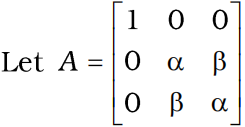 and \( |2A|^{3}=2^{21} \) where \( \alpha,\beta \in \mathbb{Z} \), then a value of \( \alpha \) is:
 then range of \( (f og)(x) \) is: