Let \( \vec{a} = 2\hat{i} + 5\hat{j} - \hat{k} \), \( \vec{b} = 2\hat{i} - 2\hat{j} + 2\hat{k} \) and \( \vec{c} \) be three vectors such that \( (\vec{c} + \hat{i}) \times (\vec{a} + \vec{b} + \hat{i}) = \vec{a} \times (\vec{c} + \hat{i}) \). If \( \vec{a}\cdot\vec{c} = -29 \), then \( \vec{c}\cdot(-2\hat{i} + \hat{j} + \hat{k}) \) is equal to:
The area enclosed between the curves \( y = x|x| \) and \( y = x - |x| \) is:
Consider three vectors \( \vec{a}, \vec{b}, \vec{c} \). Let \( |\vec{a}| = 2|\vec{b}| = 3 \) and \( \vec{a} = \vec{b}\times\vec{c} \). If \( \alpha \in \left[0,\dfrac{\pi}{3}\right] \) is the angle between the vectors \( \vec{b} \) and \( \vec{c} \), then the minimum value of \( 27\,|\vec{c}-\vec{a}|^{2} \) is equal to:
The differential equation of the family of circles passing through the origin and having centre at the line \( y = x \) is:
Let the circle \( C_{1}: x^{2}+y^{2}-2(x+y)+1=0 \) and \( C_{2} \) be a circle having centre at \( (-1,0) \) and radius \( 2 \). If the line of the common chord of \( C_{1} \) and \( C_{2} \) intersects the y-axis at the point \( P \), then the square of the distance of \( P \) from the centre of \( C_{1} \) is:
The coefficients \( a, b, c \) in the quadratic equation \( a x^{2} + b x + c = 0 \) are from the set \( \{1, 2, 3, 4, 5, 6\} \). If the probability of this equation having one real root bigger than the other is \( p \), then \( 216p \) equals
Let \( \mathrm{\beta}(m,n) =\displaystyle \int_{0}^{1} x^{m-1}(1-x)^{\,n-1}\,dx ; \, m,n>0 \). If \( \displaystyle \int_{0}^{1} (1-x^{10})^{20}\,dx = a \times \mathrm{\beta}(b,c) \), then \( 100(a+b+c) \) equals ______.
Let \( (\alpha,\beta,\gamma) \) be the image of the point \( (8,5,7) \) in the line: \( \dfrac{x-1}{2}=\dfrac{y+1}{3}=\dfrac{z-2}{5} \). Then \( \alpha+\beta+\gamma \) is equal to:
\( 60 \) words can be made using all the letters of the words \( \text{BHBJO} \), with or without meaning. If these words are written as in a dictionary, then the \( 50^{\text{th}} \) word is:
Let \( ABCD \) and \( AEFG \) be squares of side \( 4 \) and \( 2 \) units, respectively. The point \( E \) is on the line segment \( AB \) and the point \( F \) is on the diagonal \( AC \). Then the radius \( r \) of the circle passing through the point \( F \) and touching the line segments \( BC \) and \( CD \) satisfies:
Let \( S_{1}=\{z\in \mathbb{C}:|z|\le 5\} \), \( S_{2}=\left\{z\in \mathbb{C}:\operatorname{Im}\!\left(\dfrac{z+1-\sqrt{3}\,i}{1-\sqrt{3}\,i}\right)\ge 0\right\} \) and \( S_{3}=\{z\in \mathbb{C}:\operatorname{Re}(z)\ge 0\} \). Then the area of the region \( S_{1}\cap S_{2}\cap S_{3} \) is:
Let \( f:[-1,2]\to \mathbb{R} \) be given \( f(x)=2x^{2}+x+[x^{2}]-[x] \) where \( [t] \) denotes the greatest integer less than or equal to \( t \). The number of points, where \( f \) is not continuous is:
is the matrix of cofactors of the elements of \( A \), then \( \det(AB) \) is equal to:
The values of \( m, n \) for which the system of equations \( x+y+z=4 \), \( 2x+5y+5z=17 \), \( x+2y+mz=n \) has infinitely many solutions, satisfy the equation:
If the constant term in the expansion of \( \left(\dfrac{\sqrt[5]{3}}{x}+\dfrac{2x}{\sqrt[3]{5}}\right)^{12} , \; x\neq 0 \), is \(\alpha \times 2^{8} \times \sqrt[5]{3} \), then \( 25 \alpha \) is equal to:
For \( x \ge 0 \) the least value of \( K \), for which \( 4^{1+x}+4^{1-x},\; \dfrac{K}{2},\; 16^{x}+16^{-x} \) are three consecutive terms of an A.P., is equal to:
Let the set \( S=\{2,4,8,16,\ldots,512\} \) be partitioned into \( 3 \) sets \( A,B,C \) with equal number of elements such that \( A\cup B\cup C=S \) and \( A\cap B=B\cap C=A\cap C=\phi. \). The maximum number of such possible partitions of \( S \) is equal to:
Let \( A(-1,1) \) and \( B(2,3) \) be two points and \( P \) be a variable point above the line \( AB \) such that the area of \( \triangle PAB \) is \( 10 \). If the locus of \( P \) is \( ax+by=15 \), then \( 5a+2b \) is:
If \( y(\theta) = \frac{2 \cos \theta + \cos 2\theta}{\cos 3\theta + 4 \cos 2\theta + 5 \cos \theta + 2} \), then at \( \theta = \frac{\pi}{2} \), \( y'' + y' + y \) is equal to:
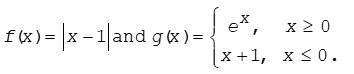
Let \( f , g : \mathbb{R} \to \mathbb{R} \) be defined as:Then the function \( f(g(x)) \) is
Let the maximum and minimum values of \( \, (\sqrt{8x - x^{2} - 12} - 4)^{2} + (x - 7)^{2} \, \), \( x \in \mathbb{R} \) be \( M \) and \( m \), respectively. Then \( M^{2} - m^{2} \) is equal to \( \_\_\_\_\_\_ \).
If \( f(t) =\displaystyle \int_{0}^{\pi} \frac{2x \, dx}{1 - \cos^{2} t \, \sin^{2} x} \), \( 0 < t < \pi \), then the value of \(\displaystyle \int_{0}^{\pi/2} \frac{\pi^{2} \, dt}{f(t)} \) equals \( \_\_\_\_\_\_ \).
Let \( a > 0 \) be a root of the equation \( 2x^{2} + x - 2 = 0 \). If \(\displaystyle \lim_{x \to \frac{1}{a}} \frac{16\left(1 - \cos\big(2 + x - 2x^{2}\big)\right)}{(1 - a x)^{2}} = \alpha + \beta \sqrt{17} \), where \( \alpha, \beta \in \mathbb{Z} \), then \( \alpha + \beta \) is equal to \( \_\_\_\_\_\_ \).
Let the point \( (+1, \alpha, \beta) \) lie on the line of the shortest distance between the lines \( \dfrac{x + 2}{-3} = \dfrac{y - 2}{4} = \dfrac{z - 5}{2} \) and \( \dfrac{x + 2}{1} = \dfrac{y + 6}{2} = \dfrac{z - 1}{0} \).Then \( (\alpha - \beta)^{2} \) is equal to \( \_\_\_\_\_\_ \).
If \( 1 + \frac{\sqrt{3}-\sqrt{2}}{\sqrt{3}} + \frac{5-2\sqrt{6}}{18} + \frac{9\sqrt{3}-11\sqrt{2}}{36\sqrt{3}} + \frac{49-20\sqrt{6}}{180} + \ldots \) upto \( \infty = 2 + \left( \sqrt{\frac{b}{a}} + 1 \right) \log_{e}\!\left( \frac{a}{b} \right) \), where \( a \) and \( b \) are integers with \( \gcd(a,b)=1 \), then \( 11a + 18b \) is equal to \( \_\_\_\_\_\_\_\_ \).
Let a line perpendicular to the line \( 2x - y = 10 \) touch the parabola \( y^{2} = 4(x - 9) \) at the point \( P \). The distance of the point \( P \) from the centre of the circle \( x^{2} + y^{2} - 14x - 8y + 56 = 0 \) is \( \_\_\_\_\_\_\_ \).
Let \( y = y(x) \) be the solution of the differential equation\( \frac{dy}{dx} + \frac{2x}{(1 + x^2)^2} y = x e^{\frac{1}{(1 + x^2)}}; \quad y(0) = 0 \), \( y(0)=0 \).Then the area enclosed by the curve \( f(x) = y(x) e^{-\frac{1}{(1 + x^2)}} \) and the line \( y-x=4 \) is \( \_\_\_\_\_\_\_ \).
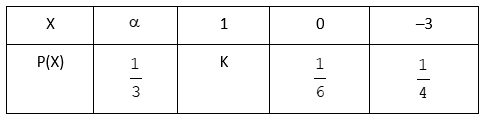
Let the mean and the standard deviation of the probability distribution
be \( \mu \) and \( \sigma \), respectively. If \( \sigma - \mu = 2 \), then \( \sigma + \mu \) is equal to \( \_\_\_\_\_\_\_ \).
The number of real solutions of the equation \( x\lvert x+5\rvert + 2\lvert x+7\rvert - 2 = 0 \) is \( \_\_\_\_\_\_\_ \).
The number of solutions of \( \sin^{2}x + (2 + 2x - x^{2})\sin x - 3(x-1)^{2} = 0 \), where \( -\pi \le x \le \pi \), is \( \_\_\_\_\_\_\_ \).

 is the matrix of cofactors of the elements of \( A \), then \( \det(AB) \) is equal to: