Let \( S = \{ x \in R : (\sqrt{3} + \sqrt{2})^x + (\sqrt{3} - \sqrt{2})^x = 10 \} \). Then the number of elements in \( S \) is:
If \( 5f(x) + 4f\!\left( \frac{1}{x} \right) = x^2 - 2 \), \( \forall x \neq 0 \) and \( y = 9x^2 f(x) \), then \( y \) is strictly increasing in:
Let \( 3, a, b, c \) be in A.P. and \( 3, a - 1, b + 1, c + 9 \) be in G.P. Then, the arithmetic mean of \( a, b \) and \( c \) is:
The area enclosed by the curves \( xy + 4y = 16 \) and \( x + y = 6 \) is equal to:
A bag contains \( 8 \) balls, whose colours are either white or black. \( 4 \) balls are drawn at random without replacement and it was found that \( 2 \) balls are white and other \( 2 \) balls are black. The probability that the bag contains equal number of white and black balls is:
Let \( f : R \to R \) and \( g : R \to R \) be defined as . Then, \( gof : R \to R \) is:
If \( n \) is the number of ways five different employees can sit into four indistinguished offices where any office may have any number of persons including zero, then \( n \) is equal to:
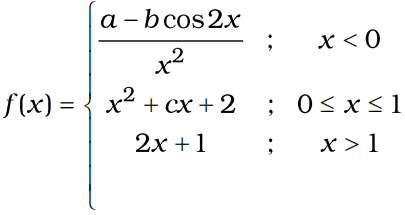
Let \( f:\mathbb{R}\to\mathbb{R} \) be defined as:If \( f \) is continuous everywhere in \( \mathbb{R} \) and \( m \) is the number of points where \( f \) is NOT differentiable then \( m+a+b+c \) equals:
The value of the integral \( \displaystyle \int_{0}^{\pi/4} \dfrac{x\,dx}{\sin^{4}(2x)+\cos^{4}(2x)} \) equals:
, \( C=ABA^{T} \) and \( X=A^{T}C^{2}A \), then \( \det X \) is equal to:
If the system of equations\( 2x+3y-z=5 \)\( x+\alpha y+3z=-4 \)\( 3x-y+\beta z=7 \)has infinitely many solutions, then \( 13\alpha\beta \) is equal to ______.
Let \( y=y(x) \) be the solution of the differential equation \( \dfrac{dy}{dx}=2x(x+y)^{3}-x(x+y)-1 \), \( y(0)=1 \). Then, \( \left(\dfrac{1}{\sqrt{2}}+y\!\left(\dfrac{1}{\sqrt{2}}\right)\right)^{2} \) equal:
Let \( \vec{a} = -5\hat{i} + \hat{j} - 3\hat{k} \), \( \vec{b} = \hat{i} + 2\hat{j} - 4\hat{k} \) and \( \vec{x} = (((\vec{a} \times \vec{b}) \times \hat{i}) \times \hat{i}) \). Then \( \vec{c} \cdot (-\hat{i} + \hat{j} + \hat{k}) \) is equal to:
Let \( C: x^{2}+y^{2}=4 \) and \( C' : x^{2}+y^{2}-4\lambda x+9=0 \) be two circles. If the set of all values of \( \lambda \) so that the circles \( C \) and \( C' \) intersect at two distinct points, is \( \mathbb{R}-[a,b] \), then the point \( (8a+12,\,16b-20) \) lies on the curve:
Let \( \frac{x^{2}}{a^{2}}+\frac{y^{2}}{b^{2}}=1 \), \( a>b \) be an ellipse, whose eccentricity is \( \frac{1}{\sqrt{2}} \) and the length of the latusrectum is \( \sqrt{14} \). Then the square of the eccentricity of \( \frac{x^{2}}{a^{2}}-\frac{y^{2}}{b^{2}}=1 \) is:
Let \( S=\{\, z\in \mathbb{C}:\ |z-1|=1 \ \text{and}\ (\sqrt{2}-1)(z+\bar{z})-i(z-\bar{z})=2\sqrt{2}\, \} \). Let \( z_{1},z_{2}\in S \) be such that \( |z_{1}|=\max\limits_{z\in S}|z| \) and \( |z_{2}|=\min\limits_{z\in S}|z| \). Then \( |\sqrt{2}\,z_{1}-z_{2}|^{2} \) equals:
$\text{If } \tan A = \frac{1}{\sqrt{x(x^2 + x + 1)}}, \; \tan B = \frac{\sqrt{x}}{\sqrt{x^2 + x + 1}} \quad \text{and} \quad \tan C = (x^{-3} + x^{-2} + x^{-1})^{1/2}, \; 0 < A, B, C < \frac{\pi}{2}, \text{ then}$ $A + B \text{ is equal to:}$
Let the median and the mean deviation about the median of \( 7 \) observation \( 170, 125, 230, 190, 210, a, b \) be \( 170 \) and \( \dfrac{205}{7} \) respectively. Then the mean deviation about the mean of these \( 7 \) observations is:
If the shortest distance between the lines \( \frac{x-\lambda}{-2}=\frac{y-2}{1}=\frac{z-1}{1} \) and \( \frac{x-\sqrt{3}}{1}=\frac{y-1}{-2}=\frac{z-2}{1} \) is \( 1 \), then the sum of all possible values of \( \lambda \) is:
For \( 0<\theta<\frac{\pi}{2} \), if the eccentricity of the hyperbola \( x^2-y^2cosec^2\theta=5 \) is \( \sqrt{7} \) times eccentricity of the ellipse \( x^2cosec^2\theta+y^2=5 \), then the value of \( \theta \) is:
Let \( 3,\,7,\,11,\,15,\,\ldots,\,403 \) and \( 2,\,5,\,8,\,11,\,\ldots,\,404 \) be two arithmetic progressions. Then the sum, of the common terms in them, is equal to ______.
Let the line \( L:\ \sqrt{2}x+y=\alpha \) pass through the point of the intersection \( P \) (in the first quadrant) of the circle \( x^2+y^2=3 \) and the parabola \( x^2=2y \). Let the line \( L \) touch two circles \( C_1 \) and \( C_2 \) of equal radius \( 2\sqrt{3} \). If the centres \( Q_1 \) and \( Q_2 \) of the circles \( C_1 \) and \( C_2 \) lie on the y-axis, then the square of the area of the triangle \( PQ_1Q_2 \) is equal to ______.
If \( \int_{-\pi/2}^{\pi/2}\frac{8\sqrt{2}\cos \,dx}{(1+e^{\sin x})(1+\sin^4 x)}=\alpha\pi+\beta\log_e(3+2\sqrt{2}) \), where \( \alpha,\,\beta \) are integers, then \( \alpha^2+\beta^2 \) equals ______.
Let \( A=\{1,2,3,\ldots,20\} \). Let \( R_1 \) and \( R_2 \) two relation on \( A \) such that,\( R_1=\{(a,b): b \text{ is divisible by } a\} \) \( R_2=\{(a,b): a \text{ is an integral multiple of } b\} \) Then, number of elements in \( R_1-R_2 \) is equal to ______.
Let the line of the shortest distance between the lines \( L_1 : \vec{r} = (\hat{i} + 2\hat{j} + 3\hat{k}) + \lambda(\hat{i} - \hat{j} + \hat{k}) \) and \( L_2 : \vec{r} = (4\hat{i} + 5\hat{j} + 6\hat{k}) + \mu(\hat{i} + \hat{j} - \hat{k}) \) intersect \( L_1 \) and \( L_2 \) at \( P \) and \( Q \) respectively. If \( (\alpha, \beta, \gamma) \) is the mid point of the line segment \( PQ \), then \( 2(\alpha + \beta + \gamma) \) is equal to ______.
If the coefficient of \( x^{30} \) in the expansion of \( \left(1+\dfrac{1}{x}\right)^{6}(1+x^{2})^{7}(1-x^{3})^{8};\, x\neq 0 \) is \( \alpha \), then \( |\alpha| \) equals ______.
Let \( P=\{z\in\mathbb{C}:\;|z+2-3i|\leq 1\} \) and \( Q=\{z\in\mathbb{C}:\; z(1+i)+\bar{z}(1-i)\leq -8\}. \) Let in \( P\cap Q,\, |z-3+2i| \) be maximum and minimum at \( z_1 \) and \( z_2 \) respectively. If \( |z_1|^{2}+2| z_2|^{2}=\alpha+\beta\sqrt{2} \), where \( \alpha,\beta \) integers, then \( \alpha+\beta \) equals ______.
The number of elements in the set \( S=\{(x,y,z):x,y,z\in\mathbb{Z},\;x+2y+3z=42,\;x,y,z\ge 0\} \) equals ______.
If \( x=x(t) \) is the solution of the differential equation \( (t+1)\,dx=(2x+(t+1)^{4})\,dt \), \( x(0)=2 \), then, \( x(1) \) equals ______.
Let $\{x\}$ denote the fractional part of $x$ and $f(x) = \frac{\cos^{-1}(1 - \{x\}^2)\sin^{-1}(1 - \{x\})}{\{x\} - \{x\}^3}, x \neq 0$. If $L$ and $R$ respectively denotes the left hand limit and the right hand limit of $f(x)$ at $x = 0$, then $\frac{32}{\pi^2}(L^2 + R^2)$ is equal to _______.

 . Then, \( gof : R \to R \) is:
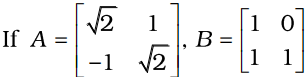 , \( C=ABA^{T} \) and \( X=A^{T}C^{2}A \), then \( \det X \) is equal to: