An urn contains \( 6 \) white and \( 9 \) black balls. Two successive draws of \( 4 \) balls are made without replacement. The probability, that the first draw gives all white balls and the second draw gives all black balls, is:
If \( y = y(x) \) is the solution curve of the differential equation \( (x^{2}-4)\,dy-(y^{2}-3y)\,dx=0, \, x>2, \, y(4)=\frac{3}{2} \) and the slope of the curve is never zero, then the value of \( y(10) \) equals:
The values of \( \alpha \), for which lie in the interval.
The position vectors of the vertices \( A, B \) and \( C \) of a triangle are \( 2\hat{i}-3\hat{j}+3\hat{k} \), \( 2\hat{i}+2\hat{j}+3\hat{k} \) and \( -\hat{i}+\hat{j}+3\hat{k} \) respectively. Let \( l \) denotes the length of the angle bisector \( AD \) of \( \angle BAC \) where \( D \) is on the line segment \( BC \), then \( 2l^{2} \) equals:
Let \(\displaystyle g(x)=3\,f\!\left(\frac{x}{3}\right)+f(3-x) \) and \( f''(x)>0 \) for all \( x\in(0,3) \). If \( g \) is decreasing in \( (0,\alpha) \) and increasing in \( (\alpha,3) \), then \( 8\alpha \) is:
Let \( \alpha=\dfrac{(4!)!}{(4!)^{3!}} \) and \( \beta=\dfrac{(5!)!}{(5!)^{4!}} \). Then:
Consider the function \( f : (0,2) \to \mathbb{R} \) defined by \( f(x)=\frac{x}{2}+\frac{2}{x} \) and the function \( g(x) \) defined by
Let the position vectors of vertices \( A, B \) and \( C \) of a triangle be \( 2\hat{i} + 2\hat{j} + \hat{k}, \, \hat{i} + 2\hat{j} + 2\hat{k} \),and \( 2\hat{i} + \hat{j} + 2\hat{k}\) respectively. Let \( l_1, l_2 \) and \( l_3 \) be the lengths of perpendiculars drawn from the ortho centre of the triangle on the sides \( AB, BC \) and \( CA \) respectively, then \( l_1^2+l_2^2+l_3^2 \) equals:
Let the image of the point \( (1,0,7) \) in the line \(\displaystyle \frac{x}{1}=\frac{y-1}{2}=\frac{z-2}{3} \) be the point \( (\alpha,\beta,\gamma) \). Then which one of the following points lies on the line passing through \( (\alpha,\beta,\gamma) \) and making angles \(\displaystyle \frac{2\pi}{3} \) and \(\displaystyle \frac{3\pi}{4} \) with \( y \)-axis and \( z \)-axis respectively and an acute angle with \( x \)-axis?
Let \( A \) and \( B \) be two finite sets with \( m \) and \( n \) elements respectively. The total number of subsets of the set \( A \) is \( 56 \) more than the total number of subsets of \( B \). Then the distance of the point \( P(m,n) \) from the point \( Q(-2,-3) \) is:
Let \( f:\mathbb{R}-\left\{\displaystyle\,\frac{-1}{2}\,\right\}\to \mathbb{R} \) and \( g:\mathbb{R}-\left\{\displaystyle\,\frac{-5}{2}\,\right\}\to \mathbb{R} \) be defined as \(\displaystyle f(x)=\frac{2x+3}{2x+1} \) and \(\displaystyle g(x)=\frac{|x|+1}{2x+5} \). Then, the domain of the function fog is:
Let \( R \) be the interior region between the lines \( 3x-y+1=0 \) and \( x+2y-5=0 \) containing the origin. The set of all values of \( a \), for which the points \( (a^2,a+1) \) lie in \( R \), is:
The integral \(\displaystyle \int \frac{(x^8-x^2)\,dx}{\left(x^{12}+3x^6+1\right)\tan^{-1}\!\left(x^3+\frac{1}{x^3}\right)} \) is equal to:
If \( 2\tan^2\theta-5\sec\theta-1 \) has exactly \( 7 \) solutions in the interval \(\displaystyle \left[0,\frac{n\pi}{2}\right] \) for the least value of \( n\in \mathbb{N} \), then \(\displaystyle \sum_{k=1}^{n} \frac{k}{2^{k}} \) is equal to:
If \( \alpha,\beta \) are the roots of the equation, \( x^{2}-x-1=0 \) and \( S_{n}=2023\,\alpha^{n}+2024\,\beta^{n} \), then:
Let \( e_1 \) be the eccentricity of the hyperbola \(\displaystyle \frac{x^2}{16}-\frac{y^2}{9}=1 \) and \( e_2 \) be the eccentricity of the ellipse \(\displaystyle \frac{x^2}{a^2}+\frac{y^2}{b^2}=1, a>b \), which passes through the foci of the hyperbola. If \( e_1 e_2=1 \), then the length of the chord of the ellipse parallel to the \( x \)-axis and passing through \( (0,2) \) is:
For \( 0 < a < 1, \) the value of the integral \( \displaystyle\int_{0}^{\pi} \frac{dx}{1 - 2a \cos x + a^2}\) is:
If \(\displaystyle \lim_{x \to 0} \frac{3 + \alpha \sin x + \beta \cos x + \log_e(1 - x)}{3 \tan^2 x} = \frac{1}{3} \), then \( 2\alpha - \beta \) is equal to:
The \( 20^{\text{th}} \) term from the end of the progression \(\displaystyle 20,\, 19\frac{1}{4},\, 18\frac{1}{2},\, 17\frac{3}{4},\, \ldots ,\, -129\frac{1}{4} \) is:
Considering only the principal values of inverse trigonometric functions, the number of positive real values of \( x \) satisfying \(\displaystyle \tan^{-1}(x)+\tan^{-1}(2x)=\frac{\pi}{4} \) is:
If the area of the region \( \{(x,y): 0 \le y \le m \) \(in \{2x,\, 6x - x^{2}\}\} \) is \( A \), then \( 12A \) is equal to __________.
If the solution curve, of the differential equation \(\displaystyle \frac{dy}{dx}=\frac{x+y-2}{x-y} \) passing through the point \( (2,1) \) is\(\displaystyle \tan^{-1}\!\left(\frac{y-1}{x-1}\right)-\frac{1}{\beta}\log_{e}\!\left(a+\left(\frac{y-1}{x-1}\right)^{2}\right)=\log_{e}|x-1|, \) then \( 5\beta+\alpha \) is equal to:
The coefficient of \( x^{2012} \) in the expansion of \( (1 - x)^{2008} (1 + x + x^{2})^{2007} \) is equal to __________ .
The lines \( \dfrac{x-2}{2}=\dfrac{y}{-2}=\dfrac{z-7}{16} \) and \( \dfrac{x+3}{4}=\dfrac{y+2}{3}=\dfrac{z+2}{1} \) intersect at the point \( P \). If the distance of \( P \) from the line \( \dfrac{x+1}{2}=\dfrac{y-1}{3}=\dfrac{z-1}{1} \) is \( l \), then \( 14\, l^{2} \) is equal to __________ .
Let the complex numbers \( \alpha \) and \( \dfrac{1}{\alpha} \) lie on the circles \( |z-z_{0}|^{2}=4 \) and \( |z-z_{0}|^{2}=16 \) respectively, where \( z_{0}=1+i \). Then, the value of \( 100\,|\alpha|^{2} \) is __________ .
Let \(\displaystyle f(x)=\int_{0}^{x} g(t)\,\log_{e}\!\left(\dfrac{1-t}{1+t}\right)\,dt \), where \( g \) is a continuous odd function.If \(\displaystyle \int_{-\pi/2}^{\pi/2} \left( f(x) + \dfrac{x^{2}\cos x}{1+e^{x}} \right) dx = \left(\dfrac{\pi}{\alpha}\right)^{2}-\alpha \), then \( \alpha \) is equal to __________ .
Let \( A \) be a \( 2 \times 2 \) real matrix and \( 1 \) be the identity matrix of order \( 2 \). If the roots of the equation \( |A - xI| = 0 \) be \( -1 \) and \( 3 \), then the sum of the diagonal elements of the matrix \( A^2 \) is __________.
If the sum of squares of all real values of \( \alpha \), for which the lines \( 2x - y + 3 = 0 \), \( 6x + 3y + 1 = 0 \) and \( a x + 2y - 2 = 0 \) do not form a triangle is \( p \), then the greatest integer less than or equal to \( p \) is __________.
Consider a circle \( (x-\alpha)^{2} + (y-\beta)^{2} = 50 \), where \( \alpha, \beta > 0 \). If the circle touches the line \( y + x = 0 \) at the point \( P \), whose distance from the origin is \( 4\sqrt{2} \), then \( (\alpha + \beta)^{2} \) is equal to __________.
The mean and standard deviation of \( 15 \) observations were found to be \( 12 \) and \( 3 \) respectively. On rechecking it was found that an observation was read as \( 10 \) in place of \( 12 \). If \( \mu \) and \( \sigma^{2} \) denote the mean and variance of the correct observations respectively, then \( 15(\mu + \mu^{2} + \sigma^{2}) \) is equal to __________.

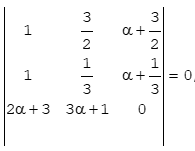 lie in the interval.
