A ray of light coming from the point \( P(1, 2) \) gets reflected from the point \( Q \) on the \( x \)-axis and then passes through the point \( R(4, 3) \). If the point \( S(h, k) \) is such that \( PQRS \) is a parallelogram, then \( hk^2 \) is equal to:
If the domain of the function \( f(x) = \sin^{-1}\!\left(\dfrac{x - 1}{2x + 3}\right) \) is \( \mathbb{R} - (\alpha, \beta) \), then \( 12\alpha\beta \) is equal to:
Let \( \alpha, \beta \) be the roots of the equation \( x^2 + 2\sqrt{2}\,x - 1 = 0 \). The quadratic equation, whose roots are \( \alpha^4 + \beta^4 \) and \( \dfrac{1}{10}(\alpha^6 + \beta^6) \), is:
Let \( f(x) = ax^3 + bx^2 + cx + 41 \) be such that \( f(1) = 40 \) , \( f'(1) = 2 \) and \( f''(1) = 4 \). Then \( a^2 + b^2 + c^2 \) is equal to:
The coefficient of \( x^{70} \) in \( x^2(1 + x)^{98} + x^3(1 + x)^{97} + x^4(1 + x)^{96} + \ldots + x^{54}(1 + x)^{46} \) is \( {}^{99}C_p - {}^{46}C_q \). Then a possible value of \( p + q \) is:
Let the line \( L \) intersect the lines \( x - 2 = -y = z - 1 \), \( 2(x + 1) = 2(y - 1) = z + 1 \) and be parallel to the line \( \dfrac{x - 2}{3} = \dfrac{y - 1}{1} = \dfrac{z - 2}{2} \). Then which of the following points lies on \( L \)?
If the sum of the series \( \frac{1}{1 \cdot (1 + d)} + \frac{1}{(1 + d)(1 + 2d)} + \ldots + \frac{1}{(1 + 9d)(1 + 10d)} \) is equal to \( 5 \), then \( 50d \) is equal to:
Let three vectors \( \vec{a}=\alpha \hat{i}+4\hat{j}+2\hat{k} \), \( \vec{b}=5\hat{i}+3\hat{j}+4\hat{k} \), \( \vec{c}=x\hat{i}+y\hat{j}+z\hat{k} \) form a triangle such that \( \vec{c}=\vec{a}-\vec{b} \) and the area of the triangle is \( 5\sqrt{6} \). If \( \alpha \) is a positive real number, then \( \left| \vec{c} \right|^{2} \) is
Let \( f(x)=x^{2}+9 \), \( g(x)=\dfrac{x}{x-9} \) and \( a=f o g(10),\, b=g o f(3) \). If \( e \) and \( l \) denote the eccentricity and the length of the latus rectum of the ellipse \( \dfrac{x^{2}}{a}+\dfrac{y^{2}}{b}=1 \), then \( 8e^{2}+l^{2} \) is equal to:
Let \( \lambda,\mu \in \mathbb{R} \). If the system of equations\( 3x+5y+\lambda z=3 \)\( 7x+11y-9z=2 \)\( 97x+155y-189z=\mu \)has infinitely many solutions; then \( \mu+2\lambda \) is equal to:
The solution of the differential equation \( (x^{2}+y^{2})dx-5xy\,dy=0, \; y(1)=0 \), is:
The shortest distance between the lines \( \frac{x-3}{4}=\frac{y+7}{-11}=\frac{z-1}{5} \) and \( \frac{x-5}{3}=\frac{y-9}{-6}=\frac{z+2}{1} \) is:
Let \( \int \frac{2-\tan x}{3+\tan x}\,dx=\frac{1}{2}\left(\alpha x+\log_{e}\left| \beta\sin x+\gamma\cos x \right|\right)+C \), where \( C \) is the constant of integration. Then \( \alpha+\frac{\gamma}{\beta} \) is equal to:
A variable line \( L \) passes through the point \( (3,5) \) and intersects the positive coordinate axes at the points \( A \) and \( B \). The minimum area of the triangle \( OAB \), where \( O \) is the origin, is:
The solution curve, of the differential equation \( 2y\frac{dy}{dx}+3=5\frac{dy}{dx} \), passing through the point \( (0,1) \), is a conic, whose vertex lies on the line:
Let \( \overrightarrow{OA}=2\vec{a},\ \overrightarrow{OB}=6\vec{a}+5\vec{b} \) and \( \overrightarrow{OC}=3\vec{b} \), where \( O \) is the origin. If the area of the parallelogram with adjacent sides \( \overrightarrow{OA} \) and \( \overrightarrow{OC} \) is \( 15 \) sq. units, then the area (in sq. units) of the quadrilateral \( OABC \) is equal to:
Let \( |\cos \theta\cos(60-\theta)\cos(60+\theta)\le \frac{1}{8},\ \theta\in[0,2\pi] \). Then, the sum of all \( \theta\in[0,2\pi] \), where \( \cos 3\theta \) attains its maximum value, is:
The parabola \( y^2 = 4x \) divides the area of the circle \( x^2 + y^2 = 5 \) in two parts. The area of the smaller part is equal to:
Let a circle passing through \( (2,0) \) have its centre at the point \( (h,k) \). Let \( (x_c,y_c) \) be the point of intersection of the lines \( 3x + 5y = 1 \) and \( (2 + c)x + 5c^2 y = 1 \). If \( h = \ \displaystyle \lim_{c \to 1} X_c and \ k = \lim_{c \to 1} y_c \), then the equation of the circle is:
The frequency distribution of the age of students in a class of \( 40 \) students is given below.
If the mean deviation about the median is \( 1.25 \), then \( 4x + 5y \) is equal to:
Let \( a \), \( b \) and \( c \) denote the outcome of three independent rolls of a fair tetrahedral die, whose four faces are marked \( 1 \), \( 2 \), \( 3 \), \( 4 \). If the probability that \( ax^2 + bx + c = 0 \) has all real roots is \( \frac{m}{n} \), \( \gcd(m,n) = 1 \), then \( m + n \) is equal to ________.
The remainder when \( 428^{2024} \) is divided by \( 21 \) is ________.
Let the centre of a circle, passing through the points \( (0,0) \), \( (1,0) \) and touching the circle \( x^2 + y^2 = 9 \), be \( (h,k) \). Then for all possible values of the coordinates of the centre \( (h,k) \), \( 4(h^2 + k^2) \) is equal to ________.
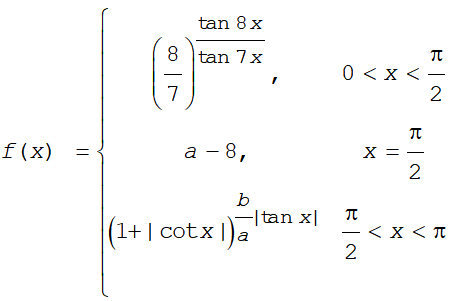
Let \( f:(0,\pi)\to \mathbb{R} \) be a function given by
If a function \( f \) satisfies \( f(m+n)=f(m)+f(n) \) for all \( m,n\in \mathbb{N} \) and \( f(1)=1 \), then the largest natural number \( \lambda \) such that \( \displaystyle \sum_{k=1}^{2022} f(\lambda+k)\le (2022)^{2} \) is equal to ________.
Let $\displaystyle \lim_{n \rightarrow \infty} \left( \frac{n}{\sqrt{n^4+1}} - \frac{2n}{(n^2+1)\sqrt{n^4+1}} + \frac{n}{\sqrt{n^4+16}} - \frac{8n}{(n^2+4)\sqrt{n^4+16}} \right) + ... + \frac{n}{\sqrt{n^4+n^4}} - \frac{2n \cdot n^2}{(n^2+n^2)\sqrt{n^4+n^4}} $ be $\frac{\pi}{k}$, using only the principal values of the inverse trigonometric functions. Then $k^2$ is equal to _______.
The sum of the square of the modulus of the elements in the set \( \left\{ z=a+ib:\; a,b\in\mathbb{Z},\; z\in \mathbb{C}\; ,\; |z-1|\le 1,\; |z-5|\le |z-5i| \right\} \) is _________.
Let \( A=\{2,3,6,7\} \) and \( B=\{4,5,6,8\} \). Let \( R \) be a relation defined on \( A\times B \) by \( (a_{1},b_{1})\,R\,(a_{2},b_{2}) \) if and only if \( a_{1}+a_{2}=b_{1}+b_{2} \). Then the number of elements in \( R \) is ________.
Let the set of all positive values of $\lambda$, for which the point of local minimum of the function $\left(1 + x(\lambda^2 - x^2)\right)$ satisfies $\frac{x^2 + x + 2}{x^2 + 5x + 6} < 0$, be $(\alpha, \beta)$. Then $\alpha^2 + \beta^2$ is equal to _______.
Let \( A \) be a non-singular matrix of order \( 3 \). If \( \det\!\big(3\,\operatorname{adj}(2\,\operatorname{adj}((\det A)\,A))\big) = 3^{-13}\cdot 2^{-10} \) and \( \det\!\big(3\,\operatorname{adj}(2A)\big) = 2^{m}\cdot 3^{n} \), then \( |3m + 2n| \) is equal to ________.