The set of all \( \alpha \), for which the vectors \( \vec{a} = \alpha t \hat{i} + 6\hat{j} - 3\hat{k} \) and \( \vec{b} = t\hat{i} - 2\hat{j} - 2\alpha t \hat{k} \) are inclined an obtuse angle for all \( t \in \mathbb{R} \), is:
Let \( f(x) = 4\cos^{3}x + 3\sqrt{3}\cos^{2}x - 10 \). The number of points of local maxima of \( f \) in interval \( (0,\, 2\pi) \) is:
The value of \( k \in \mathbb{N} \) for which the integral \( I_{n} = \int_{0}^{1} (1 - x^{k})^{n} \, dx, \ n \in \mathbb{N}, \) satisfies \( 147 I_{20} = 148 I_{21} \) is:
Let $z$ be a complex number such that $|z+2|=1$ and $\operatorname{Im}\left(\frac{z+1}{z+2}\right)=\frac{1}{5}$. Then the value of $\left|\operatorname{Re}(\overline{z+2})\right|$ is:
If the shortest distance between the lines;\( L_{1} : \ \vec{r} = (2 + \lambda)\hat{i} + (1 - 3\lambda)\hat{j} + (3 + 4\lambda)\hat{k}, \ \lambda \in \mathbb{R} \)\( L_{2} : \ \vec{r} = 2(1 + \mu)\hat{i} + 3(1 + \mu)\hat{j} + (5 + \mu)\hat{k}, \ \mu \in \mathbb{R} \)is \( \dfrac{m}{\sqrt{n}} \), where \( \gcd(m, n) = 1 \), then the value of \( m + n \) equals:
Let \( P(x, y, z) \) be a point in the first octant, whose projection in the \( xy \)-plane is the point \( Q \). Let \( OP = \gamma \); the angle between \( OQ \) and the positive \( x \)-axis be \( \theta \); and the angle between \( OP \) and the positive \( z \)-axis be \( \phi \), where \( O \) is the origin. Then the distance of \( P \) from the \( x \)-axis is:
Let \( I(x) = \int \frac{6}{\sin^2 x \, (1-\cot x)^2} \, dx \). If \( I(0) = 3 \), then \( I\!\left(\frac{\pi}{12}\right) \) is equal to:
Let the circles \( C_1 : (x-\alpha)^2 + (y-\beta)^2 = r_1^2 \) and \( C_2 : (x-8)^2 + \left(y-\frac{15}{2}\right)^2 = r_2^2 \) touch each other externally at the point \( (6,6) \). If the point \( (6,6) \) divides the line segment joining the centres of the circles \( C_1 \) and \( C_2 \) internally in the ratio \( 2:1 \), then \( (\alpha+\beta) + 4(r_1^2 + r_2^2) \) equals:
The sum of all the solutions of the equation \( (8)^{2x} - 16\cdot(8)^{x} + 48 = 0 \) is:
If the set \( R = \{(a,b): a + 5b = 42,\, a,b \in \mathbb{N}\} \) has \( m \) elements and \( \displaystyle \sum_{n=1}^{m} (1 - i^{n!}) = x + i y \), where \( i = \sqrt{-1} \), then the value of \( m + x + y \) is:
The number of critical points of the function \( f(x) = (x-2)^{2/3} (2x+1) \) is:
Let \( [t] \) be the greatest integer less than or equal to \( t \). Let \( A \) be the set of all prime factors of \( 2310 \) and \( f : A \to \mathbb{Z} \) be the function \( f(x) = \left[ \log_{2} \left( x^{3} + \left[ \frac{x^{3}}{5} \right] \right) \right] \). The number of one-to-one functions from \( A \) to the range of \( f \) is:
For the function \( f(x) = (\cos x) - x + 1, \ x \in \mathbb{R} \), between the following two statements:Statement-1 : \( f(x) = 0 \) for only one value of \( x \) in \( [0, \pi] \).Statement-2 : \( f(x) \) is decreasing in \( [0, \frac{\pi}{2}] \) and increasing in \( [\frac{\pi}{2}, \pi] \).
Let \( y = y(x) \) be the solution of the differential equation, \( (1 + y^{2}) e^{\tan x} \, dx + \cos^{2} x \, (1 + e^{2 \tan x}) \, dy = 0 \), \( y(0) = 1 \). Then \( y\!\left(\frac{\pi}{4}\right) \) is equal to:
If \( \sin x = -\frac{3}{5} \), where \( \pi < x < \frac{3\pi}{2} \), then \( 80(\tan^{2} x - \cos x) \) is equal to:
The equations of two sides \( AB \) and \( AC \) of a triangle \( ABC \) are \( 4x + y = 14 \) and \( 3x - 2y = 5 \), respectively. The point \( \left(2, \frac{4}{3}\right) \) divides the third side \( BC \) internally in the ratio \( 2:1 \), the equation of the side \( BC \) is:
Let the sum of two positive integers be \( 24 \). If the probability, that their product is not less than \( \frac{3}{4} \) times their greatest possible product, is \( \frac{m}{n} \), where \( \gcd(m,n) = 1 \), then \( n - m \) equals:
Let \( f(x) \) be a positive function such that the area bounded by \( y = f(x) \), \( y = 0 \) from \( x = 0 \) to \( x = a > 0 \) is \( e^{-a} + 4a^{2} + a - 1 \). Then the differential equation, whose general solution is \( y = c_{1} f(x) + c_{2} \), where \( c_{1} \) and \( c_{2} \) are arbitrary constants, is:
. If \( A^3 = 4A^2 - A - 21I \), where \( I \) is the identity matrix of order \( 3 \times 3 \), then \( 2a + 3b \) is equal to:
Let \( H : \frac{-x^2}{a^2} + \frac{y^2}{b^2} = 1 \) be the hyperbola, whose eccentricity is \( \sqrt{3} \) and the length of the latus rectum is \( 4\sqrt{3} \). Suppose the point \( (\alpha, 6) \), \( \alpha > 0 \) lies on \( H \). If \( \beta \) is the product of the focal distances of the point \( (\alpha, 6) \), then \( \alpha^2 + \beta \) is equal to:
The value of \( \displaystyle \lim_{x \to 0} 2\left( \frac{1-\cos x \sqrt{\cos 2x}\, \sqrt[3]{\cos 3x}\, \ldots \, \sqrt[10]{\cos 10x}}{x^2} \right) \) is ______.
. If the sum of the diagonal elements of \( A^{13} \) is \( 3^n \), then \( n \) is equal to ______.
Let \( \vec{a} = 9\hat{i} - 13\hat{j} + 25\hat{k} \), \( \vec{b} = 3\hat{i} + 7\hat{j} - 13\hat{k} \) and \( \vec{c} = 17\hat{i} - 2\hat{j} + \hat{k} \) be three given vectors. If \( \vec{r} \) is a vector such that \( \vec{r} \times \vec{a} = (\vec{b} + \vec{c}) \times \vec{a} \) and \( \vec{r} \cdot (\vec{b} - \vec{c}) = 0 \), then \( \dfrac{\left|593 \vec{r} + 67 \vec{a}\right|^2}{(593)^2} \) is equal to ______.
If range of \( f(\theta) = \dfrac{\sin^4 \theta + 3\cos^2 \theta}{\sin^4 \theta + \cos^2 \theta} , \\ \theta \in \mathbb{R} \) is \( [\alpha, \beta] \), then the sum of the infinite G.P., whose first term is \( 64 \) and the common ratio is \( \dfrac{\alpha}{\beta} \), is equal to ______.
The number of \( 3 \)-digit numbers, formed using the digits \( 2, 3, 4, 5 \) and \( 7 \), when the repetition of digits is not allowed, and which are not divisible by \( 3 \), is equal to _______.
Three balls are drawn at random from a bag containing \( 5 \) blue and \( 4 \) yellow balls. Let the random variables \( X \) and \( Y \) respectively denote the number of blue and yellow balls. If \( \overline{X} \) and \( \overline{Y} \) are the means of \( X \) and \( Y \) respectively, then \( 7\overline{X} + 4\overline{Y} \) is equal to _______.
If the orthocentre of the triangle formed by the lines \( 2x + 3y - 1 = 0 \), \( x + 2y - 1 = 0 \) and \( ax + by - 1 = 0 \), is the centroid of another triangle, whose circumcentre and orthocentre respectively are \( (3, 4) \) and \( (-6, -8) \), then the value of \( |a - b| \) is _______.
Let \( \alpha = \displaystyle \sum_{r=0}^{n} (4r^{2} + 2r + 1)\, { }^{n}C_{r} \), and \( \beta = \left( \displaystyle \sum_{r=0}^{n} \frac{{ }^{n}C_{r}}{r+1} \right) + \frac{1}{n+1} \). If \( 140 < \frac{2\alpha}{\beta} < 281 \), then the value of \( n \) is _______.
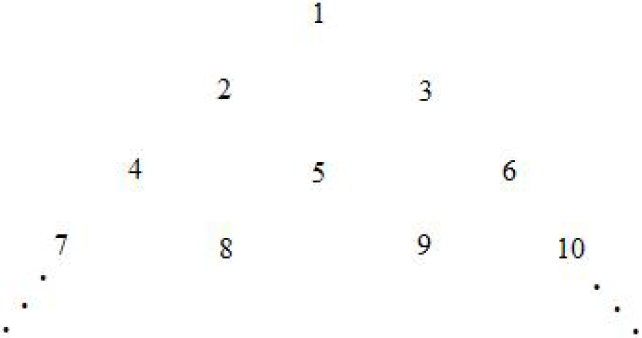
Let the positive integers be written in the form: If the \( k^{\text{th}} \) row contains exactly \( k \) numbers for every natural number \( k \), then the row in which the number \( 5310 \) will be, is _______.
Let the area of the region enclosed by the curve \( y = \min(\sin x, \cos x) \) and the x-axis between \( x = -\pi \) to \( x = \pi \) be \( A \). Then \( A^{2} \) is equal to _______.

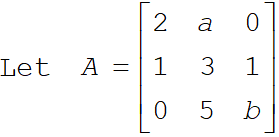 . If \( A^3 = 4A^2 - A - 21I \), where \( I \) is the identity matrix of order \( 3 \times 3 \), then \( 2a + 3b \) is equal to:
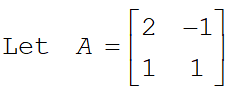 . If the sum of the diagonal elements of \( A^{13} \) is \( 3^n \), then \( n \) is equal to ______.