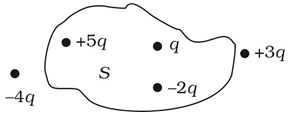
Five charges \( +q \), \( +5q \), \( -2q \), \( +3q \) and \( -4q \) are situated as shown in the figure. The electric flux due to this configuration through the surface \( S \) is:
\( \dfrac{5q}{\varepsilon_{0}} \)
\( \dfrac{q}{\varepsilon_{0}} \)
\( \dfrac{4q}{\varepsilon_{0}} \)
\( \dfrac{3q}{\varepsilon_{0}} \)
Two point charges \( 8\,\mu\text{C} \) and \( -2\,\mu\text{C} \) are located at \( x = 2 \, \text{cm} \) and \( x = 4 \, \text{cm} \), respectively on the \( x \)-axis. The ratio of electric flux due to these charges through two spheres of radii \( 3 \, \text{cm} \) and \( 5 \, \text{cm} \) with their centers at the origin is ______.
A simple pendulum has a bob with mass $m$ and charge $q$. The pendulum string has negligible mass. When a uniform and horizontal electric field $\vec{E}$ is applied, the tension in the string changes. The final tension in the string, when pendulum attains an equilibrium position is _________. ($g$: acceleration due to gravity)
A rigid dipole undergoes a simple harmonic motion about its centre in the presence of an electric field \( \vec{E}_1 = E_0 \hat{k} \). If another electric field \( \vec{E}_2 = 2E_0(\hat{y} + \hat{z}) \) is introduced to the system, what will be the percentage change in the frequency of the oscillation (approximate)?
Two point charges \( A \) and \( B \) of magnitude \( +8 \times 10^{-6} \, \text{C} \) and \( -8 \times 10^{-6} \, \text{C} \) respectively are placed at a distance \( d \) apart. The electric field at the middle point \( O \) between the charges is \( 6.4 \times 10^{4} \, \text{N C}^{-1} \). The distance \( 'd' \) between the point charges \( A \) and \( B \) is:
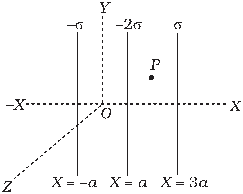
Three infinitely long charged thin sheets are placed as shown in figure. The magnitude of electric field at the point \( P \) is \( \dfrac{x \sigma}{\varepsilon_0} \). The value of \( x \) is _____ (all quantities are measured in SI units).
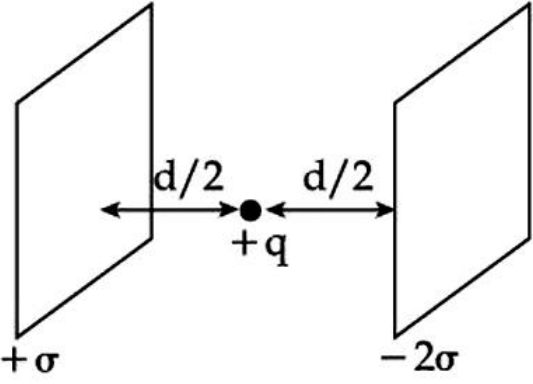
Consider two infinitely large plane parallel conducting plates as shown below. The plates are uniformly charged with a surface charge density \( +\sigma \) and \( -2\sigma \). The force experienced by a point charge \( +q \) placed at the mid point between two plates will be:
Consider two identical metallic spheres of radius \( R \) each having charge \( Q \) and mass \( m \). Their centers have an initial separation of \( 4R \). Both the spheres are given an initial speed of \( u \) towards each other. The minimum value of \( u_0 \), so that they can just touch each other is: \( \text{( Take } k = \dfrac{1}{4\pi \varepsilon_0} \text{ and assume } kQ^2 > G m^2 \text{ where } G \text{ is the Gravitational constant )} \)
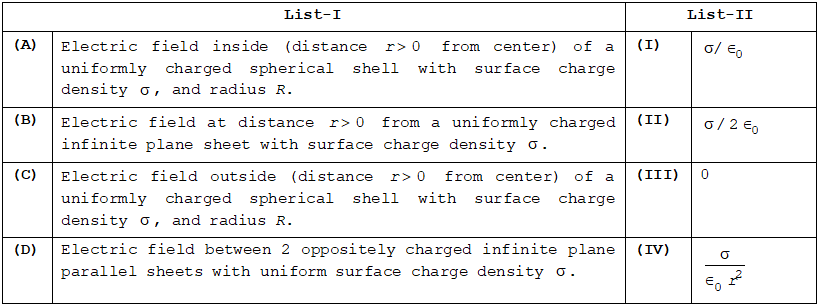
Match List - I with List - II.Choose the correct answer from the options given below:
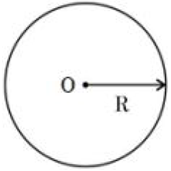
Graphical variation of electric field due to a uniformly charged insulating solid sphere of radius \( R \), with distance \( r \) from the centre \( O \) is represented by:
A three coulomb charge moves from the point \( (0,-2,-5) \) to the point \( (5,1,2) \) in an electric field expressed as \( \vec{E} = 2x\,\hat{i} + 3y^{2}\,\hat{j} + 4\,\hat{k}\ \mathrm{N/C} \). The work done in moving the charge is ______ \( \text{J} \).
Which of the following correctly represents the variation of electric potential \( (V) \) of a charged spherical conductor of radius \( (R) \) with radial distance \( (r) \) from the centre?
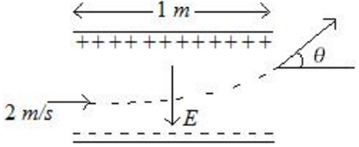
A uniform electric field \( E = (8m/e) \, \text{V/m} \) is created between two parallel plates of length \( 1 \, \text{m} \) as shown in figure, (where \( m = \) mass of electron and \( e = \) charge of electron). An electron enters the field symmetrically between the plates with a speed of \( 2 \, \text{m/s} \). The angle of the deviation \( ( \theta ) \) of the path of the electron as it comes out of the field will be ________.
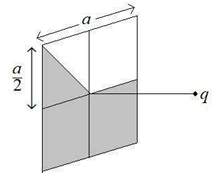
A square loop of sides $a = 1\text{m}$ is held normally in front of a point charge $q = 1\text{C}$. The flux of the electric field through the shaded region is $\frac{5}{p} \times \frac{1}{\varepsilon_0} \frac{\text{Nm}^2}{\text{C}}$, where the value of $p$ is _______ .
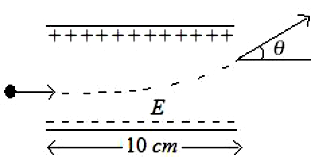
A uniform electric field of \( 10 \, \text{N/C} \) is created between two parallel charged plates (as shown in figure). An electron enters the field symmetrically between the plates with a kinetic energy \( 0.5 \, \text{eV} \). the length of each plate is \( 10 \, \text{cm} \). The angle (\( \theta \)) of deviation of the path of electron as it comes out of the field is ________ (in degree).
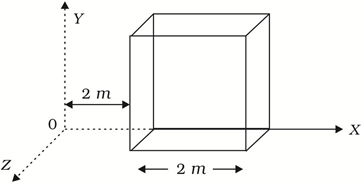
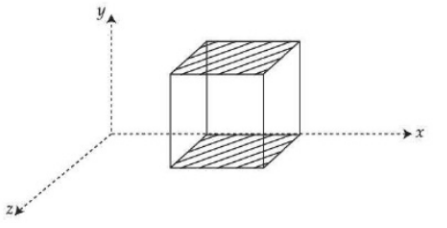
An electric field \( \vec{E} = (2x\hat{i}) \, \text{N} \, \text{C}^{-1} \) exists in space. A cube of side \( 2 \, \text{m} \) is placed in the space as per figure given below. The electric flux through the cube is ____ \( \text{N}\,\text{m}^{2}/\text{C} \).
A dipole comprises of two charged particles of identical magnitude \( q \) and opposite in nature. The mass \( 'm '\) of the positive charged particle is half of the mass of the negative charged particle. The two charges are separated by a distance \( 'l' \). If the dipole is placed in a uniform electric field, \('\bar E '\), in such a way that dipole axis makes a very small angle with the electric field, \('\bar E' \). The angular frequency of the oscillations of the dipole when released is given by:
If the electric potential at any point \( (x, y, z) \, \text{m} \) in space is given by \( V = 3x^{2} \) volt. The electric field at the point \( (1, 0, 3) \, \text{m} \) will be:
A point charge of \( 10^{-8} \, \text{C} \) is placed at origin. The work done in moving a point charge \( 2 \, \mu \text{C} \) from point \( A(4, 4, 2) \, \text{m} \) to \( B(2, 2, 1) \, \text{m} \) is ______________ \( \text{J} \). \( \left( \frac{1}{4 \pi \varepsilon_{0}} = 9 \times 10^{9} \text{ in SI units} \right) \)
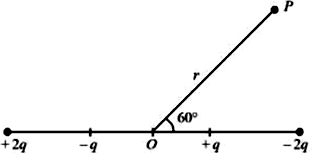
The distance between charges \( +q \) and \( -q \) is \( 2l \) and between \( +2q \) and \( -2q \) is \( 4l \). The electrostatic potential at point \( P \) at a distance \( r \) from centre \( O \) is \( -\alpha \left[ \dfrac{ql}{r^{2}} \right] \times 10^{9} \, \text{V} \), where the value of \( \alpha \) is ________. [Use \( \dfrac{1}{4\pi\varepsilon_{0}} = 9 \times 10^{9} \, \text{N m}^{2} \text{C}^{-2} \)]
An electric dipole of dipole moment \( 6 \times 10^{-6} \, \text{cm} \) is placed in uniform electric field of magnitude \( 10^{6} \, \text{V/m} \). Initially, the dipole moment is parallel to electric field. The work that needs to be done on the dipole to make its dipole moment opposite to the field, will be __________ \( \text{J} \).
Two identical metallic spheres A and B when placed at certain distance in air repel each other with a force of \( F \). Another identical uncharged sphere C is first placed in contact with A and then in contact with B and finally placed at midpoint between spheres A and B. The force experienced by sphere C will be:
The electric field in a region is given by \( \vec{E} = \dfrac{2}{5} E_{0} \hat{i} + \dfrac{3}{5} E_{0} \hat{j} \) with \( E_{0} = 4.0 \times 10^{3} \, \dfrac{N}{C} \). The flux of this field through a rectangular surface area \( 0.4 \, \mathrm{m^{2}} \) parallel to the \( Y - Z \) plane is _______ \( \mathrm{N\,m^{2}\,C^{-1}} \).
An infinite plane sheet of charge having uniform surface charge density \( +\sigma_{s} \, \text{C} \, /\text{m}^{2} \) is placed on x–y plane. Another infinitely long line charge having uniform linear charge density \( +\lambda_{\ell} \, \text{C} \,/ \text{m} \) is placed at \( z = 4 \, \text{m} \) plane and parallel to y-axis. If the magnitude values \( |\sigma_{s}| = 2|\lambda_{e}| \) then at point \( (0, 0, 2) \), the ratio of magnitudes of electric field values due to sheet charge to that of line charge is \( \pi \sqrt{n} : 1 \). The value of \( n \) is __________.
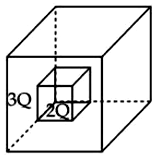
\( C_1 \) and \( C_2 \) are two hollow concentric cubes enclosing charges \( 2Q \) and \( 3Q \) respectively as shown in figure. The ratio of electric flux passing through \( C_1 \) and \( C_2 \) is:
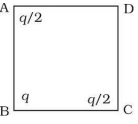
The three charges \( \dfrac{q}{2} \), \( q \) and \( \dfrac{q}{2} \) are placed at the corners \( A \), \( B \) and \( C \) of a square of side \( a \) as shown in figure. The magnitude of electric field \( (E) \) at the corner \( D \) of the square, is:
A thin metallic wire having cross sectional area of \( 10^{-4} \, \text{m}^2 \) is used to make a ring of radius \( 30 \, \text{cm} \). A positive charge of \( 2\pi \, \text{C} \) is uniformly distributed over the ring, while another positive charge of \( 30 \, \text{pC} \) is kept at the centre of the ring. The tension in the ring is __________ \( \text{N} \); provided that the ring does not get deformed (neglect the influence of gravity). \( \left( \text{given, } \frac{1}{4\pi \epsilon_0} = 9 \times 10^{9} \, \text{SI units} \right) \)
Suppose a uniformly charged wall provides a uniform electric field of \( 2 \times 10^{4} \, \text{N/C} \) normally. A charged particle of mass \( 2 \, \text{g} \) being suspended through a silk thread of length \( 20 \, \text{cm} \) and remain stayed at a distance of \( 10 \, \text{cm} \) from the wall. Then the charge on the particle will be \( \dfrac{1}{\sqrt{x}} \, \mu \text{C} \) where \( x = \_\_\_\_\_\_\_\_\_\_ \). [use \( g = 10 \, \text{m/s}^{2} \) ]
Two identical charged spheres are suspended by strings of equal lengths. The strings make an angle of \( 37^\circ \) with each other. When suspended in a liquid of density \( 0.7\ \text{g}/\text{cm}^3 \), the angle remains same. If density of material of the sphere is \( 1.4\ \text{g}/\text{cm}^3 \), the dielectric constant of the liquid is ______ \( \left( \tan 37^\circ = \dfrac{3}{4} \right) \).
Three infinitely long wires with linear charge density \( \lambda \) are placed along the \( x \)-axis, \( y \)-axis and \( z \)-axis respectively. Which of the following denotes an equipotential surface?
A bar magnet having a magnetic moment of \( 2.0 \times 10^{5} \, \text{J}\,\text{T}^{-1} \), is placed along the direction of uniform magnetic field of magnitude \( B = 14 \times 10^{-5} \, \text{T} \). The work done in rotating the magnet slowly through \( 60^\circ \) from the direction of field is:
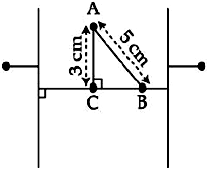
Two large plane parallel conducting plates are kept \( 10 \, \text{cm} \) apart as shown in figure. The potential difference between them is \( V \). The potential difference between the points \( A \) and \( B \) (shown in the figure) is:
Two small spherical balls of mass \( 10\,\text{g} \) each with charges \( -2\,\mu\text{C} \) and \( 2\,\mu\text{C} \), are attached to two ends of very light rigid rod of length \( 20\,\text{cm} \). The arrangement is now placed near an infinite non-conducting charge sheet with uniform charge density of \( 100\,\mu\text{C}/\text{m}^{2} \) such that length of rod makes an angle of \( 30^\circ \) with electric field generated by charge sheet. Net torque acting on the rod is:(Take \( \varepsilon_{0}:8.85\times10^{-12}\,\text{C}^{2}/\text{Nm}^{2} \) )
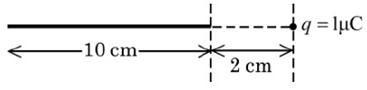
A point charge \( q = 1 \, \mu \text{C} \) is located at a distance \( 2 \, \text{cm} \) from one end of a thin insulating wire of length \( 10 \, \text{cm} \) having a charge \( Q = 24 \, \mu \text{C} \), distributed uniformly along its length, as shown in figure. Force between \( q \) and wire is ______________ \( \text{N} \).(Use: \( \dfrac{1}{4 \pi \varepsilon_{0}} = 9 \times 10^{9} \, \text{N m}^{2} / \text{C}^{2} )\)
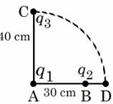
Two charges \( q_1 \) and \( q_2 \) are separated by a distance of \( 30 \, \text{cm} \). A third charge \( q_3 \) initially at ‘C’ as shown in the figure, is moved along the circular path of radius \( 40 \, \text{cm} \) C to D. If the difference in potential energy due to movement of \( q_3 \) from C to D is given by \( \dfrac{q_3 K}{4 \pi \varepsilon_0} \), the value of \( K \) is:
A point charge of \( 10\,\mu\text{C} \) is placed at the origin. At what location on the x-axis should a point charge of \( 40\,\mu\text{C} \) be placed so that the net electric field is zero at \( x = 2\,\text{cm} \) on the x-axis?
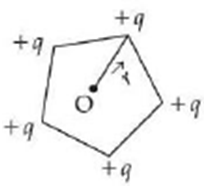
Five positive charges each having charge \( q \) are placed at the vertices of a pentagon as shown in the figure. The electric potential \( (V) \) and the electric field \( (\vec{E} )\) at the center \( O \) of the pentagon due to these five positive charges are:
A thin infinite sheet charge and an infinite line charge of respective charge densities \( +\sigma \) and \( +\lambda \) are placed parallel at \( 5 \, \text{m} \) distance from each other. Points ‘P’ and ‘Q’ are at \( \dfrac{3}{\pi} \, \text{m} \) and \( \dfrac{4}{\pi} \, \text{m} \) perpendicular distances from line charge towards sheet charge, respectively. ‘\( E_P \)’ and ‘\( E_Q \)’ are the magnitudes of resultant electric field intensities at point ‘P’ and ‘Q’, respectively. If \( \dfrac{E_P}{E_Q} = \dfrac{4}{a} \) for \( 2|\sigma| \neq |\lambda| \), then the value of \( a \) is ______
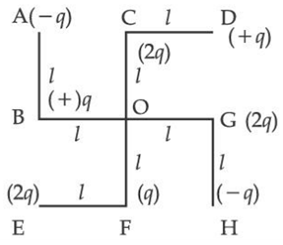
What will be the magnitude of electric field at point \( O \) as shown in figure? Each side of the figure is \( l \) and perpendicular to each other?
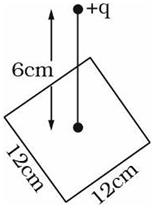
A point charge of \( +12 \, \mu\text{C} \) is at a distance \( 6 \, \text{cm} \) vertically above the centre of a square of side \( 12 \, \text{cm} \) as shown in figure. The magnitude of the electric flux through the square will be ________ \( \times 10^{3} \, \text{N m}^2/\text{C} \).
A simple pendulum of '\(m\)',length '\(l\)' and charge '\(+q\)' suspended in the electric field produced by two conducting parallel plates as shown. The value of deflection of pendulum in equilibrium position will be:
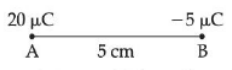
Two particles A and B having charges \( 20\,\mu\text{C} \) and \( -5\,\mu\text{C} \) respectively are held fixed with a separation of \( 5\,\text{cm} \). At what position a third charged particle should be placed so that it does not experience a net electric force?
A long cylindrical volume contains a uniformly distributed charge of density \( \rho \). The radius of cylindrical volume is \( R \). A charge particle (\( q \)) revolves around the cylinder in a circular path. The kinetic energy of the particle is:
A dipole with two electric charges of \( 2 \, \mu \text{C} \) magnitude each, with separation distance \( 0.5 \, \mu \text{m} \), is placed between the plates of a capacitor such that its axis is parallel to an electric field established between the plates when a potential difference of \( 5 \, \text{V} \) is applied. Separation between the plates is \( 0.5 \, \text{mm} \). If the dipole is rotated by \( 30^\circ \) from the axis, it tends to realign in the direction due to a torque. The value of torque is:
Two identical tennis balls each having mass '\( m \)' and charge '\( q \)' are suspended from a fixed point by threads \(\sigma\) length '\( l \)'. What is the equilibrium separation when each thread makes a small angle '\( \theta \)' with the vertical?
Three small identical bubbles of water having same charge on each coalesce to form a bigger bubble. Then the ratio of the potentials on one initial bubble and that on the resultant bigger bubbles is:
Given below are two statements: One is labelled as Assertion A and the other is labelled as Reason (R). Assertion A: Two metallic spheres are charged to the same potential. One of them is hollow and another is solid, and both have the same radii. Solid sphere will have lower charge than the hollow one. Reason R: Capacitance of metallic spheres depend on the radii of spheres. In the light of the above statements, choose the correct answer from the options given below:
In hydrogen like system the ratio of coulombian force and gravitational force between an electron and a proton is in the order of:
Two charges each of magnitude \( 0.01 \, \text{C} \) and separated by a distance of \( 0.4 \, \text{mm} \) constitute an electric dipole. If the dipole is placed in an uniform electric field ‘\( \vec{E} \)’ of \( 10 \, \text{dyne}/\text{C} \) making \( 30^\circ \) angle with \( \vec{E} \), the magnitude of torque acting on dipole is:
Two charges \( 7 \,\mu \text{C} \) and \( -4 \,\mu \text{C} \) are placed at \( (-7 \, \text{cm}, 0, 0) \) and \( (7 \, \text{cm}, 0, 0) \) respectively. Given, \( \varepsilon_0 = 8.85 \times 10^{-12} \, \text{C}^2 \, \text{N}^{-1} \, \text{m}^{-2} \), the electrostatic potential energy of the charge configuration is:
Two charges of \( 5Q \) and \( -2Q \) are situated at the points \( (3a, 0) \) and \( (-5a, 0) \) respectively. The electric flux through a sphere of radius \( 4a \) having center at origin is:
Given below are two statements: one is labelled as Assertion A and the other is labelled as Reason R.Assertion A: In electrostatics, a conductor does not store any net charge inside.Reason R: Inside the capacitor (with no dielectric medium), the free charge carriers, if placed between the plates of capacitor, experience force and drift.Choose the correct answer from the options given below:
Given below are two statements: one is labelled as Assertion A and the other is labelled as Reason RAssertion A: If an electric dipole of dipole moment \(30 \times 10^{-5} \, \text{C m}\) is enclosed by a closed surface, the net flux coming out of the surface will be zero.Reason R:Electric dipole consists of two equal and opposite charges.In the light of above, statements, choose the correct answer from the options given below.
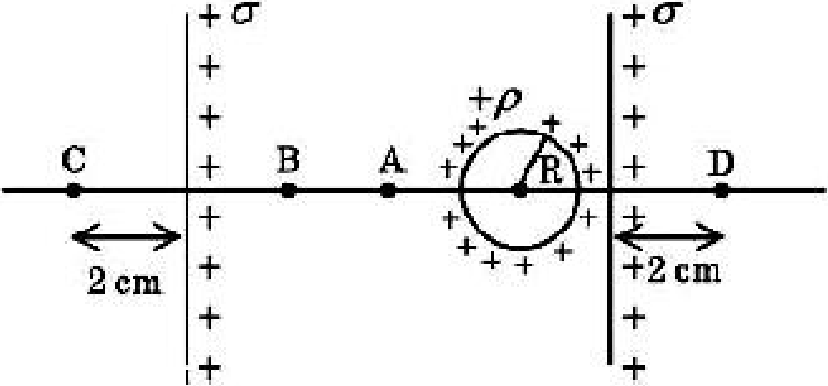
Two infinite identical charged sheets and a charged spherical body of charge density ‘\( \rho \)’ are arranged as shown in figure. Then the correct relation between the electrical fields at \( A, B, C \) and \( D \) points is:
Two ideal electric dipoles \( A \) and \( B \), having their dipole moment \( p_1 \) and \( p_2 \) respectively are placed on a plane with their centres at \( O \) as shown in the figure. At point \( C \) on the axis of dipole \( A \), the resultant electric field is making an angle of \( 37^\circ \) with the axis. The ratio of the dipole moment of \( A \) and \( B \), \( \dfrac{p_1}{p_2} \) is : \( \left(\text{Take } \sin 37^\circ C= \dfrac{3}{5}\right) \).
Three concentric spherical metallic shells X, Y and Z of radius \( a \), \( b \) and \( c \) respectively \([ a < b < c ]\) have surface charge densities \( \sigma \), \( -\sigma \) and \( \sigma \), respectively. The shells X and Z are at same potential. If the radii of X and Y are \( 2 \, \text{cm} \) and \( 3 \, \text{cm} \), respectively. The radius of shell Z is ________ \( \text{cm} \).
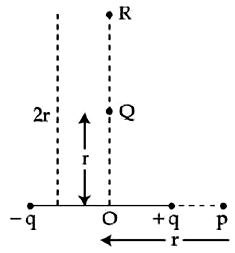
The electric field at point \( p \) due to an electric dipole is \( E \). The electric field at point \( R \) on equatorial line will be \( \dfrac{E}{x} \). The value of \( x \):
A cube is placed inside an electric field, \( \vec{E}=150y^{2}\,\hat{j} \). The side of the cube is \( 0.5 \, \text{m} \) and is placed in the field as shown in the given figure. The charge inside the cube is:
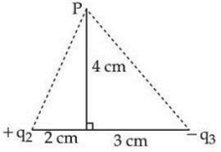
Three point charges of magnitude \( 5 \, \mu\text{C} \), \( 0.16 \, \mu\text{C} \) and \( 0.3 \, \mu\text{C} \) are located at the vertices A, B, C of a right angled triangle whose sides are \( AB = 3 \, \text{cm} \), \( BC = 3\sqrt{2} \, \text{cm} \) and \( CA = 3 \, \text{cm} \) and point A is the right angle corner. Charge at point A experiences __________ \( \text{N} \) of electrostatic force due to the other two charges.
Two uniformly charged spherical conductors A and B of radii \( 5 \, \text{mm} \) and \( 10 \, \text{mm} \) are separated by a distance of \( 2 \, \text{cm} \). If the spheres are connected by a conducting wire, then in equilibrium condition. The ratio of the magnitudes of the electric fields at the surface of the sphere A and B will be:
A thin half ring of radius \( 35 \, \text{cm} \) is uniformly charged with a total charge of \( Q \) coulomb. If the magnitude of the electric field at centre of the half ring is \( 100 \, \text{V/m} \), then the value of \( Q \) is _____ \( \text{nC} \). \( (\varepsilon_0 = 8.85 \times 10^{-12} \, \text{C}^2 / \text{Nm}^2 \) and \( \pi = 3.14) \)
The electric potential as a function of \( x, y \) is given by \( V = 5(x^{2} - y^{2}) \, \text{V} \). The electric field at a point \( (2, 3) \, \text{m} \) is ______ \( \text{V/m} \).
Given below are two statements: one is labelled as Assertion (A) and the other is labelled as Reason (R).Assertion (A): Work done by electric field on moving a positive charge on an equipotential surface is always zero.Reason (R): Electric lines of forces are always perpendicular to equipotential surfaces.In the light of the above statements, choose the most appropriate answer from the options given below:
A vertical electric field of magnitude \( 4.9 \times 10^{5} \, \text{N}/\text{C} \) just prevents a water droplet of a mass \( 0.1 \, \text{g} \) from falling. The value of charge on the droplet will be: (Given \( g = 9.8 \, \text{m}/\text{s}^{2} \))
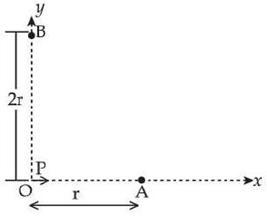
If the net electric field at point P along Y axis is zero, then the radius of \( \left|\dfrac{q_{2}}{q_{3}}\right| \) is \( \dfrac{8}{5\sqrt{x}} \), where \( x = \) ______.
A small uncharged conducting sphere is placed in contact with an identical sphere but having \( 4 \times 10^{-8} \, \text{C} \) charge and then removed to a distance such that the force of repulsion between them is \( 9 \times 10^{-3} \, \text{N} \). The distance between them is (Take \( \frac{1}{4\pi \varepsilon_{0}} \) as \( 9 \times 10^{9} \) in SI units)
Two point charges \( -4 \,\mu\mathrm{C} \) and \( 4 \,\mu\mathrm{C} \), constituting an electric dipole, are placed at \( (-9, 0, 0) \,\mathrm{cm} \) and \( (9, 0, 0) \,\mathrm{cm} \) in a uniform electric field of strength \( 10^4 \,\mathrm{N\,C^{-1}} \). The work done on the dipole in rotating it from the equilibrium through \( 180^\circ \) is:
The electric potential at the surface of an atomic nucleus \( (z = 50) \) of radius \( 9 \times 10^{-13} \, \text{cm} \) is __________ \( \times 10^{6} \, \text{V} \).
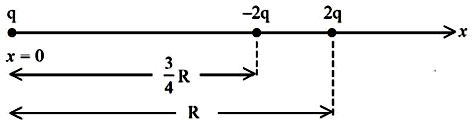
Three point charges \( q \), \( -2q \) and \( 2q \) are placed on x-axis at a distance \( x=0 \), \( x=\dfrac{3}{4}R \) and \( x=R \) respectively from origin as shown. If \( q=2\times 10^{-6} \, \text{C} \) and \( R=2 \, \text{cm} \), the magnitude of net force experienced by the charge \( -2q \) is __________ \( \text{N} \).
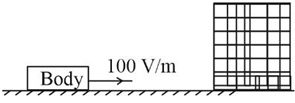
A body having specific charge \(8\,\mu\text{C}/g\) is resting on a frictionless plane at a distance \(10\,\text{cm}\) from the wall (as sown in the figure). It starts moving towards the wall when a uniform electric field of \(100\,\text{V/m}\) is applied horizontally towards the wall. If the collision of the body with the wall is perfectly elastic, then the time period of the motion will be ____________ \(\text{s}\).
A solid metal sphere of radius $R$ having charge $q$ is enclosed inside the concentric spherical shell of inner radius $a$ and outer radius $b$ as shown in the figure. The approximate variation electric field $\vec{E}$ as a function of distance $r$ from centre $O$ is given by
A long cylindrical volume contains a uniformly distributed charge of density \( \rho \, \text{C m}^{-3} \). The electric field inside the cylindrical volume at a distance \( x = \dfrac{2 \varepsilon_{0}}{\rho} \, \text{m} \) from its axis is ______ \( \text{V m}^{-1} \).
Two charged conducting spheres \( S_1 \) and \( S_2 \) of radii \( 8 \, \text{cm} \) and \( 18 \, \text{cm} \) are connected to each other by a wire. After equilibrium is established, the ratio of electric fields on \( S_1 \) and \( S_2 \) spheres are \( E_{S1} \) and \( E_{S2} \) respectively. The value of \( \frac{E_{S1}}{E_{S2}} \) is ______.
A charge \( q \) is placed at the center of one of the surface of a cube. The flux linked with the cube is:
Given below are two statements.Statement I: Electric potential is constant within and at the surface of each conductor.Statement II: Electric field just outside a charged conductor is perpendicular to the surface of the conductor at every point.In the light of the above statements, choose the most appropriate answer from the options given below.
As shown in figure, a cuboid lies in a region with electric field \( {E} = 2x^{2}\hat{i} - 4y\hat{j} + 6\hat{k} \, \frac{\text{N}}{\text{C}} \). The magnitude of charge within the cuboid is \( n \varepsilon_{0} \, \text{C} \). The value of \( n \) is _____. (If dimension of cuboid is \( 1 \times 2 \times 3 \, \text{m}^{3} \))
In a cuboid of dimension \( 2L \times 2L \times L \), a charge \( q \) is placed at the center of the surface ‘S’ having area of \( 4L^{2} \). The flux through the opposite surface to ‘S’ is given by:
Considering a group of positive charges, which of the following statements is correct?
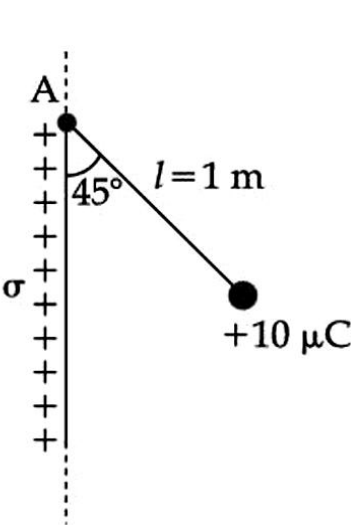
A small bob of mass \( 100 \, \mathrm{mg} \) and charge \( +10 \, \mu\mathrm{C} \) is connected to an insulating string of length \( 1 \, \mathrm{m} \). It is brought near to an infinitely long non-conducting sheet of charge density ‘\( \sigma \)’ as shown in figure. If string subtends an angle of \( 45^\circ \) with the sheet at equilibrium the charge density of sheet will be. (Given, \( \varepsilon_{0} = 8.85 \times 10^{-12} \, \mathrm{} \) and acceleration due to gravity, \( g = 10 \, \mathrm{m/s^{2}} \) )
If two charges \( q_1 \) & \( q_2 \) are separated with distance ‘\( d \)’ and placed in a medium of dielectric constant \( K \). What will be the equivalent distance between charges in air for the same electrostatic force?
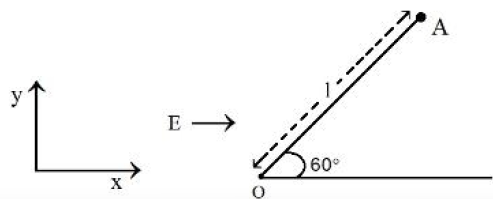
A particle of mass \( 'm' \) and charge \( 'q' \) is fastened to one end ‘A’ of a massless string having equilibrium length \( l \), whose other end is fixed at point \( 'O' \). The whole system is placed on a frictionless horizontal plane and is initially at rest. If uniform electric field is switched on along the direction as shown in figure, then the speed of the particle when it crosses the \( x \)-axis is:
Given below are two statements: one is labelled as Assertion A and the other is labelled as Reason R.Assertion A : Work done in moving a test charge between two points inside a uniformly charged spherical shell is zero, no matter which path is chosen.Reason R : Electrostatic potential inside a uniformly charged spherical shell is constant and is same as that on the surface of the shell.In the light of the above statements, choose the correct answer from the options given below:
An electron is made to enter symmetrically between two parallel and equally but oppositely charged metal plates, each of \( 10 \,\text{cm} \) length. The electron emerges out of the electric field region with a horizontal component of velocity \( 10^{6} \,\text{m/s} \). If the magnitude of the electric field between the plates is \( 9.1 \,\text{V/cm} \), then the vertical component of velocity of electron is:(mass of electron \( = 9.1 + 10^{-31} \,\text{kg} \) and charge of electron \( = 1.6 \times 10^{-19} \,\text{C} \))
Two electric dipoles of dipole moments \( 1.2 \times 10^{-30} \, \text{Cm} \) and \( 2.4 \times 10^{-30} \, \text{Cm} \) are placed in two different uniform electric fields of strengths \( 5 \times 10^{4} \, \text{NC}^{-1} \) and \( 15 \times 10^{4} \, \text{NC}^{-1} \) respectively. The ratio of maximum torque experienced by the electric dipoles will be \( \dfrac{1}{x} \). The value of \( x \) is ________.
A positive ion \( A \) and a negative ion \( B \) has charges \( 6.67 \times 10^{-19} \, \text{C} \) and \( 9.6 \times 10^{-10} \, \text{C} \), and masses \( 19.2 \times 10^{-27} \, \text{kg} \) and \( 9 \times 10^{-27} \, \text{kg} \) respectively. At an instant, the ions are separated by a certain distance \( r \). At that instant the ratio of the magnitudes of electrostatic force to gravitational force is \( P \times 10^{-13} \), where the value of \( P \) is __________.(Take \( \dfrac{1}{4\pi \varepsilon_0} = 9 \times 10^{9} \, \text{Nm}^2 \text{C}^{-1} \) and universal gravitational constant as \( 6.67 \times 10^{-11} \, \text{Nm}^2\text{kg}^{-2} \))
The electrostatic potential due to an electric dipole at a distance ' \( r \) ' varies as:
Two equal positive point charges are separated by a distance \( 2a \). The distance of a point from the centre of the line joining two charges on the equatorial line (perpendicular bisector) at which force experienced by a test charge \( q_0 \) becomes maximum is \( \frac{a}{\sqrt{x}} \). The value of \( x \) is ________.
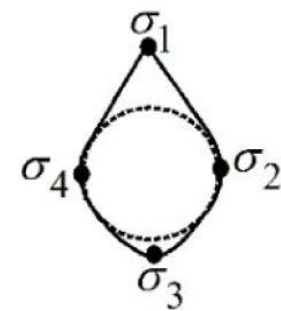
Electric charge is transferred to an irregular metallic disk as shown in figure. If \( \sigma_1 \), \( \sigma_2 \), \( \sigma_3 \) and \( \sigma_4 \) are charge densities at given points then, choose the correct answer from the options given below:A. \( \sigma_1 > \sigma_3; \sigma_2 = \sigma_4 \)B. \( \sigma_1 > \sigma_2; \sigma_3 > \sigma_4 \)C. \( \sigma_1 > \sigma_3 > \sigma_2 = \sigma_4 \)D. \( \sigma_1 < \sigma_3 < \sigma_2 = \sigma_4 \)E. \( \sigma_1 = \sigma_2 = \sigma_3 = \sigma_4 \)
Two isolated metallic solid spheres of radii \( R \) and \( 2R \) are charged such that both have same charge density \( \sigma \). The spheres are then connected by a thin conducting wire. If the new charge density of the bigger sphere is \( \sigma' \). The ratio \( \frac{\sigma'}{\sigma} \) is:
Two point charges \( Q \) each are placed at a distance \( d \) apart. A third point charge \( q \) is placed at a distance \( x \) from mid-point on the perpendicular bisector. The values \( x \) at which charge \( q \) will experience the maximum Coulomb’s force is:
Electric potential at a point ‘P’ due to a point charge of \( 5 \times 10^{-9} \, \text{C} \) is \( 50 \, \text{V} \). The distance of ‘P’ from the point charge is:(Assume, \( \dfrac{1}{4\pi \varepsilon_{0}} = 9 \times 10^{+9} \, \text{N m}^{2} \text{C}^{-2} \) )
Two charges \( q \) and \( 3q \) are separated by a distance \( r \) in air. At a distance \( x \) from charge \( q \), the resultant electric field is zero. The value of \( x \) is:
An infinite number of point charges, each carrying \( 1 \, \mu \text{C} \) charge, are placed along the y-axis at \( y = 1 \, \text{m}, 2 \, \text{m}, 4 \, \text{m}, 8 \, \text{m} \ldots \). The total force on a \( 1 \, \text{C} \) point charge, placed at the origin is \( x \times 10^{3} \, \text{N} \). The value of \( x \), to the nearest integer is:[Take \( \dfrac{1}{4 \pi \epsilon_{0}} = 9 \times 10^{9} \, \text{N m}^{2} / \text{C}^{2} \)]
An electric dipole is placed on \( x \)-axis in proximity to a line charge of linear charge density \( 3.0 \times 10^{-6} \, \text{C/m} \). Line charge is placed on \( z \)-axis and positive and negative charge of dipole is at a distance of \( 10 \, \text{mm} \) and \( 12 \, \text{mm} \) from the origin respectively. If total force of \( 4 \, \text{N} \) is exerted on the dipole, find out the amount of positive or negative charge of the dipole.
Given below are two statements: one is labelled as Assertion (A) and the other is labelled as Reason (R).Assertion (A): The outer body of an air craft is made of metal which protects person sitting inside from lightning-strikes.Reason (R): The electric field inside the cavity enclosed by a conductor is zero.In the light of the above statements, choose the most appropriate answer from the options given below;
Two identical charged particles each having a mass \( 10 \ \text{g} \) and charge \( 2.0 \times 10^{-7} \ \text{C} \) are placed on a horizontal table with a separation of \( L \) between them such that they stay in limited equilibrium. If the coefficient of friction between each particle and the table is \( 0.25 \), find the value of \( L \). [Use \( g = 10 \ \text{ms}^{-2} \)]
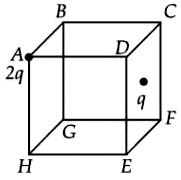
Two-point charges \( 2q \) and \( q \) are placed at vertex \( A \) and centre of face \( CDEF \) of the cube as shown in figure. The electric flux passing through the cube is:
There are three co-centric conducting spherical shells \( A, B \) and \( C \) of radii \( a, b \) and \( c \) respectively \( (c>b>a) \) and they are charged with charge \( q_1, q_2 \) and \( q_3 \) respectively. The potentials of the spheres \( A, B \) and \( C \) respectively, are:
Two charged conducting spheres of radii \( a \) and \( b \) are connected to each other by a conducting wire. The ratio of charges of the two spheres respectively is:
For a uniformly charged thin spherical shell, the electric potential \( (V) \) radially away from the centre \( (O) \) of shell can be graphically represented as:
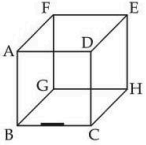
A line charge of length \( \dfrac{'a'}{2} \) is kept at the center of an edge \( BC \) of a cube \( ABCDEFGH \) having edge length \( 'a' \) as shown in the figure. If the density of lien charge is \( \lambda \) \( \text{C} \) per unit length, then the total electric flux through all the faces of the cube will be _______. (Take, \( \varepsilon_{0} \) as the free space permittivity)
An electron is moving under the influence of the electric field of a uniformly charged infinite plane sheet $S$ having surface charge density $+\sigma$. The electron at $t = 0$ is at a distance of $1\text{ m}$ from $S$ and has a speed of $1\text{ m/s}$. The maximum value of $\sigma$ if the electron strikes $S$ at $t = 1\text{s}$ is $\alpha\left[\frac{m\epsilon_0}{e}\right]\frac{\text{C}}{\text{m}^2}$, the value of $\alpha$ is ________.
An electronic field, $\vec{E} = \frac{2\hat{i} + 6\hat{j} + 8\hat{k}}{\sqrt{6}}$ passes through the surface of $4\text{ m}^2$ area having unit vector $\hat{n} = \left(\frac{2\hat{i} + \hat{j} + \hat{k}}{\sqrt{6}}\right)$. The electric flux for that surface is ______ $\text{V m}$.
A capacitor of capacitance \( 900 \, \mu \text{F} \) charged by a \( 100 \, \text{V} \) battery. The capacitor is disconnected from the battery and connected to another uncharged identical capacitor such that one plate of uncharged capacitor connected to positive plate and another plate of uncharged connected to negative plate of the charged capacitor. The loss of energy in this process is measured as \( x \times 10^{-2} \, \text{J} \). The value of \( x \) is ________.
A certain charge \( Q \) is divided into two part \( q \) and \( (Q - q) \). How should the charge \( Q \) and \( q \) be divided so that \( q \) and \( (Q - q) \) placed at a certain distance apart experience maximum electrostatic repulsion?
Force between two point charges \( q_1 \) and \( q_2 \) placed in vacuum at \(' r' \, \text{cm} \) apart is \( F \). Force between them when placed in a medium having dielectric constant \( K = 5 \) at \( '{r}/{5}' \, \text{cm} \) apart will be:
Consider a circular loop that is uniformly charged and has a radius \( a\sqrt{2} \). Find the position along the positive \( z \)-axis of the cartesian coordinate system where the electric field is maximum if the ring was assumed to be placed in \( xy \) plane at the origin:
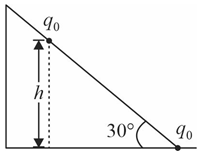
As shown in the figure, a configuration of two equal point charges \( (q_0 = +2 \, \mu\text{C}) \) is placed on an inclined plane. Mass of each point charge is \( 20 \, \text{g} \). Assume that there is no friction between charge and plane. For the system of two point charges to be in equilibrium (at rest) the height \( h = x \times 10^{-3} \, \text{m} \). The value of \( x \) is ______.(Take \( \dfrac{1}{4\pi \varepsilon_0} = 9 \times 10^9 \, \text{N m}^2 \text{C}^{-2} \), \( g = 10 \, \text{m s}^{-2} \))
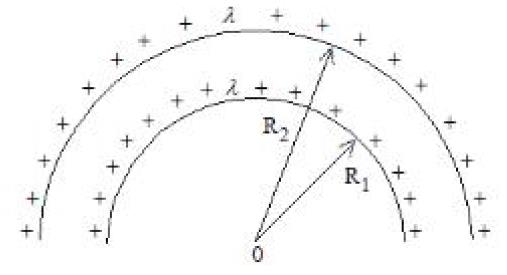
The electric potential at the centre of two concentric half rings of radii \( R_1 \) and \( R_2 \), having same linear charge density \( \lambda \), is:
For a charged spherical ball, electrostatic potential inside the ball varies with \( r \) as \( V = 2ar^2 + b \).Here, \( a \) and \( b \) are constant; \( r \) is the distance from the centre. The volume charge density inside the ball is \( -\lambda a \varepsilon \). The value of \( \lambda \) is _____________.\( \varepsilon \) = permittivity of the medium.
Find out the surface charge density at the intersection of point \( x = 3 \, \text{m} \) plane and x-axis, in the region of uniform line charge of \( 8 \, \text{nC/m} \) lying along the z-axis in free space.
The electric field in a region is given by \( \vec{E} = (2\hat{i} + 4\hat{j} + 6\hat{k}) \times 10^{3} \, \text{N} /{C} \). The flux of the field through a rectangular surface parallel to x-z plane is \( 6.0 \, \text{N m}^{2} \, \text{C}^{-1} \). The area of the surface is ______ \( \text{cm}^{2} \).
An infinitely long positively charged straight thread has a linear charge density \( \lambda \, \text{Cm}^{-1} \). An electron revolves along a circular path having axis along the length of the wire. The graph that correctly represents the variation of the kinetic energy of electron as a function of radius of circular path from the wire is:
Choose the incorrect statement:(a) The electric lines of force entering into a Gaussian surface provide negative flux.(b) A charge '\( q \)' is placed at the centre of a cube. The flux through all the faces will be the same.(c) In a uniform electric field net flux through a closed Gaussian surface containing no net charge, is zero.(d) When electric field is parallel to a Gaussian surface, it provides a finite non-zero flux.Choose the most appropriate answer from the options given below:
Two identical charged spheres are suspended by strings of equal lengths. The string make an angle \( \theta \) with each other. When suspended in water the angle remains the same. If density of the material of the sphere is \( 1.5 \, \text{g/cc} \), the dielectric constant of water will be ______. [Take density of water = \( 1 \, \text{g/cc} \)]
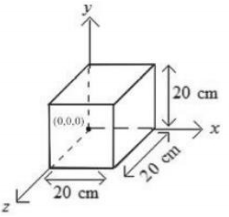
Expression for an electric field is given by \( \vec{E} = 4000 x^{2} \hat{i} \, \dfrac{\text{V}}{\text{m}} \). The electric flux through the cube of side \( 20 \, \text{cm} \) when placed in electric field (as shown in the figure) is _____ \( \text{V cm} \).
Sixty four conducting drops each of radius \( 0.02\,\text{m} \) and each carrying a charge of \( 5\,\mu\text{C} \) are combined to form a bigger drop. The ratio of surface density of bigger drop to the smaller drop will be:
Given below are two statements: one is labelled as Assertion (A) and the other is labelled as Reason (R).Assertion (A): Net dipole moment of a polar linear isotropic dielectric substance is not zero even in the absence of an external electric field.Reason (R): In absence of an external electric field, the different permanent dipoles of a polar dielectric substance are oriented in random directions. In the light of the above statements, choose the most appropriate answer from the options given below:In the light of the above statements, choose the most appropriate answer from the options given below:
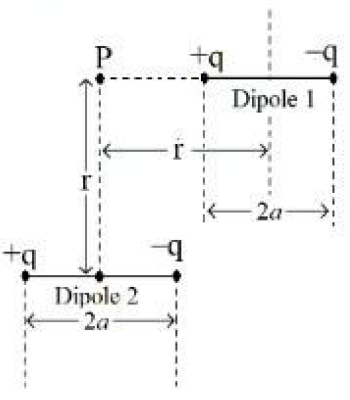
A point particle of charge \( Q \) is located at \( P \) along the axis of an electric dipole \( 1 \) at a distance \( r \) as shown in the figure. The point \( P \) is also on the equatorial plane of a second electric dipole \( 2 \) at a distance \( r \). The dipoles are made of opposite charge \( q \) separated by a distance \( 2a \). For the charge particle at \( P \) not to experience any net force, which of the following correctly describes the situation?
The two thin coaxial rings, each of radius \( a \) and having charges \( +Q \) and \( -Q \) respectively are separated by a distance of \( s \). The potential difference between the centres of the two rings is:
The total charge enclosed in an incremental volume of \( 2 \times 10^{-9} \, \mathrm{m^{3}} \) located at the origin is ______ \( \mathrm{nC} \), if electric flux density of its field is found as:\( \mathbf{D} = e^{-x} \sin y \, \hat{\imath} - e^{-x} \cos y \, \hat{\jmath} + 2 z \, \hat{k} \; \mathrm{C/m^{2}} \).
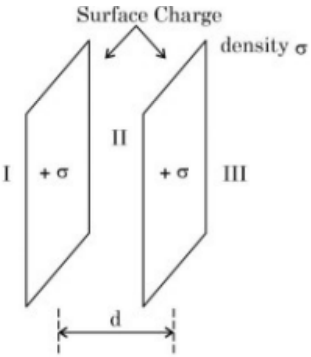
Let \( \sigma \) be the uniform surface charge density of two infinite thin plane sheets shown in figure. Then the electric fields in three different region \( {E}_{I} \), \({E}_{II} \) and \( {E}_{III} \) are:
A cubical volume is bounded by the surfaces \( x = 0 \), \( x = a \), \( y = 0 \), \( y = a \), \( z = 0 \), \( z = a \). The electric field in the region is given by \( \vec{E} = E_{0}x\,\hat{i} \). Where \( E_{0} = 4 \times 10^{4} \,\text{N C}^{-1}\text{m}^{-1} \). If \( a = 2 \,\text{cm} \), the charge contained in the cubical volume is \( Q \times 10^{-14} \,\text{C} \). The value of \( Q \) is _______.
At the center of half ring of radius \( R = 10 \, \text{cm} \) and linear charge density \( 4 \, \text{n C m}^{-1} \), the potential is \( x \pi \, \text{V} \). The value of \( x \) is ________.
Two point charges \( q_1 = 3\,\mu\text{C} \) and \( q_2 = -4\,\mu\text{C} \) are placed at points \( (2\hat{i}+3\hat{j}+3\hat{k}) \) and \( (\hat{i}+\hat{j}+\hat{k}) \) respectively. Force on charge \( q_2 \) is ______ \( \text{N} \). [Take \( \dfrac{1}{4\pi \varepsilon_0} = 9\times 10^{9} \) SI units]
The vehicles carrying inflammable fluids usually have metallic chains touching the ground:
Two metal spheres of radius \( R \) and \( 3R \) have same surface charge density \( \sigma \). If they are brought in contact and then separated, the surface charge density on smaller and bigger sphere becomes \( \sigma_1 \) and \( \sigma_2 \), respectively. The ratio \( \frac{\sigma_1}{\sigma_2} \) is:
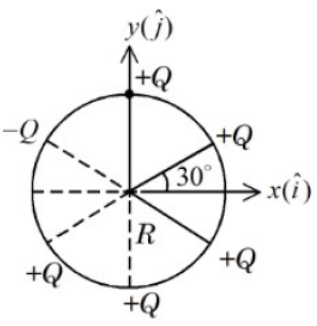
Six point charges are kept $60^\circ$ apart from each other on the circumference of a circle of radius R as shown in figure. The net electric field at the center of the circle is ________. ($\epsilon_0$ is permittivity of free space)
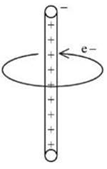
An electron revolves around an infinite cylindrical wire having uniform linear charge density \( 2 \times 10^{-8} \, \text{C m}^{-1} \) in circular path under the influence of attractive electrostatic field as shown in the figure. The velocity of electron with which it is revolving is ______ \( \times 10^{6} \, \text{m s}^{-1} \). Given mass of electron \( = 9 \times 10^{-31} \, \text{kg} \).
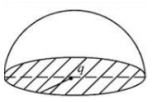
If a charge \( q \) is placed at the centre of a closed hemispherical non-conducting surface, the total flux passing through the flat surface would be:
An electric charge \( 10^{-6} \, \mu\text{C} \) is placed at origin \( (0, 0) \, \text{m} \) of \( X - Y \) co-ordinate system. Two points \( P \) and \( Q \) are situated at \( (\sqrt{3}, \sqrt{3}) \, \text{m} \) and \( (\sqrt{6}, 0) \, \text{m} \) respectively. The potential difference between the points \( P \) and \( Q \) will be :
The electrostatic potential in a charged spherical region of radius \( r \) varies as \( V = ar^3 + b \), where \( a \) and \( b \) are constants. The total charge in the sphere of unit radius is \( \alpha \times \pi a \varepsilon_0 \). The value of \( \alpha \) is ______. (permittivity of vacuum is \( \varepsilon_0 \))
Electric field in a region is given by \( \vec{E}=Ax\,\hat{i}+By\,\hat{j} \), where \( A=10 \, \mathrm{V/m^{2}} \) and \( B=5 \, \mathrm{V/m^{2}} \). If the electric potential at a point \( (10,20) \) is \( 500 \, \mathrm{V} \), then the electric potential at origin is ______ \( \mathrm{V} \).
\( \sigma \) is the uniform surface charge density of a thin spherical shell of radius \( R \). The electric field at any point on the surface of the spherical shell is:
An electric dipole of dipole moment is \( 6.0 \times 10^{-6} \, \text{C m} \) placed in a uniform electric field of \( 1.5 \times 10^{3} \, \text{N C}^{-1} \) in such a way that dipole moment is along electric field. The work done in rotating dipole by \( 180^\circ \) in this field will be ______ \( \text{mJ} \).
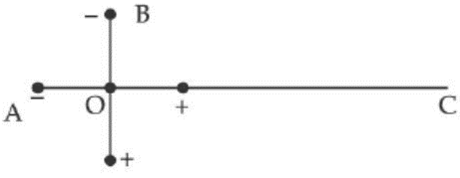
Two short electric dipoles A and B having dipole moment \( p_1 \) and \( p_2 \) respectively are placed with their axis mutually perpendicular as shown in the figure. The resultant electric field at a point \( x \) is making an angle of \( 60^\circ \) with the line joining points \( O \) and \( x \). The ratio of the dipole moments \( \frac{p_2}{p_1} \) is ______.
A metallic ring is uniformly charged as shown in figure. \( AC \) and \( BD \) are two mutually perpendicular diameters. Electric field due to arc \( AB \) at \( 'O' \) is \( 'E' \) in magnitude. What would be the magnitude of electric field at \( 'O' \) due to arc \( ABC \)?
The volume charge density of a sphere of radius \( 6 \, \text{m} \) is \( 2 \, \mu\text{C cm}^{-3} \). The number of lines of force per unit surface area coming out from the surface of the sphere is ________ \( \times 10^{10} \, \text{N C}^{-1} \).(Given : Permittivity of vacuum \( \in_{0} = 8.85 \times 10^{-12} \, \text{C}^{2} \text{N}^{-1} \text{m}^{-2} \))
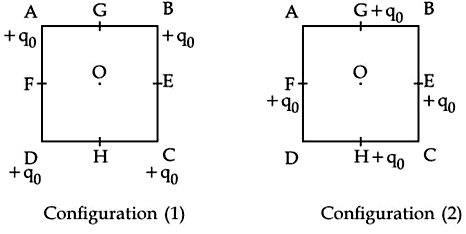
In the first configuration \( (1) \) as shown in the figure, four identical charges \( (q_0 )\) are kept at the corners \( A, B, C \) and \( D \) of square of side length ‘\( a \)’. In the second configuration \( (2) \), the same charges are shifted to mid points \( G, E, H \) and \( F \), of the square. If \(\displaystyle K = \frac{1}{4\pi \epsilon_0} \), the difference between the potential energies of configuration \( (2) \) and \( (1) \) is given by:
A uniformly charged disc of radius \( R \) having surface charge density \( \sigma \) is placed in the \( xy \) plane with its centre at the origin. Find the electric field intensity along the \( z \)-axis at a distance \( Z \) from origin:
Three charges \( +2q, +3q \) and \( -4q \) are situated at \( (0,-3a) \), \( (2a,0) \), \( (-2a,0) \) respectively in the \( xy \) plane. The resultant dipole moment about origin is ______.
An electric field is given by \( (6\hat{i}+5\hat{j}+3\hat{k}) \, \text{N/C} \). The electric flux through a surface area \( 30 \, \hat{i}{ m}^2 \) lying in YZ-plane (in SI unit) is:
A point charge \( q_1 = 4q_0 \) is placed at origin. Another point charge \( q_2 = -q_0 \) is placed at \( x = 12 \, \text{cm} \). Charge of proton is \( q_0 \). The proton is placed on \( x \) axis so that the electrostatic force on the proton is zero. In this situation, the position of the proton from the origin is ______ \( \text{cm} \).
Two metal plates (A, B) are kept horizontally with separation of \( \left( \dfrac{12}{\pi} \right) \, \text{cm} \), with plate A on the top. An atomizer jet sprays oil (density \( 1.5 \, \text{g/cm}^3 \)) droplets of radius \( 1 \, \text{mm} \) horizontally. All oil droplets carry a charge \( 5 \, \text{nC} \). The potentials \( V_A \) and \( V_B \) are required on plates A and B respectively in order to ensure the droplets do not descend. The values of \( V_A \) and \( V_B \) are ______. (Neglect the air resistance to the droplets and take \( g = 10 \, \text{m/s}^2 \))
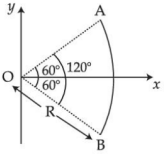
Figure shows a rod \( AB \), which is bent in a \( 120^\circ \) circular arc of radius \( R \). A charge \( (-Q) \) is uniformly distributed over rod \( AB \). What is the electric field \( \vec{E} \) at the centre of curvature \( O \)?
\( 27 \) identical drop are charged at \( 22 \, \text{V} \) each. The combine to form a bigger drop. The potential of the bigger drop will be ________ \( \text{V} \).
A particle having charge \( 10^{-9}\, \text{C} \) moving in \( x\text{-}y \) plane in fields of \( 0.4\,\hat{\jmath}\, \text{N/C} \) and \( 4\times 10^{-3}\,\hat{k}\, \text{T} \) experiences a force of \( (4\hat{\imath}+2\hat{\jmath})\times 10^{-10}\, \text{N} \). The velocity of the particle at that instant is __________ \( \text{m/s} \).
A point charge causes an electric flux of \( -2 \times 10^{4} \, \text{N m}^{2} \text{C}^{-1} \) to pass through a spherical Gaussian surface of \( 8.0 \, \text{cm} \) radius, centred on the charge. The value of the point charge is:(Given \( \varepsilon_{0} = 8.85 \times 10^{-12} \, \text{C}^{2} \text{N}^{-1} \text{m}^{-2} \))
A stream of a positively charged particles having \( \frac{q}{m} = 2 \times 10^{11} \, \frac{\mathrm{C}}{\mathrm{kg}} \) and velocity \( \vec{v}_0 = 3 \times 10^{7} \, \hat{i} \, \frac{\mathrm{m}}{\mathrm{s}} \) is deflected by an electric field \( 1.8 \, \hat{j} \, \mathrm{kV}/\mathrm{m} \). The electric field exists in a region of \( 10 \, \mathrm{cm} \) along \( x \) direction. Due to the electric field, the deflection of the charge particles in the \( y \) direction is ______.
Two charges \( 7 \, \mu \text{C} \) and \( -2 \, \mu \text{C} \) are placed at \( (-9, 0, 0) \, \text{cm} \) and \( (9, 0, 0) \, \text{cm} \) respectively in an external field \( {E} = \dfrac{A}{r^2} \, \hat{r} \), where \( A = 9 \times 10^{5} \, \text{N}/\text{C} \cdot \text{m}^{2} \). Considering the potential at infinity is \( 0 \), the electrostatic energy of the configuration is ______ \( \text{J} \).
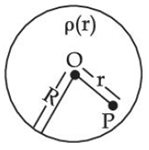
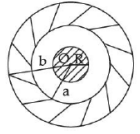
A spherically symmetric charge distribution is considered with charge density varying as is the distance from the centre O (as shown in figure). The electric field at point P will be:
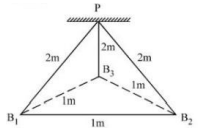
Three identical charged balls each of charge \( 2 \, \text{C} \) are suspended from a common point \( P \) by silk threads of \( 2 \, \text{m} \) each (as shown in figure). They form an equilateral triangle of side \( 1 \, \text{m} \). The ratio of net force on a charge ball to the force between any two charged balls will be:
A charge of \( 4 \, \mu \text{C} \) is to be divided into two. The distance between the two divided charges is constant. The magnitude of the divided charges so that the force between them is maximum, will be:
point charge \( 2 \times 10^{-2} \, \text{C} \) is moved from P to S in a uniform electric field of \( 30 \, \text{N} \, \text{C}^{-1} \) directed along positive x-axis. If coordinates of P and S are \( (1, \, 2, \, 0) \, \text{m} \) and \( (0, \, 0, \, 0) \, \text{m} \) respectively, the work done by electric field will be:
\( 64 \) identical drops each charged upto potential of \( 10 \, \text{mV} \) are combined to form a bigger drop. The potential of the bigger drop will be ______ \( \text{mV} \).
Two identical conducting spheres \( P \) and \( S \) with charge \( Q \) on each, repel each other with a force \( 16 \, \text{N} \). A third identical uncharged conducting sphere \( R \) is successively brought in contact with the two spheres. The new force of repulsion between \( P \) and \( S \) is:
The electric field due to a short electric dipole at a large distance \( (r) \) from center of dipole on the equatorial plane varies with distance as:
For a short dipole placed at origin \( O \), the dipole moment \( p \) is along x-axis, as shown in the figure. If the electric potential and electric field at A are \( V_0 \) and \( E_0 \), respectively, then the correct combination of the electric potential and electric field, respectively, at point B on the y-axis is given by:
An infinitely long wire has uniform linear charge density \( \lambda = 2 \, \text{nC}/\text{m} \). The net flux through a Gaussian cube of side length \( \sqrt{3} \, \text{cm} \), if the wire passes through any two corners of the cube, that are maximally displaced from each other, would be \( x \, \text{N} \, \text{m}^{2} \, \text{C}^{-1} \), where \( x \) is: [Neglect any edge effects and use \( \dfrac{1}{4\pi \varepsilon_{0}} = 9 \times 10^{9} \) SI units]
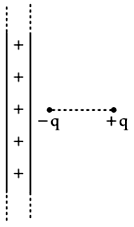
An electric dipole is placed at a distance of \( 2 \, \text{cm} \) from an infinite plane sheet having positive charge density \( \sigma_{0} \). Choose the correct option from the following.
A \( 10 \, \mu \text{C} \) charge is divided into two parts and placed at \( 1 \, \text{cm} \) distance so that the repulsive force between them is maximum. The charges of the two parts are :
Two point charges of \( 1 \, \text{nC} \) and \( 2 \, \text{nC} \) are placed at the two corners of equilateral triangle of side \( 3 \, \text{cm} \). The work done in bringing a charge of \( 3 \, \text{nC} \) from infinity to the third corner of the triangle is ________ \( \mu \text{J} \).\( \dfrac{1}{4\pi\varepsilon_{0}} = 9 \times 10^{9} \, \text{N}\cdot\text{m}^{2}\,/\text{C}^{2} \)
A point charge \( +q \) is placed at the origin. A second point charge \( +9q \) is placed at \( (d,0,0) \) in Cartesian coordinate system. The point in between them where the electric field vanishes is:
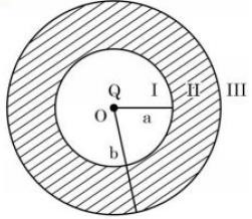
As shown in the figure, a point charge \( Q \) is placed at the centre of conducting spherical shell of inner radius \( a \) and outer radius \( b \). The electric field due to charge \( Q \) in three different regions \( I \), \( II \) and \( III \) is given by: \( ( I : r < a , \, II : a < r < b , \, III : r > b ) \).
Given below are two statements:Statement-I: A point charge is brought in an electric field. The value of electric field at a point near to the charge may increase if the charge is positive.Statement-II: An electric dipole is placed in a non-uniform electric field. The net electric force on the dipole will not be zero.Choose the correct answer from the options given below:
A positive charge particle of \( 100 \, \text{mg} \) is thrown in opposite direction to a uniform electric field of strength \( 1 \times 10^{5} \, \text{N C}^{-1} \). If the charge on the particle is \( 40 \, \mu\text{C} \) and the initial velocity is \( 200 \, \text{m s}^{-1} \), how much distance it will travel before coming to the rest momentarily:
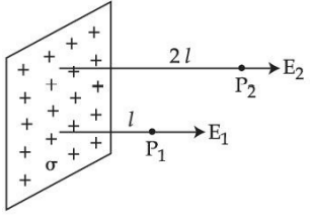
In the figure, a very large plane sheet of positive charge is shown. \( P_1 \) and \( P_2 \) are two points at distance \( l \) and \( 2l \) from the charge distribution. If \( \sigma \) is the surface charge density, then the magnitude of electric fields \( E_1 \) and \( E_2 \) at \( P_1 \) and \( P_2 \) respectively are:

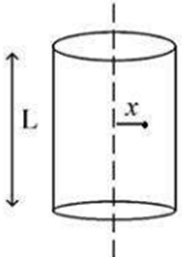
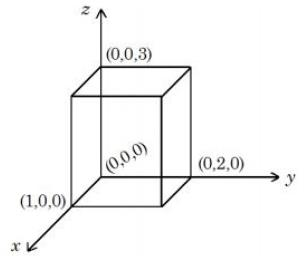
 and acceleration due to gravity, \( g = 10 \, \mathrm{m/s^{2}} \) )
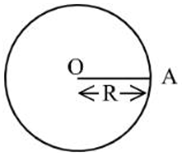
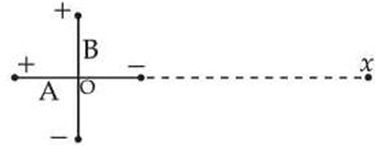
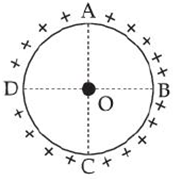
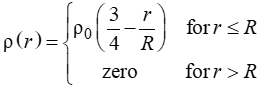 is the distance from the centre O (as shown in figure). The electric field at point P will be: