The Young's modulus of steel wire of radius \( r \) and length \( L \) is \( Y \). If the radius \( r \) and length \( L \) of the wire are doubled then the value of \( Y \).
increases by two times
reduces by half
remains unchanged
becomes one fourth
The length of a light string is \( 1.4 \, \text{m} \) when the tension on it is \( 5 \, \text{N} \). If the tension increases to \( 7 \, \text{N} \), the length of the string is \( 1.56 \, \text{m} \). The original length of the string is __________ \( \text{m} \).
When a rubber ball is taken to a depth of ________ \( \text{m} \) in deep sea, its volume decreases by \( 0.5\% \).(The bulk modulus of rubber \( = 9.8 \times 10^{8} \, \text{N m}^{-2} \) Density of sea water \( = 10^{3} \, \text{kg m}^{-3} \), \( g = 9.8 \, \text{m/ s}^{2} \) )
If the rms speed of oxygen molecules at \( 0^{\circ}\text{C} \) is \( 160 \, \text{m/s} \), find the rms speed of hydrogen molecules at \( 0^{\circ}\text{C} \).
A uniform heavy rod of mass \( 20 \, \text{kg} \), cross sectional area \( 0.4 \, \text{m}^{2} \) and length \( 20 \, \text{m} \) is hanging from a fixed support. Neglecting the lateral contraction, the elongation in the rod due to its own weight is \( x \times 10^{-9} \, \text{m} \). The value of \( x \) is __________. (Given, young modulus \( Y = 2 \times 10^{11} \, \text{N m}^{-2} \) and \( g = 10 \, \text{m s}^{-2} \))
If the length of a wire is made double and radius is halved of its respective values. Then, the Young’s modulus of the material of the wire will:
A string of area of cross-section \( 4 \, \text{mm}^2 \) and length \( 0.5 \, \text{m} \) is connected with a rigid body of mass \( 2 \, \text{kg} \). The body is rotated in a vertical circular path of radius \( 0.5 \, \text{m} \). The body acquires a speed of \( 5 \, \text{m/s} \) at the bottom of the circular path. Strain produced in the string when the body is at the bottom of the circle is _______ \( \times 10^{-5} \). (use young’s modulus \( 10^{11} \, \text{N/m}^2 \) and \( g = 10 \, \text{m/s}^2 \) )
Two cylindrical rods A and B made of different materials, are joined in a straight line. The ratios of lengths, radii and thermal conductivities of these rods are: \( \frac{L_A}{L_B} = \frac{1}{2} \), \( \frac{r_A}{r_B} = 2 \) and \( \frac{K_A}{K_B} = \frac{1}{2} \). The free ends of rods A and B are maintained at \( 400 \, \text{K} \), \( 200 \, \text{K} \), respectively. The temperature of rods interface is ___ \( \text{K} \), when equilibrium is established.
A steel wire of length \( 2 \, \text{m} \) and Young’s modulus \( 2.0 \times 10^{11} \, \text{N m}^{-2} \) is stretched by a force. If Poisson ratio and transverse strain for the wire are \( 0.2 \) and \( 10^{-3} \) respectively, then the elastic potential energy density of the wire is \( \underline{\hspace{1cm}} \times 10^{5} \) (in SI units).
Two wires A and B made of different materials of lengths \( 6.0 \, \text{cm} \) and \( 5.4 \, \text{cm} \), respectively and area of cross sections \( 3.0 \times 10^{-5} \, \text{m}^{2} \) and \( 4.5 \times 10^{-5} \, \text{m}^{2} \), respectively are stretched by the same magnitude under a given load. The ratio of the Young's modulus of A to that of B is \( x : 3 \). The value of \( x \) is \( \underline{\phantom{0}} \).
A body cools from \( 80^\circ\text{C} \) to \( 60^\circ\text{C} \) in \( 5 \) minutes. The temperature of the surrounding is \( 20^\circ\text{C} \). The time it takes to cool from \( 60^\circ\text{C} \) to \( 40^\circ\text{C} \) is:
The area of cross-section of a railway track is \( 0.01 \, \mathrm{m^{2}} \). The temperature variation is \( 10^{\circ}\mathrm{C} \). Coefficient of linear expansion of material of track is \( 10^{-5} \, / ^{\circ}\mathrm{C} \). The energy stored per meter in the track is ______ \( \mathrm{J/m} \). (Young’s modulus of material of track is \( 10^{11} \, \mathrm{N \, m^{-2}} \))
The two wires \( A \) and \( B \) of equal cross-section but of different materials are joined together. The ratio of Young's modulus of wire \( A \) and wire \( B \) is \( 20/11 \). When the joined wire is kept under certain tension the elongations in the wires \( A \) and \( B \) are equal. If the length of wire \( A \) is \( 2.2 \, \text{m} \), then the length of wire \( B \) is ______ \( \text{m} \).
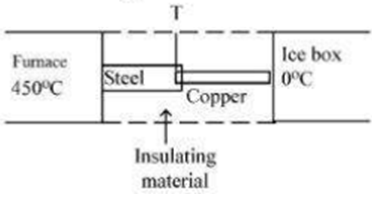
If \( K_1 \) and \( K_2 \) are the thermal conductivities, \( L_1 \) and \( L_2 \) are the lengths and \( A_1 \) and \( A_2 \) are the cross sectional areas of steel and copper rods respectively such that \( \dfrac{K_2}{K_1} = 9 \), \( \dfrac{A_1}{A_2} = 2 \), \( \dfrac{L_1}{L_2} = 2 \). Then, for the arrangement as shown in the figure, the values of temperature \( T \) of the steel – copper junction in the steady state will be:
A wire of length \( L \) and radius \( r \) is clamped rigidly at one end. When the other end of the wire is pulled by a force \( F \), its length increases by \( 5 \,\text{cm} \). Another wire of the same material of length \( 4L \) and radius \( 4r \) is pulled by a force \( 4F \) under same conditions. The increase in length of this wire is ______ \( \text{cm} \).
A wire of length \( L \) is hanging from a fixed support. The length changes to \( L_{1} \) and \( L_{2} \) when masses \( 1 \, \text{kg} \) and \( 2 \, \text{kg} \) are suspended respectively from its free end. Then the value of \( L \) is equal to:
A lead bullet penetrates into a solid object and melts. Assuming that \( 40\% \) of its kinetic energy is used to heat it, the initial speed of bullet is: (Given, initial temperature of the bullet = \( 127^\circ \text{C} \), Melting point of the bullet = \( 327^\circ \text{C} \), Latent heat of fusion of lead = \( 2.5 \times 10^{4} \, \text{J} \, \text{kg}^{-1} \), Specific heat capacity of lead = \( 125 \, \text{J} \, \text{kg}^{} \, /\text{K}^{} \))
The balloon carries a total load of \( 185 \, \text{kg} \) at normal pressure and temperature of \( 27^\circ \text{C} \). What load will the balloon carry on rising to a height at which the barometric pressure is \( 45 \, \text{cm} \) of \( \text{Hg} \) and the temperature \( -7^\circ \text{C} \). Assuming the volume constant?
Two identical metal wires of thermal conductivities \( K_1 \) and \( K_2 \) respectively are connected in series. The effective thermal conductivity of the combination is;
A cup of coffee cools from \( 90^\circ \text{C} \) to \( 80^\circ \text{C} \) in \( t \) minutes when the room temperature is \( 20^\circ \text{C} \). The time taken by the similar cup of coffee to cool from \( 80^\circ \text{C} \) to \( 60^\circ \text{C} \) at the same room temperature is:
Four identical hollow cylindrical columns of mild steel support a big structure of mass \( 50 \times 10^{3} \, \text{kg} \). The inner and outer radii of each column are \( 50 \, \text{cm} \) and \( 100 \, \text{cm} \) respectively. Assuming uniform load distribution, calculate the compression strain of each column, [use \( Y = 2.0 \times 10^{11} \, \text{Pa} \), \( g = 9.8 \, \text{m} / \text{s}^{2} \)]
A uniform metallic wire is elongated by \( 0.04 \, \text{m} \) when subjected to a linear force \( F \). The elongation, if its length and diameter is doubled and subjected to the same force will be ______ \( \text{cm} \).
A body cools in \( 7 \, \text{minutes} \) from \( 60^\circ \text{C} \) to \( 40^\circ \text{C} \). The temperature of the surrounding is \( 10^\circ \text{C} \). The temperature of the body after the next \( 7 \, \text{minutes} \) will be:
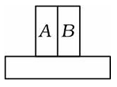
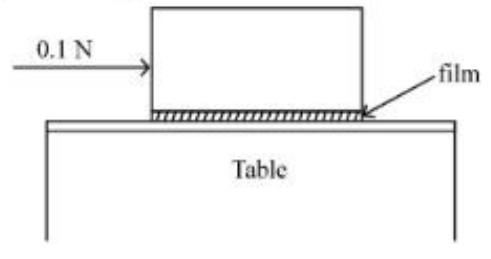
A metal block of base area \( 0.20\,\text{m}^{2} \) is placed on a table, as shown in figure. A liquid film of thickness \( 0.22\,\text{mm} \) is inserted between the block and the table. The block is pushed by a horizontal force of \( 0.1\,\text{N} \) and moves with a constant speed. If the viscosity of the liquid is \( 5.0\times 10^{-3}\,\text{Pl} \), the speed of block is ______ \( \times 10^{-3}\,\text{m/s} \).
A bowl filled with very hot soup cools from \( 98^\circ \text{C} \) to \( 86^\circ \text{C} \) in \( 2 \) minutes when the room temperature is \( 22^\circ \text{C} \). How long it will take to cool from \( 75^\circ \text{C} \) to \( 69^\circ \text{C} \)?
If average depth of an ocean is \( 4000 \, \text{m} \) and the bulk modulus of water is \( 2 \times 10^{9} \, \text{N m}^{-2} \), then fractional compression \( \dfrac{\Delta V}{V} \) of water at the bottom of ocean is \( \alpha \times 10^{-2} \). The value of \( \alpha \) is ________.(Given, \( g = 10 \, \text{ms}^{-2} \), \( \rho = 1000 \, \text{kgm}^{-3} \) )
A block of ice of mass \( 120 \, \text{g} \) at temperature \( 0^{\circ}\text{C} \) is put in \( 300 \, \text{g} \) of water at \( 25^{\circ}\text{C} \). The \( x \, \text{g} \) of ice melts as the temperature of the water reaches \( 0^{\circ}\text{C} \). The value of \( x \) is _______. \( \big( \text{Use specific heat capacity of water} = 4200 \, \text{Jkg}^{-1}\text{K}^{-1}, \ \text{Latent heat of ice} = 3.5 \times 10^{5} \, \text{Jkg}^{-1} \big) \)
A copper wire of length \( 3 \, \text{m} \) is stretched by \( 3 \, \text{mm} \) by applying an external force. The volume of the wire is \( 600 \times 10^{-6} \, \text{m}^3 \). The elastic potential energy stored in the wire in stretched condition would be ____________ \( \text{J} \).(Given Young modules of copper\( = 1.1 \times 10^{11}\,\mathrm{N/m^2}\)
A metal string \( A \) is suspended from a rigid support and its free end is attached to a block of mass \( M \). Second block having mass \( 2M \) is suspended at the bottom of the first block using a string \( B \). The area of cross sections of strings \( A \) and \( B \) are same. The ratio of lengths of strings of \( A \) to \( B \) is \( 2 \) and the ratio of their Young's moduli is \( 0.5 \). The ratio of elongations in \( A \) to \( B \) is ________.
A steel wire of length \( 3.2 \, \text{m} \) \( (Y_s = 2.0 \times 10^{11} \, \text{N m}^{-2}) \) and a copper wire of length \( 4.4 \, \text{m} \) \( (Y_C = 1.1 \times 10^{11} \, \text{N m}^{-2}) \), both of radius \( 1.4 \, \text{mm} \) are connected end to end. When stretched by a load, the net elongation is found to be \( 1.4 \, \text{mm} \). The load applied, in Newton, will be: (Given \( \pi = \dfrac{22}{7} \))
A gun fires a lead bullet of temperature \( 300 \, \text{K} \) into a wooden block. The bullet having melting temperature of \( 600 \, \text{K} \) penetrates into the block and melts down. If the total heat required for the process is \( 625 \, \text{J} \), then the mass of the bullet is ______ grams.(Latent heat of fusion of lead \( = 2.5 \times 10^{4} \, \text{J} \, \text{Kg}^{-1} \) and specific heat capacity of lead \( = 125 \, \text{J} \, \text{Kg}^{-1} \, \text{K}^{-1} \))
The bulk modulus of a liquid is \( 3 \times 10^{10} \, \text{N m}^{-2} \). The pressure required to reduce the volume of liquid by \( 2\% \) is:
A body takes \( 4 \) min. to cool from \( 61^{\circ} \text{C} \) and \( 59^{\circ} \text{C} \). If the temperature of the surroundings is \( 30^{\circ} \text{C} \), the time taken by the body to cool from \( 51^{\circ} \text{C} \) to \( 49^{\circ} \text{C} \) is:
A metal wire of length \( 0.5 \, \text{m} \) and cross-sectional area \( 10^{-4} \, \text{m}^2 \) has breaking stress \( 5 \times 10^{8} \, \text{N m}^{-2} \). A block of \( 10 \, \text{kg} \) is attached at one end of the string and is rotating in a horizontal circle. The maximum linear velocity of block will be _______ \( \text{ms}^{-1} \).
A square aluminum (shear modulus is \( 25 \times 10^{9} \, \text{N m}^{-2} \)) slab of side \( 60 \, \text{cm} \) and thickness \( 15 \, \text{cm} \) is subjected to a shearing force (on its narrow face) of \( 18.0 \times 10^{4} \, \text{N} \). The lower edge is riveted to the floor. The displacement of the upper edge is ______ \( \mu \text{m} \).
Young's modules of material of a wire of length '\( L \)' and cross-sectional area \( A \) is \( Y \). If the length of the wire is doubled and cross-sectional area is halved then Young's modules will be:
The surface of water in a water tank of cross section area \( 750 \,\text{cm}^2 \) on the top of a house is \( h \,\text{m} \) above the tap level. The speed of water coming out through the tap of cross section area \( 500 \,\text{mm}^2 \) is \( 30 \,\text{cm/s} \). At that instant, \( \frac{dh}{dt} \) is \( x \times 10^{-3} \,\text{m/s} \). The value of \( x \) will be _______.
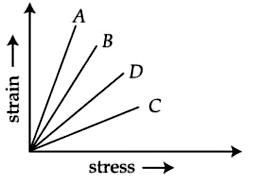
The strain-stress plot for materials A, B, C and D is shown in the figure. Which material has the largest Young's modulus?
Two blocks of masses \( 3 \, \text{kg} \) and \( 5 \, \text{kg} \) are connected by a metal wire going over a smooth pulley. The breaking stress of the metal is \( \dfrac{24}{\pi} \times 10^{2} \, \text{N m}^{-2} \). What is the minimum radius of the wire? \( \text{(Take } g = 10 \, \text{m s}^{-2}\text{)} \).
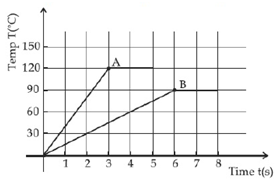
Two different metal bodies A and B of equal mass are heated at a uniform rate under similar conditions. The variation of temperature of the bodies is graphically represented as shown in the figure. The ratio of specific heat capacities is:
The height of Victoria falls is \( 63 \, \text{m} \). What is the difference in temperature of water at the top and at the bottom of fall?[Given: \( 1 \, \text{cal} = 4.2 \, \text{J} \) and specific heat of water \( = 1 \, \text{cal} \, \text{g}^{-1} \, {}^\circ\text{C}^{-1} \)]
A block of ice at \( -10^\circ \text{C} \) is slowly heated and converted to steam at \( 100^\circ \text{C} \). Which of the following curves represent the phenomenon qualitatively:
The velocity of upper layer of water in a river is \( 36 \, \text{km h}^{-1} \). Shearing stress between horizontal layers of water is \( 10^{-3} \, \text{N m}^{-2} \). Depth of the river is __________ \( \text{m} \). (Co-efficient of viscosity of water is \( 10^{-2} \, \text{Pa s} \) )
The value of tension in a long thin metal wire has been changed from \( T_1 \) to \( T_2 \). The lengths of the metal wire at two different values of tension \( T_1 \) and \( T_2 \) are \( l_1 \) and \( l_2 \) respectively. The actual length of the metal wire is:
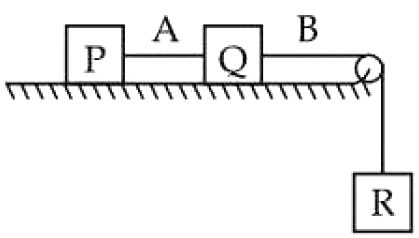
Each of three blocks \( P \), \( Q \) and \( R \) shown in figure has a mass of \( 3 \, \text{kg} \). Each of the wires \( A \) and \( B \) has cross-sectional area \( 0.005 \, \text{cm}^2 \) and Young's modulus \( 2 \times 10^{11} \, \text{N} \, \text{m}^{-2} \). Neglecting friction, the longitudinal strain on wire \( B \) is _____ \( \times 10^{4} \). (Take \( g = 10 \, \text{m} / \text{s}^{2} \) )
A thin rod having a length of \( 1 \, \text{m} \) and area of cross–section \( 3 \times 10^{-6} \, \text{m}^2 \) is suspended vertically from one end. The rod is cooled from \( 210^{\circ}\text{C} \) to \( 160^{\circ}\text{C} \). After cooling, a mass \( M \) is attached at the lower end of the rod such that the length of rod again becomes \( 1 \, \text{m} \). Young's modulus and coefficient of linear expansion of the rod are \( 2 \times 10^{11} \, \text{N m}^{-2} \) and \( 2 \times 10^{-5} \, \text{K}^{-1} \), respectively. The value of \( M \) is _____ \( \text{kg} \). (Take \( g = 10 \, \text{m s}^{-2} \))
An elastic spring under tension of \( 3\,\text{N} \) has a length \( a \). Its length is \( b \) under tension \( 2\,\text{N} \). For its length \( (3a - 2b) \), the value of tension will be _________ \( \text{N} \).
The temperature of equal masses of three different liquids \( x \), \( y \) and \( z \) are \( 10^{\circ}\text{C} \), \( 20^{\circ}\text{C} \) and \( 30^{\circ}\text{C} \) respectively. The temperature of mixture when \( x \) is mixed with \( y \) is \( 16^{\circ}\text{C} \) and that when \( y \) is mixed with \( z \) is \( 26^{\circ}\text{C} \). The temperature of mixture when \( x \) and \( z \) are mixed will be:
In order to determine the Young’s Modulus of a wire of radius \( 0.2 \, \text{cm} \) (measured using a scale of least count = \( 0.001 \, \text{cm} \)) and length \( 1 \, \text{m} \) (measured using a scale of least count = \( 1 \, \text{mm} \)), a weight of mass \( 1 \, \text{kg} \) (measured using a scale of least count = \( 1 \, \text{g} \)) was hanged to get the elongation of \( 0.5 \, \text{cm} \) (measured using a scale of least count \( 0.001 \, \text{cm} \)). What will be the fractional error in the value of Young’s Modulus determined by this experiment ?
Choose the correct relationship between Poisson ratio \( (\sigma) \), bulk modulus \( (K) \) and modulus of rigidity \( (\eta) \) of a given solid object.
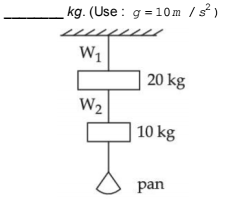
Wires \( W_{1} \) and \( W_{2} \) are made of same material having the breaking stress of \( 1.25 \times 10^{9} \, \text{N} / \text{m}^{2} \). \( W_{1} \) and \( W_{2} \) have cross-sectional area of \( 8 \times 10^{-7} \, \text{m}^{2} \) and \( 4 \times 10^{-7} \, \text{m}^{2} \), respectively. Masses of \( 20 \, \text{kg} \) and \( 10 \, \text{kg} \) hang from them as shown in the figure. The maximum mass that can be placed in the pan without breaking the wires is _______ \( \text{kg} \). (Use: \( g = 10 \, \text{m/s}^{2} \))
The fractional compression \( \left(\frac{\Delta V}{V}\right) \) of water at the depth of \( 2.5 \, \text{km} \) below the sea level is ________ \( \% \). Given, the Bulk modulus of water \( = 2 \times 10^{9} \, \text{N m}^{-2} \), density of water \( = 10^{3} \, \text{kg m}^{-3} \), acceleration due to gravity \( = g = 10 \, \text{m s}^{-2} \).
Two thin metallic spherical shells of radii \(\ r_1 \) and \(\ r_2 \) \(\ (r_1 < r_2) \) are placed with their centres coinciding. A material of thermal conductivity \(\ K \) is filled in the space between the shells. The inner shell is maintained at temperature \(\ \theta_1 \) and the outer shell at temperature \(\ \theta_2 \, (\theta_1 < \theta_2) \). The rate at which heat flows radially through the material is:
The increase in the pressure required to decrease the volume \( (\Delta V) \) of water is \( 6.3 \times 10^7 \, \text{N}/\text{m}^2 \). The percentage decrease in the volume is ________. (Bulk modulus of water \( = 2.1 \times 10^9 \, \text{N}/\text{m}^2 \))
The density and breaking stress of a wire are \( 6 \times 10^{4} \, \text{kg} / \text{m}^{3} \) and \( 1.2 \times 10^{8} \, \text{N} / \text{m}^{2} \) respectively. The wire is suspended from a rigid support on a planet where acceleration due to gravity is $\frac{1^{\mathrm{rd}}}{3}$of the value on the surface of earth. The maximum length of the wire with breaking is ________ \( \text{m} \) (take, \( g = 10 \, \text{m} / \text{s}^{2} \)).
With rise in temperature, the Young’s modulus of elasticity:
Consider a rectangular sheet of solid material of length \( l = 9 \, \text{cm} \) and width \( d = 4 \, \text{cm} \). The coefficient of linear expansion is \( \alpha = 3.1 \times 10^{-5} \, \text{K}^{-1} \) at room temperature and one atmospheric pressure. The mass of sheet \( m = 0.1 \, \text{kg} \) and the specific heat capacity \( C_v = 900 \, \text{J\kg}^{-1}\text{K}^{-1} \). If the amount of heat supplied to the material is \( 8.1 \times 10^2 \, \text{J} \) then change in area of the rectangular sheet is:
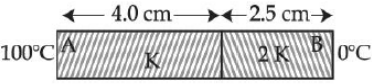
As per the given figure, two plates A and B of thermal conductivity \( K \) and \( 2K \) are joined together to form a compound plate. The thickness of plates are \( 4.0 \, \text{cm} \) and \( 2.5 \, \text{cm} \) respectively and the area of cross-section is \( 120 \, \text{cm}^{2} \) for each plate. The equivalent thermal conductivity of the compound plate is \( \left( 1 + \frac{5}{\alpha} \right) K \), then the value of \( \alpha \) will be________.
A wire of length '\( L \)' and radius '\( r \)' is clamped rigidly at one end. When the other end of the wire is pulled by a force \( f \), its length increases by '\( l \)'. Another wire of same material of length '\( 2L \)' and radius '\( 2r \)' is pulled by a force '\( 2f \)'. Then the increase in its length will be:
Two spherical soap bubbles of radii \( r_1 \) and \( r_2 \) in vacuum combine under isothermal conditions. The resulting bubble has a radius equal to:
The elongation of a wire on the surface of the earth is \( 10^{-4} \, \text{m} \). The same wire of same dimensions is elongated by \( 6 \times 10^{-5} \, \text{m} \) on another planet. The acceleration due to gravity on the planet will be __________ \( \text{ms}^{-2} \). (Take acceleration due to gravity on the surface of earth = \( 10 \, \text{ms}^{-2} \))
Glycerin of density \( 1.25 \times 10^{3}\,\text{kg}\,\text{m}^{-3} \) is flowing through the conical section of pipe. The area of cross-section of the pipe at its ends are \( 10\,\text{cm}^{2} \) and \( 5\,\text{cm}^{2} \) and pressure drop across its length is \( 3\,\text{N}\,\text{m}^{-2} \). The rate of flow of glycerin through the pipe is \( x \times 10^{-5}\,\text{m}^{3}\,\text{s}^{-1} \). The value of \( x \) is ______.
A water drop of diameter \( 2 \, \text{cm} \) is broken into \( 64 \) equal droplets. The surface tension of water is \( 0.075 \, \text{N/m} \). In this process the gain in surface energy will be:
A \( 100 \, \text{m} \) long wire having cross-sectional area \( 6.25 \times 10^{-4} \, \text{m}^{2} \) and Young’s modulus is \( 10^{10} \, \text{N m}^{-2} \) is subjected to a load of \( 250 \, \text{N} \), then the elongation in the wire will be:
A \( 100 \,\text{g} \) of iron nail is hit by a \( 1.5 \,\text{kg} \) hammer striking at a velocity of \( 60 \,\text{m}\,\text{s}^{-1} \). What will be the rise in the temperature of the nail if one fourth of energy of the hammer goes into heating the nail? [Specific heat capacity of iron \( = 0.42 \,\text{J}\,\text{g}^{-1}\,{}^\circ\text{C}^{-1} \)]
A gas based geyser heats water flowing at the rate of \( 5.0 \) litres per minute from \( 27^{\circ}\text{C} \) to \( 87^{\circ}\text{C} \). The rate of consumption of the gas is ____________ \( \text{g}/\text{s} \).\( \text{(Take heat of combustion of gas } = 5.0 \times 10^{4} \, \text{J}/\text{g} \text{ ) specific heat capacity of water } = 4200 \, \text{J}/\text{kg}\cdot{}^{\circ}\text{C}. \)
Surface tension of a soap bubble is \( 2.0 \times 10^{-2} \, \text{N m}^{-1} \). Work done to increase the radius of soap bubble from \( 3.5 \, \text{cm} \) to \( 7 \, \text{cm} \) will be: Take \( \left[ \pi = \frac{22}{7} \right] \)
The length of a metal wire is \( l_{1} \) when the tension in it is \( T_{1} \) and is \( l_{2} \) when the tension is \( T_{2} \). The natural length of the wire is:
A steam engine intakes \( 50 \, \text{g} \) of steam at \( 100^\circ \text{C} \) per minute and cools it down to \( 20^\circ \text{C} \). If latent heat of vaporization of steam is \( 540 \, \text{cal g}^{-1} \), then the heat rejected by the steam engine per minute is ________ \( \times 10^{3} \, \text{cal} \). (Given : specific heat capacity of water : \( 1 \, \text{cal g}^{-1} \, {}^\circ\text{C}^{-1} \) )
Match List - I with List - II.
Young’s moduli of the material of wires \( A \) and \( B \) are in the ratio of \( 1:4 \), while its area of cross sections are in the ratio of \( 1:3 \). If the same amount of load is applied to both the wires, the amount of elongation produced in the wires \( A \) and \( B \) will be in the ratio of:[Assume length of wires \( A \) and \( B \) are same].
At what temperature a gold ring of diameter \( 6.230 \, \text{cm} \) be heated so that it can be fitted on a wooden bangle of diameter \( 6.241 \, \text{cm} \)? Both the diameters have been measured at room temperature \( 27^{\circ}\text{C} \).(Given: coefficient of linear thermal expansion of gold \( \alpha_{L} = 1.4 \times 10^{-5} \, \text{K}^{-1} \).)
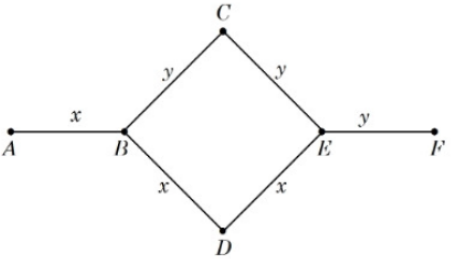
Rods $x$ and $y$ of equal dimensions but of different materials are joined as shown in figure. Temperatures of end points $A$ and $F$ dare maintained at $100^\circ\text{C}$ and $40^\circ\text{C}$ respectively. Given the thermal conductivity of rod $x$ is three times of that of rod $y$. the temperature at junction points $B$ and $E$ are (close to):
A uniform wire of length \( l \) of weight \( w \) is suspended from the roof with a weight of \( W \) at the other end. The stress in the wire at \( \frac{1}{3} \) distance from the top is \( \left( \frac{W}{A} + \frac{2w}{\gamma A} \right) \) where, \( A \) is the cross sectional area of the wire. The value of \( \gamma \) is _________.
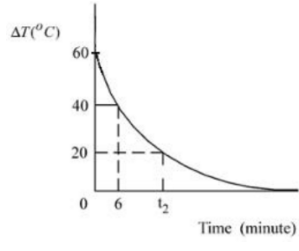
In an experiment to verify Newton’s law of cooling, a graph is plotted between, the temperature difference \( (\Delta T) \) of the water and surrounding and time as shown in figure. The initial temperature of water is taken as \( 80^\circ \text{C} \). The value of \( t_{2} \) as mentioned in the graph will be ________.
A stone of mass \( 20 \, \text{g} \) is projected from a rubber catapult of length \( 0.1 \, \text{m} \) and area of cross section \( 10^{-6} \, \text{m}^{2} \) stretched by an amount \( 0.04 \, \text{m} \). Take velocity of the projected stone is ______ m/s.(Young’s modulus of rubber \( = 0.5 \times 10^{9} \, \text{N} / \text{m}^{2} \))
Two separate wires A and B are stretched by \( 2 \, \text{mm} \) and \( 4 \, \text{mm} \) respectively, when they are subjected to a force of \( 2 \, \text{N}\). Assume that both the wires are made up of same material and the radius of wire B is \( 4 \) times that of the radius of wire A.The length of the wires A and B are in the ratio of \( a : b \). Then \( \frac{a}{b} \) can be expressed as \( \frac{1}{x} \) where \( x \) is __________ .
An air bubble of radius \( 1.0 \, \text{mm} \) is observed at a depth of \( 20 \, \text{cm} \) below the free surface of a liquid having surface tension \( 0.095 \, \text{J/m}^{2} \) and density \( 10^{3} \, \text{kg/m}^{3} \). The difference between pressure inside the bubble and atmospheric pressure is ________ \( \text{N/m}^{2} \). (Take \( g = 10 \, \text{m/s}^{2} \))
A certain pressure ‘\( P \)’ is applied to \( 1 \, \text{litre} \) of water and \( 2 \, \text{litre} \) of a liquid separately. Water gets compressed to \( 0.01\% \) whereas the liquid gets compressed to \( 0.03\% \). the ratio of Bulk modulus of water to that of the liquid is \( \frac{3}{x} \). The value of \( x \) is \( \_\_\_\_\_\_\_ \).
A wire of length \( L \) and radius \( r \) is clamped at one end. If its other end is pulled by a force \( F \), its length increases by \( l \). If the radius of the wire and the applied force both are reduced to half of their original values keeping original length constant, the increase in length will become:
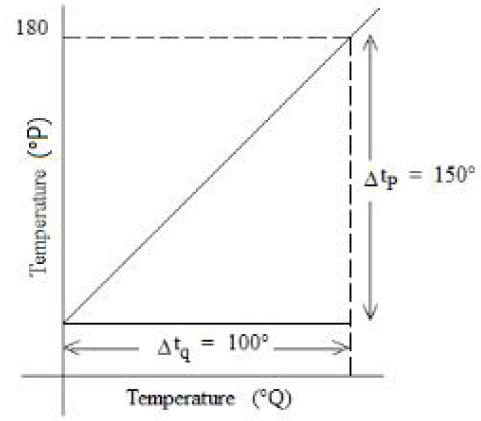
The graph between two temperature scales \( P \) and \( Q \) is shown in the figure, between upper fixed point and lower fixed point there are \( 150 \) equal divisions of scale \( P \) and \( 100 \) divisions on scale \( Q \). The relationship for conversion between the two scales is given by:
The excess pressure inside a soap bubble is thrice the excess pressure inside a second soap bubble. The ratio between the volume of the first and the second bubble is:
An ice cube of dimension \( 60 \, \text{cm} \times 50 \, \text{cm} \times 20 \, \text{cm} \) in placed in an insulation box of will thickness \( 1 \, \text{cm} \). The box keeping the ice cube at \( 0^\circ \text{C} \) of temperature is brought to a room of temperature \( 40^\circ \text{C} \). The rate of melting of ice is approximately: (Latent heat of fusion of ice is \( 3.4 \times 10^{5} \, \text{J kg}^{-1} \) and thermal conducting of insulation wall is \( 0.05 \, \text{W m}^{-1}\,\!\!^\circ\text{C}^{-1} \) )
A metal block of mass \( m \) is suspended from a rigid support through a metal wire of diameter \( 14 \, \text{mm} \). The tensile stress developed in the wire under equilibrium state is \( 7 \times 10^{5} \, \text{N m}^{-2} \). The value of mass \( m \) is _________ \( \text{kg} \). (Take, \( g = 9.8 \, \text{m s}^{-2} \) and \( \pi = \dfrac{22}{7} \))
The depth below the surface of sea to which a rubber ball be taken so as to decrease its volume by \( 0.02\% \) is \( \_\_\_ \, \text{m} \). (Take density of sea water \( = 10^{3} \, \text{kg m}^{-3} \). Bulk modulus of rubber \( = 9 \times 10^{8} \, \text{N m}^{-2} \), and \( g = 10 \, \text{m s}^{-2} \) )
If an air bubble of diameter \( 2 \, \text{mm} \) rises steadily through a liquid of density \( 2000 \, \text{kg}/\text{m}^{3} \) at a rate of \( 0.5 \, \text{cm}/\text{s} \), then the coefficient of viscosity of liquid is ________ Poise. (Take \( g = 10 \, \text{m}/\text{s}^{2} \))
A hydraulic automobile lift is designed to lift vehicles of mass \( 5000 \, \text{kg} \). The area of cross section of the cylinder carrying the load is \( 250 \, \text{cm}^2 \). The maximum pressure the smaller piston would have to bear is: [Assume \( g = 10 \, \text{m/s}^2 \)]
The length of a wire becomes \( l_1 \) and \( l_2 \) when \( 100 \, \text{N} \) and \( 120 \, \text{N} \) tensions are applied respectively. If \( 10 l_2 = 11 l_1 \), the natural length of wire will be \( \dfrac{1}{x} l_1 \). Here the value of \( x \) is ________.
Match List-I with List-II:
Choose the correct answer from the options given below:
The volume contraction of a solid copper cube of edge length \( 10 \, \text{cm} \), when subjected to a hydraulic pressure of \( 7 \times 10^{6} \, \text{Pa} \), would be __________ \( \text{mm}^{3} \).(Given bulk modulus of copper \( = 1.4 \times 10^{11} \, \text{Nm}^{-2} \))
On celcius scale the temperature of body increases by \( 40^\circ \text{C} \). The increase in temperature on Fahrenheit scale is:
The temperature of a metal strip having coefficient of linear expansion \( \alpha \) is increased from \( T_1 \) to \( T_2 \) resulting in increase of its length by \( \Delta L_1 \). The temperature is further increased from \( T_2 \) to \( T_3 \) such that the increase in its length is \( \Delta L_2 \).Given \( T_3 + T_1 = 2T_2 \) and \( T_2 - T_1 = \Delta T \), the value of \( \Delta L_2 \) is ________.
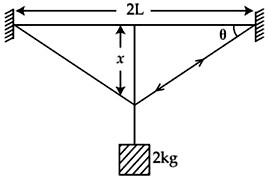
A wire of cross sectional area \( A \), modulus of elasticity \( 2\times 10^{11}\,\text{N m}^{-2} \) and length \( 2\,\text{m} \) is stretched between two vertical rigid supports. When a mass of \( 2\,\text{kg} \) is suspended at the middle it sags lower from its original position making angle \( \theta=\dfrac{1}{100} \) radian on the points of support. The value of \( A \) is ______ \( \times 10^{-4} \) \( \text{m}^{2} \) (consider \( x\ll L \)). (given: \( g=10\,\text{m/s}^{2} \))
A spherical call of radius \(1 \times 10^{-4} \, \text{m}\) and density \(10^{5} \, \text{kg/m}^{3}\) falls freely under gravity through a distance \(h\) before entering a tank of water. If after entering in water the velocity of the ball does not change, then the value of \(h\) is approximately: (The coefficient of viscosity of water is \(9.8 \times 10^{-6} \, \text{N s/m}^{2}\))
An aluminium and steel rods having same lengths and cross-sections are joined to make total length of \( 120 \, \text{cm} \) at \( 30^\circ\text{C} \). The coefficient of linear expansion of aluminium and steel are \( 24 \times 10^{-6} \, / \, ^\circ\text{C} \) and \( 1.2 \times 10^{-5} \, / \, ^\circ\text{C} \), respectively. The length of this composite rod when its temperature is raised to \( 100^\circ\text{C} \), is ________ \( \text{cm} \).
A string \( A \) of length \( 0.314 \, \text{m} \) and Young's modulus \( 2\times 10^{10}\, \text{N}/\text{m}^2 \) is connected to another string \( B \) of length and Young's modulus both twice of those of \( A \). This series combination of strings is then suspended from a rigid support and its free end is fixed to a load of mass \( 0.8 \, \text{kg} \). The net change in length of the combination is ______ \( \text{mm} \).(radius of both the strings is \( 0.2 \, \text{mm} \) and acceleration due to gravity \( =10\, \text{m}/\text{s}^2 \) (Mass of both strings is to be neglected as compared to the mass of load
The elastic behaviour of material for linear stress and linear strain, is shown in the figure. The energy density for a linear strain of \( 5 \times 10^{-4} \) is __________ \( \text{kJ} / \text{m}^{3} \). Assume that material is elastic upto the linear strain of \( 5 \times 10^{-4} \).
Eight equal drops of water are falling through air with a steady speed of \( 10 \, \text{cm/s} \). If the drops coalesce, the new velocity is:
Two persons pull a wire towards themselves. Each person exerts a force of \( 200 \, \text{N} \) on the wire. Young's modulus of the material of wire is \( 1 \times 10^{11} \, \text{N m}^{-2} \). Original length of the wire is \( 2 \, \text{m} \) and the area of cross section is \( 2 \, \text{cm}^{2} \). The wire will extend in length by ________ \( \mu \text{m} \).
Two wires of same length and radius are joined end to end and loaded. The young’s modulii of the materials of the two wires are \( Y_1 \) and \( Y_2 \). The combination behaves as a single wire then its Young’s modulus is:
Under the same load, wire \( A \) having length \( 5.0 \, \text{m} \) and cross section \( 2.5 \times 10^{-5} \, \text{m}^{2} \) stretches uniformly by the same amount as another wire \( B \) of length \( 6.0 \, \text{m} \) and a cross section of \( 3.0 \times 10^{-5} \, \text{m}^{2} \) stretches. The ratio of the Young’s modulus of wire \( A \) to that of wire \( B \) will be:
Two spherical bodies of same materials having radii \( 0.2 \, \text{m} \) and \( 0.8 \, \text{m} \) are placed in same atmosphere. The temperature of the smaller body is \( 800 \, \text{K} \) and temperature of the bigger body is \( 400 \, \text{K} \). If the energy radiated from the smaller body is \( E \), the energy radiated from the bigger body is (assume, effect of the surrounding temperature to be negligible),
A water heater of power \( 2000 \, \text{W} \) is used to heat water. The specific heat capacity of water \( 4200 \, \text{J kg}^{-1}\text{K}^{-1} \). The efficiency of heater is \( 70\% \). Time required to heat \( 2 \, \text{kg} \) of water from \( 10^\circ\text{C} \) to \( 60^\circ\text{C} \) is ______ s. (Assume that the specific heat capacity of water remains constant over the temperature range of the water)
A \( 400 \, \mathrm{g} \) solid cube having an edge of length \( 10 \, \mathrm{cm} \) floats in water. How much volume of the cube is outside the water? (Given: density of water \( = 1000 \, \mathrm{kg \, m^{-3}} \))
The force required to stretch a wire of cross-section \( 1 \, \text{cm}^{2} \) to double its length will be: (Given Young’s modulus of the wire \( = 2 \times 10^{11} \, \text{N}/\text{m}^{2} \) )
A faulty thermometer reads \( 5^{\circ} \text{C} \) in melting ice and \( 95^{\circ} \text{C} \) in stream. The correct temperature on absolute scale will be ________ \( \text{K} \) when the faulty thermometer reads \( 41^{\circ} \text{C} \).
An ideal gas is expanding such that \( PT^{3} = \text{constant} \). The coefficient of volume expansion of the gas is:
A straight magnetic strip has a magnetic moment of \( 44 \, \text{Am}^2 \). If the strip is bent in a semicircular shape, its magnetic moment will be ____ \( \text{Am}^2 \). \( \left( \text{given } \pi = \frac{22}{7} \right) \)
The water is filled upto height of \( 12 \, \text{m} \) in a tank having vertical sidewalls. A hole is made in one of the walls at a depth ‘\( h \)’ below the water level. The value of ‘\( h \)’ for which the emerging stream of water strikes the ground at the maximum range is _______ \( \text{m} \).
The figure shows a liquid of given density flowing steadily in horizontal tube of varying cross-section. Cross sectional areas at \(A\) is \(1.5\,\text{cm}^{2}\), and \(B\) is \(25\,\text{mm}^{2}\), if the speed of liquid at \(B\) is \(60\,\text{cm/s}\) then \( (P_{A}-P_{B}) \) is: (Given \(P_{A}\) and \(P_{B}\) are liquid pressures at \(A\) and \(B\) points.Density \( \rho =1000\,\text{kg m}^{-3} \)A and B are on the axis of tube.)
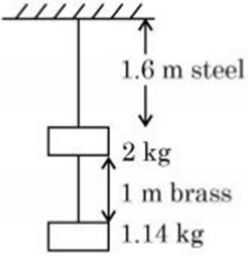
Two wires each of radius \( 0.2 \, \text{cm} \) and negligible mass, one made of steel and the other made of brass are loaded as shown in the figure. The elongation of the steel wire is ______ \( \times 10^{-6} \, \text{m} \). [Young’s modulus for steel \( = 2 \times 10^{11} \, \text{N m}^{-2} \) and \( g = 10 \, \text{m s}^{-2} \)]
Given below are two statements: one is labelled as Assertion A and the other is labelled as Reason R.Assertion A: Steel is used in the construction of building and bridges.Reason R: Steel is more elastic and its elastic limit is high.In the light of above statements, choose the most appropriate answer from the options given below
A sample of a liquid is kept at \( 1 \, \text{atm} \). It is compressed to \( 5 \, \text{atm} \) which leads to change of volume of \( 0.8 \, \text{cm}^3 \). If the bulk modulus of the liquid is \( 2 \, \text{GPa} \), the initial volume of the liquid was _______ litre. [Take \( 1 \, \text{atm} = 10^{5} \, \text{Pa} \)]
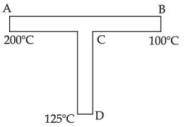
A rod \( CD \) of thermal resistance \( 10.0\,\mathrm{kW^{-1}} \) is joined at the middle of an identical rod \( AB \) as shown in figure. The ends \( A \), \( B \) and \( D \) are maintained at \( 200^\circ\mathrm{C} \), \( 100^\circ\mathrm{C} \) and \( 125^\circ\mathrm{C} \) respectively. The heat current in \( CD \) is \( P \) watt. The value of \( P \) is _______.
An amount of ice of mass \( 10^{-3} \,\text{kg} \) and temperature \( -10^{\circ}\text{C} \) is transformed to vapour of temperature \( 110^{\circ}\text{C} \) by applying heat. The total amount of work required for this conversion is,(Take, specific heat of ice \( = 2100 \,\text{Jkg}^{-1}\text{K}^{-1} \), specific heat of water \( = 4180 \,\text{Jkg}^{-1}\text{K}^{-1} \), specific heat of steam \( = 1920 \,\text{Jkg}^{-1}\text{K}^{-1} \), Latent heat of ice \( = 3.35 \times 10^{5} \,\text{Jkg}^{-1} \) and Latent heat of steam \( = 2.25 \times 10^{6} \,\text{Jkg}^{-1} \))
Two metallic wires \( P \) and \( Q \) have same volume and are made up of same material. If their area of cross sections are in the ratio \( 4:1 \) and force \( F_{1} \) is applied to \( P \), an extension of \( \Delta l \) is produced. The force which is required to produce same extension in \( Q \) is \( F_{2} \). The value of \( \dfrac{F_{1}}{F_{2}} \) is __________.
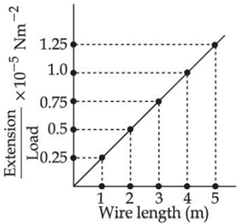
In an experiment to determine the Young’s modulus, steel wires of five different lengths \(( 1, 2, 3, 4 \) and \( 5 \, \text{m}) \) but of same cross section \(( 2 \, \text{mm}^2 )\) were taken and curves between extension and load were obtained. The slope (extension/load) of the curves were plotted with the wire length and the following graph is obtained. If the Young’s modulus of given steel wires is \( x \times 10^{11} \, \text{N m}^{-2} \), then the value of \( x \) is ______.
A brass wire of length \( 2 \, \text{m} \) and radius \( 1 \, \text{mm} \) at \( 27^\circ \text{C} \) is held taut between two rigid supports. Initially it was cooled to a temperature of \( -43^\circ \text{C} \) creating a tension \( T \) in the wire. The temperature to which the wire has to be cooled in order to increase the tension in it to \( 1.4T \), is _____ \( ^\circ \text{C} \).
A geyser heats water flowing at a rate of 2.0 kg per minute from 30$^\circ$C to 70$^\circ$C. If geyser operates on a gas burner, the rate of combustion of fuel will be ______ g min$^{-1}$.
[Heat of combustion = 8 $\times$ 10$^3$ J g$^{-1}$, Specific heat of water = 4.2 J g$^{-1}$ $^\circ$C$^{-1}$]
\( 10 \, \text{kg} \) of ice at \( -10^\circ \text{C} \) is added to \( 100 \, \text{kg} \) of water to lower its temperature from \( 25^\circ \text{C} \). Consider no heat exchange to surroundings. The decrement to the temperature of water is _________ \( ^\circ \text{C} \). (specific heat of ice \( = 2100 \, \text{J/kg}\!\cdot\!^\circ \text{C} \), specific heat of water \( = 4200 \, \text{J/kg}\!\cdot\!^\circ \text{C} \), latest heat of fusion of ice \( = 3.36 \times 10^{5} \, \text{J} / \text{kg} \) )
Given below are two statements: one is labelled as Assertion (A) and the other is labelled as Reason (R).Assertion (A): The property of body, by virtue of which it tends to regain its original shape when the external force is removed, is Elasticity.Reason (R): The restoring force depends upon the bonded inter atomic and inter molecular force of solid.In the light of the above statements, choose the most appropriate answer from the options given below:
The heat extracted out of \( x \) gram of water initially at \( 50^\circ \text{C} \) to cool it down to \( 0^\circ \text{C} \) is sufficient to evaporate \( (1000 - x) \) gram of water also initially at \( 50^\circ \text{C} \). The value of \( x \) (closest integer) is ____________ .(Take latent heat of water \( 2256 \, \text{kJ/kg} \cdot \text{K} \), specific heat capacity of water \( 4200 \, \text{J/kg} \cdot \text{K} \))
Two slabs with square cross section of different materials \( (1, 2) \) with equal sides \( (l) \) and thickness \( d_{1} \) and \( d_{2} \) such that \( d_{2} = 2 d_{1} \) and \( l > d_{2} \). Considering lowest edges of these slabs are fixed to the floor, we apply equal shearing force on the narrow faces. The angle of deformation is \( \theta_{2} = 2 \theta_{1} \). If the shear moduli of material \( 1 \) is \( 4 \times 10^{9} \, \text{N} / \text{m}^{2} \), then shear moduli of material \( 2 \) is \( x \times 10^{9} \, \text{N} / \text{m}^{2} \), where value of \( x \) is _______.
Two wires A and B are made of same material having ratio of lengths \( \dfrac{L_A}{L_B} = \dfrac{1}{3} \) and their diameters ratio \( \dfrac{d_A}{d_B} = 2 \). If both the wires are stretched using same force, what would be the ratio of their respective elongations?
The surface tension of soap solution is \( 3.5 \times 10^{-2} \, \text{N m}^{-1} .\) The amount of work done required to increase the radius of soap bubble from \( 10 \, \text{cm} \) to \( 20 \, \text{cm} \) is ________ \( \times 10^{-4} \, \text{J} .\) (take \( \pi = {22}/{7} \))
One end of a metal wire is fixed to a ceiling and a load of \( 2 \, \text{kg} \) hands from the other end. A similar wire is attached to the bottom of the load and anther load of \( 1 \, \text{kg} \) hangs from this lower wire. Then the ratio of longitudinal strain of upper wire to that of the lower wire will be ________.[Area of cross section of wire \( = 0.005 \, \text{cm}^2 \); \( Y = 2 \times 10^{11} \, \text{N m}^{-2} \) and \( g = 10 \, \text{m s}^{-2} \)]
Which of the following best represents the temperature versus heat supplied graph for water, in the range of \( -20^\circ \text{C} \) to \( 120^\circ \text{C} \)?
A steel rod of length \( 1 \, \text{m} \) and cross sectional area \( 10^{-4} \, \text{m}^{2} \) is heated from \( 0^\circ \text{C} \) to \( 200^\circ \text{C} \) without being allowed to extend or bend. The compressive tension produced in the rod is \( \_\_\_\_\_\_\_\_\_ \times 10^{4} \, \text{N} \)(Given Young’s modulus of steel \( = 2 \times 10^{11} \, \text{N m}^{-2} \), coefficient of linear expansion \( = 10^{-5} \, \text{K}^{-1} \))
A spherical soap bubble of radius \( 3 \, \text{cm} \) is formed inside another spherical soap bubble of radius of \( 6 \, \text{cm} \). If the internal pressure of the smaller bubble of radius \( 3 \, \text{cm} \) in the above system is equal to the internal pressure of the another single soap bubble of radius \( r \, \text{cm} \). The value of \( r \) is _____
A hole is drilled in a metal sheet. At \( 27^{\circ}\mathrm{C} \), the diameter of hole is \( 5 \, \mathrm{cm} \). When the sheet is heated to \( 177^{\circ}\mathrm{C} \) the change in the diameter of hole is \( d \times 10^{-3} \, \mathrm{cm} \). The value of \( d \) will be ______ if coefficient of linear expansion of the metal is \( 1.6 \times 10^{-5} \,/ {^{\circ}}\mathrm{C}^{} \).
A raindrop with radius \( R = 0.2 \, \text{mm} \) falls from a cloud at a height \( h = 2000 \, \text{m} \) above ground. Assume that the drop is spherical throughout its fall and the force of buoyancy may be neglected, then the terminal speed attained by the raindrop is:[Density of water \( f_w = 1000 \, \text{kg m}^{-3} \), and Density of air \( f_a = 1.2 \, \text{kg m}^{-3} \), \( g = 10 \, \text{m s}^{-2} \) Coefficient of viscosity of air \( = 1.8 \times 10^{-5} \, \text{N s m}^{-2} \)]
Two conductors have the same resistance at \( 0^\circ \text{C} \) but their temperature coefficients of resistance are \( \alpha_{1} \) and \( \alpha_{2} \). The respective temperature coefficients for their series and parallel combinations are:
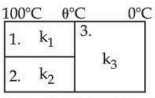
Three conductors of same length having thermal conductivity \( k_1 \), \( k_2 \) and \( k_3 \) are connected as shown in figure. Area of cross sections of \( 1^{\text{st}} \) and \( 2^{\text{nd}} \) conductor are same and for \( 3^{\text{rd}} \) conductor it is double of the \( 1^{\text{st}} \) conductor. The temperatures are given in the figure. In steady state condition, the value of \( \theta \) is ________ \( ^\circ \text{C} \).(Given: \( k_1 = 60 \, \text{J s}^{-1} \text{ m}^{-1} \text{ K}^{-1} \), \( k_2 = 120 \, \text{J s}^{-1} \text{ m}^{-1} \text{ K}^{-1} \), \( k_3 = 135 \, \text{J s}^{-1} \text{ m}^{-1} \text{ K}^{-1} \) )
A small spherical ball of radius \( 0.1 \, \text{mm} \) and density \( 10^{4} \, \text{kg m}^{-3} \) falls freely under gravity through a distance \( h \) before entering a tank of water. If, after entering the water the velocity of ball does not change and it continue to fall with same constant velocity inside water, then the value of \( h \) will be _______ \( \text{m} \).(Given \( g = 10 \, \text{m s}^{-2} \), viscosity of water \( = 1.0 \times 10^{-5} \, \text{N -s m}^{-2} \).)
A steel rod has a radius of \( 20 \, \text{mm} \) and a length of \( 2.0 \, \text{m} \). A force of \( 62.8 \, \text{kN} \) stretches it along its length. Young's modulus of steel is \( 2.0 \times 10^{11} \, \text{N/m}^{2} \). The longitudinal strain produced in the wire is __________ \( \times 10^{-5} \).
A \( 3 \, \text{m} \) long wire of radius \( 3 \, \text{mm} \) shows an extension of \( 0.1 \, \text{mm} \) when loaded vertically by a mass of \( 50 \, \text{kg} \) in an experiment to determine Young's modulus. The value of Young's modulus of the wire as per this experiment is \( P \times 10^{11} \, \text{N m}^{-2} \), where the value of \( P \) is: [Take : \( g = 3\pi \, \text{m} \, /\text{s}^{2} \)]
A unit scale is to be prepared whose length does not change with temperature and remains \( 20 \,\text{cm} \), using a bimetallic strip made of brass and iron each of different length. The length of both components would change in such a way that difference between their lengths remains constant. If length of brass is \( 40 \,\text{cm} \) and length of iron will be ______ \( \text{cm} \).(\( \alpha_{\text{iron}} = 1.2 \times 10^{-5} \,\text{K}^{-1} \) & \( \alpha_{\text{brass}} = 1.8 \times 10^{-5} \,\text{K}^{-1} \)).
A bimetallic strip consists of metals A and B. It is mounted rigidly as shown. The metal A has higher coefficient of expansion compared to that of metal B. When the bimetallic strip is placed in a cold bath, it will:
The area of cross section of the rope used to lift a load by a crane is \( 2.5 \times 10^{-4} \, \text{m}^2 \). The maximum lifting capacity of the crane is \( 10 \) metric tons. To increase the lifting capacity of the crane to \( 25 \) metric tons, the required area of cross section of the rope should be: (take \( g = 10 \, \text{ms}^{-2} \))
The surface tension of a soap bubble is \( 0.03 \, \text{N}/\text{m} \). The work done in increasing the diameter of bubble from \( 2 \, \text{cm} \) to \( 6 \, \text{cm} \) is \( \alpha \pi \times 10^{-4} \, \text{J} \). The value of \( \alpha \) is _________. (Take \( \pi = 3.14 \))
If \( E \) and \( H \) represents the intensity of electric field and magnetising field respectively, then the unit of \( E/H \) will be:
A wire of length \( 10 \, \text{cm} \) and diameter \( 0.5 \, \text{mm} \) is used in a bulb. The temperature of the wire is \( 1727^\circ \text{C} \) and power radiated by the wire is \( 94.2 \, \text{W} \). Its emissivity is \( \frac{x}{8} \) where \( x = \) ________________.$(\text{Given } \sigma = 6.0 \times 10^{-8} \text{ W m}^{-2} \text{ K}^{-4}, \pi = 3.14 \text{ and assume that the emissivity of wire material}$ $\text{is same at all wavelength.})$
A cube has side length \( 5 \, \text{cm} \) and modulus of rigidity \( 10^{5} \, \text{N}/\text{m}^{2} \). The displacement produced by a force of \( 10 \, \text{N} \) in the upper face of cube is ______ \( \text{mm} \).
The Young’s modulus of a steel wire of length \( 6 \, \text{m} \) and cross-sectional area \( 3 \, \text{mm}^2 \), is \( 2 \times 10^{11} \, \text{N/m}^2 \). The wire is suspended from its support on a given planet. A block of mass \( 4 \, \text{kg} \) is attached to the free end of the wire. The acceleration due to gravity on the planet is \( \tfrac{1}{4} \) of its value on the earth. The elongation of wire is: (Take \( g \) on the earth \( = 10 \, \text{m/s}^2 \))
In \( 5 \) minutes, a body cools from \( 75^\circ \text{C} \) to \( 65^\circ \text{C} \) at room temperature of \( 25^\circ \text{C} \). The temperature of body at the end of next \( 5 \) minutes is _______ \( ^\circ \text{C} \).
Two plates \( A \) and \( B \) have thermal conductivities \( 84 \, \text{W m}^{-1} \text{K}^{-1} \) and \( 126 \, \text{W m}^{-1} \text{K}^{-1} \) respectively. They have same surface area and same thickness. They are placed in contact along their surfaces. If the temperatures of the outer surfaces of \( A \) and \( B \) are kept at \( 100^{\circ}\text{C} \) and \( 0^{\circ}\text{C} \) respectively, then the temperature of the surface of contact in steady state is ________ \( ^{\circ}\text{C} \).
During the melting of a slab of ice at \( 273 \, \text{K} \) at atmospheric pressure:
A cylindrical rod of length \( 1 \, \text{m} \) and radius \( 4 \, \text{cm} \) is mounted vertically. It is subjected to a shear force of \( 10^5 \, \text{N} \) at the top. Considering infinitesimally small displacement in the upper edge, the angular displacement \( \theta \) of the rod axis from its original position would be:(shear moduli, \( G = 10^{10} \, \text{N/m}^2 \) )

 is \( 0.5 \). The ratio of elongations in \( A \) to \( B \) is ________.