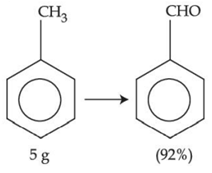
In the above reaction, \( 5 \ \text{g} \) of toluene is converted into benzaldehyde with \( 92 \ \% \) yield. The amount of benzaldehyde produced is ______ \( \times 10^{-2} \ \text{g} \). (Nearest integer)
Consider the complete combustion of butane, the amount of butane utilized to produce \( 72.0 \, \text{g} \) of water is __________ \( \times 10^{-1} \, \text{g} \). (in nearest integer)
\( 4 \, \text{g} \) equimolar mixture of \( \mathrm{NaOH} \) and \( \mathrm{Na_2CO_3} \) contains \( x \, \text{g} \) of \( \mathrm{NaOH} \) and \( y \, \text{g} \) of \( \mathrm{Na_2CO_3} \). The value of \( x \) is _____ \( \text{g} \). (Nearest integer)
The mass of iron converted into \( \mathrm{Fe_3O_4} \) by the action of \( 18 \, \text{g} \) of steam is:(Given: Molar mass of H, O and Fe are \( 1 \), \( 16 \) and \( 56 \, \text{g mol}^{-1} \) respectively)Assume iron is present in excess:
The elemental composition of a compound is \( 54.2\% \) C, \( 9.2\% \) H and \( 36.6\% \) O. If the molar mass of the compound is \( 132 \, \text{g mol}^{-1} \), the molecular formula of the compound is:[Given: The relative atomic mass of \( \text{C} : \text{H} : \text{O} = 12 : 1 : 16 \)]
\( 10 \, \text{mL} \) of \( 2 \, \text{M} \) NaOH solution is added to \( 20 \, \text{mL} \) of \( 1 \, \text{M} \) HCl solution kept in a beaker. Now, \( 10 \, \text{mL} \) of this mixture is poured into a volumetric flask of \( 100 \, \text{mL} \) containing \( 2 \) moles of HCl and made the volume upto the mark with distilled water. The solution in this flask is:
The density of ' \( x \) ' M solution (' \( x \) ' molar) of NaOH is \( 1.12 \, \text{g mL}^{-1} \), while in molality, the concentration of the solution is \( 3 \, \text{m} \) (\( 3 \) molal). Then \( x \) is (Given: Molar mass of NaOH is \( 40 \, \text{g /mol}^{} \))
Aqueous HCl reacts with \( \mathrm{MnO_2 (s)} \) to form \( \mathrm{MnCl_2 (aq)} \), \( \mathrm{Cl_2 (g)} \) and \( \mathrm{H_2O (l)} \). What is the weight (in \( \mathrm{g} \)) of \( \mathrm{Cl_2} \) liberated when \( 8.7 \,\mathrm{g} \) of \( \mathrm{MnO_2 (s)} \) is reacted with excess aqueous HCl solution?(Given Molar mass in \( \mathrm{g\,mol^{-1}} \) \( \mathrm{Mn} = 55 \), \( \mathrm{Cl} = 35.5 \), \( \mathrm{O} = 16 \), \( \mathrm{H} = 1 \))
Number of hydrogen atoms per molecule of a hydrocarbon A having \( 85.8\% \) carbon is ______. (Given: Molar mass of A = \( 84 \, \text{g mol}^{-1} \).)
Methylation of \( 10 \,\text{g} \) of benzene gave \( 9.2 \,\text{g} \) of toluene. Calculate the percentage yield of toluene _______. (Nearest integer)
Number of moles of \( \mathrm{H^+} \) ions required by \( 1 \) mole of \( \mathrm{MnO_4^-} \) to oxidise oxalate ion to \( \mathrm{CO_2} \) is ________.
Molarity \( (\text{M}) \) of an aqueous solution containing \( x \,\text{g} \) of anhyd. \( \text{CuSO}_4 \) in \( 500 \,\text{mL} \) solution at \( 32\,^{\circ}\text{C} \) is \( 2 \times 10^{-1} \,\text{M} \). Its molality will be ________ \( \times 10^{-3} \) m. (Nearest integer).[Given density of the solution \( = 1.25 \,\text{g/mL} \)]
When a hydrocarbon \( A \) undergoes complete combustion it requires \( 11 \) equivalents of oxygen and produces \( 4 \) equivalents of water. What is the molecular formula of \( A \)?
Some \( \mathrm{CO_2} \) gas was kept in a sealed container at a pressure of \( 1 \,\text{atm} \) and at \( 273 \,\text{K} \). This entire amount of \( \mathrm{CO_2} \) gas was later passed through an aqueous solution of \( \mathrm{Ca(OH)_2} \). The excess unreacted \( \mathrm{Ca(OH)_2} \) was later neutralized with \( 0.1 \,\text{M} \) of \( 40 \,\text{mL} \) HCl. If the volume of the sealed container of \( \mathrm{CO_2} \) was \( x \), then \( x \) is _____________ \( \text{cm}^3 \) (nearest integer).[Given: The entire amount of \( \mathrm{CO_2(g)} \) reacted with exactly half the initial amount of \( \mathrm{Ca(OH)_2} \) present in the aqueous solution.]
Number of grams of bromine that will completely react with \( 5.0 \, \text{g} \) of pent-1-ene is __________ \( \times 10^{-2} \, \text{g} \). (Atomic mass of \( \mathrm{Br} = 80 \, \text{g/mol} \)) (Nearest Integer)
\(1 \, \text{g}\) of a carbonate \((\mathrm{M_2CO_3})\) on treatment with excess \(\mathrm{HCl}\) produces \(0.01 \, \text{mol}\) of \(\mathrm{CO_2}\). The molar mass of \(\mathrm{M_2CO_3}\) is __________ \(\text{g mol}^{-1}\). \((\text{Nearest integer})\)
On complete combustion \( 1.0 \, \mathrm{g} \) of an organic compound \( (X) \) gave \( 1.46 \, \mathrm{g} \) of \( \mathrm{CO_2} \) and \( 0.567 \, \mathrm{g} \) of \( \mathrm{H_2O} \). The empirical formula mass of compound \( (X) \) is ______ \( \mathrm{g} \).(Given molar mass in \( \mathrm{g \, mol^{-1}} \) \( \mathrm{C:} \, 12 \), \( \mathrm{H:} \, 1 \), \( \mathrm{O:} \, 16 \))
\( 20 \, \text{mL} \) of sodium iodide solution gave \( 4.74 \, \text{g} \) silver iodide when treated with excess of silver nitrate solution. The molarity of the sodium iodide solution is ______ \( \text{M} \). (Nearest integer value)[Given: \( \mathrm{Na} = 23 \), \( \mathrm{I} = 127 \), \( \mathrm{Ag} = 108 \), \( \mathrm{N} = 14 \), \( \mathrm{O} = 16 \, \text{g mol}^{-1} \)]
Production of iron in blast furnace follows the following equation\( \mathrm{Fe_3O_4(s)} + 4\,\mathrm{CO(g)} \rightarrow 3\,\mathrm{Fe(l)} + 4\,\mathrm{CO_2(g)} \)When \( 4.640 \, \text{kg} \) of \( \mathrm{Fe_3O_4} \) and \( 2.520 \, \text{kg} \) of \( \mathrm{CO} \) are allowed to react then the amount of iron (in \( \text{g} \)) produced is:[Given: Molar Atomic mass \( (\mathrm{g\, mol^{-1}}) \): Fe \( = 56 \)Molar Atomic mass \( (\mathrm{g\, mol^{-1}}) \): O \( = 16 \)Molar Atomic mass \( (\mathrm{g\, mol^{-1}}) \): C \( = 12 \) ]
The quantity which changes with temperature is:
\( 14.0 \, \mathrm{g} \) of calcium metal is allowed to react with excess \( \mathrm{HCl} \) at \( 1.0 \, \mathrm{atm} \) pressure and \( 273 \, \mathrm{K} \). Which of the following statements is incorrect?\([ \)Given: Molar mass in \( \mathrm{g\,mol^{-1}} \) of \( \mathrm{Ca} – 40 \), \( \mathrm{Cl} – 35.5 \), \( \mathrm{H} – 1 ]\)
The number of atoms in \( 8 \, \text{g} \) of sodium is \( x \times 10^{23} \). The value of \( x \) is:[Given: \( N_A = 6.02 \times 10^{23} \, \text{mol}^{-1} \) Atomic mass of Na \( = 23.0 \, \text{u} \)]
In the reaction, \( 2\mathrm{Al(s)} + 6\mathrm{HCl(aq)} \rightarrow 2\mathrm{Al}^{3+}\mathrm{(aq)} + 6\mathrm{Cl^-}\mathrm{(aq)} + 3\mathrm{H_2(g)} \)
When \( 0.01 \) mol of an organic compound containing \( 60\% \) carbon was burnt completely, \( 4.4 \, \text{g} \) of \( \mathrm{CO_2} \) was produced. The molar mass of compound is __________ \( \text{g mol}^{-1} \) (Nearest Integer)
\( 2 \, \text{L} \) of \( 0.2 \, \text{M} \) \( \mathrm{H_2SO_4} \) is reacted with \( 2 \, \text{L} \) of \( 0.1 \, \text{M} \) \( \mathrm{NaOH} \) solution, the molarity of the resulting product \( \mathrm{Na_2SO_4} \) in the solution is __________ millimolar. (Nearest integer)
\( 116 \, \text{g} \) of a substance upon dissociation reaction, yields \( 7.5 \, \text{g} \) of hydrogen, \( 60 \, \text{g} \) of oxygen and \( 48.5 \, \text{g} \) of carbon. Given that the atomic masses of \( \mathrm{H} \), \( \mathrm{O} \) and \( \mathrm{C} \) are \( 1 \), \( 16 \) and \( 12 \), respectively. The data agrees with how many formulae of the following? __________. A. \( \mathrm{CH_3COOH} \) B. \( \mathrm{HCHO} \) C. \( \mathrm{CH_3OOCH_3} \) D. \( \mathrm{CH_3CHO} \)
The molar mass of the water insoluble product formed from the fusion of chromite ore \( \mathrm{(FeCr_2O_4)} \) with \( \mathrm{Na_2CO_3} \) in presence of \( \mathrm{O_2} \) is ________ \( \mathrm{g \, mol^{-1}} \).
If the concentration of glucose \( \mathrm{(C_6H_{12}O_6} )\) in blood is \( 0.72 \,\mathrm{g\,L^{-1}} \), the molarity of glucose in blood is _______ \( \times 10^{-3} \,\mathrm{M} \). (Nearest integer) [Given: Atomic mass of \( \mathrm{C} = 12 \), \( \mathrm{H} = 1 \), \( \mathrm{O} = 16 \,\mathrm{u} \)]
\( 0.05 \, \text{cm} \) thick coating of silver is deposited on a plate of \( 0.05 \, \text{m}^{2} \) area. The number of silver atoms deposited on plate are __________ \( \times 10^{23} \). (At mass Ag \( = 108 \), \( d = 7.9 \, \text{g} \, \text{cm}^{-3} \) )
The ratio of mass percentage \( (\text{w/w}) \) of \( \mathrm{C:H} \) in a hydrocarbon is \( 12:1 \). It has two carbon atoms. The weight \( (\text{in g}) \) of \( \mathrm{CO_{2}(g)} \) formed when \( 3.38\ \text{g} \) of this hydrocarbon is completely burnt in oxygen is:(Given: Molar mass in \( \text{g mol}^{-1} \) \( \mathrm{C:12,H:1,O:16} \) )
The density of a monobasic strong acid (Molar mass \( 24.2 \, \text{g/mol} \)) is \( 1.21 \, \text{kg/L} \). the volume of its solution required for the complete neutralization of \( 25 \, \text{mL} \) of \( 0.24 \, \text{M} \) NaOH is ________ \( \times 10^{-2} \) mL (Nearest integer)
A solution of sugar is obtained by mixing \( 200 \, \text{g} \) of its \( 25\% \) solution and \( 500 \, \text{g} \) of its \( 40\% \) solution (both by mass). The mass percentage of the resulting sugar solution is ______. (Nearest integer)
\( 4.7 \, \text{g} \) of phenol is heated with \( \text{Zn} \) to give product X. If this reaction goes to \( 60\% \) completion then the number of moles of compound X formed will be ________ \( \times 10^{-2} \). (Nearest Integer)(Given molar mass in \( \text{g} \, \text{mol}^{-1} \) : H: \( 1 \), C: \( 12 \), O: \( 16 \))
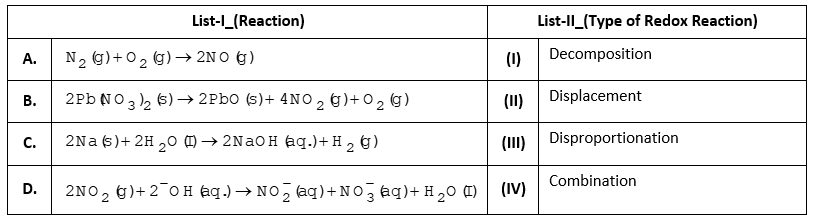
Match List-I with List-II.
Choose the correct answer from the options given below:
Molality of \( 0.8 \, \text{M} \, \mathrm{H_2SO_4} \) solution (density \( 1.06 \, \text{g cm}^{-3} \)) is ______ \( \times 10^{-3} \, \text{m} \).
If \( 80 \, \text{g} \) of copper sulphate \( \mathrm{CuSO_4 \cdot 5H_2O} \) is dissolved in deionized water to make \( 5 \, \text{L} \) of sodium. The concentration of the copper sulphate solution is \( x \times 10^{-3} \, \text{mol L}^{-1} \). The value of \( x \) is:
On complete combustion of \( 0.492\,\text{g} \) of an organic compound containing \( \mathrm{C} \), \( \mathrm{H} \) and \( \mathrm{O} \), \( 0.7938\,\text{g} \) of \( \mathrm{CO_2} \) and \( 0.4428\,\text{g} \) of \( \mathrm{H_2O} \) was produced. The \( \% \) composition of oxygen in the compound is ______.
The volume of \( 0.02 \, \mathrm{M} \) aqueous \( \mathrm{HBr} \) required to neutralize \( 10.0 \, \mathrm{mL} \) of \( 0.01 \, \mathrm{M} \) aqueous \( \mathrm{Ba(OH)_2} \) is: (Assume complete neutralization)
An aqueous \( \mathrm{KCl} \) solution of density \( 1.20 \, \mathrm{g\, mL^{-1}} \) has a molality of \( 3.30 \, \mathrm{mol\, kg^{-1}} \). The molarity of the solution in \( \mathrm{mol\, L^{-1}} \) is ______. (Nearest integer)
\( 10 \, \text{mL} \) of gaseous hydrocarbon on combustion gives \( 40 \, \text{mL} \) of \( \text{CO}_2 (g) \) and \( 50 \, \text{mL} \) of water vapour. Total number of carbon and hydrogen atoms in the hydrocarbon is __________.
The normality of \( \mathrm{H_2SO_4} \) in the solution obtained on mixing \( 100 \, \mathrm{mL} \) of \( 0.1 \, \mathrm{M} \) \( \mathrm{H_2SO_4} \) with \( 50 \, \mathrm{mL} \) of \( 0.1 \, \mathrm{M} \) \( \mathrm{NaOH} \) is _______ \( \times 10^{-1} \, \mathrm{N} \). (Nearest Integer)
A \( 0.166\ \mathrm{g} \) sample of an organic compound was digested with conc. \( \mathrm{H_2SO_4} \) and then distilled with \( \mathrm{NaOH} \). The ammonia gas evolved was passed through \( 50.0\ \mathrm{mL} \) of \( 0.5\ \mathrm{N} \) \( \mathrm{H_2SO_4} \). The used acid required \( 30.0\ \mathrm{mL} \) of \( 0.25\ \mathrm{N} \) \( \mathrm{NaOH} \) for complete neutralization. The mass percentage of nitrogen in the organic compound is ________________.
\( 250 \, \text{g} \) solution of D-glucose in water contains \( 10.8\% \) of carbon by weight. The molality of the solution is nearest to (Given: Atomic Weights are, H, \( 1\,\text{u} \); C, \( 12\,\text{u} \), O, \( 16\,\text{u} \)).
A \( 100 \, \text{mL} \) solution of \( \mathrm{CH_3CH_2MgBr} \) on treatment with methanol produces \( 2.24 \, \text{mL} \) of a gas at STP. The weight of gas produced is ________ \( \text{mg} \). [nearest integer]
The volume of \( \mathrm{HCl} \), containing \( 73 \, \mathrm{g \, L^{-1}} \), required to completely neutralize \( \mathrm{NaOH} \) obtained by reacting \( 0.69 \, \mathrm{g} \) of metallic sodium with water, is _______ \( \mathrm{mL} \). (Nearest Integer)(Given: molar Masses of \( \mathrm{Na} \), \( \mathrm{Cl} \), \( \mathrm{O} \), \( \mathrm{H} \), are \( 23 \), \( 35 \), \( 5 \), \( 16 \) and \( 1 \, \mathrm{g \, mol^{-1}} \) )
Fortification of food with iron is done using \( \mathrm{FeSO}_{4}\cdot7\mathrm{H}_{2}\mathrm{O} \). The mass in grams of the \( \mathrm{FeSO}_{4}\cdot7\mathrm{H}_{2}\mathrm{O} \) required to achieve \( 12 \,\text{ppm} \) of iron in \( 150 \,\text{kg} \) of wheat is ______ (Nearest integer) [Given: Molar mass of Fe, S and O respectively are \( 56 \), \( 32 \) and \( 16 \,\mathrm{g\, mol^{-1}} \)]
If \( 5 \) moles of \( \text{BaCl}_2 \) is mixed with \( 2 \) moles of \( \text{Na}_3\text{PO}_4 \), the maximum number of moles of \( \text{Ba}_3(\text{PO}_4)_2 \) formed is __________ (Nearest integer)
In the given reaction,\( X + Y + 3Z \rightleftharpoons \mathrm{XYZ_3} \). If one mole of each of \( X \) and \( Y \) with \( 0.05 \, \text{mol} \) of \( Z \) gives compound \( \mathrm{XYZ_3} \). (Given: Atomic masses of \( X, Y \) and \( Z \) are \( 10, 20 \) and \( 30 \, \text{amu} \), respectively.) The yield of \( \mathrm{XYZ_3} \) is ________ \( \text{g} \). (Nearest integer)
The number of units, which are used to express concentration of solutions from the following is _______Mass percent, Mole, Mole fraction, Molarity, ppm, Molality
\( \mathrm{CaCO_3(s) + 2HCl(aq) \rightarrow CaCl_2(aq) + CO_2(g) + H_2O(l)} \)Consider the above reaction, what mass of \( \mathrm{CaCl_2} \) will be formed if \( 250 \, \mathrm{mL} \) of \( 0.76 \, \mathrm{M} \) HCl reacts with \( 1000 \, \mathrm{g} \) of \( \mathrm{CaCO_3} \)?(Given : Molar mass of Ca, C, O, H and Cl are \( 40 \), \( 12 \), \( 16 \), \( 1 \) and \( 35.5 \, \mathrm{g \, mol^{-1}} \), respectively)
The density of \( 3 \, \text{M} \) solution of \( \text{NaCl} \) is \( 1.0 \, \text{g} \, \text{mL}^{-1} \). Molality of the solution is ______ \( \times 10^{-2} \, \text{m} \). (Nearest integer). Given : Molar mass of \( \text{Na} \) and \( \text{Cl} \) is \( 23 \) and \( 35.5 \, \text{g} \, \text{mol}^{-1} \) respectively.
Given below are two statements:Statement I: \( \mathrm{S}_8 \) solid undergoes disproportionation reaction under alkaline conditions to form \( \mathrm{S}^{2-} \) and \( \mathrm{S}_2\mathrm{O}_3^{2-} \).Statement II: \( \mathrm{ClO}_4^{-} \) can undergo disproportionation reaction under acidic condition.In the light of the above statements, choose the most appropriate answer from the options given below:
A solution of \( \mathrm{H_2SO_4} \) is \( 31.4\% \) \( \mathrm{H_2SO_4} \) by mass and has a density of \( 1.25 \, \mathrm{g/mL} \). The molarity of the \( \mathrm{H_2SO_4} \) solution is __________ \( \mathrm{M} \) (nearest integer) [Given molar mass of \( \mathrm{H_2SO_4} = 98 \, \mathrm{g \, mol^{-1}} \) ]
Consider the following reaction occurring in the blast furnace:\( \mathrm{Fe_3O_4 (s) + 4\,CO (g) \rightarrow 3\,Fe (l) + 4\,CO_2 (g)} \)\( 'x' \) \( \mathrm{kg} \) of iron is produced when \( 2.32 \times 10^{3} \; \mathrm{kg} \; \mathrm{Fe_3O_4} \) and \( 2.8 \times 10^{2} \; \mathrm{kg} \; \mathrm{CO} \) are bought together in the furnace. The value of \( 'x' \) is _______ . (nearest integer)\( \{ \text{Given: molar mass of } \mathrm{Fe_3O_4} = 232 \; \mathrm{g\,mol^{-1}} \} \)molar mass of \( \mathrm{CO} = 28 \; \mathrm{g\,mol^{-1}} \)molar mass of \( \mathrm{Fe} = 56 \; \mathrm{g\,mol^{-1}} \)
Identify the correct statements:A. Hydrated salts can be used as primary standard.B. Primary standard should not undergo any reaction with air.C. Reactions of primary standard with another substance should be instantaneous and stoichiometric.D. Primary standard should not be soluble in water.E. Primary standard should have low relative molar mass.Choose the correct answer from the options given below:
Complete combustion of \( 3 \, \text{g} \) of ethane gives \( x \times 10^{22} \) molecules of water. The value of \( x \) is ____________. (Round off to the nearest integer).[Use: \( N_A = 6.023 \times 10^{23} \); Atomic masses in \( \text{u} \) : \( \text{C} : 12.0 \); \( \text{O} : 16.0 \); \( \text{H} : 1.0 \)]
The number of moles of methane required to produce \( 11 \, \text{g} \) \( \mathrm{CO_2(g)} \) after complete combustion is:(Given molar mass of methane in \( \mathrm{g \, mol^{-1}} : 16 \))
The density of \( \text{NaOH} \) solution is \( 1.2 \, \text{g cm}^{-3} \). The molality of this solution is ________ \( \text{m} \). (Round off to the Nearest Integer) [Use: Atomic masses: Na: \( 23.0 \, \text{u} \) O: \( 16.0 \, \text{u} \) H: \( 1.0 \, \text{u} \); Density of \( \text{H}_2\text{O} \): \( 1.0 \, \text{g cm}^{-1} \)]
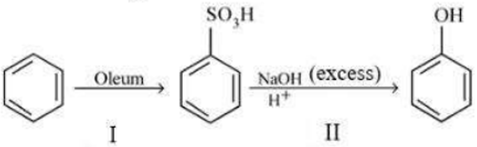
In the following reaction,The \( \% \) yield for reaction \( \mathrm{I} \) is \( 60\% \) and that of reaction \( \mathrm{II} \) is \( 50\% \). The overall yield of the complete reaction is ______ \( \% \) [Nearest Integer]
The moles of methane required to produce \( 81 \, \text{g} \) of water after complete combustion is ________ \( \times 10^{-2} \, \text{mol} \). [Nearest integer]
On combustion \( 0.210 \, \text{g} \) of an organic compound containing \( \mathrm{C} \), \( \mathrm{H} \) and \( \mathrm{O} \) gave \( 0.127 \, \text{g} \) \( \mathrm{H_2O} \) and \( 0.307 \, \text{g} \) \( \mathrm{CO_2} \). The percentages of hydrogen and oxygen in the given organic compound respectively are:
\( 80 \, \text{mL} \) of a hydrocarbon on mixing with \( 264 \, \text{mL} \) of oxygen in a closed U-tube undergoes complete combustion. The residual gases after cooling to \( 273 \, \text{K} \) occupy \( 224 \, \text{mL} \). When the system is treated with KOH solution, the volume decreases to \( 64 \, \text{mL} \). The formula of the hydrocarbon is:
\( 5 \, \text{g} \) of \( \mathrm{NaOH} \) was dissolved in deionized water to prepare at \( 450 \, \text{mL} \) stock solution. What volume (in \( \text{mL} \)) of this solution would be required to prepare \( 500 \, \text{mL} \) of \( 0.1 \, \text{M} \) solution? ________.Given : Molar Mass of \( \mathrm{Na} \), \( \mathrm{O} \) and \( \mathrm{H} \) is \( 23 \), \( 16 \) and \( 1 \, \text{g mol}^{-1} \) respectively
\( \mathrm{A} + 2\mathrm{B} \longrightarrow \mathrm{AB_2} \)\( 36.0 \, \text{g} \) of ‘\( \mathrm{A} \)’ (Molar mass: \( 60 \, \mathrm{gm \, mol^{-1}} \)) and \( 56.0 \, \text{g} \) of ‘\( \mathrm{B} \)’ (Molar mass: \( 80 \, \mathrm{gm \, mol^{-1}} \)) are allowed to react. Which of the following statements are correct?\( \mathrm{A}. \) ‘\( \mathrm{A} \)’ is the limiting reagent.\( \mathrm{B}. \) \( 77.0 \, \text{g} \) of \( \mathrm{AB_2} \) is formed.\( \mathrm{C}. \) Molar mass of \( \mathrm{AB_2} \) is \( 140 \, \mathrm{gm \, mol^{-1}} \).\( \mathrm{D}. \) \( 15.0 \, \text{g} \) of \( \mathrm{A} \) is left unreacted after the completion of reaction.Choose the correct answer from the options given below:
Butane reacts with oxygen to produce carbon dioxide and water following the equation given below.\( \mathrm{C_4H_{10}(g)} + \frac{13}{2}\mathrm{O_2(g)} \rightarrow 4\mathrm{CO_2(g)} + 5\mathrm{H_2O(l)} \)If \( 174.0 \, \mathrm{kg} \) of butane is mixed with \( 320.0 \, \mathrm{kg} \) of \( \mathrm{O_2} \) the volume of water formed in liters is _____. (Nearest integer)[Given: (a) Molar mass of \( \mathrm{C, H, O} \) are \( 12, 1, 16 \, \mathrm{g \, mol^{-1}} \) respectively, (b) Density of water \( = 1 \, \mathrm{g \, mL^{-1}} \)]
A solution containing \( 200 \, \text{mL} \) of \( 0.5 \, \text{M} \, \mathrm{KCl} \) is mixed with \( 50 \, \text{mL} \) of \( 19\% \, \text{w/v} \, \mathrm{MgCl_2} \) and resulting solution is diluted \( 8 \) times. Molarity of chloride ion in final solution:
The mass of sodium acetate \( \mathrm{(CH_3COONa)} \) required to prepare \( 250 \, \text{mL} \) of \( 0.35 \, \text{M} \) aqueous solution is _______ \( \text{g} \). (Molar mass of \( \mathrm{CH_3COONa} \) is \( 82.02 \, \text{g} \, \text{mol}^{-1} \) )
Quantitative analysis of an organic compound (X) shows following \( \% \) composition. C : \( 14.5\% \) Cl : \( 64.46\% \) H : \( 1.8\% \) (Empirical formula mass of the compound (X) is ______ \( \times 10^{-1} \) ) [Given molar mass in \( \mathrm{g\, mol^{-1}} \) of C : \( 12 \) , H : \( 1 \) , O : \( 16 \) , Cl : \( 35.5 \)]
A sample of \( \mathrm{CaCO_3} \) and \( \mathrm{MgCO_3} \) weighed \( 2.21 \, \text{g} \) is ignited to constant weight of \( 1.152 \, \text{g} \). The composition of mixture is:(Given molar mass in \( \text{g mol}^{-1} \) \( \mathrm{CaCO_3} : 100, \; \mathrm{MgCO_3} : 84 \))
\( 1 \, \text{L} \) aqueous solution of \( \mathrm{H_2SO_4} \) contains \( 0.02 \, \text{m mol} \, \mathrm{H_2SO_4} \) , \( 50\% \) of this solution is diluted with deionized water to give \( 1 \, \text{L} \) solution (A). In solution (A), \( 0.01 \, \text{m mol} \) of \( \mathrm{H_2SO_4} \) are added. Total m mols of \( \mathrm{H_2SO_4} \) in the final solution is __________ \( \times 10^{3} \) \( \text{m mols} \).
Mass of methane required to produce \( 22 \, \text{g} \) of \( \mathrm{CO_2} \) after complete combustion is ________ \( \text{g} \). (Given Molar mass in \( \text{g mol}^{-1} \), \( \mathrm{C} = 12.0 \), \( \mathrm{H} = 1.0 \), \( \mathrm{O} = 16.0 \))
An organic compound has \( 42.1\% \) carbon, \( 6.4\% \) hydrogen and remainder is oxygen. If its molecular weight is \( 342 \), then its molecular formula is:
\( 0.5 \, \text{g} \) of an organic compound \((X)\) with \( 60\% \) carbon will produce ________ \( \times 10^{-1} \, \text{g} \) of \( \mathrm{CO_2} \) on complete combustion.
Molality \( (m) \) of \( 3 \, \mathrm{M} \) aqueous solution of \( \mathrm{NaCl} \) is:(Given: Density of solution \( = 1.25 \, \mathrm{g \, mL^{-1}} \), Molar mass in \( \mathrm{g \, mol^{-1}} \): \( \mathrm{Na\!-\!23, \, Cl\!-\!35.5} \))
Concentrated nitric acid is labelled as \( 75\% \) by mass. The volume in \( \text{mL} \) of the solution which contains \( 30 \, \text{g} \) of nitric acid is ____________. Given: Density of nitric acid solution is \( 1.25 \, \text{g/mL} \).
The molarity of a \( 70\% \) (mass/mass) aqueous solution of a monobasic acid (X) is ______ \( \times 10^{-1} \) \( \mathrm{M} \). (Nearest integer) [Given: Density of aqueous solution of (X) is \( 1.25 \, \mathrm{g\, mL^{-1}} \). Molar mass of the acid is \( 70 \, \mathrm{g\, mol^{-1}} \)]
The correct order of total number of atoms present in (A) \( 2 \) moles of cyclohexane (B) \( 684 \, \text{g} \) of sucrose (C) \( 90.8 \, \text{L} \) of dihydrogen at STP is:
Sodium oxide reacts with water to produce sodium hydroxide. \( 20.0 \, \text{g} \) of sodium oxide is dissolved in \( 500 \, \text{mL} \) of water. Neglecting the change in volume, the concentration of the resulting NaOH solution is _______ \( \times 10^{-1} \, \text{M} \). (Nearest integer) [Atomic mass: \( \mathrm{Na} = 23.0 \), \( \mathrm{O} = 16.0 \), \( \mathrm{H} = 1.0 \)]
\( 100 \, \text{g} \) of propane is completely reacted with \( 1000 \, \text{g} \) of oxygen. The mole fraction of carbon dioxide in the resulting mixture is \( x \times 10^{-2} \). The value of \( x \) is _______. (Nearest integer) [Atomic weight : \( \mathrm{H} = 1.008 \); \( \mathrm{C} = 12.00 \); \( \mathrm{O} = 16.00 \)]
The neutralization occurs when \( 10 \, \text{mL} \) of \( 0.1 \, \text{M} \) acid ‘\( A \)’ allowed to react with \( 30 \, \text{mL} \) of \( 0.05 \, \text{M} \) base \( \mathrm{M(OH)_2} \). The basicity of the acid ‘\( A \)’ is ______________. [\( \mathrm{M} \) is a metal]
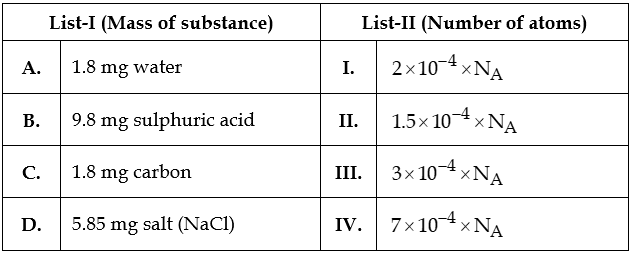
Match List-I with List-II.Choose the correct answer from the options given below:
The d-electronic configuration of an octahedral Co(II) complex having magnetic moment of \( 3.95 \ \text{BM} \) is:
The molarity of the solution prepared by dissolving \( 6.3 \, \mathrm{g} \) of oxalic acid \( \left(\mathrm{H_2C_2O_4\cdot 2H_2O}\right) \) in \( 250 \, \mathrm{mL} \) of water in \( \mathrm{mol\, L^{-1}} \) is \( x \times 10^{-2} \). The value of \( x \) is __________ .(Nearest integer) [Atomic mass: H : \( 1.0 \), C : \( 12.0 \), O : \( 16.0 \)]
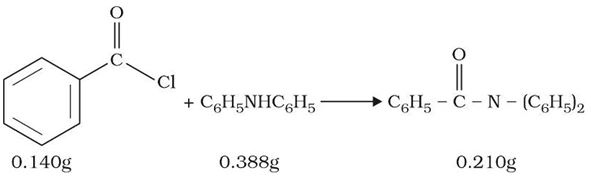
Consider the above reaction. The percentage yield of amide product is ________. (Round off to the Nearest Integer) [Given : Atomic mass : \( \mathrm{C}: 12.0\,\text{u} \), \( \mathrm{H}: 1.0\,\text{u} \), \( \mathrm{N}: 14.0\,\text{u} \), \( \mathrm{O}: 16.0\,\text{u} \), \( \mathrm{Cl}: 35.5\,\text{u} \)]
The incorrect postulates of the Dalton’s atomic theory are:(A) Atoms of different elements differ in mass(B) Matter consists of divisible atoms(C) Compounds are formed when atoms of different element combine in a fixed ratio(D) All the atoms of given element have different properties including mass(E) Chemical reaction involve reorganisation of atomsChoose the correct answer from the options given below:
How many grams of residue is obtained by heating \( 2.76 \, \text{g} \) of silver carbonate?(Given: Molar mass of C, O and Ag are \( 12 \), \( 16 \) and \( 108 \, \text{g mol}^{-1} \) respectively)
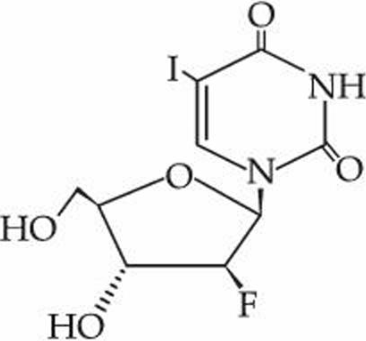
\( 0.1 \) mol of the following given antiviral compound \( (\mathrm{P}) \) will weigh __________ \( \times 10^{-1} \, \mathrm{g} \) (nearest integer).\( \text{(Given : molar mass in g mol}^{-1}\text{ ) } \mathrm{H}:1 , \mathrm{C}:12 , \mathrm{N}:14 , \mathrm{O}:16 , \mathrm{F}:19 , \mathrm{I}:127 \)
Two elements \( \mathrm{A} \) and \( \mathrm{B} \) which form \( 0.15 \) moles of \( \mathrm{A_2B} \) and \( \mathrm{AB_3} \) type compounds. If both \( \mathrm{A_2B} \) and \( \mathrm{AB_3} \) weigh equally, then the atomic weight of \( \mathrm{A} \) is ______ times of atomic weight of \( \mathrm{B} \).
If a rocket runs on a fuel \( (\mathrm{C}_{15}\mathrm{H}_{30}) \) and liquid oxygen, the weight of oxygen required and \( \mathrm{CO}_{2} \) released for every litre of fuel respectively are: (Given : density of the fuel is \( 0.756 \, \text{g/mL} \))
What is the mole fraction of water in \( 10\% \) by weight \( (w/w) \) of aqueous urea solution?[Given: Molar mass of H, O, C and N are \( 1 \), \( 16 \), \( 12 \) and \( 14 \, \text{g mol}^{-1} \) respectively.]
An oxide of iron contains \( 69.9\% \) iron, it empirical formula, is:(Given: Molar mass of Fe and O are \( 56 \) and \( 16\,\text{g mol}^{-1} \) respectively)
Hemoglobin contains \( 0.34\% \) of iron by mass, The number of Fe atoms in \( 3.3 \, \text{g} \) of hemoglobin is. (Given Atomic mass of Fe is \( 56 \, \text{u} \), \( N_A = 6.022 \times 10^{23} \, \text{mol}^{-1} \))
Given below are two statements: one is labelled as Assertion (A) and the other is labelled as Reason (R).Assertion (A): At \( 10^\circ \mathrm{C} \), the density of a \( 5\,\mathrm{M} \) solution of \( \mathrm{KCl} \) [atomic masses of \( \mathrm{K} \) and \( \mathrm{Cl} \) are \( 39 \) and \( 35.5 \,\mathrm{g\, mol^{-1}} \) respectively], is \( x \,\mathrm{g\, ml^{-1}} \). The solution is cooled to \( -21^\circ \mathrm{C} \). The molality of the solution will remain unchanged.Reason (R): The molality of a solution does not change with temperature as mass remains unaffected with temperature.In the light of the above statements, choose the correct answer from the options given below.
Assume carbon buns according to following equation:\( 2\mathrm{C(s)} + \mathrm{O_2(g)} \rightarrow 2\mathrm{CO(g)} \)When \( 12 \, \text{g} \) carbon is burnt in \( 48 \, \text{g} \) of oxygen, the volume of carbon monoxide produced is ________ \( \times 10^{-1} \, \text{L} \) at STP [Nearest integer][Given: Assume CO as ideal gas, Mass of C is \( 12 \, \text{g mol}^{-1} \), Mass of O is \( 16 \, \text{g mol}^{-1} \) and molar volume of an ideal gas at STP is \( 22.7 \, \text{L mol}^{-1} \)]
Consider the reaction\( 4\mathrm{HNO_3(l)}+ 3\mathrm{KCl}(s) \rightarrow \mathrm{Cl_2}(g) + \mathrm{NOCl}(g) + 2\mathrm{H_2O}(g) + 3\mathrm{KNO_3}(s) \)The amount of \( \mathrm{HNO_3} \) required to produce \( 110.0 \, \text{g} \) of \( \mathrm{KNO_3} \) is(Given: Atomic masses of \( \mathrm{H}, \mathrm{O}, \mathrm{N} \) and \( \mathrm{K} \) \( 1, 16, 14 \) and \( 39 \), respectively.)
\( 56.0 \, \text{L} \) of nitrogen gas is mixed with excess of hydrogen gas and it is found that \( 20 \, \text{L} \) of ammonia gas is produced. The volume of unused nitrogen gas is found to be _______ \( \text{L} \).
\( 0.5 \,\text{g} \) of an organic compound on combustion gave \( 1.46 \,\text{g} \) of \( \text{CO}_2 \) and \( 0.9 \,\text{g} \) of \( \text{H}_2\text{O} \). The percentage of carbon in the compound is __________. (Nearest integer) [Given: Molar mass (in \( \text{g mol}^{-1} \)) \( \text{C} : 12 \) ; \( \text{H} : 1 \) ; \( \text{O} : 16 \)]
Volume of \( 3 \, \text{M} \) NaOH (formula weight \( 40 \, \text{g mol}^{-1} \)) which can be prepared from \( 84 \, \text{g} \) of NaOH is __________ × \( 10^{-1} \, \text{dm}^3 \).
Given below are two statements: one is labelled as Assertion A and the other is labelled as Reasons R.Assertion A: \( 3.1500 \, \text{g} \) of hydrated oxalic acid dissolved in water to make \( 250.0 \, \text{mL} \) solution will result in \( 0.1 \, \text{M} \) oxalic acid solution.Reason R: Molar mass of hydrated oxalic acid is \( 126 \, \text{g mol}^{-1} \).In the light of the above statements, choose the correct answer from the options given below:
In Duma’s method of estimation of nitrogen, \( 0.1840 \, \text{g} \) of an organic compound gave \( 30 \, \text{mL} \) of nitrogen collected at \( 287 \, \text{K} \) and \( 758 \, \text{mm of Hg} \) pressure. The percentage composition of nitrogen in the compound is __________. (Round off to the Nearest Integer). [Given : Aqueous tension at \( 287 \, \text{K} \) \( = 14 \, \text{mm of Hg} \)]
The volume of hydrogen liberated at \( \mathrm{STP} \) by treating \( 24 \, \mathrm{g} \) of magnesium with excess of hydrochloric acid is ________ \( \times 10^{-2} \, \mathrm{L} \).Given: Molar volume of gas is \( 22.4 \, \mathrm{L} \) at \( \mathrm{STP} \)Molar mass of magnesium is \( 24 \, \mathrm{g \, mol^{-1}} \)
A solution is prepared by adding \( 2 \, \text{g} \) of “X” to \( 1 \, \text{mole} \) of water. Mass percent of “X” in the solution is:
Which of the following have same number of significant figures? A \( 0.00253 \) B \( 1.0003 \) C \( 15.0 \) D \( 163 \) Choose the correct answer from the options given below:
\( 10.0 \, \text{mL} \) of \( \mathrm{Na_2CO_3} \) solution is titrated against \( 0.2 \, \mathrm{M} \) \( \mathrm{HCl} \) solution. The following titre values were obtained in \( 5 \) readings. \( 4.8 \, \text{mL} \), \( 4.9 \, \text{mL} \), \( 5.0 \, \text{mL} \), \( 5.0 \, \text{mL} \) and \( 5.0 \, \text{mL} \). Based on these reading, and convention of titrimetric estimation the concentration of \( \mathrm{Na_2CO_3} \) solution is _____ \( \text{mM} \).
The exact volume of \( 1 \, \mathrm{M} \) \( \mathrm{NaOH} \) solution required to neutralize \( 50 \, \mathrm{mL} \) of \( 1 \, \mathrm{M} \) \( \mathrm{H_3PO_3} \) solution and \( 100 \, \mathrm{mL} \) of \( 2 \, \mathrm{M} \) \( \mathrm{H_3PO_2} \) solution, respectively, are:
Incorrect statement for the use of indicators in acid-base titration is:
A metal chloride contains \( 55.0\% \) of chlorine by weight. \( 100 \, \text{mL} \) vapours of the metal chloride at STP weigh \( 0.57 \, \text{g} \). The molecular formula of the metal chloride is: (Given: Atomic mass of chlorine is \( 35.5 \, \text{u} \))
\( \mathrm{SO_2Cl_2} \) on reaction with excess of water results into acidic mixture\( \mathrm{SO_2Cl_2} + 2\mathrm{H_2O} \rightarrow \mathrm{H_2SO_4} + 2\mathrm{HCl} \) \( 16 \) moles of \( \mathrm{NaOH} \) is required for the complete neutralization of the resultant acidic mixture.The number of moles of \( \mathrm{SO_2Cl_2} \) used is :
Using the rules for significant figures, the correct answer for the expression \( \frac{0.02858 \times 0.112}{0.5702} \) will be:
\( 100 \, \text{mL} \) of \( \mathrm{Na_3PO_4} \) solution contains \( 3.45 \, \text{g} \) of sodium. The molarity of the solution is ______ \( \times 10^{-2} \, \text{mol L}^{-1} \). (Nearest integer)[Atomic masses - \( \text{Na} : 23.0 \, \text{u} \), \( \text{O} : 16.0 \, \text{u} \), \( \text{P} : 31.0 \, \text{u} \)]
Mass of magnesium required to produce \( 220 \, \text{mL} \) of hydrogen gas at \( \text{STP} \) on reaction with excess of dil. \( \mathrm{HCl} \) is: Given: Molar mass of \( \mathrm{Mg} \) is \( 24 \, \text{g mol}^{-1} \).
When a hydrocarbon A undergoes combustion in the presence of air, it requires \( 9.5 \) equivalents of oxygen and produces \( 3 \) equivalents of water. What is the molecular formula of A?
The molarity of \( 1 \, \text{L} \) orthophosphoric acid \( (\mathrm{H_3PO_4}) \) having \( 70\% \) purity by weight (specific gravity \( 1.54 \, \text{g cm}^{-3} \)) is _______ \( \text{M} \).(Molar mass of \( \mathrm{H_3PO_4} = 98 \, \text{g mol}^{-1} \))
A \( 1.84 \, \text{mg} \) sample of polyhydric alcoholic compound ‘X’ of molar mass \( 92.0 \, \text{g/mol} \) gave \( 1.344 \, \text{mL} \) of \( \mathrm{H}_2 \) gas at STP. The number of alcoholic hydrogens present in compound ‘X’ is __________.
Choose the correct statements.(A) Weight of a substance is the amount of matter present in it.(B) Mass is the force exerted by gravity on an object.(C) Volume is the amount of space occupied by a substance.(D) Temperatures below $0\,^{\circ}\text{C}$ are possible in Celsius scale, but in Kelvin scale negative temperature is not possible.(E) Precision refers to the closeness of various measurements for the same quantity.Choose the correct answer from the options given below:
\( x \) \( \text{mg} \) of pure \( \mathrm{HCl} \) was used to make an aqueous solution. \( 25.0 \, \text{mL} \) of \( 0.1 \, \text{M} \) \( \mathrm{Ba(OH)_2} \) solution is used when the \( \mathrm{HCl} \) solution was titrated against it. The numerical value of \( x \) is _______ \( \times 10^{-1} \). (Nearest integer) [Given: Molar mass of \( \mathrm{HCl} \) and \( \mathrm{Ba(OH)_2} \) are \( 36.5 \) and \( 171.0 \, \text{g mol}^{-1} \) respectively]
If a substance ‘A’ dissolves in solution of a mixture of ‘B’ and ‘C’ with their respective number of moles as \( n_A \), \( n_B \) and \( n_C \), Mole fraction of C in the solution is:
What is the mass ratio of ethylene glycol \( \left(\mathrm{C_2H_6O_2}, \text{ molar mass } = 62 \, \text{g/mol}\right) \) required for making \( 500 \, \text{g} \) of \( 0.25 \) molal aqueous solution and \( 250 \, \text{mL} \) of \( 0.25 \) molal aqueous solution?
Number of moles and number of molecules in \( 1.4187 \, \text{L} \) of \( \text{SO}_2 \) at STP respectively are:
The Molarity \( (M) \) of an aqueous solution containing \( 5.85 \, \mathrm{g} \) of \( \mathrm{NaCl} \) in \( 500 \, \mathrm{mL} \) water is: (Given: Molar Mass Na : \( 23 \) and Cl : \( 35.5 \, \mathrm{g \, mol^{-1}} \) )
Molality of an aqueous solution of urea is \( 4.44 \, \text{m} \). Mole fraction of urea in solution is \( x \times 10^{-3} \). Value of \( x \) is _____________. (Integer answer)
Compound \( A \) contains \( 8.7\% \) Hydrogen, \( 74\% \) Carbon and \( 17.3\% \) Nitrogen. The molecular formula of the compound is,Given: Atomic masses of \( \mathrm{C}, \mathrm{H} \) and \( \mathrm{N} \) are \( 12, 1 \) and \( 14 \) amu respectively.The molar mass of the compound \( A \) is \( 162 \, \text{g mol}^{-1} \).
\( 250 \, \text{mL} \) of \( 0.5 \, \text{M} \) \( \mathrm{NaOH} \) was added to \( 500 \, \text{mL} \) of \( 1 \, \text{M} \) \( \mathrm{HCl} \). The number of unreacted \( \mathrm{HCl} \) molecules in the solution after complete reaction is ______ \( \times 10^{21} \). (Nearest integer). ( \( N_A = 6.022 \times 10^{23} \) ).
The number of molecules and moles in \( 2.8375 \) litres of \( \mathrm{O_2} \) at STP are respectively:
Zinc reacts with hydrochloric acid to give hydrogen and zinc chloride. The volume of hydrogen gas produced at STP from the reaction of \( 11.5 \, \text{g} \) of zinc with excess \( \text{HCl} \) is ______ \( \text{L} \) (nearest integer). (Given: Molar mass of \( \text{Zn} \) is \( 65.4 \, \text{g mol}^{-1} \) and molar volume of \( \text{H}_{2} \) at STP \( = 22.7 \, \text{L} \) )
An organic compound gives \( 0.220 \, \text{g} \) of \( \mathrm{CO_2} \) and \( 0.126 \, \text{g} \) of \( \mathrm{H_2O} \) on complete combustion. If the \( \% \) of carbon is \( 24 \) then the \( \% \) of hydrogen is _______ \( \times 10^{-1} \). (Nearest integer)
\( 200 \, \text{mL} \) of \( 0.2 \, \mathrm{M} \, \mathrm{H_2SO_4} \) is titrated with \( 0.1 \, \mathrm{M} \, \mathrm{NaOH} \). If the titration is stopped after adding \( 100 \, \text{mL} \) of \( \mathrm{NaOH} \). What volume (in \( \text{mL} \)) of \( 0.2 \, \mathrm{N} \, \mathrm{Ba(OH)_2} \) is required to complete the neutralization?
A commercially sold conc. \( \mathrm{HCl} \) is \( 35\% \) \( \mathrm{HCl} \) by mass. If the density of this commercial acid is \( 1.46 \, \text{g} \, /\text{mL}^{} \), the molarity of this solution is: (Atomic mass: \( \mathrm{Cl} = 35.5 \, \text{amu} \), \( \mathrm{H} = 1 \, \text{amu} \))
Chlorophyll extracted from the crushed green leaves was dissolved in water to make \( 2 \, \mathrm{L} \) solution of Mg of concentration \( 48 \, \mathrm{ppm} \). The number of atoms of Mg in this solution is \( x \times 10^{20} \) atoms. The value of \( x \) is _________. (Nearest Integer)(Given : Atomic mass of Mg is \( 24 \, \mathrm{g \, mol^{-1}} \); \( N_A = 6.02 \times 10^{23} \, \mathrm{mol^{-1}} \) )
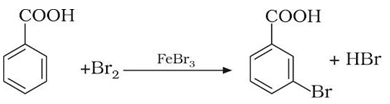
Consider the above reaction where \( 6.1 \, \text{g} \) of Benzoic acid is used to get \( 7.8 \, \text{g} \) of m-bromo benzoic acid. The percentage yield of the product is____ [Given: Atomic masses: \( \mathrm{C:12.0\,u, \ H:1.0\,u, \ O:16.0\,u, \ Br:80.0\,u} \)].
Combustion of glucose \( (\mathrm{C_6H_{12}O_6}) \) produces \( \mathrm{CO_2} \) and water. The amount of oxygen (in \( \mathrm{g} \)) required for the complete combustion of \( 900 \) \( \mathrm{g} \) of glucose is: [Molar mass of glucose in \( \mathrm{g\,mol^{-1}} \) = \( 180 \)]
One mole of \( \mathrm{Cl_2(g)} \) was passed into \( 2 \, \mathrm{L} \) of cold \( 2 \, \mathrm{M} \) \( \mathrm{KOH} \) solution. After the reaction, the concentrations of \( \mathrm{Cl^-} \), \( \mathrm{ClO^-} \) and \( \mathrm{OH^-} \) are respectively (assume volume remains constant)
When \( 800 \, \text{mL} \) of \( 0.5 \, \text{M} \) nitric acid is heated in a beaker, its volume is reduced to half and \( 11.5 \, \text{g} \) of nitric acid is evaporated. The molarity of the remaining nitric acid solution is \( x \times 10^{-2} \, \text{M} \). (Nearest Integer) (Molar mass of nitric acid is \( 63 \, \text{g} \, \text{mol}^{-1} \) )
The number of \( \mathrm{N} \) atoms in \( 681 \, \text{g} \) of \( \mathrm{C}_7\mathrm{H}_5\mathrm{N}_3\mathrm{O}_6 \) is \( x \times 10^{21} \). The value of \( x \) is __________.\( N_A = 6.02 \times 10^{23} \, \text{mol}^{-1} \) (Nearest Integer)
Consider the following reaction: \( 3\mathrm{PbCl_2} + 2(\mathrm{NH_4})_3\mathrm{PO_4} \rightarrow \mathrm{Pb_3(PO_4)_2} + 6\mathrm{NH_4Cl} \) If \( 72 \) mmol of \( \mathrm{PbCl_2} \) is mixed with \( 50 \) mmol of \( (\mathrm{NH_4})_3\mathrm{PO_4} \), then the amount of \( \mathrm{Pb_3(PO_4)_2} \) formed is ______ mmol. (Nearest integer)
\( \mathrm{N_{2(g)}} + 3\mathrm{H_{2(g)}} \rightleftharpoons 2\mathrm{NH_{3(g)}} \) \( 20 \, \text{g} \) \( 5 \, \text{g} \) Consider the above reaction, the limiting reagent of the reaction and number of moles of \( \mathrm{NH_3} \) formed respectively are: