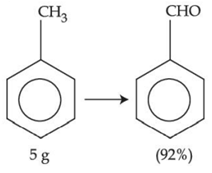
In the above reaction, \( 5 \ \text{g} \) of toluene is converted into benzaldehyde with \( 92 \ \% \) yield. The amount of benzaldehyde produced is ______ \( \times 10^{-2} \ \text{g} \). (Nearest integer)
On complete combustion of \( 0.492\,\text{g} \) of an organic compound containing \( \mathrm{C} \), \( \mathrm{H} \) and \( \mathrm{O} \), \( 0.7938\,\text{g} \) of \( \mathrm{CO_2} \) and \( 0.4428\,\text{g} \) of \( \mathrm{H_2O} \) was produced. The \( \% \) composition of oxygen in the compound is ______.
The normality of \( \mathrm{H_2SO_4} \) in the solution obtained on mixing \( 100 \, \mathrm{mL} \) of \( 0.1 \, \mathrm{M} \) \( \mathrm{H_2SO_4} \) with \( 50 \, \mathrm{mL} \) of \( 0.1 \, \mathrm{M} \) \( \mathrm{NaOH} \) is _______ \( \times 10^{-1} \, \mathrm{N} \). (Nearest Integer)
A \( 0.166\ \mathrm{g} \) sample of an organic compound was digested with conc. \( \mathrm{H_2SO_4} \) and then distilled with \( \mathrm{NaOH} \). The ammonia gas evolved was passed through \( 50.0\ \mathrm{mL} \) of \( 0.5\ \mathrm{N} \) \( \mathrm{H_2SO_4} \). The used acid required \( 30.0\ \mathrm{mL} \) of \( 0.25\ \mathrm{N} \) \( \mathrm{NaOH} \) for complete neutralization. The mass percentage of nitrogen in the organic compound is ________________.
\( 250 \, \text{g} \) solution of D-glucose in water contains \( 10.8\% \) of carbon by weight. The molality of the solution is nearest to (Given: Atomic Weights are, H, \( 1\,\text{u} \); C, \( 12\,\text{u} \), O, \( 16\,\text{u} \)).
A \( 100 \, \text{mL} \) solution of \( \mathrm{CH_3CH_2MgBr} \) on treatment with methanol produces \( 2.24 \, \text{mL} \) of a gas at STP. The weight of gas produced is ________ \( \text{mg} \). [nearest integer]
In the given reaction,\( X + Y + 3Z \rightleftharpoons \mathrm{XYZ_3} \). If one mole of each of \( X \) and \( Y \) with \( 0.05 \, \text{mol} \) of \( Z \) gives compound \( \mathrm{XYZ_3} \). (Given: Atomic masses of \( X, Y \) and \( Z \) are \( 10, 20 \) and \( 30 \, \text{amu} \), respectively.) The yield of \( \mathrm{XYZ_3} \) is ________ \( \text{g} \). (Nearest integer)
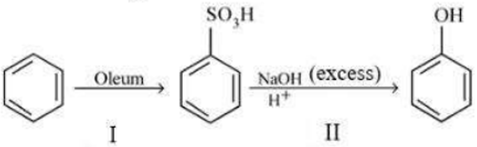
In the following reaction,The \( \% \) yield for reaction \( \mathrm{I} \) is \( 60\% \) and that of reaction \( \mathrm{II} \) is \( 50\% \). The overall yield of the complete reaction is ______ \( \% \) [Nearest Integer]
The moles of methane required to produce \( 81 \, \text{g} \) of water after complete combustion is ________ \( \times 10^{-2} \, \text{mol} \). [Nearest integer]
\( 1 \, \text{L} \) aqueous solution of \( \mathrm{H_2SO_4} \) contains \( 0.02 \, \text{m mol} \, \mathrm{H_2SO_4} \) , \( 50\% \) of this solution is diluted with deionized water to give \( 1 \, \text{L} \) solution (A). In solution (A), \( 0.01 \, \text{m mol} \) of \( \mathrm{H_2SO_4} \) are added. Total m mols of \( \mathrm{H_2SO_4} \) in the final solution is __________ \( \times 10^{3} \) \( \text{m mols} \).
The neutralization occurs when \( 10 \, \text{mL} \) of \( 0.1 \, \text{M} \) acid ‘\( A \)’ allowed to react with \( 30 \, \text{mL} \) of \( 0.05 \, \text{M} \) base \( \mathrm{M(OH)_2} \). The basicity of the acid ‘\( A \)’ is ______________. [\( \mathrm{M} \) is a metal]
Two elements \( \mathrm{A} \) and \( \mathrm{B} \) which form \( 0.15 \) moles of \( \mathrm{A_2B} \) and \( \mathrm{AB_3} \) type compounds. If both \( \mathrm{A_2B} \) and \( \mathrm{AB_3} \) weigh equally, then the atomic weight of \( \mathrm{A} \) is ______ times of atomic weight of \( \mathrm{B} \).
If a rocket runs on a fuel \( (\mathrm{C}_{15}\mathrm{H}_{30}) \) and liquid oxygen, the weight of oxygen required and \( \mathrm{CO}_{2} \) released for every litre of fuel respectively are: (Given : density of the fuel is \( 0.756 \, \text{g/mL} \))
Hemoglobin contains \( 0.34\% \) of iron by mass, The number of Fe atoms in \( 3.3 \, \text{g} \) of hemoglobin is. (Given Atomic mass of Fe is \( 56 \, \text{u} \), \( N_A = 6.022 \times 10^{23} \, \text{mol}^{-1} \))
Given below are two statements: one is labelled as Assertion (A) and the other is labelled as Reason (R).Assertion (A): At \( 10^\circ \mathrm{C} \), the density of a \( 5\,\mathrm{M} \) solution of \( \mathrm{KCl} \) [atomic masses of \( \mathrm{K} \) and \( \mathrm{Cl} \) are \( 39 \) and \( 35.5 \,\mathrm{g\, mol^{-1}} \) respectively], is \( x \,\mathrm{g\, ml^{-1}} \). The solution is cooled to \( -21^\circ \mathrm{C} \). The molality of the solution will remain unchanged.Reason (R): The molality of a solution does not change with temperature as mass remains unaffected with temperature.In the light of the above statements, choose the correct answer from the options given below.
Consider the reaction\( 4\mathrm{HNO_3(l)}+ 3\mathrm{KCl}(s) \rightarrow \mathrm{Cl_2}(g) + \mathrm{NOCl}(g) + 2\mathrm{H_2O}(g) + 3\mathrm{KNO_3}(s) \)The amount of \( \mathrm{HNO_3} \) required to produce \( 110.0 \, \text{g} \) of \( \mathrm{KNO_3} \) is(Given: Atomic masses of \( \mathrm{H}, \mathrm{O}, \mathrm{N} \) and \( \mathrm{K} \) \( 1, 16, 14 \) and \( 39 \), respectively.)
\( 56.0 \, \text{L} \) of nitrogen gas is mixed with excess of hydrogen gas and it is found that \( 20 \, \text{L} \) of ammonia gas is produced. The volume of unused nitrogen gas is found to be _______ \( \text{L} \).
\( \mathrm{SO_2Cl_2} \) on reaction with excess of water results into acidic mixture\( \mathrm{SO_2Cl_2} + 2\mathrm{H_2O} \rightarrow \mathrm{H_2SO_4} + 2\mathrm{HCl} \) \( 16 \) moles of \( \mathrm{NaOH} \) is required for the complete neutralization of the resultant acidic mixture.The number of moles of \( \mathrm{SO_2Cl_2} \) used is :
Using the rules for significant figures, the correct answer for the expression \( \frac{0.02858 \times 0.112}{0.5702} \) will be:
A \( 1.84 \, \text{mg} \) sample of polyhydric alcoholic compound ‘X’ of molar mass \( 92.0 \, \text{g/mol} \) gave \( 1.344 \, \text{mL} \) of \( \mathrm{H}_2 \) gas at STP. The number of alcoholic hydrogens present in compound ‘X’ is __________.
Compound \( A \) contains \( 8.7\% \) Hydrogen, \( 74\% \) Carbon and \( 17.3\% \) Nitrogen. The molecular formula of the compound is,Given: Atomic masses of \( \mathrm{C}, \mathrm{H} \) and \( \mathrm{N} \) are \( 12, 1 \) and \( 14 \) amu respectively.The molar mass of the compound \( A \) is \( 162 \, \text{g mol}^{-1} \).
A commercially sold conc. \( \mathrm{HCl} \) is \( 35\% \) \( \mathrm{HCl} \) by mass. If the density of this commercial acid is \( 1.46 \, \text{g} \, /\text{mL}^{} \), the molarity of this solution is: (Atomic mass: \( \mathrm{Cl} = 35.5 \, \text{amu} \), \( \mathrm{H} = 1 \, \text{amu} \))
Chlorophyll extracted from the crushed green leaves was dissolved in water to make \( 2 \, \mathrm{L} \) solution of Mg of concentration \( 48 \, \mathrm{ppm} \). The number of atoms of Mg in this solution is \( x \times 10^{20} \) atoms. The value of \( x \) is _________. (Nearest Integer)(Given : Atomic mass of Mg is \( 24 \, \mathrm{g \, mol^{-1}} \); \( N_A = 6.02 \times 10^{23} \, \mathrm{mol^{-1}} \) )
When \( 800 \, \text{mL} \) of \( 0.5 \, \text{M} \) nitric acid is heated in a beaker, its volume is reduced to half and \( 11.5 \, \text{g} \) of nitric acid is evaporated. The molarity of the remaining nitric acid solution is \( x \times 10^{-2} \, \text{M} \). (Nearest Integer) (Molar mass of nitric acid is \( 63 \, \text{g} \, \text{mol}^{-1} \) )
The number of \( \mathrm{N} \) atoms in \( 681 \, \text{g} \) of \( \mathrm{C}_7\mathrm{H}_5\mathrm{N}_3\mathrm{O}_6 \) is \( x \times 10^{21} \). The value of \( x \) is __________.\( N_A = 6.02 \times 10^{23} \, \text{mol}^{-1} \) (Nearest Integer)
\( \mathrm{N_{2(g)}} + 3\mathrm{H_{2(g)}} \rightleftharpoons 2\mathrm{NH_{3(g)}} \) \( 20 \, \text{g} \) \( 5 \, \text{g} \) Consider the above reaction, the limiting reagent of the reaction and number of moles of \( \mathrm{NH_3} \) formed respectively are: