48 questions from 2023
. If \( \left|\operatorname{adj}\!\left(\operatorname{adj}\!\left(\operatorname{adj}(2A)\right)\right)\right| = (16)^n \), then \( n \) is equal to:
, where \( a,c\in\mathbb{R} \). If \( A^{3}=A \) and the positive value of \( a \) belongs to the interval \( (n-1,n] \), where \( n\in\mathbb{N} \), then \( n \) is equal to ________ .
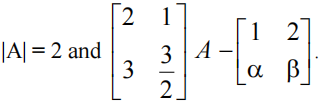
, \( |A|=2 \). . If \( \left|\,2\,\operatorname{adj}\!\left(2\,\operatorname{adj}(2A)\right)\!\right|=32^{\,n} \), then \( 3n+\alpha \) is equal to:
The number of symmetric matrices of order \( 3 \), with all the entries from the set \( \{0,1,2,3,4,5,6,7,8,9\} \) is:
If the system of equations\( x + y + a z = b \)\( 2x + 5y + 2z = 6 \)\( x + 2y + 3z = 3 \)Has infinitely many solutions, then \( 2a + 3b \) is equal to:
Let \( \alpha \) and \( \beta \) be real numbers. Consider a \( 3 \times 3 \) matrix \( A \) such that \( A^{2}=3A+\alpha I \). If \( A^{4}=21A+\beta I \), then:
For the system of linear equations\( 2x+4y+2az=b \)\( x+2y+3z=4 \)\( 2x-5y+2z=8 \)Which of the following is NOT correct?
Let \( A \) be a \( 2 \times 2 \) matrix with real entries such that \( A' = \alpha A + I \), where \( \alpha \in \mathbb{R} - \{-1, 1\} \). If \( \det \left(A^{2} - A\right) = 4 \), then the sum of all possible values of \( \alpha \) is equal to:
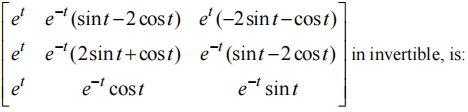
The set of all values of \( t\in \) ℝ for which the matrix
Consider the following system of equations\( \alpha x+2y+z=1 \)\( 2\alpha x+3y+z=1 \)\( 3x+\alpha y+2z=\beta \)for some \( \alpha,\beta\in \mathbb{R} \). Then which of the following is NOT correct.
If \( A = \dfrac{1}{5! \; 6! \; 7!} \) , then \( \left| \operatorname{adj}(\operatorname{adj}(2A)) \right| \) is equal to:
Let \( S \) be the set of values of \( \lambda \), for which the system of equations \( 6\lambda x - 3y + 3z = 4\lambda^{2} \),\( 2x + 6\lambda y + 4z = 1 \),\( 3x + 2y + 3\lambda z = \lambda \) has no solution. Then \( 12 \displaystyle\sum_{\lambda \in S} \lvert \lambda \rvert \) is equal to \( \_\_\_\_\_ \).
Let \( A \) be a symmetric matrix such that If the sum of the diagonal elements of \( A \) is \( s \), then \( \frac{\beta s}{\alpha^2} \) is equal to ____________.
If a point \( P(\alpha, \beta, \gamma) \) satisfying lies on the plane \( 2x + 4y + 3z = 5 \), then \( 6\alpha + 9\beta + 7\gamma \) is equal to:
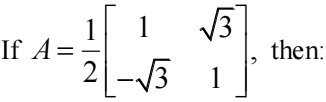
, \( A^{-1} = \alpha A + \beta I \) and \( \alpha + \beta = -2 \), then \( 4\alpha^{2} + \beta^{2} + \lambda^{2} \) is equal to:
, then \( \lambda, \dfrac{\lambda}{3} \) are the roots of the equation.
If the system of equations:\( x + 2y + 3z = 3 \)\( 4x + 3y - 4z = 4 \)\( 8x + 4y - \lambda z = 9 + \mu \)has infinitely many solutions, then the ordered pair \( (\lambda, \mu) \) is equal to:
Let \( S = \{ M = [a_{ij}],\ a_{ij} \in \{0, 1, 2\},\ 1 \le i, j \le 2 \} \) be a sample space and \( A = \{ M \in S : M \text{ is invertible} \} \) be an event. Then \( P(A) \) is equal to:
Let \( A, B, C \) be \( 3 \times 3 \) matrices such that \( A \) is symmetric and \( B \) and \( C \) are skew-symmetric. Consider the statements:\( (S1)\; A^{13}B^{26}-B^{26}A^{13} \) is symmetric.\( (S2)\; A^{26}C^{13}-C^{13}A^{26} \) is symmetric.Then,
For the system of linear equations\( x + y + z = 6 \)\( \alpha x + \beta y + 7z = 3 \)\( x + 2y + 3x = 14 \),Which of the following is not true?
and \( Q= PAP^{T} \). If \( P^{T}Q^{2007}P\), then \( 2a+b-3c-4d \) equal to:
Let \( A = [a_{ij}]_{2 \times 2} \), where \( a_{ij} \neq 0 \) for all \( i, j \) and \( A^{2} = I \). Let \( a \) be the sum of all diagonal elements of \( A \) and \( b = |A| \). Then \( 3a^{2} + 4b^{2} \) is equal to:
If \( P \) is a \( 3\times 3 \) real matrix such that \( P^{T}=\alpha P+(\alpha -1)I \), where \( \alpha>1 \), then:
, then the sum of all the elements of the matrix \( \displaystyle \sum_{n=1}^{50} B^{n} \) is equal to:
, \(\ \alpha > 2 \) be the adjoint of a matrix A and \(|A|=2\). Then \([\alpha-2\alpha\,\alpha]\) is equal to:
If \( A \) and \( B \) are two non-zero \( n\times n \) matrices such that \( A^{2}+B=A^{2}B \), then:
. Then the sum of the diagonal elements of the matrix \( (A + I)^{11} \) is equal to:
The number of square matrices of order \( 5 \) with entries from the set \( \{0, 1\} \), such that the sum of all the elements in each row is \( 1 \) and the sum of all the elements in each column is also \( 1 \), is:
Let \( \alpha \) be a root of the equation \( (a-c)x^2 + (b-a)x + (c-b) = 0 \) where \( a,b,c \) are distinct real numbers such that the matrix is singular. Then, the value of \( \dfrac{(a-c)^2}{(b-a)(c-b)} + \dfrac{(b-a)^2}{(a-c)(c-b)} + \dfrac{(c-b)^2}{(a-c)(b-a)} \) is:
. If \( \displaystyle\sum_{k=1}^{n}D_k=96 \), then \( n \) is equal to ____.
Let the system of linear equations\( -x + 2y - 9z = 7 \)\( -x + 3y + 7z = 9 \)\( -2x + y + 5z = 8 \)\( -3x + y + 13z = \lambda \)Has a unique solution \( x = \alpha, y = \beta, z = \gamma \). Then the distance of the point \( (\alpha, \beta, \gamma) \) from the plane \( 2x - 2y + z = \lambda \) is:
Let \( S \) denote the set of all real values of \( \lambda \) such that the system of equations\( \lambda x+y+z=1 \)\( x+\lambda y+z=1 \)\( x+y+\lambda z=1 \)is inconsistent, then \( \displaystyle \sum_{\lambda \in S}\left(|\lambda|^{2}+|\lambda|\right) \) is equal to:
Let \( A \) be a \( n\times n \) matrix such that \( |A|=2 \). If the determinant of the matrix \( \mathrm{Adj}\!\left(2\cdot \mathrm{Adj}\!\left(2A^{-1}\right)\right) \) is \( 2^{84} \), then \( n \) is equal to ______.
Let \( x,y,z>1 \) and then \( \left| \operatorname{adj}\!\left(\operatorname{adj}\, A^{2}\right) \right| \) is equal to:
For the system of linear equations \( \alpha x+y+z=1, \ x+\alpha y+z=1, \ x+y+\alpha z=\beta \), which one of the following statements is NOT correct?
, \( d = |A| \neq 0 \) and \( |A - d(\operatorname{Adj} A)| = 0 \). Then:
For the system of equations\( x+y+z=6 \)\( x+2y+\alpha z=10 \)\( x+3y+5z=\beta \), which one of the following is NOT true?
If the system of linear equations\( 7x + 11y + \alpha z = 13 \)\( 5x + 4y + 7z = \beta \)\( 175x + 194y + 57z = 361 \)has infinitely many solutions, then \( \alpha + \beta + 2 \) is equal to:
Let \( A=[a_{ij}],\, a_{ij}\in \mathbb{Z}\cap[0,4],\, 1\le i,j\le 2 \). The number of matrices \( A \) such that sum of all entries is a prime number \( p\in(2,13) \) is ________.
Let the determinant of a square matrix \( A \) of order \( m \) be \( m-n \), where \( m \) and \( n \) satisfy \( 4m+n=22 \) and \( 17m+4n=93 \). If \( \det\!\big(n\,\operatorname{adj}(\operatorname{adj}(mA))\big)=3^{a}5^{b}6^{c} \) then \( a+b+c \) is equal to:
, where \( i=\sqrt{-1} \).If \( M=A^{T}BA \), then the inverse of the matrix \( AM^{2023}A^{T} \) is:
If \( A \) is a \( 3 \times 3 \) matrix and \( |A| = 2 \), then \( \left| 3 \, \mathrm{adj}\!\left( \left|3A\right| A^2 \right) \right| \) is equal to:
If the system of equations\( 2x+y-z=5 \)\( 2x-5y+\lambda z=\mu \)\( x+2y-5z=7 \)has infinitely many solutions, then \( (\lambda+\mu)^{2}+(\lambda-\mu)^{2} \) is equal to:
If \( \alpha \) and \( \beta \) respectively are the maximum and the minimum value of \( f \), then:
Let \( S \) be the set of all values of \( \theta \in [-\pi, \pi] \) for which the system of linear equations\( x + y + \sqrt{3}\,z = 0 \)\( -x + (\tan \theta)\,y + \sqrt{7}\,z = 0 \)\( x + y + (\tan \theta)\,z = 0 \)has non-trivial solution. Then \( \dfrac{120}{\pi} \displaystyle\sum_{\theta \in S} \theta \) is equal to:
Let \( A \) be a \( 3 \times 3 \) matrix such that \( \left|\operatorname{adj}(\operatorname{adj}(\operatorname{adj} A))\right| = 12^4 \) Then \( \left| A^{-1} \operatorname{adj} A \right| \) is equal to:
Let \( S_1 \) and \( S_2 \) be respectively the sets of all \( a \in R - \{0\} \) for which the system of linear equations.\( ax + 2ay - 3az = 1 \)\( (2a + 1)x + (2a + 3)y + (a + 1)z = 2 \)\( (3a + 5)x + (a + 5)y + (a + 2)z = 3 \)has unique solution and infinitely many solutions. Then:

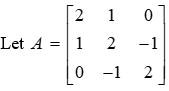 . If \( \left|\operatorname{adj}\!\left(\operatorname{adj}\!\left(\operatorname{adj}(2A)\right)\right)\right| = (16)^n \), then \( n \) is equal to:
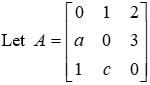 , where \( a,c\in\mathbb{R} \). If \( A^{3}=A \) and the positive value of \( a \) belongs to the interval \( (n-1,n] \), where \( n\in\mathbb{N} \), then \( n \) is equal to ________ .
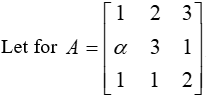 , \( |A|=2 \). . If \( \left|\,2\,\operatorname{adj}\!\left(2\,\operatorname{adj}(2A)\right)\!\right|=32^{\,n} \), then \( 3n+\alpha \) is equal to:
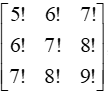 , then \( \left| \operatorname{adj}(\operatorname{adj}(2A)) \right| \) is equal to:
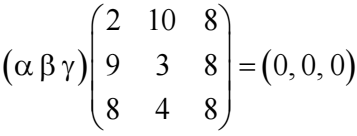 lies on the plane \( 2x + 4y + 3z = 5 \), then \( 6\alpha + 9\beta + 7\gamma \) is equal to:
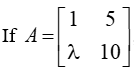 , \( A^{-1} = \alpha A + \beta I \) and \( \alpha + \beta = -2 \), then \( 4\alpha^{2} + \beta^{2} + \lambda^{2} \) is equal to:
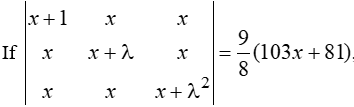 , then \( \lambda, \dfrac{\lambda}{3} \) are the roots of the equation.
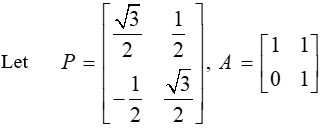 and \( Q= PAP^{T} \). If \( P^{T}Q^{2007}P\)
 , then \( 2a+b-3c-4d \) equal to:
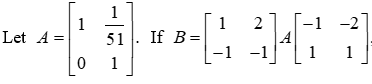 , then the sum of all the elements of the matrix \( \displaystyle \sum_{n=1}^{50} B^{n} \) is equal to:
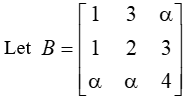 , \(\ \alpha > 2 \) be the adjoint of a matrix A and \(|A|=2\). Then \([\alpha-2\alpha\,\alpha]\)
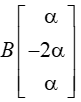 is equal to:
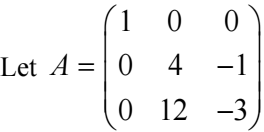 . Then the sum of the diagonal elements of the matrix \( (A + I)^{11} \) is equal to:
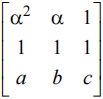 is singular. Then, the value of \( \dfrac{(a-c)^2}{(b-a)(c-b)} + \dfrac{(b-a)^2}{(a-c)(c-b)} + \dfrac{(c-b)^2}{(a-c)(b-a)} \) is:
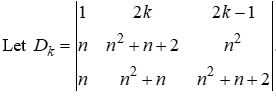 . If \( \displaystyle\sum_{k=1}^{n}D_k=96 \), then \( n \) is equal to ____.
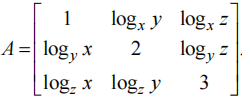 then \( \left| \operatorname{adj}\!\left(\operatorname{adj}\, A^{2}\right) \right| \) is equal to:
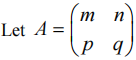 , \( d = |A| \neq 0 \) and \( |A - d(\operatorname{Adj} A)| = 0 \). Then:
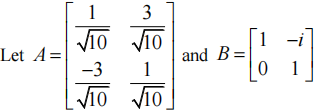 , where \( i=\sqrt{-1} \).
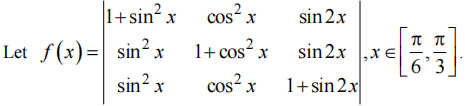 If \( \alpha \) and \( \beta \) respectively are the maximum and the minimum value of \( f \), then: