22 questions from 2026
The sum of all possible value of \( \theta \in [0,2\pi] \), for which the system of equations:\( x\cos 3\theta-8y-12z=0 \)\( x\cos 2\theta+3y+3z=0 \)\( x+y+3z=0 \)has a non-trivial solution, is equal to:
If \( \det(B) = 66 \), then \( \det(\operatorname{adj}(A)) \) equals:
Let \( \alpha , \beta \in \mathbb{R} \) be such that the system of linear equations\( x + 2y + z = 5 \)\( 2x + y + \alpha z = 5 \)\( 8x + 4y + \beta z = 18 \)has no solution. Then \( \dfrac{\beta}{\alpha} \) is equal to:
For some \( \alpha,\beta \in \mathbb{R} \), let be such that \( A^{2}-4A+2I=B^{2}-3B+I=O \). Then \( \left( \det\!\left( \operatorname{adj}\!\left(A^{3}-B^{3}\right) \right) \right)^{2} \) is equal to ________.
Let \( |A| = 6 \), where \( A \) is a \( 3 \times 3 \) matrix. If \( \left|\operatorname{adj}\!\left(3\,\operatorname{adj}\!\left(A^{2}\cdot \operatorname{adj}(2A)\right)\right)\right| = 2^{m}\cdot 3^{n} \), \( m, n \in N \), then \( m+n \) is equal to ______.
Let be a set of \( 2 \times 2 \) matrices. Then the number of matrices in \( S \), for which the sum of the diagonal elements is equal to \( 4 \), is:
Let and \( B=[b_{ij}],\,1\le i,j\le 3 \). If \( B=A^{99}-I \), then the value of \( \dfrac{b_{31}-b_{21}}{b_{32}} \) is:
Let Then the sum of all elements of the matrix \( \operatorname{adj}(\operatorname{adj}(2(\operatorname{adj}A)^{-1})) \) is equal to:
If the system of equations:\( x+y+z=5 \)\( x+2y+3z=9 \)\( x+3y+\lambda z=\mu \)has infinitely many solutions, then the value of \( \lambda+\mu \) is:
Let \( A \) be a \( 3 \times 3 \) matrix such that If \( \det(A) = 1 \), then \( \det(\operatorname{adj}(A^2 + A)) \) is equal to:
If the system of linear equations: \( x + y + z = 6 \), \( x + 2y + 5z = 10 \), \( 2x + 3y + \lambda z = \mu \) has infinitely many solutions, then the value of \( \lambda + \mu \) equals:
Among the statements:then \( \cos^{2}\alpha + \cos^{2}\beta + \cos^{2}\gamma = \frac{3}{2} \) and then \( p^{2} = 196q^{2} \).
Let \( A \) be a \( 3 \times 3 \) matrix such that \( A + A^{T} = O \). If and \( \det(\operatorname{adj}(2\operatorname{adj}(A + I))) = (2)^{\alpha} \cdot (3)^{\beta} \cdot (11)^{\gamma} \); \( \alpha, \beta, \gamma \) are non-negative integers, then \( \alpha + \beta + \gamma \) is equal to ________.
Let \( A, B \) and \( C \) be three \( 2 \times 2 \) matrices with real entries such that \( B = (I + A)^{-1} \) and \( A + C = I \).
Let \( P=[p_{ij}] \) and \( Q=[q_{ij}] \) be two square matrices of order \( 3 \) such that \( q_{ij}=2^{(i+j-1)}p_{ij} \) and \( \det(Q)=2^{10} \). Then the value of \( \det(\operatorname{adj}(\operatorname{adj}P)) \) is:
Let satisfy\( A^2+\alpha(\operatorname{adj}(\operatorname{adj}(A)))+\beta(\operatorname{adj}(A)\operatorname{adj}(\operatorname{adj}(A)))\)= for some \( \alpha,\beta \in \mathbb{R} \). Then \( (\alpha-\beta)^2 \) is equal to _____.
The number of \( 3 \times 2 \) matrices \( A \), which can be formed using the elements of the set \( \{-2,-1,0,1,2\} \) such that the sum of all the diagonal elements of \( A^T A \) is \( 5 \), is ________.
Let \( M \) be a \( 3\times 3 \) matrix such that then \( x+y+z \) equals:
then the determinant of the matrix \( \left(A^{2025} - 3A^{2024} + A^{2023}\right) \) is
Consider the matrices and . If matrices \( P \) and \( Q \) are such that \( PA = B \) and \( AQ = B \), then the absolute value of the sum of the diagonal elements of \( 2(P+Q) \) is ______.
If the system of equations \( x + 5y + 6z = 4 \), \( 2x + 3y + 4z = 7 \), \( x + 6y + az = b \) has infinitely many solutions, then the point \( (a,b) \) lies on the line:
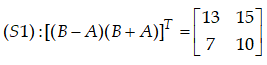
Let If \( A^{2}-4A+I=O \) and \( B^{2}-5B-6I=O \), then among the two statements:and \((\text{S2}): \det(\operatorname{adj}(A+B))=-5,\)

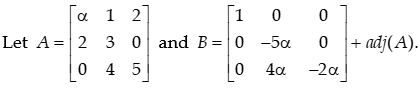 If \( \det(B) = 66 \), then \( \det(\operatorname{adj}(A)) \) equals:
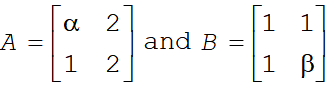 be such that \( A^{2}-4A+2I=B^{2}-3B+I=O \). Then \( \left( \det\!\left( \operatorname{adj}\!\left(A^{3}-B^{3}\right) \right) \right)^{2} \) is equal to ________.
 be a set of \( 2 \times 2 \) matrices. Then the number of matrices in \( S \), for which the sum of the diagonal elements is equal to \( 4 \), is:
 and \( B=[b_{ij}],\,1\le i,j\le 3 \). If \( B=A^{99}-I \), then the value of \( \dfrac{b_{31}-b_{21}}{b_{32}} \) is:
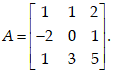 Then the sum of all elements of the matrix \( \operatorname{adj}(\operatorname{adj}(2(\operatorname{adj}A)^{-1})) \) is equal to:
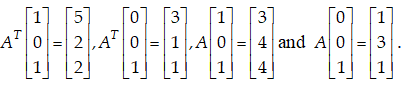

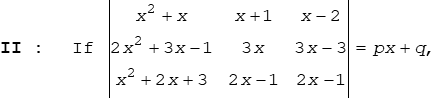
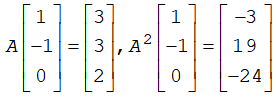 and \( \det(\operatorname{adj}(2\operatorname{adj}(A + I))) = (2)^{\alpha} \cdot (3)^{\beta} \cdot (11)^{\gamma} \); \( \alpha, \beta, \gamma \) are non-negative integers, then \( \alpha + \beta + \gamma \) is equal to ________.

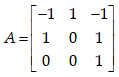 satisfy
 for some \( \alpha,\beta \in \mathbb{R} \). Then \( (\alpha-\beta)^2 \) is equal to _____.
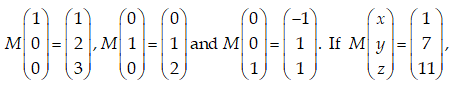 then \( x+y+z \) equals:
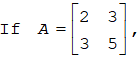 then the determinant of the matrix \( \left(A^{2025} - 3A^{2024} + A^{2023}\right) \) is
 and
 . If matrices \( P \) and \( Q \) are such that \( PA = B \) and \( AQ = B \), then the absolute value of the sum of the diagonal elements of \( 2(P+Q) \) is ______.
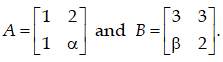 If \( A^{2}-4A+I=O \) and \( B^{2}-5B-6I=O \), then among the two statements: