Let \( S=\{1,2,3,4,5,6\} \). Then the probability that a randomly chosen onto function \( g \) from \( S \) to \( S \) satisfies \( g(3)=2g(1) \) is:
\( \dfrac{1}{15} \)
\( \dfrac{1}{30} \)
\( \dfrac{1}{10} \)
\( \dfrac{1}{5} \)
The probability that two randomly selected subsets of the set \( \{1,2,3,4,5\} \) have exactly two elements in their intersection, is:
Let in a Binomial distribution, consisting of \( 5 \) independent trials, probabilities of exactly \( 1 \) and \( 2 \) success be \( 0.4096 \) and \( 0.2048 \) respectively. Then the probability of getting exactly \( 3 \) successes is equal to:
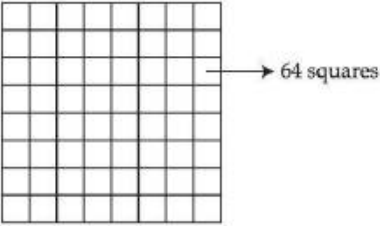
Two squares are chosen at random on a chessboard (see figure). The probability that they have a side in common is:
An electric instrument consists of two units. Each unit must function independently for the instrument to operate. The probability that the first unit functions is \( 0.9 \) and that of the second unit is \( 0.8 \). The instrument is switched on and it fails to operate. If the probability that only the first unit failed and second unit is functioning is \( p \), then \( 98p \) is equal to __________ .
Four dice are thrown simultaneously and the numbers shown on these dice are recorded in \( 2 \times 2 \) matrices. The probability that such formed matrices have all different entries and are non-singular, is:
The probability distribution of random variable \( X \) is given by:
Let \( p = P(1 < X < 4 \mid X < 3) \). If \( 5p = \lambda k \), then \( \lambda \) is equal to ________.
Let there be three independent events \( E_1, E_2 \) and \( E_3 \). The probability that only \( E_1 \) occurs is \( \alpha \), only \( E_2 \) occurs is \( \beta \) and only \( E_3 \) occurs is \( \gamma \). Let ‘\( p \)’ denote the probability of none of events occurs that satisfies the equations \( (\alpha - 2\beta)p = \alpha \beta \) and \( (\beta - 3\gamma)p = 2\beta \gamma \). All the given probabilities are assumed to lie in the interval \( (0,1) \). Then \( \dfrac{\text{Probability of occurrence of }E_1}{\text{Probability of occurrence of }E_3} \) is equal to ________.
Two fair dice are thrown. The numbers on them are taken as \( \lambda \) and \( \mu \), and a system of linear equations\( x+y+z=5 \)\( x+2y+3z=\mu \)\( x+3y+\lambda z=1 \)is constructed. If \( p \) is the probability that the system has a unique solution and \( q \) is the probability that the system has no solution, then:
Two dices are rolled. If both dices have six faces numbered \( 1, 2, 3, 5, 7 \) and \( 11 \), then the probability that the sum of the numbers on the top faces is less than or equal to \( 8 \) is:
Let \( A \) and \( B \) be independent events such that \( P(A)=p \), \( P(B)=2p \). The largest value of \( p \), for which \( P \) (exactly one of \( A, B \) occurs) \( = \frac{5}{9} \), is:
Let \( 9 \) distinct balls be distributed among \( 4 \) boxes, \( B_1,B_2,B_3 \) and \( B_4 \). If the probability that \( B_3 \) contains exactly \( 3 \) balls is \( k\left(\dfrac{3}{4}\right)^{9} \) then \( k \) lies in the set:
Let a computer program generate only the digits \( 0 \) and \( 1 \) to form a string of binary numbers with probability of occurrence of \( 0 \) at even places be \( \frac{1}{2} \) and probability of occurrence of \( 0 \) at the odd place be \( \frac{1}{3} \). Then the probability that '\( 10 \)' is followed by '\( 01 \)' is equal to:
Words with or without meaning are to be formed using all the letters of the word EXAMINATION. The probability that the letter \( M \) appears at the fourth position in any such word is:
The probability of selecting integers \( a\in[-5,30] \) such that \( x^{2}+2(a+4)x-5a+64>0 \), for all \( x\in \mathbb{R} \), is:
Let \( X \) be a random variable such that the probability function of a distribution is given by \( P(X = 0) = \dfrac{1}{2} , \; P(X = j) = \dfrac{1}{3^{j}} \; (j = 1, 2, 3, \ldots, \infty) \). Then the mean of the distribution and \( P(X \text{ is positive and even}) \) respectively are:
When a certain biased die is rolled, a particular face occurs with probability \( \dfrac{1}{6} - x \) and its opposite face occurs with probability \( \dfrac{1}{6} + x \). All other faces occur with probability \( \dfrac{1}{6} \). Note that opposite faces sum to \( 7 \) in any die. If \( 0 < x < \dfrac{1}{6} \), and the probability of obtaining total sum \( = 7 \), when such a die is rolled twice, is \( \dfrac{13}{96} \), then the value of \( x \) is:
Let \( A \) denote the event that a \( 6 \)-digit integer formed by \( 0,1,2,3,4,5,6 \) without repetitions, be divisible by \( 3 \). Then probability of event \( A \) is equal to: