Let \( A \) be the set of all functions \( f : Z \to Z \) and \( R \) be a relation on \( A \) such that \( R=\{(f,g): f(0)=g(1) \text{ and } f(1)=g(0)\} \). Then \( R \) is:
Transitive but neither reflexive nor symmetric
Symmetric but neither reflexive nor transitive
Reflexive but neither symmetric nor transitive
Symmetric and transitive but not reflexive
Let \( f:\mathbb{R}-\left\{\displaystyle\,\frac{-1}{2}\,\right\}\to \mathbb{R} \) and \( g:\mathbb{R}-\left\{\displaystyle\,\frac{-5}{2}\,\right\}\to \mathbb{R} \) be defined as \(\displaystyle f(x)=\frac{2x+3}{2x+1} \) and \(\displaystyle g(x)=\frac{|x|+1}{2x+5} \). Then, the domain of the function fog is:
Let \( f \) be a polynomial function such that \( \log_{2}(f(x))=\big[\log_{2}\!\big(2+\frac{2}{3}+\frac{2}{9}+\ldots \infty\big)\big]\cdot \log_{3}\!\left(1+\frac{f(x)}{f(1/x)}\right) \), \( x>0 \) and \( f(6)=37 \). Then \( \displaystyle\sum_{n=1}^{10} f(n) \) is equal to ______.
Let \( f : \mathbb{R} \to \mathbb{R} \) be a continuous function satisfying \( f(0) = 1 \) and \( f(2x) - f(x) = x \) for all \( x \in \mathbb{R} \). If \( \displaystyle \lim_{n \to \infty} \Big[ f(x) - f\!\left(\dfrac{x}{2^n}\right) \Big] = G(x) \), then \( \displaystyle \sum_{r=1}^{10} G(r^2) \) is equal to:
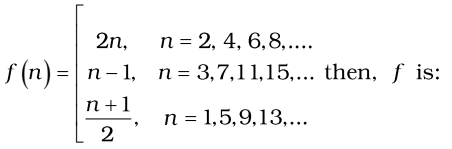
Let a function \( f : \mathbb{N} \to \mathbb{N} \) be defined by
The domain of the function \( f(x)=\dfrac{1}{\sqrt{[x]^2-3[x]-10}} \)is: (where \( [x] \) denotes the greatest integer less than or equal to \( x \))
Let \( f(x) = x^5 + 2x^3 + 3x + 1, \ x \in \mathbb{R} \), and \( g(x) \) be a function such that \( g(f(x)) = x \) for all \( x \in \mathbb{R} \). Then \( \dfrac{g(7)}{g'(7)} \) is equal to:
\( f(\alpha)=\displaystyle\int\limits_{1}^{\alpha}\frac{\log_{10} t}{1+t}\,dt, \ \alpha>0 \) If , then \( f(e^{3})+f(e^{-3}) \) is equal to:
If the domain of the function \(\displaystyle f(x) = \frac{\sqrt{x^2 - 25}}{(4 - x^2)} + \log_{10}\!\left( x^2 + 2x - 15 \right) \) is \( (-\infty, \alpha) \cup (\beta, \infty) \), then \( \alpha^2 + \beta^3 \) is equal to:
The domain of the function \( cosec^{-1}\!\left(\frac{1+x}{x}\right) \) is:
Consider the relation \( R \) on the set \( \{ -2, -1, 0, 1, 2 \} \) defined by \( (a, b) \in R \) if and only if \( 1 + ab > 0 \). Then, among the statements:I. The number of elements in \( R \) is \( 17 \).II. \( R \) is an equivalence relation.
Let \( A = \{1, 2, 3, 5, 8, 9\} \). Then the number of possible functions \( f : A \to A \) such that \( f(m \cdot n) = f(m) \cdot f(n) \) for every \( m, n \in A \) with \( m \cdot n \in A \) is equal to _________.
Let \( x=2 \) be a local minima of the function \( f(x)=2x^{4}-18x^{2}+8x+12,\, x\in(-4,4) \). If \( M \) is local maximum value of the function \( f \) in \( (-4,4) \), then \( M= \)
Let \( f(x) \) be a function such that \( f(x+y) = f(x)\cdot f(y) \) for all \( x, y \in \mathbb{N} \). If \( f(1) = 3 \) and \( \displaystyle \sum_{k=1}^{n} f(k) = 3279 \), then the value of \( n \) is:
Let \( f(x) = \frac{x - 1}{x + 1} ,\; x \in \mathbb{R} - \{ 0, -1, 1 \} \). If \( f^{\,n+1}(x) = f\!\left(f^{\,n}(x)\right) \) for all \( n \in \mathbb{N} \), then \( f^{6}(6) + f^{7}(7) \) is equal to:
If the domain of the function \( f(x)=\log_{e}\!\left(\dfrac{2x+3}{4x^{2}+x-3}\right)+\cos^{-1}\!\left(\dfrac{2x-1}{x+2}\right) \) is \( (\alpha,\beta] \), then the value of \( 5\beta-4\alpha \) is equal to:
If \( f(x)=\sin\!\left(\cos^{-1}\!\left(\dfrac{1-2^{2x}}{1+2^{2x}}\right)\right) \) and its first derivative with respect to \( x \) is \( -\dfrac{b}{a}\log_e 2 \) when \( x=1 \), where \( a \) and \( b \) are integers, then the minimum value of \( \left|a^{2}-b^{2}\right| \) is __________.
The set of all values of $a$ for which $\displaystyle \lim_{x \to a} ([x - 5] - [2x + 2]) = 0$, where $[\alpha]$ denotes the greatest integer less than or equal to $\alpha$ is equal to:
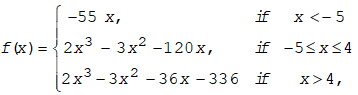
Let \( f:\mathbb{R}\to\mathbb{R} \) and \( g:\mathbb{R}\to\mathbb{R} \) be defined as where \( a, b \) are non-negative real numbers. If \( (g\circ f)(x) \) is continuous for all \( x\in\mathbb{R} \), then \( a+b \) is equal to ____________.
Let \([.]\) denote the greatest integer function. If the domain of the function \( f(x) = \cos^{-1}\!\left(\frac{4x + 2[x]}{3}\right) \) is \([\alpha,\beta]\), then \( 12(\alpha + \beta) \) is equal to:
The number of distinct real roots of the equation \( x^{7} - 7x - 2 = 0 \) is:
The relation \( R=\{(a,b):\gcd(a,b)=1,\, 2a\neq b,\, a,b\in \mathbb{Z}\} \) is:
The number of real solution(s) of the equation \( x^2 + 3x + 2 = m\ \, in\{\,|x - 3|, \, |x + 2|\,\} \) is :
If \( S = \{ a \in \mathbb{R} \ :|2a - 1| = 3\ [a] + 2\{a\} \} \), where [t] denotes the greatest integer less than or equal to \( t \) and \( \{t\} \) represents the fractional part of \( t \), then \( 72 \sum\limits_{a \in S} a \) is equal to \( \_\_\_\_\_\_\_\_\_\_\_ \).
Let \( A=\{1,2,3,4,5,6\} \). The number of one-one functions \( f:A\to A \) such that \( f(1)\ge 3 \), \( f(3)\le 4 \) and \( f(2)+f(3)=5 \), is ______.
Consider the function \( f:\mathbb{R}\to\mathbb{R} \) defined by \( f(x)=\dfrac{2x}{\sqrt{1+9x^{2}}} \). If the composition of \( (\underbrace{f \circ f \circ f \circ \dots \circ f}_{10\text{ times}})(x) = \frac{2^{10}x}{\sqrt{1 + 9\alpha x^2}} \), then the value of \( \sqrt{3\alpha+1} \) is equal to __________.
Let \( f:\mathbb{N} \to \mathbb{N} \) be a function such that \( f(m+n) = f(m) + f(n) \) for every \( m,n \in \mathbb{N} \). If \( f(6) = 18 \), then \( f(2)\cdot f(3) \) is equal to:
For the function \( f : [1,\infty) \to [1,\infty) \) defined \( f(x) = (x-1)^4 + 1 \), among the two statements:(I) The set \( S=\{x \in [1,\infty) : f(x)=f^{-1}(x)\} \) contains exactly two elements, and(II) The set \( S=\{x \in [1,\infty) : f(x)=f^{-1}(x+1)\} \) is an empty set,
The absolute minimum value, of the function \( f(x)=\left|x^{2}-x+1\right|+\left[\,x^{2}-x+1\,\right] \), where \([\,t\,]\) denotes the greatest integer function, in the interval \([ -1,\, 2 ]\), is:
The domain of the function \( f(x) := \dfrac{\cos^{-1}\!\left( \dfrac{x^{2} - 5x + 6}{x^{2} - 9} \right)}{\log_{e}(x^{2} - 3x + 2)} \) is:
Let \( [ x ] \) denote the greatest integer less than or equal to \( x \). Then the domain of \( f(x)=\sec^{-1}(2[ x ] + 1) \) is:
Let \( f(x)=2x^{2}-x-1 \) and \( S=\{\,n\in \mathbb{Z}:\; |f(n)|\le 800\,\} \). Then, the value of \( \sum\limits_{n\in S} f(n) \) is equal to ______.
Let \( A=\{x\in \mathbb{R}:[x+3]+[x+4]\le 3\} \), \( B=\left\{x\in \mathbb{R}:3^{x}\left(\displaystyle\sum_{r=1}^{\infty}\dfrac{3}{10^{r}}\right)^{x-3}<3^{-3x}\right\} \), where \([t]\) denotes greatest integer function. Then:
Let for some \( \alpha\in \mathbb{R} \), \( f:\mathbb{R}\to\mathbb{R} \) be a function satisfying \( f(x+y)=f(x)+2y^{2}+y+\alpha xy \) for all \( x,y\in\mathbb{R} \). If \( f(0)=-1 \) and \( f(1)=2 \), then the value of is:
Consider a function \( f:\mathbb{N} \rightarrow \mathbb{R} \), satisfying \( f(1) + 2f(2) + 3f(3) + \ldots + x f(x) = {x(x+1)}{}; \, x \ge 2 \) with \( f(1) = 1 \). Then \( \frac{1}{f(2022)} + \frac{1}{f(2028)} \) is equal to:
Let \( S = \{1, 2, 3, 4, 5, 6\} \). Then the number of one-one functions \( f : S \to P(S) \), where \( P(S) \) denotes the power set of \( S \), such that \( f(n) \subset f(m) \) where \( n < m \) is ________.
Let \( f^1(x) = \frac{3x + 2}{2x + 3}, \; x \in \mathbb{R} - \left\{ \frac{-3}{2} \right\} \). For \( n \ge 2 \), define \( f^n(x) = f^1 \circ f^{n-1}(x) \). If \( f^5(x) = \frac{ax + b}{bx + a} \), \( \gcd(a,b) = 1 \), then \( a + b \) is equal to _______.
Let \( R_1 = \{(a,b) \in N \times N : |a-b| \le 13\} \) and \( R_2 = \{(a,b) \in N \times N : |a-b| \ne 13\} \). Then on \( N \):
Let the function \( f:[0,2]\to \mathbb{R} \) be defined as where \( [t] \) denotes the greatest integer less then or equal to \( t \). Then the value of the integral \(\displaystyle \int_{0}^{2} x f(x)\,dx \) is:
Let \( f : R \to R \) and \( g : R \to R \) be defined as . Then, \( gof : R \to R \) is:
fg
Let the domain of the function \( f(x)=\log_{3}\log_{5}\!\big(7-\log_{2}(x^{2}-10x+85)\big)+\sin^{-1}\!\left(\left|\dfrac{3x-7}{17-x}\right|\right) \) be \( (\alpha,\beta] \). Then \( \alpha+\beta \) is equal to:
Let the domain of the function \( f(x) = \log_{3}\!\big(\log_{5}\!\big(\log_{7}(9x - x^{2} - 13)\big)\big) \) be the interval \( (m, n) \). Let the hyperbola \( \frac{x^{2}}{a^{2}} - \frac{y^{2}}{b^{2}} = 1 \) have eccentricity \( \frac{n}{3} \) and the length of the latus rectum \( \frac{8m}{3} \). Then \( b^{2} - a^{2} \) is equal to:
Let \( f(x) = \dfrac{2^{x+2}+16}{2^{2x+1}+2^{x+4}+32} \). Then the value of \( 8\!\left( f\!\left(\tfrac{1}{15}\right) + f\!\left(\tfrac{2}{15}\right) + \cdots + f\!\left(\tfrac{59}{15}\right) \right) \) is equal to:
Let \( f(x)=\ (x)^2-[ x+3] - 3,\ x\in \mathbb{R} \), where \([ . ]\) is the greatest integer function. Then
The number of functions \( f \), from the set \( A=\left\{x\in \mathbb{N}:x^{2}-10x+9\le 0\right\} \) to the set \( B=\left\{n^{2}:n\in \mathbb{N}\right\} \) such that \( f(x)\le (x-3)^{2}+1 \), for every \( x\in A \), is ________.
The number of distinct real roots of the equation \( |x|\,|x+2| - 5|x+1| - 1 = 0 \) is \( \_\_\_\_\_\_\_\_\_\_\_ \).
The number of relations, on the set \( \{1,2,3\} \) containing \( (1,2) \) and \( (2,3) \), which are reflexive and transitive but not symmetric, is_____.
Let $f:\mathbb{R} \rightarrow \mathbb{R}$ be a function defined by $f(x)=\left( 2\left( 1-\frac{x^{25}}{2} \right) \left( 2+x^{25} \right) \right)^{\frac{1}{50}}$. If the function $g(x)=f(f(f(x)))+f(f(x))$, then the greatest integer less than or equal to $g(1)$ is ______.
Let \( f : R \to R \) be defined as \( f(x)=\dfrac{2x^2-3x+2}{3x^2+x+3} \). Then \( f \) is:
If the domain of the function $f(x) = \frac{[x]}{1+x^2}$, where $[x]$ is greatest integer $\leq x$, is $[2,6)$, then its range is:
Let \( D \) be the domain of the function \( f(x) = \sin^{-1}\!\left( \log_{3x} \left( \dfrac{6 + 2\log_3{x}}{-5x} \right) \right) \). If the range of the function \( g : D \to \mathbb{R} \) defined by \( g(x) = x - [x ] \), (\( [ x ] \) is the greatest integer function), is \( (\alpha, \beta) \), then \( \alpha^{2} + \dfrac{5}{\beta} \) is equal to:
Let \( f:[0,3]\!\to\!A \) be defined by \( f(x)=2x^{3}-15x^{2}-36x+7 \) and \( g:[0,\infty)\!\to\!B \) be defined by \( g(x)=\dfrac{x^{2025}}{x^{2025}+1} \). If both the functions are onto and \( S=\{x\in \mathbb{Z}:x\in A \text{ or } x\in B\} \), then \( n(S) \) is equal to:
The equation \( e^{4x} + 8e^{3x} + 13e^{2x} - 8e^{x} + 1 = 0, \, x \in \mathbb{R} \) has:
If the domain of the function \( f(x) = \cos^{-1}\!\left(\frac{2x - 5}{11 - 3x}\right) + \sin^{-1}\!\left(2x^2 - 3x + 1\right) \) is the interval \( [\alpha, \beta] \), then \( \alpha + 2\beta \) is equal to:
Let \( R = \{(x,y) \in \mathbb{N} \times \mathbb{N} : \log_{a}(x+y) \le 2\} \). Then the minimum number of elements, required to be added in \( R \) to make it a transitive relation, is __________.
If the functions are defined as \( f(x)=\sqrt{x} \) and \( g(x)=\sqrt{1-x} \), then what is the common domain of the following functions: \( f+g,\, f-g,\, \frac{f}{g},\, \frac{g}{f} , g-f\) where \( (f \pm g)(x)=f(x)\pm g(x) \), \( (f/g)(x)=\frac{f(x)}{g(x)} \)
Let \( A = \{(x,y): 2x + 3y = 23, \, x,y \in \mathbb{N}\} \) and \( B = \{ x : (x,y) \in A \} \). Then the number of one-one functions from \( A \) to \( B \) is equal to ________.
If \( f(x) = \frac{2^x}{2^x + \sqrt{2}} , \ x \in \mathbb{R} \), then \( \displaystyle \sum_{k=1}^{81} f\!\left( \frac{k}{82} \right) \) is equal to:
Let \( f : \mathbb{R} \to \mathbb{R} \) be a differentiable function that satisfies the relation \( f(x+y) = f(x) + f(y) - 1 \), \( \forall x, y \in \mathbb{R} \). If \( f'(0) = 2 \), then \( | f(-2) | \) is equal to __________.
Let \( f : R \to R \) be defined as \( f(x) = x - 1 \) and \( g : R - \{ 1, -1 \} \to R \) be defined as \( g(x) = \frac{x^2}{x^2 - 1} \). Then the function \( fog \) is:
If domain of the function \( \log_{e}\!\left(\dfrac{6x^{2}+5x+1}{2x-1}\right)+\cos^{-1}\!\left(\dfrac{2x^{2}-3x+4}{3x-5}\right) \) is \( (\alpha,\beta)\cup(\gamma,\delta] \), then \( 18(\alpha^{2}+\beta^{2}+\gamma^{2}+\delta^{2}) \) is equal to ________.
If the domain of the function \( f(x)=\sin^{-1}\!\left(\dfrac{1}{x^{2}-2x-2}\right) \) is \( (-\infty,\alpha] \cup [\beta,\gamma] \cup (\delta,\infty) \), then \( \alpha+\beta+\gamma+\delta \) is equal to:
If \( y=y(x) \) is the solution of the differential equation \( \dfrac{dy}{dx}+\dfrac{4x}{(x^{2}-1)}y=\dfrac{x+2}{(x^{2}-1)^{5/2}},\, x>1 \) such that \( y(2)=\dfrac{2}{9}\log_{e}(2+\sqrt{3}) \) and \( y(\sqrt{2})=\alpha \log_{e}(\sqrt{\alpha}+\beta)+\beta-\sqrt{\gamma},\; \alpha,\beta,\gamma \in \mathbb{N} \), then \( \alpha\beta\gamma \) is equal to __________.
Let \( S=\{4,6,9\} \) and \( T=\{9,10,11,\ldots,1000\} \). If \( A=\{ a_1+a_2+\ldots+a_k : k\in \mathbb{N}, a_1,a_2,a_3,\ldots,a_k\in S \} \), then the sum of all the elements in the set \( T-A \) is equal to__________.
The number of functions \( f : \{1,2,3,4\} \to \{ a \in Z \, \, |a| \le 8 \} \) satisfying \( f(n) + \frac{1}{n} f(n+1) = 1 , \forall n \in \{1,2,3\} \) is:
For an integer \( n \ge 2 \), if the arithmetic mean of all coefficients in the binomial expansion of \( (x + y)^{2n - 3} \) is \( 16 \), then the distance of point \( P(2n - 1, n^2 - 4n) \) from the line \( x + y = 8 \) is:
Let the domain of the function \( f(x)=\cos^{-1}\!\Big(\dfrac{4x+5}{3x-7}\Big) \) be \( [\alpha,\beta] \) and the domain of \( g(x)=\log_{2}\!\big(2-6\log_{27}(2x+5)\big) \) be \( (\gamma,\delta) \). Then \( \big|7(\alpha+\beta)+4(\gamma+\delta)\big| \) is equal to ______.
If the function \( f:(-\infty,-1)\to (a,b] \) defined by \( f(x) = e^{x^3-3x+1} \) is one – one and onto, then the distance of the point \( P(2b+4,a+2) \) from the line \( x+e^{-3}y=4 \) is:
Let \( f: R \rightarrow R \) be a function defined by \( f(x)=(2+3a)x^{2}+\left(\frac{a+2}{a-1}\right)x+b, \, a\neq 1 \). If \( f(x+y)=f(x)+f(y)+1-\frac{2}{7}xy \), then the value of \( 28\sum_{i=1}^{5} |f(i)| \) is:
Consider two sets \( A=\{x\in\mathbb{Z}:\,|(|x-3|-3)|\le 1\} \) and \( B=\left\{x\in\mathbb{R}-\{1,2\}:\,\dfrac{(x-2)(x-4)}{x-1}\,\log_e(|x-2|)=0\right\} \). Then the number of onto functions \( f\!:\!A\to B \) is equal to:
If \( g(x) = 3x^2 + 2x - 3 \), \( f(0) = -3 \) and \( 4g(f(x)) = 3x^2 - 32x + 72 \), then \( f(g(2)) \) is equal to:
Let \( f , g : \mathbb{R} \to \mathbb{R} \) be defined as:Then the function \( f(g(x)) \) is
If the domain of the function \( f(x) = \sin^{-1}\!\left(\dfrac{5 - x}{3 + 2x}\right) + \dfrac{1}{\log\_{e}(10 - x)} \) is \( (-\infty, \alpha] \cup [\beta, \gamma) - \{\delta\} \), then \( 6(\alpha + \beta + \gamma + \delta) \) is equal to:
Let \( f(x) = \frac{1}{7 - \sin 5x} \) be a function defined on \( \mathbb{R} \). Then the range of the function \( f(x) \) is equal to:
The inverse of \( y = 5^{\log x} \) is:
If the domain of the function \( f(x) = \log_{9}\!\left( \frac{2x-3}{5+4x} \right) + \sin^{-1}\!\left( \frac{4+3x}{2-x} \right) \) is \( (\alpha, \beta] \), then \( \alpha^{2} + 4\beta \) is equal to:
The range of the function \( f(x) = \sqrt{3 - x} + \sqrt{2 + x} \) is :
Let \( R_1 \) and \( R_2 \) be two relations defined on \( \mathbb{R} \) by \( a \, R_1 \, b \Leftrightarrow ab \ge 0 \) and \( a \, R_2 \, b \Leftrightarrow a \ge b \). Then:
Suppose \(f : \mathbb{R} \rightarrow (0, \infty)\) be a differentiable function such that \(5 f(x+y) = f(x)\cdot f(y), \; \forall \, x, y \in \mathbb{R}\). If \(f(3) = 320\), then \(\displaystyle \sum_{n=0}^{5} f(n)\) is equal to:
The function \( f(x)=\frac{x^{2}+2x-15}{x^{2}-4x+9},\ x\in \mathbb{R} \) is:
The range of the function \( f(x) = \log_{\sqrt{5}}\!\left( 3 + \cos\!\left(\frac{3\pi}{4} + x\right) + \cos\!\left(\frac{\pi}{4} + x\right) + \cos\!\left(\frac{\pi}{4} - x\right) - \cos\!\left(\frac{3\pi}{4} - x\right) \right) \) is:
Let \( A = \{1,2,3,4,5\} \) and \( B = \{1,2,3,4,5,6\} \). Then the number of functions \( f : A \to B \) satisfying \( f(1) + f(2) = f(4) - 1 \) is equal to _______.
The domain of the function \( f(x) = \sin^{-1}\!\left(\dfrac{x^{2}-3x+2}{x^{2}+2x+7}\right) \) is :
The range of \(f(x)\) \(=4\sin^{-1}\left(\dfrac{x^2}{x^2+1}\right)\) is :
Let \( f \) be a real valued continuous function defined on the positive real axis such that \(\displaystyle g(x) = \int_{0}^{x} t\, f(t)\, dt \). If \( g(x^{3}) = x^{6} + x^{7} \), then value of \(\displaystyle \sum_{r=1}^{15} f(r^{3}) \) is:
Let \(f:\mathbb{R}\to \mathbb{R}\) be defined as:Let \(A=\{x\in \mathbb{R}:f \text{ is increasing}\}\). Then \(A\) is equal to:
Let \( f(x) = \log_e x \) and \( g(x) = \dfrac{x^4 - 2x^3 + 3x^2 - 2x + 2}{2x^2 - 2x + 1} \). Then the domain of \( fog \) is:
Let \( f:\mathbb{R}-\{2,6\}\to\mathbb{R} \) be real valued function defined as \( f(x)=\frac{x^2+2x+1}{x^2-8x+12} \). Then range of \( f \) is
Let \( f:\mathbb{R}\to\mathbb{R} \) be a function defined by \( f(x)=\dfrac{2e^{2x}}{e^{2x}+e} \). Then \( f\!\left(\frac{1}{100}\right)+f\!\left(\frac{2}{100}\right)+f\!\left(\frac{3}{100}\right)+\ldots+f\!\left(\frac{99}{100}\right) \) is equal to \( \_\_\_ \).
For \( x\in \mathbb{R} \), two real valued functions \( f(x) \) and \( g(x) \) are such that, \( g(x)=\sqrt{x}+1 \) and \( f\circ g(x)=x+3-\sqrt{x} \). Then \( f(0) \) is equal to:
The function \( f: N-\{1\}\to N \); defined by \( f(n)= \) the highest prime factor of \( n \), is:
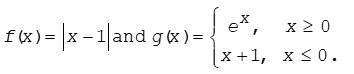
Let \( f \) and \( g \) be two functions defined by and . Then \( (g \circ f)(x) \) is:
Let \( f,g : \mathbb{N} - \{1\} \to \mathbb{N} \) be functions defined by \( f(a) = \alpha \), where \( \alpha \) is the maximum of the powers of those primes \( p \) such that \( p^{\alpha} \) divided \( a \), and \( g(a) = a + 1 \), for all \( a \in \mathbb{N} - \{1\} \). Then, the function \( f + g \) is:
Let \( R_1 \) and \( R_2 \) be relations on the set \( \{ 1, 2, \ldots, 50 \} \) such that \( R_1 = \{ (p, p^n) : p \text{ is a prime and } n \ge 0 \text{ is an integer} \} \) and \( R_2 = \{ (p, p^n) : p \text{ is a prime and } n = 0 \text{ or } 1 \} \). Then, the number of elements in \( R_1 - R_2 \) is ________.
Let \( f:\mathbb{R}-\{0\}\rightarrow(-\infty,1) \) be a polynomial of degree \( 2 \), satisfying \(\displaystyle f(x)f\!\left(\frac{1}{x}\right)=f(x)+f\!\left(\frac{1}{x}\right) \). If \( f(k)=-2k \), then the sum of squares of all possible values of \( k \) is:
If \( f(x)=\dfrac{(\tan 1^\circ)\,x+\log_e (123)}{x\log_e(1234)-(\tan 1^\circ)} , \; x>0 \), then the least value of \( f(f(x))+f\!\left(f\!\left(\dfrac{4}{x}\right)\right) \) is:
Let \( f:\mathbb{R}\rightarrow \mathbb{R} \) be a function such that \( f(x)=\dfrac{x^{2}+2x+1}{x^{2}+1} \). Then:
Let \( g : \mathbb{N} \to \mathbb{N} \) be defined as\( g(3n+1) = 3n + 2, \)\( g(3n+2) = 3n + 3, \)\( g(3n+3) = 3n + 1, \\ \text{for all } n \ge 0. \)Then which of the following statements is true?
If the range of the function \( f(x)=\frac{5-x}{x^{2}-3x+2},\ x\neq 1,2, \) is \( (-\infty,\alpha]\cup[\beta,\infty) \), then \( \alpha^{2}+\beta^{2} \) is equal to:
If \( a+\alpha=1, \; b+\beta=2 \) and \( a f(x)+\alpha f\!\left(\frac{1}{x}\right)=b x+\frac{\beta}{x}, \; x\neq 0 \), then the value of the expression\( \displaystyle \frac{f(x) + f\left(\frac{1}{x}\right)}{x + \frac{1}{x}}\) is __________.
If the domain of the function \( f(x) = \log_{7} \left( 1 - \log_{4} (x^{2} - 9x + 18) \right) \) is \( (\alpha, \beta) \cup (\gamma, \delta) \), then \( \alpha + \beta + \gamma + \delta \) is equal to:
The number of points in the interval \( [2,4] \), at which the function \( f(x)=\left[x^{2}-x-\frac{1}{2}\right] \), where \( [.] \) denotes the greatest integer function, is _________.
The number of elements in the set \( S = \left\{ x \in \mathbb{R} : 2\cos\!\left(\dfrac{x^2 + x}{6}\right) = 4^{x} + 4^{-x} \right\} \) is:
Let \( f(x)=2+|x|-|x-1|+|x+1|,\, x\in \mathbb{R} \).Consider\((S1):\;\displaystyle f'\!\left(-\frac{3}{2}\right)+f'\!\left(-\frac{1}{2}\right)+f'\!\left(\frac{1}{2}\right)+f'\!\left(\frac{3}{2}\right)=2\)\((S2):\; \displaystyle\int\limits_{-2}^{2} f(x)\,dx = 12\)Then,
If the absolute maximum value of the function \( f(x)=(x^{2}-2x+7)e^{(4x^{3}-12x^{2}-180x+31)} \) in the interval \( [-3,0] \) is \( f(\alpha) \), then :
Let \( c,k \in R \). If \( f(x)=(c+1)x^2+(1-c^2)x+2k \) and \( f(x+y)=f(x)+f(y)-xy \), for all \( x,y \in R \), then the value of \( \left| 2 \left( f(1)+f(2)+f(3)+\ldots+f(20) \right) \right| \) is equal to __________.
Let the domains of the functions \( f(x)=\log_{4}\log_{3}\log_{7}\left(8-\log_{2}\left(x^{2}+4x+5\right)\right) \) and \( g(x)=\sin^{-1}\!\left(\dfrac{7x+10}{x-2}\right) \) be \( (\alpha,\beta) \) and \( [\gamma,\delta] \), respectively. Then \( \alpha^{2}+\beta^{2}+\gamma^{2}+\delta^{2} \) is equal to:
If the domain of the function \( f(x)=\sqrt{\log_{0.6}\!\left(\left|\frac{2x-5}{x^{2}-4}\right|\right)} \) is \( (-\infty,a]\cup\{b\}\cup[c,d)\cup(e,\infty) \), then the value of \( a+b+c+d+e \) is _______.
Let \( f:\mathbb{R}\to\mathbb{R} \) satisfies \( f(x+y)=2^{x}f(y)+4^{y}f(x),\ \forall x,y\in\mathbb{R}. \) If \( f(2)=3 \), then \( 14\cdot \frac{f'(4)}{f'(2)} \) is equal to ______.
The number of real roots of the equation \( e^{6x}-e^{4x}-2e^{3x}-12e^{2x}+e^{x}+1=0 \) is:
Let \( f:\mathbb{N}\to \mathbb{R} \) be a function such that \( f(x+y)=2f(x)f(y) \) for natural numbers \( x \) and \( y \). If \( f(1)=2 \), then the value of \( \alpha \) for which \( \displaystyle \sum_{k=1}^{10} f(\alpha+k)=\dfrac{512}{3}\left(2^{20}-1\right) \) holds, is:
For some \( a,b,c \in \mathbb{N} \), let \( f(x)=ax-3 \) and \( g(x)=x^{b}+c,\, x\in \mathbb{R} \). If \( (fog)^{-1}(x)=\left(\frac{x-7}{2}\right)^{\frac{1}{3}} \), then \( (fog)(ac)+(gof)(b) \) is equal to ________.
Let \( [\alpha] \) denote the greatest integer \( \le \alpha \). Then \( [\sqrt{1}] + [\sqrt{2}] + [\sqrt{3}] + \ldots + [\sqrt{120}] \) is equal to _____.
Let \( f : ℝ-\{0,1\} \to \) ℝ be a function such that \( f(x) + f\!\left(\dfrac{1}{1-x}\right) = 1 + x \). Then \( f(2) \) is equal to:
Let \( f : \mathbb{R} - \{3\} \to \mathbb{R} - \{1\} \) be defined by \( f(x) = \dfrac{x - 2}{x - 3} \). Let \( g : \mathbb{R} \to \mathbb{R} \) be given as \( g(x) = 2x - 3 \). Then, the sum of all the values of \( x \) for which \( f^{-1}(x) + g^{-1}(x) = \dfrac{13}{2} \) is equal to:
Let \( f : \mathbb{R} \to \mathbb{R} \) be a function defined by \( f(x) = \log_{\sqrt{m}} \left\{ \sqrt{2}(\sin x - \cos x) + m - 2 \right\} \), for some \( m \), such that the range of \( f \) is \( [0,2] \). Then the value of \( m \) is _______.
If \( f(x) = \dfrac{2^{2x}}{2^{2x} + 2} , \, x \in R \), then \( f\!\left(\dfrac{1}{2023}\right) + f\!\left(\dfrac{2}{2023}\right) + \ldots + f\!\left(\dfrac{2022}{2023}\right) \) is equal to:
Consider functions \( f: A \to B \) and \( g: B \to C \) \( (A,B,C \subseteq R) \) such that \( (g \circ f)^{-1} \) exists, then:
If the domain of the function \( \sin^{-1}\!\left(\dfrac{3x-22}{2x-19}\right) + \log_e\!\left(\dfrac{3x^2-8x+5}{x^2-3x-10}\right) \) is \( (\alpha,\ \beta] \), then \( 3\alpha + 10\beta \) is equal to:
Let \( f:(-2,2)\rightarrow \mathbb{R} \) be defined by where \([x]\) denotes the greatest integer function. If \(m\) and \(n\) respectively are the number of points in \((-2,2)\) at which \(y=| f(x)|\) is not continuous and not differentiable then \(m+n\) is equal to ____.
Let the function \( f(x)=2x^{3}+(2p-7)x^{2}+3(2p-9)x-6 \) have a maxima for some value of \( x<0 \) and a minima for some value of \( x>0 \). Then, the set of all values of \( p \) is:
Let \( f(x)=3\sqrt{x-2}+\sqrt{4-x} \) be a real valued function. If \( \alpha \) and \( \beta \) are respectively the minimum and the maximum values of \( f \), then \( \alpha^2+2\beta^2 \) is equal to:
If the domain of the function \( f(x)=\dfrac{1}{\sqrt{10+3x-x^{2}}}+\dfrac{1}{\sqrt{x+|x|}} \) is \( (a,b) \), then \( (1+a^{2})+b^{2} \) is equal to:
Let \( f(x)=2x^{n}+\lambda, \lambda\in \mathbb{R}, n\in \mathbb{N} \), and \( f(4)=133, f(5)=255 \). Then the sum of all the positive integer divisors of \( \left(f(3)-f(2)\right) \) is:
Let \( A = \{1, 2, 3, \ldots, 7\} \) and let \( P(A) \) denote the power set of \( A \). If the number of functions \( f : A \to P(A) \) such that \( a \in f(a),\ \forall\, a \in A \) is \( m^n \), \( m \) and \( n \in \mathbb{N} \) and \( m \) is least, then \( m + n \) is equal to ______.
Let \( f \) be a function such that \( 3 f(x) + 2 f\!\left( \frac{m}{19x} \right) = 5x, \, x \neq 0 \), where \( m = \sum_{i=1}^{9} (i^2) \). Then \( f(5)-f(2) \) is equal to:
If the domain of the function \( \log_{5}(18x-x^{2}-77) \) is \( (\alpha,\beta) \) and the domain of the function \(\displaystyle \log_{(x-1)}\!\left(\frac{2x^{2}+3x-2}{x^{2}-3x-4}\right) \) is \( (\gamma,\delta) \), then \( \alpha^{2}+\beta^{2}+\gamma^{2} \) is equal to:
Let \( f \) be a function such that \( f(x)+3\,f\!\left(\dfrac{24}{x}\right)=4x,\; x\neq 0 \). Then \( f(3)+f(8) \) is equal to:
Let \( f:\mathbb{R}\to \mathbb{R} \) and \( g:\mathbb{R}\to \mathbb{R} \) be two functions defined by \( f(x)=\log_{e}(x^{2}+1)-e^{-x}+1 \) and \( g(x)=\dfrac{1-2e^{2x}}{e^{x}} \). Then, for which of the following range of \( \alpha \), the inequality \( f\!\left(g\!\left(\dfrac{(\alpha-1)^{2}}{3}\right)\right)>f\!\left(g\!\left(\alpha-\dfrac{5}{3}\right)\right) \) holds?
The total number of functions \( f : \{1,2,3,4\} \to \{1,2,3,4,5,6\} \) Such that \( f(1) + f(2) = f(3) \) is equal to :
Let \( f \) and \( g \) be functions satisfying \( f(x + y) = f(x) f(y),\; f(1) = 7 \) and \( g(x + y) = g(xy),\; g(1) = 1 \), for all \( x, y \in \mathbb{N} \). If \( \sum\limits_{x=1}^{n} \left( \frac{f(x)}{g(x)} \right) = 19607 \), then \( n \) is equal to:
If \( A = \{ x \in \mathbb{R} : |x - 2| > 1 \} \), \( B = \{ x \in \mathbb{R} : \sqrt{x^2 - 3} > 1 \} \), \( C = \{ x \in \mathbb{R} : |x - 4| \ge 2 \} \) and \( Z \) is the set of all integers, then the number of subsets of the set \( (A \cap B \cap C)^{c} \cap Z \) is \( \_\_\_\_\_\_\_\_\_\_ \).
The number of integral solutions \( x \) of \( \log_{\left(x+\dfrac{7}{2}\right)}\left(\dfrac{x-7}{2x-3}\right)^2 \ge 0 \) is:
The domain of the function \( \cos^{-1}\!\left( \dfrac{2 \sin^{-1}\!\left( \dfrac{1}{4x^{2}-1} \right)}{\pi} \right) \) is:
Let [.] denote the greatest integer function. If the domain of the function \( f(x)=\sin^{-1}\!\left(\frac{x+[x]}{3}\right) \) is \( [\alpha,\beta] \), then \( \alpha^{2}+\beta^{2} \) is equal to:
If a function \( f \) satisfies \( f(m+n)=f(m)+f(n) \) for all \( m,n\in \mathbb{N} \) and \( f(1)=1 \), then the largest natural number \( \lambda \) such that \( \displaystyle \sum_{k=1}^{2022} f(\lambda+k)\le (2022)^{2} \) is equal to ________.
Let \( A=\{1,3,4,6,9\} \) and \( B=\{2,4,5,8,10\} \). Let \( R \) be a relation defined on \( A\times B \) such that \( R=\{((a_1,b_1),(a_2,b_2)):\; a_1\le b_2 \;\&\; b_1\le a_2\} \). Then the number of elements in the set \( R \) is:
Let \( [t] \) be the greatest integer less than or equal to \( t \). Let \( A \) be the set of all prime factors of \( 2310 \) and \( f : A \to \mathbb{Z} \) be the function \( f(x) = \left[ \log_{2} \left( x^{3} + \left[ \frac{x^{3}}{5} \right] \right) \right] \). The number of one-to-one functions from \( A \) to the range of \( f \) is:
The domain of the function \( f(x)=\sin^{-1}\!\left[\;2x^{2}-3\;\right]+\log_{2}\!\left(\log_{\dfrac{1}{2}}\!\left(x^{2}-5x+5\right)\right) \), where \([t]\) is the greatest integer functions, is :
Suppose \( f \) is a function satisfying \( f(x+y)=f(x)+f(y) \) for all \( x,y \in \mathbb{N} \) and \( f(1)=\dfrac{1}{5} \). If \( \displaystyle \sum_{n=1}^{m} \dfrac{f(n)}{n(n+1)(n+2)}=\dfrac{1}{12} \), then \( m \) is equal to _________.
Let \( f(x)=2x+\tan^{-1}x \) and \( g(x)=\log_{e}\!\left(\sqrt{1+x^{2}}+x\right) \), \( x\in[0,3] \). Then:
then range of \( (f og)(x) \) is:
The function \( f : (-\infty,\infty) \to (-\infty,1) \) defined by \( f(x) = \dfrac{2^x - 2^{-x}}{2^x + 2^{-x}} \) is:

 where \( a, b \) are non-negative real numbers. If \( (g\circ f)(x) \) is continuous for all \( x\in\mathbb{R} \), then \( a+b \) is equal to ____________.
 is:
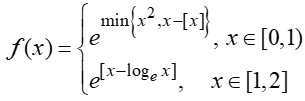 where \( [t] \) denotes the greatest integer less then or equal to \( t \). Then the value of the integral \(\displaystyle \int_{0}^{2} x f(x)\,dx \) is:
 . Then, \( gof : R \to R \) is:
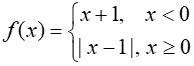 and
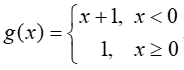 . Then \( (g \circ f)(x) \) is:
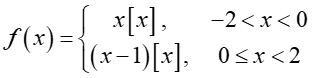
 then range of \( (f og)(x) \) is: