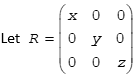
 be a non-zero \( 3 \times 3 \) matrix, where \( x \sin \theta = y \sin \!\left(\theta + \dfrac{2\pi}{3}\right) = z \sin \!\left(\theta + \dfrac{4\pi}{3}\right) \neq 0, \\ \theta \in (0, 2\pi) \). For a square matrix \( M \), Let trace \( (M) \) denote the sum of all the diagonal entries of \( M \). Then, among the statements:
(I) \( \text{Trace} (R) = 0 \)
(II) If \( \text{trace}(\operatorname{adj}(\operatorname{adj}(R))) = 0 \), then \( R \) has exactly one non-zero entry.
