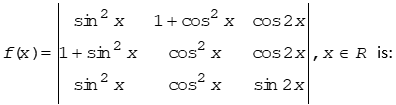
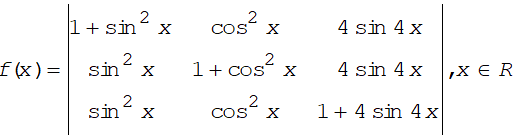
If \( \alpha \) and \( \beta \) respectively are the maximum and the minimum value of \( f \), then:
\( \beta^2 - 2\sqrt{\alpha} = \frac{19}{4} \)
\( \beta^2 + 2\sqrt{\alpha} = \frac{19}{4} \)
\( \alpha^2 - \beta^2 = 4\sqrt{3} \)
\( \alpha^2 + \beta^2 = \frac{9}{2} \)
Let \( A \) be a \( 3\times 3 \) real matrix such that \( A^{2}(A-2I)-4(A-I)=0 \), where \( I \) and \( O \) are the identity and null matrices, respectively. If \( A^{5}=\alpha A^{2}+\beta A+\gamma I \), where \( \alpha,\beta \) and \( \gamma \) are real constants, then \( \alpha+\beta+\gamma \) is equal to:
Let \( A \) be a matrix of order \( 3 \times 3 \) and \(|A| = 5\). If \( |2 \, \operatorname{adj}(3A \, \operatorname{adj}(2A))| = 2^{\alpha} \cdot 3^{\beta} \cdot 5^{\gamma}, \alpha,\beta,\gamma \in \) \(\mathbb{R}\) , then \( \alpha + \beta + \gamma \) is equal to:
\(\displaystyle \text{Let } A = \begin{bmatrix} \frac{1}{\sqrt{2}} & -2 \\ 0 & 1 \end{bmatrix} \text{ and } P = \begin{bmatrix} \cos\theta & -\sin\theta \\ \sin\theta & \cos\theta \end{bmatrix}\)\( ,\theta>0 \). If \( B=PA P^{T},\; C=P^{T}B^{10}P \) and the sum of the diagonal elements of \( C \) is \( \frac{m}{n} \), where \( \gcd(m,n)=1 \), then \( m+n \) is:
Let \( \alpha , \beta \in \mathbb{R} \) be such that the system of linear equations\( x + 2y + z = 5 \)\( 2x + y + \alpha z = 5 \)\( 8x + 4y + \beta z = 18 \)has no solution. Then \( \dfrac{\beta}{\alpha} \) is equal to:
Let \( A \) be a \( 3\times3 \) matrix having entries from the set \( \{-1,0,1\} \). The number of all such matrices \( A \) having sum of all the entries equal to \( 5 \), is ________.
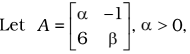
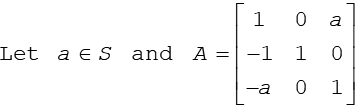
, where \( a,c\in\mathbb{R} \). If \( A^{3}=A \) and the positive value of \( a \) belongs to the interval \( (n-1,n] \), where \( n\in\mathbb{N} \), then \( n \) is equal to ________ .
The value of \( k\in \mathbb{R} \), for which the following system of linear equations\( 3x-y+4z=3, \)\( x+2y-3z=-2, \)\( 6x+5y+kz=-3, \)has infinitely many solutions, is:
For some \( \alpha,\beta \in \mathbb{R} \), let be such that \( A^{2}-4A+2I=B^{2}-3B+I=O \). Then \( \left( \det\!\left( \operatorname{adj}\!\left(A^{3}-B^{3}\right) \right) \right)^{2} \) is equal to ________.
The system of equations:\( x + y + z = 6 \),\( x + 2y + 5z = 9 \),\( x + 5y + \lambda z = \mu \),has no solution if:
The positive value of the determinant of the matrix \( A \), whose
, \( |A|=2 \). . If \( \left|\,2\,\operatorname{adj}\!\left(2\,\operatorname{adj}(2A)\right)\!\right|=32^{\,n} \), then \( 3n+\alpha \) is equal to:
If the shortest distance between the lines \( \frac{x-\lambda}{3}=\frac{y-2}{-1}=\frac{z-1}{1} \) and \( \frac{x+2}{-3}=\frac{y+5}{2}=\frac{z-4}{4} \) is \( \frac{44}{\sqrt{30}} \), then the largest possible value of \( |\lambda| \) is equal to ______.
If the system of equations \( x+4y-z=\lambda, \ 7x+9y+\mu z=-3, \ 5x+y+2z=-1 \) has infinitely many solutions, then \( (2\mu+3\lambda )\) is equal to:
Let \( |A| = 6 \), where \( A \) is a \( 3 \times 3 \) matrix. If \( \left|\operatorname{adj}\!\left(3\,\operatorname{adj}\!\left(A^{2}\cdot \operatorname{adj}(2A)\right)\right)\right| = 2^{m}\cdot 3^{n} \), \( m, n \in N \), then \( m+n \) is equal to ______.
where \( \alpha \) is a non-zero real number an \( N=\displaystyle\sum_{k=1}^{49}M^{2k} \). If \( (I-M^{2})N=-2I \), then the positive integral values of \( \alpha \) is ______.
If the system of linear equations\( x-2y+z=-4 \)\( 2x+\alpha y+3z=5 \)\( 3x-y+\beta z=3 \)has infinitely many solutions, then \( 12\alpha+13\beta \) is equal to:
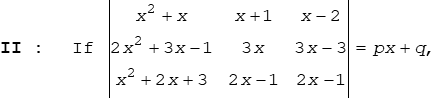
for all \( x\in \mathbb{R} \), then \( 2f(0)+f'(0) \) is equal to:
If the system of equations \( 2x + \lambda y + 3z = 5 \) \( 3x + 2y - z = 7 \) \( 4x + 5y + \mu z = 9 \) has infinitely many solutions, then \( \left(\lambda^{2} + \mu^{2}\right) \) is equal to :
Let \( A = [a_{ij}] \) be a square matrix of order \( 3 \) such that \( a_{ij} = 2^{\,j-i} \), for all \( i, j = 1, 2, 3 \). Then, the matrix \( A^2 + A^3 + \ldots + A^{10} \) is equal to:
then a possible value of \( \alpha \) is:
Then \( A^{2025} - A^{2020} \) is equal to:
The maximum value of
Let \( A \) be a square matrix of order \( 3 \) such that \( \det(A) = -2 \) and \( \det\!\big( 3\,\operatorname{adj}(-6\,\operatorname{adj}(3A)) \big) = 2^{m+n}\cdot 3^{mn},\; m>n \). Then \( 4m + 2n \) is equal to __________.
For a \( 3 \times 3 \) matrix \( M \), let \( \text{trace}(M) \) denote the sum of all the diagonal elements of \( M \). Let \( A \) be a \( 3 \times 3 \) matrix such that \( |A| = \frac{1}{2} \) and \( \text{trace}(A) = 3 \). If \( B = \operatorname{adj}(\operatorname{adj}(2A)) \), then the value of \( |B| + \text{trace}(B) \) equals:
If the system of equations\( (\lambda - 1)x + (\lambda - 4)y + \lambda z = 5 \)\( \lambda x + (\lambda - 1)y + (\lambda - 4)z = 7 \)\( (\lambda + 1)x + (\lambda + 2)y - (\lambda + 2)z = 9 \)has infinitely many solutions, then \( \lambda^{2} + \lambda \) is equal to:
Let \( S \) be the set containing all \( 3 \times 3 \) matrices with entries from \( \{-1, 0, 1\} \). The total number of matrices \( A \in S \) such that the sum of all the diagonal elements of \( A^{T}A \) is \( 6 \) is _______.
If \( \alpha + \beta + \gamma = 2\pi \), then the system of equations\( x + (\cos \gamma) y + (\cos \beta) z = 0 \)\( (\cos \gamma) x + y + (\cos \alpha) z = 0 \)\( (\cos \beta) x + (\cos \alpha) y + z = 0 \)
Let \( A \) be a \( 3 \times 3 \) matrix such that \( \left| \operatorname{adj} \left(\operatorname{adj}(\operatorname{adj} A)\right) \right| = 81 \). If \( S = \left\{ n \in {Z} : \left(\left| \operatorname{adj}(\operatorname{adj} A) \right|\right)^{\frac{(n-1)^{2}}{2}} = |A|^{\left(3n^{2} - 5n - 4\right)} \right\} \), then \( \displaystyle \sum_{n \in S} |A|^{\left(n^{2} + n\right)} \) is equal to:
Let A be a matrix of order $2 \times 2$, whose entries are from the set $\{0,1,2,3,4,5\}$. If the sum of all the entries of A is a prime number $p, 2 < p < 8$, then the number of such matrices A is _________.
such that \( \det(A)=0 \) and \( \alpha + \beta = 1 \). If \( I \) denotes \( 2 \times 2 \) identify matrix, then the matrix \( (I + A)^8 \) is:
The number of symmetric matrices of order \( 3 \), with all the entries from the set \( \{0,1,2,3,4,5,6,7,8,9\} \) is:
Let \( A = [a_{ij}] \) be a matrix of order \( 3 \times 3 \), with \( a_{ij} = (\sqrt{2})^{\,i+j} \). If the sum of all the elements in the third row of \( A^{2} \) is \( \alpha + \beta \sqrt{2} \), \( \alpha,\beta \in \mathbb{Z} \), then \( \alpha + \beta \) is equal to:
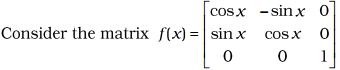
Given below are two statements:Statement I: \( f(-x) \) is the inverse of the matrix \( f(x) \).Statement II: \( f(x)f(y)=f(x+y) \).In the light of the above statements, choose the correct answer from the options given below:
If the system of equations\( x + y + a z = b \)\( 2x + 5y + 2z = 6 \)\( x + 2y + 3z = 3 \)Has infinitely many solutions, then \( 2a + 3b \) is equal to:
Let be a set of \( 2 \times 2 \) matrices. Then the number of matrices in \( S \), for which the sum of the diagonal elements is equal to \( 4 \), is:
Consider the system of linear equations \( x+y+z=5 \), \( x+2y+\lambda^{2}z=9 \), \( x+3y+\lambda z=\mu \), where \( \lambda,\mu \in \mathbb{R} \). Then, which of the following statement is \(\text {NOT}\) correct?
Let \( [\lambda] \) be the greatest integer less than or equal to \( \lambda \). The set of all values of \( \lambda \) for which the system of linear equations \( x + y + z = 4 \), \( 3x + 2y + 5z = 3 \), \( 9x + 4y + (28 + [\lambda])z = [\lambda] \) has a solution is :
Let \( \alpha \) and \( \beta \) be real numbers. Consider a \( 3 \times 3 \) matrix \( A \) such that \( A^{2}=3A+\alpha I \). If \( A^{4}=21A+\beta I \), then:
Consider the system of linear equations\( -x + y + 2z = 0 \)\( 3x - ay + 5z = 1 \)\( 2x - 2y - az = 7 \)Let \( S_{1} \) be the set of all \( a \in \mathbb{R} \) for which the system is inconsistent and \( S_{2} \) be the set of all \( a \in \mathbb{R} \) for which the system has infinitely many solutions. If \( n(S_{1}) \) and \( n(S_{2}) \) denote the number of elements in \( S_{1} \) and \( S_{2} \) respectively, then:
If the system of linear equations \( 2x + y - z = 3 \) \( x - y - z = \alpha \) \( 3x + 3y + \beta z = 3 \) has infinitely many solution, then \( \alpha + \beta - \alpha \beta \) is equal to __________.
Let \( A \) and \( B \) be two square matrices of order \( 3 \) such that \( |A|=3 \) and \( |B|=2 \). Then \( \left|A^{T}A\,(\operatorname{adj}(2A))^{-1}\,(\operatorname{adj}(4B)\operatorname{(adj}(AB))^{-1}\,AA^{T}\right| \) is equal to:
For the system of linear equations\( 2x+4y+2az=b \)\( x+2y+3z=4 \)\( 2x-5y+2z=8 \)Which of the following is NOT correct?
Let \( A \) be a \( 2 \times 2 \) matrix with real entries such that \( A' = \alpha A + I \), where \( \alpha \in \mathbb{R} - \{-1, 1\} \). If \( \det \left(A^{2} - A\right) = 4 \), then the sum of all possible values of \( \alpha \) is equal to:
If the system of linear equations\( 3x + y + \beta z = 3 \)\( 2x + \alpha y - z = -3 \)\( x + 2y + z = 4 \)has infinitely many solutions, then the value of \( 22\beta - 9\alpha \) is:
If \( B = I - {^{5}C_{1}}(\operatorname{adj}A) + {^{5}C_{2}}(\operatorname{adj}A)^2 - \ldots - {^{5}C_{5}}(\operatorname{adj}A)^5 \), then the sum of all elements of the matrix \( B \) is:
Then the sum of the squares of all the values of \( a \), for which \( 2\, f'(10) - f'(5) + 100 = 0 \), is
Let \( \theta \in \left(0, \frac{\pi}{2}\right) \). If the system of linear equation.\( (1 + \cos^2 \theta)x + \sin^2 \theta \, y + 4 \sin 3\theta \, z = 0 \)\( \cos^2 \theta \, x + (1 + \sin^2 \theta) y + 4 \sin 3\theta \, z = 0 \)\( \cos^2 \theta \, x + \sin^2 \theta \, y + (1 + 4 \sin 3\theta) z = 0 \)Has a non-trivial solution, then the value of \( \theta \) is:
Let \( A \) be a \( 2 \times 2 \) real matrix and \( 1 \) be the identity matrix of order \( 2 \). If the roots of the equation \( |A - xI| = 0 \) be \( -1 \) and \( 3 \), then the sum of the diagonal elements of the matrix \( A^2 \) is __________.
Let \( f:\mathbb{R}\to \mathbb{R} \) be defined as \( f(x)=x^3+x-5 \).If \( g(x) \) is a function such that \( f(g(x))=x \), \( \forall 'x'\in \mathbb{R} \) then \( g'(63) \) is equal to ________________.
The set of all values of \( t\in \) ℝ for which the matrix
If \(\displaystyle P = \begin{bmatrix} 1 & 0 \\ 1/2 & 1 \end{bmatrix}\), then \( P^{50} \) is:
The number of elements in the set where \( I \) is \( 2 \times 2 \) identity matrix, is _________.
If \( \det(\operatorname{adj}(\operatorname{adj}(3A))) = 2^{m}\cdot 3^{n} \), \( m, n \in \mathbb{N} \), then \( m+n \) is equal to:
Let and \( B=[b_{ij}],\,1\le i,j\le 3 \). If \( B=A^{99}-I \), then the value of \( \dfrac{b_{31}-b_{21}}{b_{32}} \) is:
. The sum of the prime factors of \( \left|P^{-1}AP-2I\right| \) is equal to:
Let \( A \) be a \( 2 \times 2 \) symmetric matrix such that and the determinant of \( A \) be \( 1 \).If \( A^{-1} = \alpha A + \beta I, \) where \( I \) is an identity matrix of order \( 2 \times 2 \), then \( \alpha + \beta \) equals _______________ .
Let \( A \) and \( B \) be two \( 3 \times 3 \) matrices such that \( AB = I \) and \( \lvert A \rvert = \frac{1}{8} \). Then \( \left| \operatorname{adj}\left( B \, \operatorname{adj}(2A) \right) \right| \) is equal to
The system of equations \( kx + y + z = 1 \), \( x + ky + z = k \) and \( x + y + zk = k^2 \) has no solution if \( k \) is equal to:
If the system of equations\( 2x - y + z = 4 \)\( 5x + \lambda y + 3z = 12 \)\( 100x - 47y + \mu z = 212 \),has infinitely many solutions, then \( \mu - 2\lambda \) is equal to:
The number of values of \( \alpha \) for which the system of equations:\( x + y + z = \alpha \)\( \alpha x + 2\alpha y + 3z = -1 \)\( x + 3\alpha y + 5z = 4 \)is inconsistent, is
Let Then the sum of all elements of the matrix \( \operatorname{adj}(\operatorname{adj}(2(\operatorname{adj}A)^{-1})) \) is equal to:
If the system of equations:\( x+y+z=5 \)\( x+2y+3z=9 \)\( x+3y+\lambda z=\mu \)has infinitely many solutions, then the value of \( \lambda+\mu \) is:
If \( A \) is a square matrix of order \( 3 \) such that \( \det(A)=3 \) and \( \det(\text{adj}(-4 \, \text{adj}(-3 \, \text{adj}(3 \, \text{adj}((2A)^{-1}))))) = 2^m 3^n\), then \( m+2n \) is equal to:
Let \( J_{n,m} = \int_{0}^{\tfrac{1}{2}} \frac{x^m}{x^n - 1} \, dx \), \( \forall \, n > m \) and \( n, m \in \mathbb{N} \). Consider a matrix \( A = [a_{ij}]_{3 \times 3} \) where Then \( \lvert \operatorname{adj}\, A^{-1} \rvert \) is:
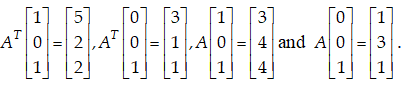
Let \( A = [a_{ij}] \) be a \( 3 \times 3 \) matrix such that \(\displaystyle A \begin{bmatrix} 0 \\ 1 \\ 0 \end{bmatrix} = \begin{bmatrix} 0 \\ 0 \\ 1 \end{bmatrix}, A \begin{bmatrix} 4 \\ 1 \\ 3 \end{bmatrix} = \begin{bmatrix} 0 \\ 1 \\ 0 \end{bmatrix} \text{ and } A \begin{bmatrix} 2 \\ 1 \\ 2 \end{bmatrix} = \begin{bmatrix} 1 \\ 0 \\ 0 \end{bmatrix}\), then \( a_{23} \) equals:
. If \( A^3 = 4A^2 - A - 21I \), where \( I \) is the identity matrix of order \( 3 \times 3 \), then \( 2a + 3b \) is equal to:
Consider the following system of equations\( \alpha x+2y+z=1 \)\( 2\alpha x+3y+z=1 \)\( 3x+\alpha y+2z=\beta \)for some \( \alpha,\beta\in \mathbb{R} \). Then which of the following is NOT correct.
If the system of equations\(11x+y+\lambda z=-5\) \(2x+3y+5z=3\) \(8x-19y-39z=\mu\) has infinitely many solutions, then \( \lambda^{4}-\mu \) is equal to:
Let \( A \) be a \( 3\times 3 \) real matrix such that.Then, the system has.
Let \( M \) and \( m \) respectively be the maximum and the minimum values of Then \( M^4 - m^4 \) is equal to:
If \( A = \dfrac{1}{5! \; 6! \; 7!} \) , then \( \left| \operatorname{adj}(\operatorname{adj}(2A)) \right| \) is equal to:
Let \( A \) be a \( 3 \times 3 \) invertible matrix. If \( \left| \operatorname{adj}(24A) \right| = \left| \operatorname{adj}\!\left( 3 \operatorname{adj}(2A) \right) \right| \), then \( |A|^{2} \) is equal to:
, then value of \( \det(A^{4})+\det\!\big(A^{10}-(\operatorname{Adj}(2A))^{10}\big) \) is equal to ______.
and \( A \) be a \( 2 \times 2 \) matrix such that \( AB^{-1} = A^{-1} \). If \( BCB^{-1} = A \) and \( C^{4} + \alpha C^{2} + \beta I = 0 \), then \( 2\beta - \alpha \) is equal to
If the system of equations\( x+\big(\sqrt{2}\sin\alpha\big)y+\big(\sqrt{2}\cos\alpha\big)z=0 \)\( x+(\cos\alpha)y+(\sin\alpha)z=0 \)\( x+(\sin\alpha)y-(\cos\alpha)z=0 \)has a non-trivial solution, then \( \alpha\in\left(0,\dfrac{\pi}{2}\right) \) is equal to:
Let \( S \) be the set of values of \( \lambda \), for which the system of equations \( 6\lambda x - 3y + 3z = 4\lambda^{2} \),\( 2x + 6\lambda y + 4z = 1 \),\( 3x + 2y + 3\lambda z = \lambda \) has no solution. Then \( 12 \displaystyle\sum_{\lambda \in S} \lvert \lambda \rvert \) is equal to \( \_\_\_\_\_ \).
Let \( A = \begin{bmatrix} 0 & -2 \cr 2 & 0 \end{bmatrix} \). If \( M \) and \( N \) are two matrices given by \( M =\displaystyle \sum_{k=1}^{10} A^{2k} \) and \( N = \displaystyle \sum_{k=1}^{10} A^{2k-1} \) then \( MN^{2} \) is:
Let \( A \) be a square matrix of order \( 2 \) such that \( |A| = 2 \) and the sum of its diagonal elements is \( -3 \). If the points \( (x, y) \) satisfying \( A^2 + xA + yI = 0 \) lie on a hyperbola, whose transverse axis is parallel to the \( x \)-axis, eccentricity is \( e \) and the length of the latus rectum is \( l \), then \( e^4 + l^4 \) is equal to \( \_\_\_\_\_\_\_\_\_\_ \).
If the system of equations\( x+2y-3z=2 \)\( 2x+\lambda y+5z=5 \) \( 14x+3y+\mu z=33 \) has infinitely many solutions, then \( \lambda+\mu \) is equal to:
Let the system of linear equations \( x + 2y + z = 2 \), \( \alpha x + 3y - z = \alpha \), \( -\alpha x + y + 2z = -\alpha \) be inconsistent. Then \( \alpha \) is equal to:
and \( |2A|^{3}=2^{21} \) where \( \alpha,\beta \in \mathbb{Z} \), then a value of \( \alpha \) is:
Let \( A \) be a symmetric matrix such that If the sum of the diagonal elements of \( A \) is \( s \), then \( \frac{\beta s}{\alpha^2} \) is equal to ____________.
If a point \( P(\alpha, \beta, \gamma) \) satisfying lies on the plane \( 2x + 4y + 3z = 5 \), then \( 6\alpha + 9\beta + 7\gamma \) is equal to:
, \( A^{-1} = \alpha A + \beta I \) and \( \alpha + \beta = -2 \), then \( 4\alpha^{2} + \beta^{2} + \lambda^{2} \) is equal to:
Let \( \alpha, \beta, \gamma \) be the real roots of the equation, \( x^3 + ax^2 + bx + c = 0 \), \( (a,b,c \in \mathbb{R} \) and \( a,b \ne 0) \). If the system of equations (in \( u, v, w \)) given by \( \alpha u + \beta v + \gamma w = 0 \); \( \beta u + \gamma v + \alpha w = 0 \); \( \gamma u + \alpha v + \beta w = 0 \) has non-trivial solution, then value of \( \dfrac{\alpha^2}{b} \) is:
, then \( \lambda, \dfrac{\lambda}{3} \) are the roots of the equation.
If \( \alpha \ne a,\ \beta \ne b,\ \gamma \ne c \) and then \( \dfrac{a}{\alpha-a}+\dfrac{b}{\beta-b}+\dfrac{\gamma}{\gamma-c} \) is equal to:
If the system of equations:\( x + 2y + 3z = 3 \)\( 4x + 3y - 4z = 4 \)\( 8x + 4y - \lambda z = 9 + \mu \)has infinitely many solutions, then the ordered pair \( (\lambda, \mu) \) is equal to:
Let \( S = \{ M = [a_{ij}],\ a_{ij} \in \{0, 1, 2\},\ 1 \le i, j \le 2 \} \) be a sample space and \( A = \{ M \in S : M \text{ is invertible} \} \) be an event. Then \( P(A) \) is equal to:
Let \( A, B, C \) be \( 3 \times 3 \) matrices such that \( A \) is symmetric and \( B \) and \( C \) are skew-symmetric. Consider the statements:\( (S1)\; A^{13}B^{26}-B^{26}A^{13} \) is symmetric.\( (S2)\; A^{26}C^{13}-C^{13}A^{26} \) is symmetric.Then,
. If the sum of the diagonal elements of \( A^{13} \) is \( 3^n \), then \( n \) is equal to ______.
For the system of linear equations\( x + y + z = 6 \)\( \alpha x + \beta y + 7z = 3 \)\( x + 2y + 3x = 14 \),Which of the following is not true?
Let \( I \) be the identity matrix of order \( 3 \times 3 \) and for the matrix \( |A|=-1 \). Let \( B \) be the inverse of the matrix \( \operatorname{adj}\!\left(A\,\operatorname{adj}(A^{2})\right) \). Then \( |(\lambda B+1)| \) is equal to _______________.
Let \( A \) be a \( 3 \times 3 \) matrix such that If \( \det(A) = 1 \), then \( \det(\operatorname{adj}(A^2 + A)) \) is equal to:
, \( C=ABA^{T} \) and \( X=A^{T}C^{2}A \), then \( \det X \) is equal to:
If the system of linear equations: \( x + y + z = 6 \), \( x + 2y + 5z = 10 \), \( 2x + 3y + \lambda z = \mu \) has infinitely many solutions, then the value of \( \lambda + \mu \) equals:
Let the system of equations \( x + 5y - z = 1 \) \( 4x + 3y - 3z = 7 \) \( 24x + y + \lambda z = \mu \) \( \lambda,\mu \in \mathbb{R} \), have infinitely many solutions. Then the number of the solutions of this system. If \( x,y,z \) are integers and satisfy \( 7 \le x + y + z \le 77 \), is:
Among the statements:then \( \cos^{2}\alpha + \cos^{2}\beta + \cos^{2}\gamma = \frac{3}{2} \) and then \( p^{2} = 196q^{2} \).
If the matrix satisfies \( A\!\left(A^{3} + 3I\right) = 2I \), then the value of \( k \) is:
If the system of linear equations:\( x + y + 2z = 6 \),\( 2x + 3y + az = a + 1 \),\( -x - 3y + bz = 2b \),where \( a, b \in \mathbb{R} \), has infinitely many solutions, then \( 7a + 3b \) is equal to:
Let \( A \) and \( B \) be any two \( 3\times 3 \) symmetric and skew symmetric matrices respectively. Then which of the following is NOT true?
The system of equation\( -k x + 3y - 14z = 25 \)\( -15x + 4y - k z = 3 \)\( -4x + y + 3z = 4 \)is consistent for all \( k \) in the set
and \( Q= PAP^{T} \). If \( P^{T}Q^{2007}P\), then \( 2a+b-3c-4d \) equal to:
If the system of equations\( 2x+7y+\lambda z=3 \)\( 3x+2y+5z=4 \)\( x+\mu y+3z=-1 \)has infinitely many solutions, then \( (\lambda-\mu) \) is equal to ______.
Let \( A = [a_{ij}] \) be a \( 3 \times 3 \) matrix, whereLet a function \( f:\mathbb{R}\to\mathbb{R} \) be defined as \( f(x)=\det(A) \). Then the sum of maximum and minimum value of \( f \) on \( \mathbb{R} \) is equal to:
Consider the system of linear equations\( x + y + z = 4\mu, \quad x + 2y + 2\lambda z = 10\mu, \quad x + 3y + 4\lambda^{2} z = \mu^{2} + 15 \), where, \( \lambda, \mu \in \mathbb{R} \). Which one of the following statements is NOT correct?
where \( [t] \) denotes the greatest integer less than or equal to \( t \). If \( \det(A) = 192 \), then the set of values of \( x \) is the interval:
Let \( A \) be a \( 3 \times 3 \) matrix such that \( A + A^{T} = O \). If and \( \det(\operatorname{adj}(2\operatorname{adj}(A + I))) = (2)^{\alpha} \cdot (3)^{\beta} \cdot (11)^{\gamma} \); \( \alpha, \beta, \gamma \) are non-negative integers, then \( \alpha + \beta + \gamma \) is equal to ________.
Let \( A=[a_{ij}] \) be a real matrix of order \( 3\times 3 \), such that \( a_{i1}+a_{i2}+a_{i3}=1 \), for \( i=1,2,3 \). Then, the sum of all the entries of the matrix \( A^{3} \) is equal to:
Let the system of linear equations\( x + y + \alpha z = 2 \)\( 3x + y + z = 4 \)\( x + 2z = 1 \)have a unique solution \( (x^*, y^*, z^*) \). If \( (\alpha, x^*) \), \( (y^*, \alpha) \) and \( (x^*, -y^*) \) are collinear points, then the sum of absolute values of all possible values of \( \alpha \) is:
Let \( A \) be a square matrix such that \( AA^{T} = I \). Then \( \frac{1}{2} A \left[ (A + A^{T})^{2} + (A - A^{T})^{2} \right] \) is equal to:
\( Y = \alpha I + \beta X + \gamma X^2 \) and \( Z = \alpha^2 I - \alpha \beta X + (\beta^2 - \alpha \gamma) X^2, \ \alpha, \beta, \gamma \in \mathbb{R}. \) Then \( (\alpha - \beta + \gamma)^2 \) is equal to _______.
,\( x\in[0,\pi]. \) Then the maximum value of \( f(x) \) is equal to ______.
Let \( A, B \) and \( C \) be three \( 2 \times 2 \) matrices with real entries such that \( B = (I + A)^{-1} \) and \( A + C = I \).
. If \( \operatorname{Tr}(A) \) denotes the sum of all diagonal elements of the matrix \( A \), then \( \operatorname{Tr}(A) - \operatorname{Tr}(B) \) has value equal to:
For \( \alpha, \beta \in \) \(\mathbb{R}\) and a natural number \( n \), let . Then \( 2A_{10} - A_8 \) is:
Let \( M \) denote the set of all real matrices of order \( 3 \times 3 \) and let \( S=\{-3,-2,-1,1,2\} \). Let \( S_{1}=\{A=[a_{ij}] \in M: A=A^{T} \text{ and } a_{ij}\in S, \\ \forall \ i,j\} \), \( S_{2}=\{A=[a_{ij}] \in M: A-A^{T} \text{ and } a_{ij}\in S, \\ \forall \ i,j\} \), \( S_{3}=\{A=[a_{ij}] \in M: a_{11}+a_{22}+a_{33}=0 \text{ and } a_{ij}\in S, \\ \forall \ i,j\} \). If \( n(S_{1}\cup S_{2}\cup S_{3}) = 125\,\alpha \), then \( \alpha \) equals ______.
The number of \( \theta \in (0,4\pi) \) for which the system is linear equations \( 3(\sin 3\theta)x - y + z = 2 \) \( 3(\cos 2\theta)x + 4y + 3z = 3 \) \( 6x + 7y + 7z = 9 \) Has no solution, is :
The number of matrices of order \( 3 \times 3 \), whose entries are either \( 0 \) or \( 1 \) and the sum of all the entries is a prime number, is__________.
Let \( P=[p_{ij}] \) and \( Q=[q_{ij}] \) be two square matrices of order \( 3 \) such that \( q_{ij}=2^{(i+j-1)}p_{ij} \) and \( \det(Q)=2^{10} \). Then the value of \( \det(\operatorname{adj}(\operatorname{adj}P)) \) is:
Let \( A \) be \( 3 \times 3 \) matrix and \( \det(A) = 2 \). If \( n = \det\dfrac{(\operatorname{adj}(\operatorname{adj}(\ldots(\operatorname{adj} A))) )}{ 2024 \text{-times} }\) remainder when \( n \) is divided by \( 9 \) is equal to ______.
Let the system of linear equations \( 4x + \lambda y + 2z = 0 \) \( 2x - y + z = 0 \) \( \mu x + 2y + 3z = 0, \lambda, \mu \in \mathbb{R} \). Has a non-trivial solution. Then which of the following is true?
Let \( A = [a_{ij}]_{2 \times 2} \), where \( a_{ij} \neq 0 \) for all \( i, j \) and \( A^{2} = I \). Let \( a \) be the sum of all diagonal elements of \( A \) and \( b = |A| \). Then \( 3a^{2} + 4b^{2} \) is equal to:
If \( P \) is a \( 3\times 3 \) real matrix such that \( P^{T}=\alpha P+(\alpha -1)I \), where \( \alpha>1 \), then:
If the system of linear equations:\( 2x + y - z = 7 \)\( x - 3y + 2z = 1 \)\( x + 4y + \delta z = k \), where \( \delta, k \in \mathbb{R} \)Has infinitely many solutions, then \( \delta + k \) is equal to:
, then the sum of all the elements of the matrix \( \displaystyle \sum_{n=1}^{50} B^{n} \) is equal to:
Let \( A \) be a \( 2\times 2 \) matrix with \( \det(A) = -1 \) and \( \det\!\left((A+I)\big(\operatorname{Adj}(A)+I\big)\right)=4 \). Then the sum of the diagonal elements of \( A \) can be:
Let satisfy\( A^2+\alpha(\operatorname{adj}(\operatorname{adj}(A)))+\beta(\operatorname{adj}(A)\operatorname{adj}(\operatorname{adj}(A)))\)= for some \( \alpha,\beta \in \mathbb{R} \). Then \( (\alpha-\beta)^2 \) is equal to _____.
Let \( a, b, c, d \) be in arithmetic progression with common difference \( \lambda \). , then value of \( \lambda^{2} \) is equal to _______.
Define a relation \( R \) over a class of \( n \times n \) real matrices \( A \) and \( B \) as “\( ARB \) iff there exists a non-singular matrix \( P \) such that \( P A P^{-1} = B \)”. Then which of the following is true?
Let \( a \in \mathbb{R} \) and \( A \) be a matrix of order \( 3 \times 3 \) such that \( \det(A) = -4 \) and , where \( I \) is the identity matrix of order \( 3 \times 3 \). If \( \det\!\big((a+1)\operatorname{adj}((a-1)A)\big) \) is \( 2^{m}\,3^{n} \), \( m, n \in \{ 0 \), \( 1 \), \( 2 \), \( \ldots \), \( 20 )\} \), then \( m+n \) is equal to:
Let \( \alpha, \beta \; (\alpha \ne \beta) \) be the values of \( m \), for which the equations \( x + y + z = 1 \); \( x + 2y + 4z = m \) and \( x + 4y + 10z = m^{2} \) have infinitely many solutions. Then the value of \( \sum\limits_{n=1}^{10} \left(n^{\alpha} + n^{\beta}\right) \) is equal to:
If \( A, B \) and \( \operatorname({adj}(A^{-1}) + \operatorname{adj}(B^{-1}) \)) are non-singular matrices of same order, then the inverse of \( A\left(\operatorname{adj}(A^{-1}) + \operatorname{adj}(B^{-1})\right)^{-1}B \) , is equal to:
, \(\ \alpha > 2 \) be the adjoint of a matrix A and \(|A|=2\). Then \([\alpha-2\alpha\,\alpha]\) is equal to:
The solutions of the equation
If \( A \) and \( B \) are two non-zero \( n\times n \) matrices such that \( A^{2}+B=A^{2}B \), then:
. Then the sum of the diagonal elements of the matrix \( (A + I)^{11} \) is equal to:
If the system of equations\( 2x+3y-z=5 \)\( x+\alpha y+3z=-4 \)\( 3x-y+\beta z=7 \)has infinitely many solutions, then \( 13\alpha\beta \) is equal to ______.
Let \( A \) be a matrix of order \( 3 \times 3 \) and \( \det(A) = 2 \). then \( \det\!\big(\det(A)\operatorname{adj}(5\operatorname{adj}(A^{3}))\big) \) is equal to ______.
The probability that a randomly chosen \( 2 \times 2 \) matrix with all the entries from the set of first \( 10 \) primes, is singular, is equal to:
The number of square matrices of order \( 5 \) with entries from the set \( \{0, 1\} \), such that the sum of all the elements in each row is \( 1 \) and the sum of all the elements in each column is also \( 1 \), is:
The number of \( 3 \times 2 \) matrices \( A \), which can be formed using the elements of the set \( \{-2,-1,0,1,2\} \) such that the sum of all the diagonal elements of \( A^T A \) is \( 5 \), is ________.
Let \( A \) be a \( 3\times 3 \) real matrix. If \( \det\!\big(2\,\mathrm{Adj}(2\,\mathrm{Adj}(\mathrm{Adj}(2A)))\big)=2^{41} \), then the value of \( \det(A^{2}) \) equals _________.
Let \( S = \{ \sqrt{n} : 1 \leq n \leq 50 \text{ and } n \text{ is odd} \} \). If \( \sum\limits_{a \in S} \det(\operatorname{adj} A) = 100\,\lambda \), then \( \lambda \) is equal to:
For real numbers \( \alpha \) and \( \beta \), consider the following system of linear equations: \( x+y-z=2, \quad x+2y+\alpha z=1, \quad 2x-y+z=\beta \). If the system has infinite solutions, then \( \alpha+\beta \) is equal to ________.
, \( B = [B_{1}, B_{2}, B_{3}] \) are column matrices, and If \( \alpha = |B| \) and \( \beta \) is the sum of all the diagonal element of \( B \), then \( \alpha^{3} + \beta^{3} \) is equal to ____________.
The number of distinct real roots of in the interval \( -\dfrac{\pi}{4} \le x \le \dfrac{\pi}{4} \) is:
Let \( \alpha \) be a root of the equation \( (a-c)x^2 + (b-a)x + (c-b) = 0 \) where \( a,b,c \) are distinct real numbers such that the matrix is singular. Then, the value of \( \dfrac{(a-c)^2}{(b-a)(c-b)} + \dfrac{(b-a)^2}{(a-c)(c-b)} + \dfrac{(c-b)^2}{(a-c)(b-a)} \) is:
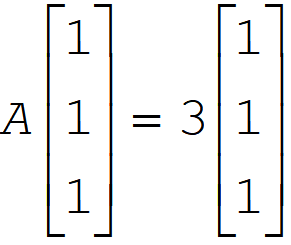
Let \( M \) be a \( 3\times 3 \) matrix such that then \( x+y+z \) equals:
. If \( \displaystyle\sum_{k=1}^{n}D_k=96 \), then \( n \) is equal to ____.
Let \( A \) and \( B \) be two \( 3\times 3 \) non-zero real matrices such that \( AB \) is a zero matrix. Then.
Let the system of linear equations\( -x + 2y - 9z = 7 \)\( -x + 3y + 7z = 9 \)\( -2x + y + 5z = 8 \)\( -3x + y + 13z = \lambda \)Has a unique solution \( x = \alpha, y = \beta, z = \gamma \). Then the distance of the point \( (\alpha, \beta, \gamma) \) from the plane \( 2x - 2y + z = \lambda \) is:
Let \( A = I_{2} - 2MM^{T} \) where \( M \) is a real matrix of order \( 2 \times 1 \) such that the relation \( M^{T}M = I_{1} \) holds. If \( \lambda \) is a real number such that the relation \( AX = \lambda X \) holds for some non-zero real matrix \( X \) of order \( 2 \times 1 \), then the sum of squares of all possible values of \( \lambda \) is equal to ________.
Let \( A \) be a non-singular matrix of order \( 3 \). If \( \det\!\big(3\,\operatorname{adj}(2\,\operatorname{adj}((\det A)\,A))\big) = 3^{-13}\cdot 2^{-10} \) and \( \det\!\big(3\,\operatorname{adj}(2A)\big) = 2^{m}\cdot 3^{n} \), then \( |3m + 2n| \) is equal to ________.
If the system of linear equations,\( 2x + 3y - z = -2 \)\( x + y + z = 4 \)\( x - y + |\lambda| z = 4\lambda - 4 \)Where \( \lambda \in \mathbb{R} \), has no solution, then:
Let \( S \) denote the set of all real values of \( \lambda \) such that the system of equations\( \lambda x+y+z=1 \)\( x+\lambda y+z=1 \)\( x+y+\lambda z=1 \)is inconsistent, then \( \displaystyle \sum_{\lambda \in S}\left(|\lambda|^{2}+|\lambda|\right) \) is equal to:
Let \( A \) be a \( n\times n \) matrix such that \( |A|=2 \). If the determinant of the matrix \( \mathrm{Adj}\!\left(2\cdot \mathrm{Adj}\!\left(2A^{-1}\right)\right) \) is \( 2^{84} \), then \( n \) is equal to ______.
Let \( \alpha \in (0,\infty) \) and . If \( \det\!\big(\operatorname{adj}(2A-A^{T})\cdot \operatorname{adj}(A-2A^{T})\big)=2^{8} \), then \( (\det(A))^{2} \) is equal to:
Let \( A \) be a \( 3 \times 3 \) matrix of non-negative real elements such that . Then the maximum value of \( \det(A) \) is _________.
Let \( x,y,z>1 \) and then \( \left| \operatorname{adj}\!\left(\operatorname{adj}\, A^{2}\right) \right| \) is equal to:
Let \(A\) and \(B\) be \(3 \times 3\) real matrices such that \(A\) is symmetric matrix and \(B\) is skew-symmetric matrix. Then the system of linear equations \(\left(A^{2}B^{2}-B^{2}A^{2}\right)X=O\), where \(X\) is a \(3 \times 1\) column matrix of unknown variables and \(O\) is a \(3 \times 1\) null matrix, has:
For the system of linear equations \( \alpha x+y+z=1, \ x+\alpha y+z=1, \ x+y+\alpha z=\beta \), which one of the following statements is NOT correct?
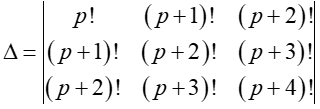
Let \( p \) and \( p+2 \) be prime number and letThen the sum of the maximum values of \( \alpha \) and \( \beta \), such that \( p^{\alpha} \) and \( (p+2)^{\beta} \) divide \( \Delta \), is__________.
Let \( \alpha \beta \gamma = 45; \alpha, \beta, \gamma \in \; \)\(\mathbb{R}\). If \( x(\alpha, 1, 2) + y(1, \beta, 2) + z(2, 3, \gamma) = (0, 0, 0) \) for some \( x, y, z \in \; \)\(\mathbb{R}\), \( xyz \ne 0 \), then \( 6\alpha + 4\beta + \gamma \) is equal to __________.
then the determinant of the matrix \( \left(A^{2025} - 3A^{2024} + A^{2023}\right) \) is
, \( d = |A| \neq 0 \) and \( |A - d(\operatorname{Adj} A)| = 0 \). Then:
For the system of equations\( x+y+z=6 \)\( x+2y+\alpha z=10 \)\( x+3y+5z=\beta \), which one of the following is NOT true?
, where \( \alpha,\beta,\gamma \) are three distinct natural numbers. If \( \dfrac{\det(\operatorname{adj}(\operatorname{adj}(\operatorname{adj}(\operatorname{adj}A))))}{(\alpha-\beta)^{16}(\beta-\gamma)^{16}(\gamma-\alpha)^{16}}=2^{32}\times 3^{16} \), then the number of such \( 3 \)- tuples \( (\alpha,\beta,\gamma) \) is ________.
If the system of linear equations\( 7x + 11y + \alpha z = 13 \)\( 5x + 4y + 7z = \beta \)\( 175x + 194y + 57z = 361 \)has infinitely many solutions, then \( \alpha + \beta + 2 \) is equal to:
Let \( A=[a_{ij}],\, a_{ij}\in \mathbb{Z}\cap[0,4],\, 1\le i,j\le 2 \). The number of matrices \( A \) such that sum of all entries is a prime number \( p\in(2,13) \) is ________.
Let for any three distinct consecutive terms \( a, b, c \) of an A.P. the lines \( ax + by + c = 0 \) be concurrent at the point \( P \) and \( Q \equiv (\alpha,\beta) \) be a point such that the system of equations\( x + y + z = 6 \)\( 2x + 5y + \alpha z = \beta \) and\( x + 2y + 3z = 4 \), has infinitely many solutions. The \( (PQ)^2 \) is equal to ________.
Let the determinant of a square matrix \( A \) of order \( m \) be \( m-n \), where \( m \) and \( n \) satisfy \( 4m+n=22 \) and \( 17m+4n=93 \). If \( \det\!\big(n\,\operatorname{adj}(\operatorname{adj}(mA))\big)=3^{a}5^{b}6^{c} \) then \( a+b+c \) is equal to:
The number of real values of \( \lambda \), such that the system of linear equations\( 2x-3y+5z=9 \)\( x+3y-z=-18 \)\( 3x-y+(\lambda^{2}-|\lambda|)z=16 \) has no solution is:
Let and \( B = I + \operatorname{adj}(A) + (\operatorname{adj}A)^2 + \ldots + (\operatorname{adj}A)^{10} \). Then, the sum of all the elements of the matrix \( B \) is:
Consider the matrices and . If matrices \( P \) and \( Q \) are such that \( PA = B \) and \( AQ = B \), then the absolute value of the sum of the diagonal elements of \( 2(P+Q) \) is ______.
.If \( A_{ij} \) is the cofactor of \( a_{ij} \), \( C_{ij}= \displaystyle \sum_{k=1}^{2} a_{ik}A_{jk} \), \( 1\le i,j\le 2 \), and \( C=[C_{ij}] \), then \( 8|C| \) is equal to:
If for some \( \theta \in (0,\pi) \), \( A^{2} = A^{T} \), then the sum of the diagonal elements of the matrix \( (A + I)^{3} + (A - I)^{3} - 6A \) is equal to ______.
If the system of equations \( x + 5y + 6z = 4 \), \( 2x + 3y + 4z = 7 \), \( x + 6y + az = b \) has infinitely many solutions, then the point \( (a,b) \) lies on the line:
Let the matrix satisfy \( A^n = A^{n-2} + A^2 - I \) for \( n \ge 3 \). Then the sum of all the elements of \( A^{50} \) is:
is the matrix of cofactors of the elements of \( A \), then \( \det(AB) \) is equal to:
, where \( i=\sqrt{-1} \).If \( M=A^{T}BA \), then the inverse of the matrix \( AM^{2023}A^{T} \) is:
Let \( S = \{ m \in \mathbb{Z} : A^{m^2} + A^m = 3I - A^{-6} \} \), where. Then \( n(S) \) is equal to ________.
If \( A \) is a \( 3 \times 3 \) matrix and \( |A| = 2 \), then \( \left| 3 \, \mathrm{adj}\!\left( \left|3A\right| A^2 \right) \right| \) is equal to:
Let the system of equations:\( 2x + 3y + 5z = 9 \),\( 7x + 3y - 2z = 8 \),\( 12x + 3y - (4 + \lambda)z = 16 - \mu \),have infinitely many solutions. Then the radius of the circle centred at \( (\lambda, \mu) \) and touching the line \( 4x = 3y \) is:
The values of \( \alpha \), for which lie in the interval.
and let \( T_{n}=\{A\in S: A^{n(n+1)}=I\} \). Then the number of elements in \( \displaystyle \bigcap_{n=1}^{100} T_{n} \) is _______.
If the system of equations\( 2x+y-z=5 \)\( 2x-5y+\lambda z=\mu \)\( x+2y-5z=7 \)has infinitely many solutions, then \( (\lambda+\mu)^{2}+(\lambda-\mu)^{2} \) is equal to:
\( i = \sqrt{-1} \), and \( Q = A^T B A \), then the inverse of the matrix \( A Q^{2021} A^T \) is equal to:
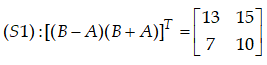
Let If \( A^{2}-4A+I=O \) and \( B^{2}-5B-6I=O \), then among the two statements:and \((\text{S2}): \det(\operatorname{adj}(A+B))=-5,\)
Let \( S \) be the set of all values of \( \theta \in [-\pi, \pi] \) for which the system of linear equations\( x + y + \sqrt{3}\,z = 0 \)\( -x + (\tan \theta)\,y + \sqrt{7}\,z = 0 \)\( x + y + (\tan \theta)\,z = 0 \)has non-trivial solution. Then \( \dfrac{120}{\pi} \displaystyle\sum_{\theta \in S} \theta \) is equal to:
If the following system of linear equations\( 2x+y+z=5 \)\( x-y+z=3 \)\( x+y+az=b \)has no solution, then:
be a non-zero \( 3 \times 3 \) matrix, where \( x \sin \theta = y \sin \!\left(\theta + \dfrac{2\pi}{3}\right) = z \sin \!\left(\theta + \dfrac{4\pi}{3}\right) \neq 0, \\ \theta \in (0, 2\pi) \). For a square matrix \( M \), Let trace \( (M) \) denote the sum of all the diagonal entries of \( M \). Then, among the statements:(I) \( \text{Trace} (R) = 0 \)(II) If \( \text{trace}(\operatorname{adj}(\operatorname{adj}(R))) = 0 \), then \( R \) has exactly one non-zero entry.
Let \( A \) be a \( 3 \times 3 \) matrix such that \( \left|\operatorname{adj}(\operatorname{adj}(\operatorname{adj} A))\right| = 12^4 \) Then \( \left| A^{-1} \operatorname{adj} A \right| \) is equal to:
If the system of equations \( ax + y + z = 5 \), \( x + 2y + 3z = 4 \), \( x + 3y + 5z = \beta \) has infinitely many solutions, then the ordered pair \( (\alpha, \beta) \) is equal to:
Let \( A=\{a_{ij}\} \) be a \(3\times3\) matrix, whereThen \( \det\!\big(3\,\operatorname{Adj}(2A^{-1})\big) \) is equal to ________.
Let \( S_1 \) and \( S_2 \) be respectively the sets of all \( a \in R - \{0\} \) for which the system of linear equations.\( ax + 2ay - 3az = 1 \)\( (2a + 1)x + (2a + 3)y + (a + 1)z = 2 \)\( (3a + 5)x + (a + 5)y + (a + 2)z = 3 \)has unique solution and infinitely many solutions. Then:
Let \( A \) be a \( 3\times 3 \) real matrix such thatIf \( X=(x_1,x_2,x_3)^T \) and \( I \) is an identity matrix of order \( 3 \), then the system
Let \( \lambda,\mu \in \mathbb{R} \). If the system of equations\( 3x+5y+\lambda z=3 \)\( 7x+11y-9z=2 \)\( 97x+155y-189z=\mu \)has infinitely many solutions; then \( \mu+2\lambda \) is equal to:
Let \( \alpha \) be a solution of \( x^2 + x + 1 = 0 \), and for some \( a \) and \( b \) in \( \mathbb{R} \), If \( \dfrac{4}{\alpha^4} + \dfrac{m}{\alpha^a} + \dfrac{n}{\alpha^b} = 3 \), then \( m + n \) is equal to ______.
The ordered pair \( (a, b) \), for which the system of linear equations.\( 3x - 2y + z = b \)\( 5x - 8y + 9z = 3 \)\( 2x + y + az = -1 \)Has no solution, is:
The values of \( a \) and \( b \) for which the system of equations\( 2x+3y+6z=8 \)\( x+2y+az=5 \)\( 3x+5y+9z=b \)has no solution, are:
Let \( A \) be a \( 3 \times 3 \) matrix such that \( X^{T} A X = 0 \) for all non-zero \( 3 \times 1 \) matrices , and \( \det(\operatorname{adj}(2(A+I))) = 2^{\alpha} 3^{\beta} 5^{\gamma} \), \( \alpha, \beta, \gamma \in \mathbb{N} \), then \( \alpha^{2} + \beta^{2} + \gamma^{2} \) is ________.
Let the system of equations \( x + 2y + 3z = 5, \; 2x + 3y + z = 9, \; 4x + 3y + \lambda z = \mu \) have infinite number of solutions. Then \( \lambda + 2\mu \) is equal to:
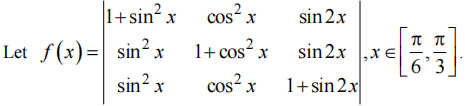 If \( \alpha \) and \( \beta \) respectively are the maximum and the minimum value of \( f \), then:

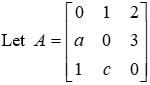 , where \( a,c\in\mathbb{R} \). If \( A^{3}=A \) and the positive value of \( a \) belongs to the interval \( (n-1,n] \), where \( n\in\mathbb{N} \), then \( n \) is equal to ________ .
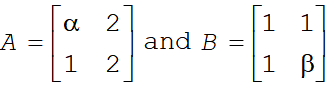 be such that \( A^{2}-4A+2I=B^{2}-3B+I=O \). Then \( \left( \det\!\left( \operatorname{adj}\!\left(A^{3}-B^{3}\right) \right) \right)^{2} \) is equal to ________.
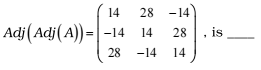
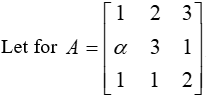 , \( |A|=2 \). . If \( \left|\,2\,\operatorname{adj}\!\left(2\,\operatorname{adj}(2A)\right)\!\right|=32^{\,n} \), then \( 3n+\alpha \) is equal to:
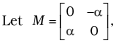 where \( \alpha \) is a non-zero real number an \( N=\displaystyle\sum_{k=1}^{49}M^{2k} \). If \( (I-M^{2})N=-2I \), then the positive integral values of \( \alpha \) is ______.
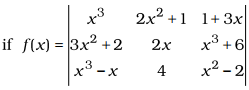 for all \( x\in \mathbb{R} \), then \( 2f(0)+f'(0) \) is equal to:

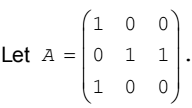 Then \( A^{2025} - A^{2020} \) is equal to:
 be a set of \( 2 \times 2 \) matrices. Then the number of matrices in \( S \), for which the sum of the diagonal elements is equal to \( 4 \), is:
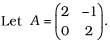 If \( B = I - {^{5}C_{1}}(\operatorname{adj}A) + {^{5}C_{2}}(\operatorname{adj}A)^2 - \ldots - {^{5}C_{5}}(\operatorname{adj}A)^5 \), then the sum of all elements of the matrix \( B \) is:
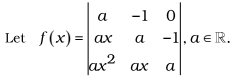 Then the sum of the squares of all the values of \( a \), for which \( 2\, f'(10) - f'(5) + 100 = 0 \), is
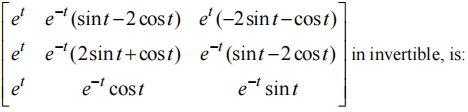
 where \( I \) is \( 2 \times 2 \) identity matrix, is _________.

 and \( B=[b_{ij}],\,1\le i,j\le 3 \). If \( B=A^{99}-I \), then the value of \( \dfrac{b_{31}-b_{21}}{b_{32}} \) is:
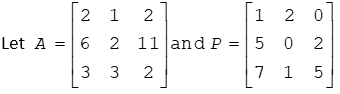 . The sum of the prime factors of \( \left|P^{-1}AP-2I\right| \) is equal to:
 and the determinant of \( A \) be \( 1 \).
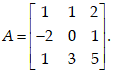 Then the sum of all elements of the matrix \( \operatorname{adj}(\operatorname{adj}(2(\operatorname{adj}A)^{-1})) \) is equal to:
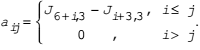 Then \( \lvert \operatorname{adj}\, A^{-1} \rvert \) is:
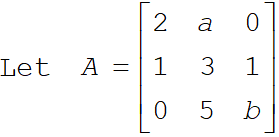 . If \( A^3 = 4A^2 - A - 21I \), where \( I \) is the identity matrix of order \( 3 \times 3 \), then \( 2a + 3b \) is equal to:
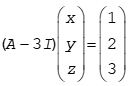
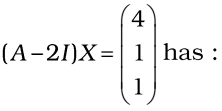
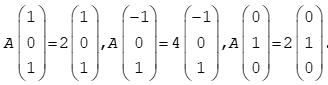 .Then, the system
 has.
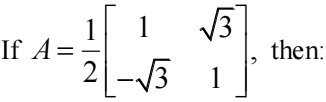
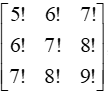 , then \( \left| \operatorname{adj}(\operatorname{adj}(2A)) \right| \) is equal to:
 , then value of \( \det(A^{4})+\det\!\big(A^{10}-(\operatorname{Adj}(2A))^{10}\big) \) is equal to ______.
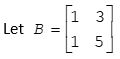 and \( A \) be a \( 2 \times 2 \) matrix such that \( AB^{-1} = A^{-1} \). If \( BCB^{-1} = A \) and \( C^{4} + \alpha C^{2} + \beta I = 0 \), then \( 2\beta - \alpha \) is equal to
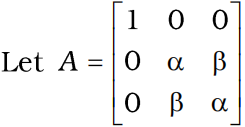 and \( |2A|^{3}=2^{21} \) where \( \alpha,\beta \in \mathbb{Z} \), then a value of \( \alpha \) is:
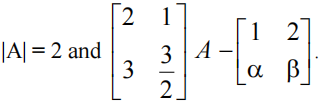
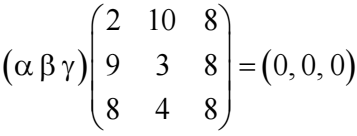 lies on the plane \( 2x + 4y + 3z = 5 \), then \( 6\alpha + 9\beta + 7\gamma \) is equal to:
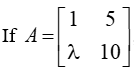 , \( A^{-1} = \alpha A + \beta I \) and \( \alpha + \beta = -2 \), then \( 4\alpha^{2} + \beta^{2} + \lambda^{2} \) is equal to:
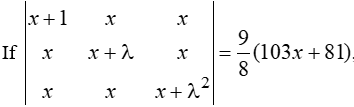 , then \( \lambda, \dfrac{\lambda}{3} \) are the roots of the equation.
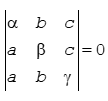 then \( \dfrac{a}{\alpha-a}+\dfrac{b}{\beta-b}+\dfrac{\gamma}{\gamma-c} \) is equal to:
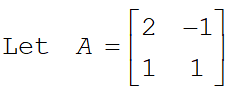 . If the sum of the diagonal elements of \( A^{13} \) is \( 3^n \), then \( n \) is equal to ______.
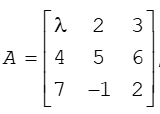 \( |A|=-1 \). Let \( B \) be the inverse of the matrix \( \operatorname{adj}\!\left(A\,\operatorname{adj}(A^{2})\right) \). Then \( |(\lambda B+1)| \) is equal to _______________.
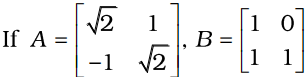 , \( C=ABA^{T} \) and \( X=A^{T}C^{2}A \), then \( \det X \) is equal to:

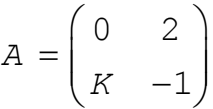 satisfies \( A\!\left(A^{3} + 3I\right) = 2I \), then the value of \( k \) is:
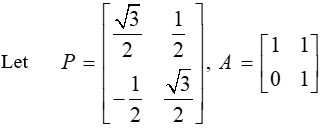 and \( Q= PAP^{T} \). If \( P^{T}Q^{2007}P\)
 , then \( 2a+b-3c-4d \) equal to:
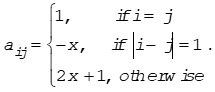
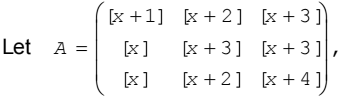 where \( [t] \) denotes the greatest integer less than or equal to \( t \). If \( \det(A) = 192 \), then the set of values of \( x \) is the interval:
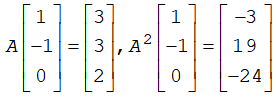 and \( \det(\operatorname{adj}(2\operatorname{adj}(A + I))) = (2)^{\alpha} \cdot (3)^{\beta} \cdot (11)^{\gamma} \); \( \alpha, \beta, \gamma \) are non-negative integers, then \( \alpha + \beta + \gamma \) is equal to ________.
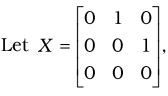 \( Y = \alpha I + \beta X + \gamma X^2 \) and \( Z = \alpha^2 I - \alpha \beta X + (\beta^2 - \alpha \gamma) X^2, \ \alpha, \beta, \gamma \in \mathbb{R}. \)
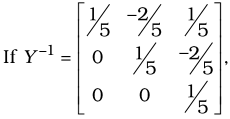 Then \( (\alpha - \beta + \gamma)^2 \) is equal to _______.
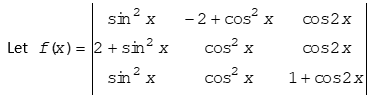 ,\( x\in[0,\pi]. \) Then the maximum value of \( f(x) \) is equal to ______.

 . If \( \operatorname{Tr}(A) \) denotes the sum of all diagonal elements of the matrix \( A \), then \( \operatorname{Tr}(A) - \operatorname{Tr}(B) \) has value equal to:
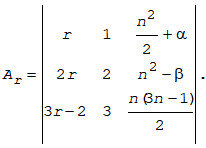 . Then \( 2A_{10} - A_8 \) is:
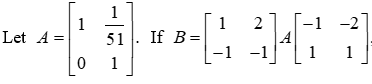 , then the sum of all the elements of the matrix \( \displaystyle \sum_{n=1}^{50} B^{n} \) is equal to:
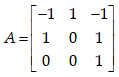 satisfy
 for some \( \alpha,\beta \in \mathbb{R} \). Then \( (\alpha-\beta)^2 \) is equal to _____.
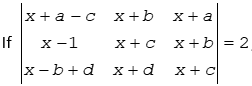 ,
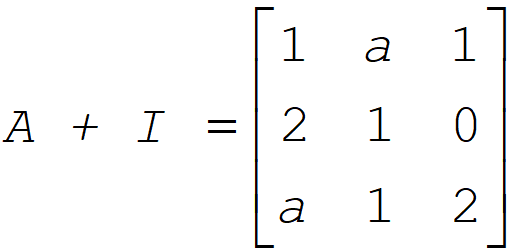 , where \( I \) is the identity matrix of order \( 3 \times 3 \). If \( \det\!\big((a+1)\operatorname{adj}((a-1)A)\big) \) is \( 2^{m}\,3^{n} \), \( m, n \in \{ 0 \), \( 1 \), \( 2 \), \( \ldots \), \( 20 )\} \), then \( m+n \) is equal to:
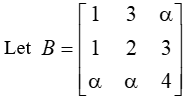 , \(\ \alpha > 2 \) be the adjoint of a matrix A and \(|A|=2\). Then \([\alpha-2\alpha\,\alpha]\)
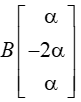 is equal to:
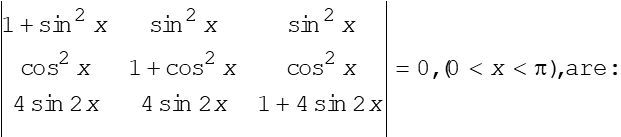
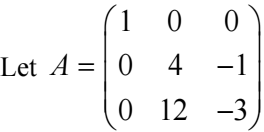 . Then the sum of the diagonal elements of the matrix \( (A + I)^{11} \) is equal to:
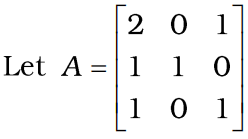 , \( B = [B_{1}, B_{2}, B_{3}] \) are column matrices, and
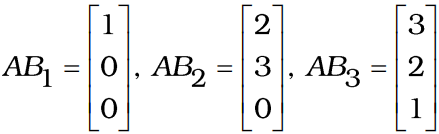 If \( \alpha = |B| \) and \( \beta \) is the sum of all the diagonal element of \( B \), then \( \alpha^{3} + \beta^{3} \) is equal to ____________.
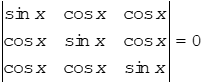 in the interval \( -\dfrac{\pi}{4} \le x \le \dfrac{\pi}{4} \) is:
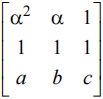 is singular. Then, the value of \( \dfrac{(a-c)^2}{(b-a)(c-b)} + \dfrac{(b-a)^2}{(a-c)(c-b)} + \dfrac{(c-b)^2}{(a-c)(b-a)} \) is:
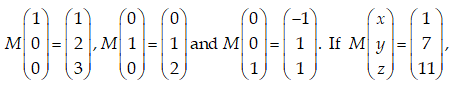 then \( x+y+z \) equals:
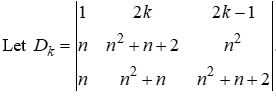 . If \( \displaystyle\sum_{k=1}^{n}D_k=96 \), then \( n \) is equal to ____.
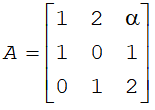 . If \( \det\!\big(\operatorname{adj}(2A-A^{T})\cdot \operatorname{adj}(A-2A^{T})\big)=2^{8} \), then \( (\det(A))^{2} \) is equal to:
 . Then the maximum value of \( \det(A) \) is _________.
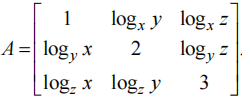 then \( \left| \operatorname{adj}\!\left(\operatorname{adj}\, A^{2}\right) \right| \) is equal to:
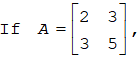 then the determinant of the matrix \( \left(A^{2025} - 3A^{2024} + A^{2023}\right) \) is
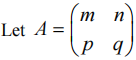 , \( d = |A| \neq 0 \) and \( |A - d(\operatorname{Adj} A)| = 0 \). Then:
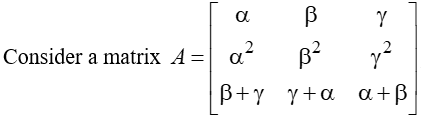 , where \( \alpha,\beta,\gamma \) are three distinct natural numbers. If \( \dfrac{\det(\operatorname{adj}(\operatorname{adj}(\operatorname{adj}(\operatorname{adj}A))))}{(\alpha-\beta)^{16}(\beta-\gamma)^{16}(\gamma-\alpha)^{16}}=2^{32}\times 3^{16} \), then the number of such \( 3 \)- tuples \( (\alpha,\beta,\gamma) \) is ________.
 and \( B = I + \operatorname{adj}(A) + (\operatorname{adj}A)^2 + \ldots + (\operatorname{adj}A)^{10} \). Then, the sum of all the elements of the matrix \( B \) is:
 and
 . If matrices \( P \) and \( Q \) are such that \( PA = B \) and \( AQ = B \), then the absolute value of the sum of the diagonal elements of \( 2(P+Q) \) is ______.
 .
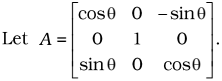
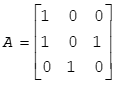 satisfy \( A^n = A^{n-2} + A^2 - I \) for \( n \ge 3 \). Then the sum of all the elements of \( A^{50} \) is:
 is the matrix of cofactors of the elements of \( A \), then \( \det(AB) \) is equal to:
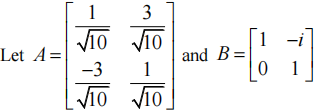 , where \( i=\sqrt{-1} \).
 . Then \( n(S) \) is equal to ________.
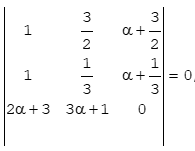 lie in the interval.
 and let \( T_{n}=\{A\in S: A^{n(n+1)}=I\} \). Then the number of elements in \( \displaystyle \bigcap_{n=1}^{100} T_{n} \) is _______.
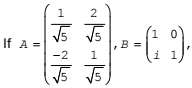 \( i = \sqrt{-1} \), and \( Q = A^T B A \), then the inverse of the matrix \( A Q^{2021} A^T \) is equal to:
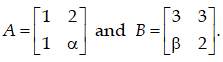 If \( A^{2}-4A+I=O \) and \( B^{2}-5B-6I=O \), then among the two statements:
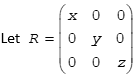 be a non-zero \( 3 \times 3 \) matrix, where \( x \sin \theta = y \sin \!\left(\theta + \dfrac{2\pi}{3}\right) = z \sin \!\left(\theta + \dfrac{4\pi}{3}\right) \neq 0, \\ \theta \in (0, 2\pi) \). For a square matrix \( M \), Let trace \( (M) \) denote the sum of all the diagonal entries of \( M \). Then, among the statements:
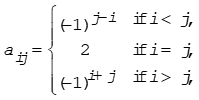
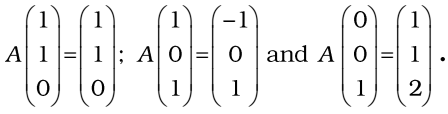
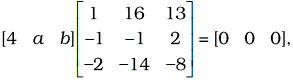
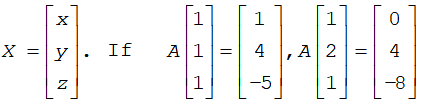 , and \( \det(\operatorname{adj}(2(A+I))) = 2^{\alpha} 3^{\beta} 5^{\gamma} \), \( \alpha, \beta, \gamma \in \mathbb{N} \), then \( \alpha^{2} + \beta^{2} + \gamma^{2} \) is ________.