If \( 5f(x) + 4f\!\left( \frac{1}{x} \right) = x^2 - 2 \), \( \forall x \neq 0 \) and \( y = 9x^2 f(x) \), then \( y \) is strictly increasing in:
\( \left( -\frac{1}{\sqrt{5}}, 0 \right) \cup \left( 0, \frac{1}{\sqrt{5}} \right) \)
\( \left( -\frac{1}{\sqrt{5}}, 0 \right) \cup \left( \frac{1}{\sqrt{5}}, \infty \right) \)
\( \left( 0, \frac{1}{\sqrt{5}} \right) \cup \left( \frac{1}{\sqrt{5}}, \infty \right) \)
\( \left( -\infty, -\frac{1}{\sqrt{5}} \right) \cup \left( 0, \frac{1}{\sqrt{5}} \right) \)
Let \( f(x)=\displaystyle\int_{0}^{x}t(t^2-9t+20)\,dt,\; 1\le x\le 5 \). If the range of \( f \) is \( [\alpha,\beta] \), then \( 4(\alpha+\beta) \) equals:
Suppose for a differentiable function \( h \), \( h(0) = 0 \), \( h(1) \) and \( h'(0) = h'(1) = 2 \). If \( g(x) = h(e^{x})\,e^{h(x)} \), then \( g'(0) \) is equal to:
Let \( f:\mathbb{R} \to \mathbb{R} \) be a function defined by \( f(x) = \big||x+2| - 2|x|\big| \). If \( m \) is the number of points of local minima and \( n \) is the number of points of local maxima of \( f \), then \( m + n \) is:
Let \( f(x) = 4\cos^{3}x + 3\sqrt{3}\cos^{2}x - 10 \). The number of points of local maxima of \( f \) in interval \( (0,\, 2\pi) \) is:
If the maximum value of \( a \), for which the function \( f_a(x)=\tan^{-1}2x-3ax+7 \) is non-decreasing in \( \left(-\dfrac{\pi}{6},\dfrac{\pi}{6}\right) \), is \( \bar a \), then \( f_{\bar a}\!\left(\dfrac{\pi}{8}\right) \) is equal to:
The number of distinct real roots of the equation\( x^{5}\left(x^{3}-x^{2}-x+1\right)+x\left(3x^{3}-4x^{2}-2x+4\right)-1=0 \) is ________.
Let \( f(x) \) be a cubic polynomial with \( f(1)=-10 \), \( f(-1)=6 \), and has a local minima at \( x=1 \), and \( f'(x) \) has a local minima at \( x=-1 \). Then \( f(3) \) is equal to ______.
A water tank has the shape of a right circular cone with axis vertical and vertex downwards. Its semi-vertical angle is \( \tan^{-1}\dfrac{3}{4} \). Water is poured in it at a constant rate of \( 6 \) cubic meter per hour. The rate (in square meter per hour), at which the wet curved surface area of the tank is increasing, when the depth of water in the tank is \( 4 \) meters, is _______.
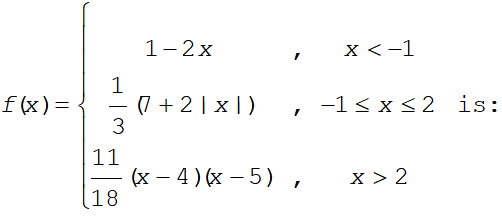
Let \( f:\mathbb{R}\to\mathbb{R} \) be defined as Then \( f \) is increasing function in the interval.
The number of critical points of the function \( f(x) = (x-2)^{2/3} (2x+1) \) is:
Consider the following three statements for the function \( f:(0,\infty)\to \mathbb{R} \) defined by \( f(x)=|\log_e x|-|x-1| \):(\( \mathrm{I} \)) \( f \) is differentiable at all \( x>0 \).(\( \mathrm{II} \)) \( f \) is increasing in \( (0,1) \).(\( \mathrm{III} \)) \( f \) is decreasing in \( (1,\infty) \).Then:
The minimum value of the twice differentiable function \( f(x) = \displaystyle\int\limits_{0}^{x} e^{\,x-t} f'(t) \, dt - (x^{2} - x + 1) e^{x}, \ x \in \mathbb{R} \) is:
Let \( f : \mathbb{R} - \{0\} \to \mathbb{R} \) be a function satisfying \( f\!\left(\dfrac{x}{y}\right) = \dfrac{f(x)}{f(y)} \) for all \( x,y \), \( f(y) \neq 0 \). If \( f'(1)=2024 \), then:
Let \( f:\mathbb{R}\to\mathbb{R} \) be a thrice differentiable function such that \( f(0)=0 \), \( f(1)=1 \), \( f(2)=-1 \), \( f(3)=2 \) and \( f(4)=-2 \). Then, the minimum number of zeros of \(( 3f' f''+ff''')(x) \) is ___________.
A box open from top is made from a rectangular sheet of dimension \( a \times b \) by cutting squares each of side \( x \) from each of the four corners and folding up the flaps. If the volume of the box is maximum, then \( x \) is equal to :
Let \( f:\mathbb{R}\to \mathbb{R} \) be a function defined by \( f(x)=(x-3)^{n_1}(x-5)^{n_2}, \, n_1,n_2 \in \mathbb{N} \). Then, which of the following is NOT true?
The number of critical points of the function in the interval \( (-2\pi,2\pi) \) is equal to:
The number of solutions of the equation \( 2\theta - \cos^2 \theta + \sqrt{2} = 0 \) in \( R \) is equal to __________.
If the equation of the normal to the curve \( y = \frac{x - a}{(x + b)(x - 2)} \) at the point \( (1, -3) \) is \( x - 4y = 13 \), then the value of \( a + b \) is equal to ______.
Let \( a \in \mathbb{Z} \) and \( [t] \) be the greatest integer \( \le t \). Then the number of points, where the function \( f(x) = [a + 13 \sin x], \; x \in (0, \pi) \) is not differentiable, is ____________.
If the function \( f(x)=2x^3-9ax^2+12a^2x+1, \ a>0 \) has a local maximum at \( x=\alpha \) and a local minimum at \( x=\alpha^2 \), then \( \alpha \) and \( \alpha^2 \) are the roots of the equation:
A wire of length \( 36 \, \text{m} \) is cut into two pieces, one of the pieces is bent to form a square and the other is bent to form a circle. If the sum of the areas of the two figures is minimum and the circumference of the circle is \( k \) (\( \text{meter} \)), then \( \left(\frac{4}{\pi} + 1\right)k \) is equal to ________.
Let \( f(x)=2^{x}-x^{2},\ x\in \mathbb{R} \). If \( m \) and \( n \) are respectively the number of points at which the curves \( y=f(x) \) and \( y=f'(x) \) intersect the \( x \)-axis, then the value of \( m+n \) is __________.
The number of points on the curve \( y = 54x^5 - 135x^4 - 70x^3 + 180x^2 + 210x \) at which the normal lines are parallel to \( x + 90y + 2 = 0 \) is:
The number of distinct real roots of the equation \( 3x^4 + 4x^3 - 12x^2 + 4 = 0 \) is \( \_\_\_\_\_\_\_\_\_\_ \).
A wire of length \( 20 \, \text{m} \) is to be cut into \( 2 \) pieces. One of the pieces is to be made into a square and the other into a regular hexagon. Then the length of the side (in meters) of the hexagon, so that the combined area of the square and the hexagon is minimum, is:
The sum of all local minimum values of the function
Let be a singular matrix. Let \( f(x)=\int_{0}^{x}(t^{2}+2t+3)\,dt, \; x\in [\,1,\alpha\,] \). If \( M \) and \( m \) are respectively the maximum and the minimum values of \( f \) in \( [\,1,\alpha\,] \), then \( 3(M-m) \) is equal to:
Let \(\displaystyle g(x)=3\,f\!\left(\frac{x}{3}\right)+f(3-x) \) and \( f''(x)>0 \) for all \( x\in(0,3) \). If \( g \) is decreasing in \( (0,\alpha) \) and increasing in \( (\alpha,3) \), then \( 8\alpha \) is:
If the function \( f(x)=2x^3-9ax^2+12a^2x+1 \), where \( a>0 \), attains its local maximum and local minimum values at \( p \) and \( q \), respectively, such that \( p^2=q \), then \( f(3) \) is equal to:
Let \( f(x) = 2\cos^{-1}x + 4\cot^{-1}x - 3x^{2} - 2x + 10, \, x \in [-1,1] \). If \([a,b]\) is the range of the function \( f \), then \( 4a - b \) is equal to:
Let \( S \) be the set of all the natural numbers, for which the line \( \dfrac{x}{a}+\dfrac{y}{b}=2 \) is a tangent to the curve \( \left(\dfrac{x}{a}\right)^{n}+\left(\dfrac{y}{b}\right)^{n}=2 \) at the point \( (a,b), ab\neq 0 \). Then:
Let \( f(x) = x^{2025} - x^{2000}, \ x \in [0,1] \) and the minimum value of the function \( f(x) \) in the interval \( [0,1] \) be \( (80)^{80}(n)^{-81} \). Then \( n \) is equal to:
The function \( f(x)=\dfrac{x}{x^{2}-6x-16}, \ x\in \mathbb{R}-\{-2,8\}. \)
The number of points where the function\([t]\) denotes the greatest integer \( \le t \), is discontinuous is ____________.
Let \( f(x) \) be a polynomial of degree \( 5 \), and have extrema at \( x=1 \) and \( x=-1 \). If \( \displaystyle \lim_{x\to0}\left(\dfrac{f(x)}{x^{3}}\right)=-5 \), then \( f(2)-f(-2) \) is equal to:
If \( m \) and \( n \) respectively are the number of local maximum and local minimum points of the function \( f(x)=\int_{0}^{x^{2}} \frac{t^{2}-5t+4}{2+e^{t}} \, dt \), then the ordered pair \( (m,n) \) is equal to
A wire of length \( 22 \, \text{m} \) is to be cut into two pieces. One of the pieces is to be made into a square and the other into an equilateral triangle. Then, the length of the side of the equilateral triangle, so that the combined area of the square and the equilateral triangle is minimum, is:
In an A.P., the sixth term \( a_6 = 2 \). If the product \( a_1 a_4 a_5 \) is the greatest, then the common difference of the A.P. is equal to:
A spherical chocolate ball has a layer of ice-cream of uniform thickness around it. When the thickness of the ice-cream layer is \( 1 \, \text{cm} \), the ice-cream melts at the rate of \( 81 \, \text{cm}^{3}/\text{min} \) and the thickness of the ice-cream layer decreases at the rate of \( \frac{1}{4\pi} \, \text{cm} \ / \text{min} \). The surface area (in \( \text{cm}^{2} \)) of the chocolate ball (without the ice-cream layer) is:
If the curve \( y = ax^{2} + bx + c, \, x \in \mathbb{R} \), passes through the point \( (1,2) \) and the tangent line to this curve at origin is \( y = x \), then the possible values of \( a, b, c \), are:
$If\ the\ angle\ made\ by\ the\ tangent\ at\ the\ point\ (x_0, y_0)\ on\ the\ curve$ $x = 12\Big(t + \sin t \cos t\Big), y = 12\big(1 + \sin t\big)^2, 0 < t < \frac{\pi}{2},\ with\ the\ positive\ x\text{-axis}\ is\ \frac{\pi}{3},\ then\ y_0\ is\ equal\ to\ :$
The number of points, where the curve \( y = x^5 - 20x^3 + 50x + 2 \) crosses the \( x \)-axis, is _________.
Let \( S = (-1, \infty) \) and \( f : S \to \mathbb{R} \) be defined as \( f(x) = \int_{-1}^{x} (e^{t} - 1)^{11}(2t - 1)^{5}(t - 3)^{12}(2t - 10)^{61} dt \). Let \( p \) = Sum of squares of the values of \( x \), where \( f(x) \) attains local maxima on \( S \), and \( q \) = Sum of the values of \( x \), where \( f(x) \) attains local minima on \( S \). Then, the value of \( p^{2} + 2q \) is __________.
Let \( f : [2, 4] \to \mathbb{R} \) be a differentiable function such that \( (x \log_{e} x) f^{\prime}(x) + (\log_{e} x) f(x) + f(x) \ge 1, \, x \in [2,4] \) with \( f(2) = \dfrac{1}{2} \) and \( f(4) = \dfrac{1}{4} \). Consider the following two statements:\( (A): \quad f(x) \le 1, \text{ for all } x \in [2, 4] \)\( (B): \quad f(x) \ge \dfrac{1}{8}, \text{ for all } x \in [2, 4] \)Then,
The number of distinct real roots of \( x^4 - 4x + 1 = 0 \)
The sum of the maximum and minimum values of the function \( f(x) = |5x-7| + \lfloor x^2 + 2x \rfloor \) in the interval \( \left[ \dfrac{5}{4}, 2 \right] \), where \( [ t ] \) is the greatest integer \( \le t \), is ____________ .
The sum of absolute maximum and absolute minimum values of the function \( f(x) = |2x^{2} + 3x - 2| + \sin x \cos x \) in the interval \( [0, 1] \) is:
Let \(f\) be a twice differentiable function defined on \(\mathbb{R}\) such that \(f(0)=1\), \(f'(0)=2\) and \(f'(x)\neq 0\) for all \(x\in \mathbb{R}\). If \(\begin{vmatrix} f(x) & f'(x) \\ f'(x) & f''(x) \end{vmatrix}=0\), for all \(x\in \mathbb{R}\), then the value of \(f(1)\) lies in the interval:
If the local maximum value of the function \( f(x)=\left(\dfrac{\sqrt{3}e}{2\sin x}\right)^{\sin^2 x},\ x\in\left(0,\dfrac{\pi}{2}\right), \) is \( \dfrac{k}{e} \), then \( \left(\dfrac{k}{e}\right)^8+\dfrac{k^8}{e^5}+k^8 \) is equal to:
Consider a cuboid of sides \( 2x \), \( 4x \) and \( 5x \) and a closed hemisphere of radius \( r \). If the sum of their surface areas is a constant \( k \), then the ratio \( x : r \), for which the sum of their volumes is maximum, is:
Let \( f,g:(1,\infty)\to \mathbb{R} \) be defined as \( f(x)=\frac{2x+3}{5x+2} \) and \( g(x)=\frac{2-3x}{1-x} \). If the range of the function \( f\circ g : [2,4]\to \mathbb{R} \) is \( [\alpha,\beta] \), then \( \frac{1}{\beta-\alpha} \) is equal to:
Let the function \( f(x) = 2x^2 - \log_e x, \, x > 0 \), be decreasing in \( (0, a) \) and increasing in \( (a, 4) \). A tangent to the parabola \( y^2 = 4ax \) at a point \( P \) on it passes through the point \( (8a, 8a - 1) \) but does not pass through the point \( \left(-\dfrac{1}{a}, 0\right) \). If the equation of the normal at \( P \) is \( \dfrac{x}{\alpha} + \dfrac{y}{\beta} = 1 \), then \( \alpha + \beta \) is equal to ______.
A wire of length \( 20\,\text{m} \) is to the cut into two pieces. A piece of length \( l_{1} \) is bent to make a square of area \( A_{1} \) and the other piece of length \( l_{2} \) is made into a circle of area \( A_{2} \). If \( 2A_{1}+3A_{2} \) is minimum then \( (\pi l_{1}):l_{2} \) is equal to:
If the tangent at the point \( (x_{1}, y_{1}) \) on the curve \( y = x^{3} + 3x^{2} + 5 \) passes through the origin, then \( (x_{1}, y_{1}) \) does NOT lie on the curve:
Let \( f : \mathbb{R} \to \mathbb{R} \) be a twice differentiable function such that \( (\sin x \cos y)(f(2x+2y)-f(2x-2y))=(\cos x \sin y)(f(2x+2y)+f(2x-2y)) \), for all \( x, y \in \mathbb{R} \). If \( f'(0)=\frac{1}{2} \), then the value of \( 24\, f'\!\left(\frac{5\pi}{3}\right) \) is:
Let \(\displaystyle f(x) = \int_{0}^{x^{2}} \frac{t^{2}-8t+15}{e^{t}} \, dt , \; x \in \mathbb{R} \). Then the numbers of local maximum and local minimum points of \( f \), respectively, are:
Let \( f(x)=3\sin^{4}x+10\sin^{3}x+6\sin^{2}x-3, \ x \in \left[-\dfrac{\pi}{6},\dfrac{\pi}{2}\right] \). Then, \( f \) is:
Let the tangent to the curve \( x^{2} + 2x - 4y + 9 = 0 \) at the point \( P(1, 3) \) on it meet the \( y \)-axis at \( A \). Let the line passing through \( P \) and parallel to the line \( x - 3y = 6 \) meet the parabola \( y^{2} = 4x \) at \( B \). If \( B \) lies on the line \( 2x - 3y = 8 \), then \( (AB)^{2} \) is equal to ____________.
Consider the triangles with vertices \( A(2,1) \), \( B(0,0) \) and \( C(t,4),\ t\in[0,4] \). If the maximum and the minimum perimeters of such triangles are obtained at \( t=\alpha \) and \( t=\beta \) respectively, then \( 6\alpha+21|\beta| \) is equal to __________.
Let the set of all positive values of $\lambda$, for which the point of local minimum of the function $\left(1 + x(\lambda^2 - x^2)\right)$ satisfies $\frac{x^2 + x + 2}{x^2 + 5x + 6} < 0$, be $(\alpha, \beta)$. Then $\alpha^2 + \beta^2$ is equal to _______.
The value of \( \log_e2 \, \dfrac{d}{dx}\!\left(\log_{\cos x} \text{cosec}\, x\right) \) at \( x=\dfrac{\pi}{4} \) is
The sum of the absolute maximum and minimum values of the function \( f(x) = \left| x^2 - 5x + 6 \right| - 3x + 2 \) in the interval \( [-1, 3] \) is equal to:
If the area of the region \( \{(x,y): |x^{2}-2| \le y \le x\} \) is \( A \), then \( 6A + 16\sqrt{2} \) is equal to ______
Let \( S \) be the set of all \( a \in \mathbb{N} \) such that the area of the triangle formed by the tangent at the point \( P(b,c) \), \( b,c \in \mathbb{N} \), on the parabola \( y^{2}=2ax \) and the lines \( x=b \), \( y=0 \) is \( 16 \, \text{unit}^2 \), then \( \sum_{a \in S} a \) is equal to ________.
For the function \( f(x)=\sin x+3x-\dfrac{2}{\pi}(x^{2}+x) \), where \( x\in\left[0,\dfrac{\pi}{2}\right] \), consider the following two statements: (\(I\)) \( f \) is increasing in \( \left(0,\dfrac{\pi}{2}\right) \). (\(II\)) \( f' \) is decreasing in \( \left(0,\dfrac{\pi}{2}\right) \). Between the above two statements,
Let \( f:\mathbb{R}\to (0,\infty) \) be strictly increasing function such that \( \displaystyle\lim_{x\to\infty}\dfrac{f(7x)}{f(x)}=1 \). Then, the value of \( \displaystyle \lim_{x\to\infty}\left[\dfrac{f(5x)}{f(x)}-1\right] \) is equal to:
Consider the system of linear equations in \( x,y,z \):\( x + 2y + tz = 0, \)\( 6x + y + 5tz = 0, \)\( 3x + t^2y + f(t)z = 0, \)where \( f:\mathbb{R} \to \mathbb{R} \) is a differentiable function. If this system has infinitely many solutions for all \( t \in \mathbb{R} \), then \( f \)
Let ‘\( a \)’ be a real number such that the function \( f(x)=ax^{2}+6x-15,\ x\in \mathbb{R} \) is increasing in \( \left(-\infty,\dfrac{3}{4}\right) \) and decreasing in \( \left(\dfrac{3}{4},\infty\right) \). Then the function \( g(x)=ax^{2}-6x+15,\ x\in \mathbb{R} \) has a:
Let \( f \) and \( g \) be twice differential even functions on \( (-2,2) \) such that \( f\!\left(\frac{1}{4}\right)=0 \), \( f\!\left(\frac{1}{2}\right)=0 \), \( f(1)=1 \) and \( g\!\left(\frac{3}{4}\right)=0 \), \( g(1)=2 \). Then, the minimum number of solutions of \( f(x)g''(x)+f'(x)g'(x)=0 \) in \( (-2,2) \) is equal to ______.
Let \( f : [0,1] \to \mathbb{R} \) be a twice differentiable function in \( (0,1) \) such that \( f(0) = 3 \) and \( f(1) = 5 \). If the line \( y = 2x + 3 \) intersects the graph of \( f \) at only two distinct points in \( (0,1) \), then the least number of points \( x \in (0,1) \), at which \( f''(x) = 0 \), is __________.
Let \( f \) be a real polynomial of degree \( n \) such that \( f(x)=f'(x)f''(x) \), for all \( x\in\mathbb{R} \). If \( f(0)=0 \), then \( 36\left(f'(2)+f''(2)+\int_{0}^{2}f(x)\,dx\right) \) is equal to:
The sum of the absolute maximum and absolute minimum values of the function \( f(x) = \tan^{-1}(\sin x - \cos x) \) in the interval \( [0, \pi] \) is:
Consider the function \( f : R \rightarrow R \) defined by . Then \( f \) is :
If the tangent to the curve \( y=x^{3}-x^{2}+x \) at the point \( (a,b) \) is also tangent to the curve \( y=5x^{2}+2x-25 \) at the point \( (2,-1) \), then \( |2a+9b| \) is equal to ________.
The function \( f(x) = 2x + 3(x)^\dfrac{2}{3}, \, x \in R \) has:
The curve \( y(x) = ax^3 + bx^2 + cx + 5 \) touches the x-axis at the point \( P(-2,0) \) and cuts then y-axis at the point \( Q \), where \( y' \) is equal to \( 3 \). Then the local maximum value of \( y(x) \) is :
Let \( f(x) = x^{3} + x^{2} f'(1) + 2x \, f''(2) + f^{''' }(3), \ x \in \mathbb{R} \). Then the value of \( f'(5) \) is:
Let \( x = -1 \) and \( x = 2 \) be the critical points of the function \( f(x) = x^3 + ax^2 + b \log_e |x|+1, \, x \neq 0 \). Let \( m \) and \( M \) respectively be the absolute minimum and the absolute maximum values of \( f \) in the interval \( \left[-2, -\frac{1}{2}\right] \). Then \( |M + m| \) is equal to: \( \text{(Take } \log_e 2 = 0.7 \text{)} \)
Let \( f(x)=3^{(x^2-2)^3+4}, \; x \in R \). Then which of the following statements are true?\( P:\; x=0 \) is a point of local minima of \( f \)\( Q:\; x=\sqrt{2} \) is a point of inflection of \( f \)\( R:\; f' \) is increasing for \( x>\sqrt{2} \)
The sum of the absolute minimum and the absolute maximum values of the function \( f(x)=\left|3x-x^{2}+2\right|-x \) in the interval \( [-1,2] \) is:
Let \( (2, 3) \) be the largest open interval in which the function \( f(x) = 2 \, \log_e (x - 2) - x^2 + a x + 1 \) is strictly increasing and \( (b, c) \) be the largest open interval, in which the function \( g(x) = (x - 1)^3 (x + 2 - a)^2 \) is strictly decreasing. Then \( 100(a + b - c) \) is equal to :
The maximum area of a triangle whose one vertex is at \( (0, 0) \) and the other two vertices lie on the curve \( y = -2x^2 + 54 \) at points \( (x, y) \) and \( (-x, y) \), where \( y > 0 \), is:
Consider the region \( R = \left\{ (x, y) : x \le y \le 9 - \frac{11}{3} x^{2}, \ x \ge 0 \right\} \). The area, of the largest rectangle of sides parallel to the coordinate axes and inscribed in \( R \), is:
Let the area enclosed by the \( x \)-axis, and the tangent and normal drawn to the curve \( 4x^{3}-3xy^{2}+6x^{2}-5xy-8y^{2}+9x+14=0 \) at the point \( (-2,3) \) be \( A \). The \( 8A \) is equal to ____________ .
For the function \( f(x) = 4\log_e(x-1) - 2x^{2} + 4x + 5, \ x > 1 \), which one of the following is NOT correct?
\( x \in \) \(\mathbb{R}\) , then \( \frac{d^{2}y}{dx^{2}} + y \) is equal to:
Let the function \( f(x) = \frac{x}{3} + \frac{3}{x} + 3, \ x \neq 0 \) be strictly increasing in \( (-\infty, \alpha_{1}) \cup (\alpha_{2}, \infty) \) and strictly decreasing in \( (\alpha_{3}, \alpha_{4}) \cup (\alpha_{4}, \alpha_{5}) \). Then \( \displaystyle \sum_{i=1}^{5}\alpha_{i}^{2} \) is equal to:
Let \( f(x)=|(x-1)|(x^2-2x-3)|+x-3, \ x\in \mathbb{R} \). If \( m \) and \( M \) are respectively the number of points of local minimum and local maximum of \( f \) in the interval \( (0,4) \), then \( m+M \) is equal to __________.
Let \( f(x) = (x + 3)^2 (x - 2)^3 ,\ x \in [-4, 4] \). If \( M \) and \( m \) are the maximum and minimum values of \( f \), respectively in \( [-4, 4] \), then the value of \( M - m \) is:
The local maximum value of the function \( f(x) = \left(\frac{2}{x}\right)^{x^{2}}, \; x>0 \), is:
Let \( a>0 \). If the function \( f(x)=6x^3-45ax^2+108a^2x+1 \) attains its local maximum and minimum values at the points \( x_1 \) and \( x_2 \) respectively such that \( x_1x_2=54 \), then \( a+x_1+x_2 \) is equal to:
. Then the set of all values of \( b \), for which \( f(x) \) has maximum value at \( x=1 \), is:
Let \( \dfrac{x^2}{f(a^2+7a+3)}+\dfrac{y^2}{f(3a+15)}=1 \) represent an ellipse with major axis along \( y \)-axis, where \( f \) is a strictly decreasing positive function on \( \mathbb{R} \). If the set of all possible values of \( a \) is \( \mathbb{R}-[\alpha,\beta] \), then \( \alpha^2+\beta^2 \) is equal to:
The surface area of a balloon of spherical shape being inflated, increases at a constant rate. If initially, the radius of balloon is \( 3 \) units and after \( 5 \) seconds, it becomes \( 7 \) units, then its radius after \( 9 \) seconds is :
Let \( a \in \mathbb{R} \) be such that the function is continuous at \( x=0 \), where \( \{x\} = x - [ x ], \, [ x ] \) is the greatest integer less than or equal to \( x \). Then:
The number of real solutions of \( x^7 + 5x^3 + 3x + 1 = 0 \) is equal to _______.
Let \( M \) and \( N \) be the number of points on the curve \( y^{5}-9xy+2x=0 \), where the tangents to the curve are parallel to \( x \)-axis , respectively. Then the value of \( M+N \) equals ______.
A square piece of tin of side \( 30 \, \text{cm} \) is to be made into a box without top by cutting a square from each corner and folding up the flaps to form a box. If the volume of the box is maximum, then its surface area (in \( \text{cm}^2 \)) is equal to:
If the functions \( f(x)=\frac{x^{3}}{3}+2bx+\frac{ax^{2}}{2} \) and \( g(x)=\frac{x^{3}}{3}+ax+bx^{2} \), \( a \neq 2b \) have a common extreme point, then \( a+2b+7 \) is equal to:
The interval in which the function \( f(x) = x^x, \ x > 0 \), is strictly increasing is:
Let \( f(x) \) and \( g(x) \) be twice differentiable functions satisfying \( f''(x)=g''(x) \) for all \( x\in \mathbb{R} \), \( f'(1)=2g'(1)=4 \) and \( g(2)=3f(2)=9 \). Then \( f(25)-g(25) \) is equal to:
Let \( f:\mathbb{R}\to\mathbb{R} \) be a polynomial function of degree from having extreme values at \( x = 4 \) and \( x = 5 \). If \( \displaystyle \lim_{x\to 0} \dfrac{f(x)}{x^{2}} = 5 \), then \( f(2) \) is equal to:
Let \( \lambda^{*} \) be the largest value of \( \lambda \) for which the function \( f_{\lambda}(x)=4\lambda x^{3}-36\lambda x^{2}+36x+48 \) is increasing for all \( x\in \mathbb{R} \). Then \( f_{\lambda^{*}}(1)+f_{\lambda^{*}}(-1) \) is equal to:
Let \( (2\alpha,\alpha) \) be the largest interval in which the function \( f(t) = \frac{|t + 1|}{t^2} , \, t < 0 \) , is strictly decreasing. Then the local maximum value of the function \( g(x) = 2\log_{e}(x - 2) + \alpha x^2 + 4x - \alpha , \, x > 2 , \) is ________.
If range of \( f(\theta) = \dfrac{\sin^4 \theta + 3\cos^2 \theta}{\sin^4 \theta + \cos^2 \theta} , \\ \theta \in \mathbb{R} \) is \( [\alpha, \beta] \), then the sum of the infinite G.P., whose first term is \( 64 \) and the common ratio is \( \dfrac{\alpha}{\beta} \), is equal to ______.
The function \( f(x)=x e^{x(1-x)},\; x\in \mathbb{R}, \) is:
Consider the function \( f : \left[ -\frac{1}{2}, 1 \right] \to \)ℝ defined by \( f(x) = 4\sqrt{2}\,x^3 - 3\sqrt{2}\,x - 1 \). Consider the statements:(I) The curve \( y = f(x) \) intersects the \( x \)-axis exactly at one point(II) The curve \( y = f(x) \) intersects the \( x \)-axis at \( x = \cos\frac{\pi}{12} \)Then:
Let the set of all values of \( p \), for which \( f(x) = (p^2 - 6p + 8)(\sin^2 2x - \cos^2 2x) + 2(2 - p)x + 7 \) does not have any critical point, be the interval \( (a, b) \). Then \( 16ab \) is equal to ________.
Water is being filled at the rate of \( 1 \, \text{cm}^{3} / \text{sec} \) in a right circular conical vessel (vertex downwards) of height \( 35 \, \text{cm} \) and diameter \( 14 \, \text{cm} \). When the height of the water level is \( 10 \, \text{cm} \), the rate (in \( \text{cm}^{2} / \text{sec} \)) at which the wet conical surface area of the vessel increases is

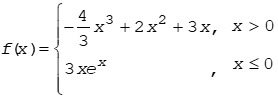
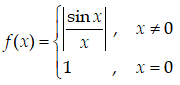 in the interval \( (-2\pi,2\pi) \) is equal to:
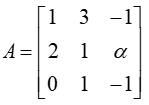 be a singular matrix. Let \( f(x)=\int_{0}^{x}(t^{2}+2t+3)\,dt, \; x\in [\,1,\alpha\,] \). If \( M \) and \( m \) are respectively the maximum and the minimum values of \( f \) in \( [\,1,\alpha\,] \), then \( 3(M-m) \) is equal to:

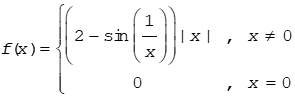 . Then \( f \) is :
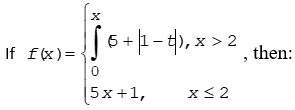

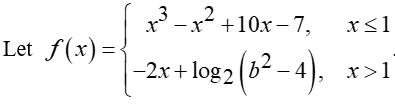 . Then the set of all values of \( b \), for which \( f(x) \) has maximum value at \( x=1 \), is:
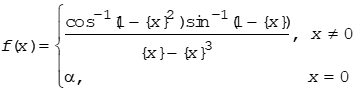 is continuous at \( x=0 \), where \( \{x\} = x - [ x ], \, [ x ] \) is the greatest integer less than or equal to \( x \). Then: