Let \( a \in \mathbb{R} \) be such that the function is continuous at \( x=0 \), where \( \{x\} = x - [ x ], \, [ x ] \) is the greatest integer less than or equal to \( x \). Then:
\( \alpha = \dfrac{\pi}{\sqrt{2}} \)
\( \alpha = \dfrac{\pi}{4} \)
no such \( \alpha \) exists
\( \alpha = 0 \)

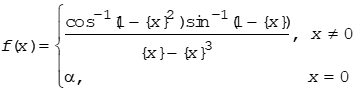 is continuous at \( x=0 \), where \( \{x\} = x - [ x ], \, [ x ] \) is the greatest integer less than or equal to \( x \). Then: