Let \( S=\{z \in \mathbb{C}: z^2+4z+16=0\} \). Then is equal to:
\( 42 \)
\( 23 \)
\( 27 \)
\( 38 \)
Let \( S=\{z\in \mathbb{C}: z^{2}+\overline{z}=0\} \). Then \( \sum\limits_{z\in S}(\mathrm{Re}(z)+\mathrm{Im}(z)) \) is equal to _______.
If \( a_{r}=\cos \frac{2r\pi }{9}+i \sin \frac{2r\pi }{9},\ r=1,2,3,\ldots,\ i=\sqrt{-1} \), then the determinant is equal to:
Let \( A = \left\{ z \in \mathbb{C} : \left| \frac{z + 1}{z - 1} \right| < 1 \right\} \) and \( B = \left\{ z \in \mathbb{C} : \arg \!\left( \frac{z - 1}{z + 1} \right) = \frac{2\pi}{3} \right\} \). Then \( A \cap B \) is:
Let \( \arg(z) \) represent the principal argument of the complex number \( z \). Then, \( |z| = 3 \) and \( \arg(z-1) - \arg(z+1) = \pi/4 \) intersect.
Two number \( k_1 \) and \( k_2 \) are randomly chosen from the set of natural numbers. Then, the probability that the value of \( i^{k_1} + i^{k_2} \) \( (i = \sqrt{-1}) \) is non-zero, equals:
For all \( z \in \mathbb{C} \) on the curve \( C_{1}: |z| = 4 \), let the locus of the point \( z + \frac{1}{z} \) be the curve \( C_{2} \). then:
Let \( z_1, z_2 \in \mathbb{C} \) be the distinct solutions of the equation \( z^2 + 4z - (1 + 12i) = 0 \). Then \( |z_1|^2 + |z_2|^2 \) is equal to:
Let \( S=\left\{ z\in\mathbb{C}-\{i,2i\}:\dfrac{z^{2}+8iz-15}{z^{2}-3iz-2}\in\mathbb{R}\right\}. \) If \( \alpha-\dfrac{13}{11}i\in S,\; \alpha\in\mathbb{R}-\{0\} \), then \( 242\alpha^{2} \) is equal to ______.
For \( n \in N \), let \( S_{n}=\{ z \in C : |z-3+2i|=\dfrac{n}{4} \} \) & \( T_{n}=\{ z \in C : |z-2+3i|=\dfrac{1}{n} \} \). Then the number of elements in the set \( \{ n \in N : S_{n} \cap T_{n}=\phi \} \) is :
Let \( S=\{\, z\in \mathbb{C}:\ |z-1|=1 \ \text{and}\ (\sqrt{2}-1)(z+\bar{z})-i(z-\bar{z})=2\sqrt{2}\, \} \). Let \( z_{1},z_{2}\in S \) be such that \( |z_{1}|=\max\limits_{z\in S}|z| \) and \( |z_{2}|=\min\limits_{z\in S}|z| \). Then \( |\sqrt{2}\,z_{1}-z_{2}|^{2} \) equals:
If the set \( R = \{(a,b): a + 5b = 42,\, a,b \in \mathbb{N}\} \) has \( m \) elements and \( \displaystyle \sum_{n=1}^{m} (1 - i^{n!}) = x + i y \), where \( i = \sqrt{-1} \), then the value of \( m + x + y \) is:
Consider the following two statements:Statement I : For any two non-zero complex numbers \( z_{1},z_{2} \) \( (|z_{1}|+|z_{2}|)\left|\frac{z_{1}}{|z_{1}|}+\frac{z_{2}}{|z_{2}|}\right|\le (|z_{1}|+|z_{2}|) \),andStatement II : If \( x,y,z \) are three distinct complex numbers and \( a,b,c \) are three positive real numbers such that \( \frac{a}{|y-z|}=\frac{b}{|z-x|}=\frac{c}{|x-y|} \), then \( \frac{a^{2}}{y-z}+\frac{b^{2}}{z-x}+\frac{c^{2}}{x-y}=1 \).Between the above two statements:
If \( x^2 + x + 1 = 0 \), then the value of \( \left(x + \frac{1}{x}\right)^4 + \left(x^2 + \frac{1}{x^2}\right)^4 + \left(x^3 + \frac{1}{x^3}\right)^4 + \cdots + \left(x^{25} + \frac{1}{x^{25}}\right)^4 \) is:
If \( z^{2}+z+1=0, \; z\in \mathbb{C} \), then \( \left| \displaystyle \sum_{n=1}^{15}\left(z^{n}+(-1)^{n}\frac{1}{z^{n}}\right)^{2}\right|^{} \) is equal to ______.
If the real part of the complex number \( (\,1-\cos\theta+2i\sin\theta\,)^{-1} \) is \( \dfrac{1}{5} \) for \( \theta \in (0,\pi) \), then the value of the integral \( \displaystyle\int\limits_{0}^{\theta}\sin x\,dx \) is equal to:
If \( z \) and \( \omega \) are two complex numbers such that \( |z\omega|=1 \) and \( \arg(z)-\arg(\omega)=\dfrac{3\pi}{2} \), then \( \arg\!\left(\dfrac{1-2\bar z\omega}{1+3\bar z\omega}\right) \) is:(Here \( \arg(z) \) denotes the principal argument of complex number \( z \))
If \( \alpha+i\beta \) and \( \gamma+i\delta \) are the roots of \( x^{2}-(3-2i)x-(2i-2)=0 \), \( i=\sqrt{-1} \), then \( \alpha\gamma+\beta\delta \) is equal to:
The sum of all possible values of \( \theta \in [-\pi, 2\pi] \), for which \(\displaystyle \frac{1 + i\cos\theta}{1 - 2i\cos\theta} \) is purely imaginary, is equal to:
The complex number \( z=\frac{i-1}{\cos \frac{\pi}{3}+i\sin \frac{\pi}{3}} \) is equal to:
Let \( z \) be the complex number satisfying \( |z-5| \le 3 \) and having maximum positive principal argument. Then \( 34 \left|\frac{5z-12}{5iz+16}\right|^{2} \) is equal to:
For two non-zero complex numbers \( z_1 \) and \( z_2 \), if \( \operatorname{Re}(z_1 z_2)=0 \) and \( \operatorname{Re}(z_1+z_2)=0 \), then which of the following are possible?A. \( \operatorname{Im}(z_1) > 0 \) and \( \operatorname{Im}(z_2) > 0 \)B. \( \operatorname{Im}(z_1) < 0 \) and \( \operatorname{Im}(z_2) > 0 \)C. \( \operatorname{Im}(z_1) > 0 \) and \( \operatorname{Im}(z_2) < 0 \)D. \( \operatorname{Im}(z_1) < 0 \) and \( \operatorname{Im}(z_2) < 0 \)Choose the correct answer from the options given below:
If \( z=\frac{\sqrt{3}}{2}+\frac{i}{2},\ i=\sqrt{-1} \), then \( (z^{201}-i)^{8} \) is equal to:
Let \( S=\left\{x \in [-6,3]-\{-2,2\}:\; \dfrac{|x+3|-1}{|x|-2}\ge 0\right\} \) and \( T=\left\{x\in \mathbb{Z}: x^2-7|x|+9\le 0\right\}. \) Then the number of elements in \( S\cap T \) is:
Let integers \( a,b\in[-3,3] \) be such that \( a+b\ne 0 \). Then the number of all possible ordered pairs \( (a,b) \), for which \( \left|\dfrac{z-a}{\,z+b\,}\right|=1 \) and , where \( \omega \) and \( \omega^2 \) are the roots of \( x^2+x+1=0 \), is equal to ________.
Let \( A = \left\{ \ \theta \in (0, 2\pi) : \dfrac{1 + 2i \sin \theta}{1 - i \sin \theta} \ \text{is purely imaginary} \ \right\}. \) Then the sum of the elements in \( A \) is:
The equation \( \arg \left( \frac{z-1}{z+1} \right) = \frac{\pi}{4} \) represents a circle with:
Let $\alpha = 8 - 14i$, $A = \left\{ z \in \mathbb{C} : \frac{\alpha z - \bar{\alpha}\bar{z}}{z^2 - (\bar{z})^2 - 112i} = 1 \right\}$ and $B = \{z \in \mathbb{C} : |z + 3i| = 4\}$. Then $\sum_{z \in A \cap B} (\text{Re } z - \text{Im } z)$ is equal to ________.
Let a circle \( C \) in complex plane pass through the point \( z_1 = 3 + 4i \), \( z_2 = 4 + 3i \) and \( z_3 = 5i \). If \( z (\neq z_1) \) is a point on \( C \) such that the line through \( z \) and \( z_1 \) is perpendicular to the line through \( z_2 \) and \( z_3 \), then \( \arg(z) \) is equal to:
If \( z=2+3i \), then \( z^{5}+(\overline{z})^{5} \) is equal to:
Let \( \mathbb{C} \) be the set of all complex numbers. Let \( S_1 = \{ z \in \mathbb{C} \mid |z - 3 - 2i|^2 = 8 \} \), \( S_2 = \{ z \in \mathbb{C} \mid \operatorname{Re}(z) \ge 5 \} \) and \( S_3 = \{ z \in \mathbb{C} \mid |z - \overline{z}| \ge 8 \} \). Then the number of elements in \( S_1 \cap S_2 \cap S_3 \) is equal to:
Let \( \alpha \) and \( \beta \) be the sum and the product of all the non-zero solutions of the equation \( (\bar{z})^{2}+|z|=0,\ z\in \mathbb{C} \). Then \( 4(\alpha^{2}+\beta^{2}) \) is equal to:
Let \( n \) denote the number of solutions of the equation \( z^2+3\bar{z}=0 \), where \( z \) is a complex number. Then the value of \( \displaystyle \sum_{k=0}^{\infty}\frac{1}{n^k} \) is equal to:
If for the complex numbers \( z \) satisfying \( |z - 2 - 2i| \le 1 \), the maximum value of \( |3iz + 6| \) is attained at \( a + ib \), then \( a + b \) is equal to:
Let \( S_{1}=\{z\in \mathbb{C}:|z|\le 5\} \), \( S_{2}=\left\{z\in \mathbb{C}:\operatorname{Im}\!\left(\dfrac{z+1-\sqrt{3}\,i}{1-\sqrt{3}\,i}\right)\ge 0\right\} \) and \( S_{3}=\{z\in \mathbb{C}:\operatorname{Re}(z)\ge 0\} \). Then the area of the region \( S_{1}\cap S_{2}\cap S_{3} \) is:
Let \( S_{1}, S_{2} \) and \( S_{3} \) be three sets defined as : \( S_{1} = \{ z \in \mathbb{C} : |z - 1| \le \sqrt{2} \} \) \( S_{2} = \{ z \in \mathbb{C} : \mathrm{Re}((1-i)z) \ge 1 \} \) \( S_{3} = \{ z \in \mathbb{C} : \mathrm{Im}(z) \le 1 \} \) Then the set \( S_{1} \cap S_{2} \cap S_{3} \) :
If $\alpha$ denotes the number of solutions of $|1-i|^x = 2^x$ and $\beta = \left( \frac{|z|}{\arg(z)} \right)$, where $z = \frac{\pi}{4}(1+i)^4 \left[ \frac{1-\sqrt{\pi}i}{\sqrt{\pi}+i} + \frac{\sqrt{\pi}-i}{1+\sqrt{\pi}i} \right]$, $i = \sqrt{-1}$, then the distance of the point $(\alpha, \beta)$ from the line $4x - 3y = 7$ is _________
Let for some real numbers \( \alpha \) and \( \beta \) \( a = \alpha - i\beta \). If the system of equations \( 4i x + (1+i)y = 0 \) and \( 8\left( \cos \frac{2\pi}{3} + i \sin \frac{2\pi}{3} \right)x + \bar{a}y = 0 \) has more than one solution, then \( \frac{\alpha}{\beta} \) is equal to
Let $z$ be a complex number such that $|z+2|=1$ and $\operatorname{Im}\left(\frac{z+1}{z+2}\right)=\frac{1}{5}$. Then the value of $\left|\operatorname{Re}(\overline{z+2})\right|$ is:
For \( a \in \mathbb{C} \), let \( A=\{ z \in \mathbb{C} : \operatorname{Re}(a+\bar z)>\operatorname{Im}(\bar{a}+z) \} \) and \( B=\{ z \in \mathbb{C} : \operatorname{Re}(a+\bar z)<\operatorname{Im}(\bar{a}+z) \} \). Then among the two statements:(\( \mathrm{S1} \)) : If \( \operatorname{Re}(a), \operatorname{Im}(a) > 0 \), then the set \( A \) contains all the real numbers(\( \mathrm{S2} \)) : If \( \operatorname{Re}(a), \operatorname{Im}(a) < 0 \), then the set \( B \) contains all the real numbers
Let \( z_1, z_2 \) and \( z_3 \) be three complex numbers on the circle \( |z| = 1 \) with \( \arg(z_1) = -\pi/4 \), \( \arg(z_2) = 0 \) and \( \arg(z_3) = \pi/4 \). If \( \left| z_1\overline{z_2} + z_2\overline{z_3} + z_3\overline{z_1} \right|^{2} = \alpha + \beta \sqrt{2}, \alpha, \beta \in \mathbb{Z} \), then the value of \( \alpha^{2} + \beta^{2} \) is:
The value of \( \left( \frac{1 + \sin\frac{2\pi}{9} + i\cos\frac{2\pi}{9}}{1 + \sin\frac{2\pi}{9} - i\cos\frac{2\pi}{9}} \right)^3 \) is:
Let \(S=\left\{z\in\mathbb{C}:\ \overline z=i\big(z^2+\operatorname{Re}(\overline z)\big)\right\}\). Then \(\displaystyle\sum_{z\in S}\lvert z\rvert^2\) is equal to :
If \( S = \left\{ z \in \mathbb{C} : \dfrac{z - i}{z + 2i} \in \mathbb{R} \right\} \), then:
Let \( C \) be the set of all complex numbers. Let \( S_1=\{z\in \mathbb{C}: |z-2|\leq 1\} \) and \( S_2=\{z\in \mathbb{C}: z(1+i)+\bar{z}(1-i)\geq 4\} \) Then, the maximum value of \( \left|z-\dfrac{5}{2}\right|^2 \) for \( z\in S_1\cap S_2 \) is equal to :
Let \( z = (1+i)(1+2i)(1+3i)\ldots(1+ni) \), where \( i=\sqrt{-1} \). If \( |z|^{2}=44200 \), then \( n \) is equal to ________ .
Let \( \alpha, \beta \) be the roots of the equation \( x^2 - x + 2 = 0 \) with \( \operatorname{Im}(\alpha) > \operatorname{Im}(\beta) \). Then \( \alpha^6 + \alpha^4 + \beta^4 - 5\alpha^2 \) is equal to __________.
Let \( p, q \in \) ℝ and \( (1-\sqrt{3}i)^{200} = 2^{199}(p+iq), \; i=\sqrt{-1} \). Then \( p+q+q^{2} \) and \( p-q+q^{2} \) are roots of the equation.
Let the product of \( \omega_1 = (8 + i) \sin \theta + (7 + 4i)\cos \theta \) and \( \omega_2 = (i + 8i)\sin \theta + (4 + 7i)\cos \theta \) be \( \alpha + i\beta \), \( i = \sqrt{-1} \). Let \( p \) and \( q \) be the maximum and the minimum values of \( \alpha + \beta \) respectively. Then \( p + q \) is equal to
Let \( \alpha , \beta \) be the roots of the equations \( x^{2} - \sqrt{6}\,x + 3 = 0 \) such that \( \operatorname{Im}(\alpha) > \operatorname{Im}(\beta) \). Let \( \alpha, \beta \) be integers not divisible by \( 3 \) and \( n \) be a natural number such that \( \dfrac{\alpha^{99}}{\beta} + \alpha^{98} = 3^{n}(a + ib),\; i = \sqrt{-1} \). Then \( n + a + b \) is equal to ______.
Let \( z \) be a complex number such that \( \lvert z-6 \rvert = 5 \) and \( \lvert z + 2 - 6i \rvert = 5 \). Then the value of \( z^{3} + 3z^{2} - 15z + 141 \) is equal to:
Let \( P=\{z\in\mathbb{C}:\;|z+2-3i|\leq 1\} \) and \( Q=\{z\in\mathbb{C}:\; z(1+i)+\bar{z}(1-i)\leq -8\}. \) Let in \( P\cap Q,\, |z-3+2i| \) be maximum and minimum at \( z_1 \) and \( z_2 \) respectively. If \( |z_1|^{2}+2| z_2|^{2}=\alpha+\beta\sqrt{2} \), where \( \alpha,\beta \) integers, then \( \alpha+\beta \) equals ______.
Let the minimum value \( v_0 \) of \( v = |z|^{2} + |z-3|^{2} + |z-6i|^{2}, \, z \in \mathbb{C} \) is attained at \( z=z_0 \). Then \( \left|2z_0{^2}-\overline{z_0{^3}}+3\right|^{2}+v_0{^2} \) is equal to:
If the center and radius of the circle \( \left|\dfrac{z-2}{z-3}\right|=2 \) are respectively \( (\alpha,\beta) \) and \( \gamma \), then \( 3(\alpha+\beta+\gamma) \) is equal to:
Let \( S \) be the set of all \( (\alpha,\beta),\, \pi<\alpha,\beta<2\pi \), for which the complex number \( \dfrac{1-i\sin\alpha}{1+2i\sin\alpha} \) is purely imaginary and \( \dfrac{1+i\cos\beta}{1-2i\cos\beta} \) is purely real. Let \( Z_{\alpha\beta}=\sin 2\alpha + i\cos 2\beta,\, (\alpha,\beta)\in S \). Then \(\displaystyle \sum_{(\alpha,\beta)\in S}\left(iZ_{\alpha\beta}+\frac{1}{i{\bar Z_{\alpha\beta}}}\right) \) is equal to:
The least value of \( |z| \) where \( z \) is complex number which satisfies the inequality \( \displaystyle \exp\left(\frac{(|z| + 3)(|z| - 1)}{||z| + 1|}\log_e 2\right) \ge \log_{\sqrt{2}}|5\sqrt{7} + 9i|, \, i = \sqrt{-1} \), is equal to:
If \( z \) is a complex number such that \( |z| \ge 1 \), then the minimum value of \(\displaystyle \left| z + \frac{1}{2}(3 + 4i) \right| \) is:
If \( (\sqrt{3} + i)^{100} = 2^{99}(p + iq) \), then \( p \) and \( q \) are roots of the equation:
Let \( z \) be a complex number such that the real part of \( \dfrac{z-2i}{z+2i} \) is zero. Then, the maximum value of \( \lvert z - (6 + 8i) \rvert \) is equal to
Let the complex numbers \( \alpha \) and \( \dfrac{1}{\alpha} \) lie on the circles \( |z-z_{0}|^{2}=4 \) and \( |z-z_{0}|^{2}=16 \) respectively, where \( z_{0}=1+i \). Then, the value of \( 100\,|\alpha|^{2} \) is __________ .
If \( z \) is a complex number such that \( \dfrac{z-i}{z-1} \) is purely imaginary, then the minimum value of \( \left| z-(3+3i) \right| \) is:
Let \( \alpha \) and \( \beta \) be the roots of the equation \( x^2 + (2i - 1) = 0 \) Then, the value of \( \lvert \alpha^8 + \beta^8 \rvert \) is equal to:
Let \( S=\{z\in \mathbb{C}: |z-3|\le 1 \text{ and } \bar{z}(4+3i)+z(4-3i)\le 24\} \). If \( \alpha+i\beta \) is the point in \( S \) which is closest to \( 4i \), then \( 25(\alpha+\beta) \) is equal to _______.
Let \( z_1, z_2 \) be the roots of the equation \( z^2 + a z + 12 = 0 \) and \( z_1, z_2 \) form an equilateral triangle with origin. Then, the value of \( |a| \) is ____________.
If \( z \) is a complex number, then the number of common roots of the equations \( z^{1985} + z^{100} + 1 = 0 \) and \( z^{3} + 2z^{2} + 2z + 1 = 0 \), is equal to:
If \( \alpha,\beta,\gamma,\delta \) are the roots of the equation \( x^{4}+x^{3}+x^{2}+x+1=0 \), then \( \alpha^{2021}+\beta^{2021}+\gamma^{2021}+\delta^{2021} \) is equal to :
Let \( |z_1 - 8 - 2i| \le 1 \) and \( |z_2 - 2 + 6i| \le 2 \), \( z_1, z_2 \in \mathbb{C} \). Then the minimum value of \( |z_1 - z_2| \) is:
Let \( \alpha, \beta \) be the roots of the equation \( x^2 - ax - b = 0 \) with \( \operatorname{Im}(\alpha) < \operatorname{Im}(\beta) \). Let \( P_n = \alpha^n - \beta^n \). If \( P_3 = -5\sqrt{7}\,i \), \( P_4 = -3\sqrt{7}\,i \), \( P_5 = 11\sqrt{7}\,i \) and \( P_6 = 45\sqrt{7}\,i \), then \( |\alpha^4 + \beta^4| \) is equal to __________.
If \( S = \{ z \in \mathbb{C} : |z-i| = |z+i| = |z-1| \} \), then, \( n(S) \) is:
Let \( S = \{ z = x + iy : |z - 1 + i| \ge |z|, \; |z| < 2, \; |z + i| = |z - 1| \}\). Then the set of all values of \( x \), for which \( w = 2x + iy \in S \) for some \( y \in \mathbb{R} \), is
Let \( O \) be the origin, the point \( A \) be \( z_1 = \sqrt{3} + 2\sqrt{2}\,i \), the point \( B(z_2) \) be such that \( \sqrt{3}\,|z_2| = |z_1| \) and \( \arg(z_2) = \arg(z_1) + \frac{\pi}{6} \). Then:
Let \( z_1 \) and \( z_2 \) be two complex numbers such that \( \arg(z_1-z_2)=\dfrac{\pi}{4} \) and \( z_1,\,z_2 \) satisfy the equation \( |z-3|=\operatorname{Re}(z) \). Then the imaginary part of \( z_1+z_2 \) is equal to ______.
Let \( O \) be the origin and \( A \) be the point \( z_1 = 1 + 2i \). If \( B \) is the point \( z_2 \), \( \operatorname{Re}(z_2) < 0 \), such that \( OAB \) is a right angled isosceles triangle with \( OB \) as hypotenuse, then which of the following is NOT true?
If for \( z=\alpha+i\beta \), \( |z+2|=z+4(1+i) \), then \( \alpha+\beta \) and \( \alpha\beta \) are the roots of the equation.
Let \( z = 1 + i \) and \( z_{1} = \dfrac{1 + i\overline{z}}{\overline{z}(1 - z) + \dfrac{1}{\overline{z}}} \). Then \( \dfrac{12}{\pi} \arg(z_{1}) \) is equal to _______.
Let \( \alpha \) be a root of the equation \( 1 + x^2 + x^4 = 0 \). Then the value of \( \alpha^{1011} + \alpha^{2022} - \alpha^{3033} \) is equal to:
Let \( z=\frac{1-i\sqrt{3}}{2} \), \( i=\sqrt{-1} \). Then the value of \( 21+\left(z+\frac{1}{z}\right)^{3}+\left(z^{2}+\frac{1}{z^{2}}\right)^{3}+\left(z^{3}+\frac{1}{z^{3}}\right)^{3}+\ldots+\left(z^{21}+\frac{1}{z^{21}}\right)^{3} \) is ________.
Let \( A = \left\{ \theta \in [0, 2\pi] : 1 + 10\,Re\left( \frac{2\cos\theta + i\sin\theta}{\cos\theta - 3i\sin\theta} \right) = 0 \right\}. \) Then \( \displaystyle \sum_{\theta \in A} \theta^{2} \) is equal to:
Let $S = \left\{ z \in C : \left\{ \left| \frac{z - 6i}{z - 2i} \right| = 1 \text{ and } \left| \frac{z - 8 + 2i}{z + 2i} \right| = \frac{3}{5} \right\} \right\}$. Then $\sum_{z \in S} |z|^2$ is equal to:
Among the statements(\( \mathrm{S1} \)) : The set \( \left\{ z \in \mathbb{C} - \{-i\} : |z| = 1 \text{ and } \frac{z-i}{z+i} \text{ is purely real} \right\} \) contains exactly two elements, and(\( \mathrm{S2} \)) : The set \( \left\{ z \in \mathbb{C} - \{-1\} : |z| = 1 \text{ and } \frac{z-1}{z+1} \text{ is purely imaginary} \right\} \) contains infinitely many elements.
Let a complex number be \( w = 1 - \sqrt{3} i \). Let another complex \( z \) be such that \( |zw| = 1 \) and \( \arg(z) - \arg w = \dfrac{\pi}{2} \). Then the area of the triangle with vertices origin, \( z \) and \( w \) is equal to:
If \( z=x+iy \) satisfies \( |z|-2=0 \) and \( |z-i|-|z+5i|=0 \), then
If \( \alpha \) and \( \beta \) are the roots of the equation \( 2z^2 - 3z - 2i = 0 \), where \( i = \sqrt{-1} \), then \( 16\,. \mathrm{Re}\!\left( \frac{\alpha^{19}+\beta^{19} + \alpha^{11} + \beta^{11}}{\alpha^{15} + \beta^{15}} \right) \cdot \mathrm{Im}\!\left( \frac{\alpha^{19}+\beta^{19} + \alpha^{11} + \beta^{11}}{\alpha^{15} + \beta^{15}} \right) \) is equal to:
Let \( S=\{z\in\mathbb{C}:\,4z^{2}+\overline{z}=0\} \). Then \( \displaystyle \sum_{z\in S}|z|^{2} \) is equal to:
If the set \( \left\{\operatorname{Re}\!\left(\dfrac{z-\bar{z}+z\bar{z}}{2-3z+5\bar{z}}\right): z\in \mathbb{C}, \operatorname{Re}(z)=3 \right\} \) is equal to the interval \( (\alpha,\beta] \), then \( 24(\beta-\alpha) \) is equal to:
Let \( S=\{z\in \mathbb{C}:z^2+\sqrt{6}iz-3=0\} \). Then \( \sum\limits_{z\in S} z^8 \) is equal to:
Let \( z \) be a complex number such that \( |z+2| = |z-2| \) and \( \arg\!\left(\frac{z+3}{z-i}\right) = \frac{\pi}{4} \). Then \( |z|^{2} \) is equal to:
The number of complex numbers \( z \), satisfying \( |z| = 1 \) and \(\displaystyle \left| \frac{z}{\overline{z}} + \frac{\overline{z}}{z} \right| = 1 \), is:
Let \( r \) and \( \theta \) respectively be the modulus and amplitude of the complex number \( z = 2 - i\!\left( 2 \tan \dfrac{5\pi}{8} \right) \), then \( (r,\theta) \) is equal to:
If \( z_1 \) and \( z_2 \) are two distinct complex number such that \( \left|\dfrac{z_1-2z_2}{\dfrac{1}{2}-{z_1}\bar z_2}\right|=2 \), then
Let \( w_{1} \) be the point obtained by the rotation of \( z_{1} = 5 + 4i \) about the origin through a right angle in the anticlockwise direction, and \( w_{2} \) be the point obtained by the rotation of \( z_{2} = 3 + 5i \) about the origin through a right angle in the clockwise direction. Then the principal argument of \( w_{1} - w_{2} \) is equal to:
Let \( \alpha = \frac{-1 + i\sqrt{3}}{2} \) and \( \beta = \frac{-1 - i\sqrt{3}}{2} \), \( i = \sqrt{-1} \). If \( (7 - 7\alpha + 9\beta)^{20} + (9 + 7\alpha - 7\beta)^{20} + (-7 + 9\alpha + 7\beta)^{20} + (14 + 7\alpha + 7\beta)^{20} = m^{10} \), then \( m \) is ______________.
If \( z_1, z_2, z_3 \in \mathbb{C} \) are the vertices of an equilateral triangle, whose centroid is \( z_0 \) then \( \displaystyle\sum_{k=1}^{3}\left(z_k - z_0\right)^2 \) is equal to:
If the real part of the complex number \( z = \dfrac{3 + 2 i \cos \theta}{1 - 3 i \cos \theta}, \ \theta \in \left(0, \dfrac{\pi}{2}\right) \) is zero, then the value of \( \sin^{2} 3\theta + \cos^{2} \theta \) is equal to ______.
Let \( z_{1} \) and \( z_{2} \) be two complex numbers such that \( \bar{z}_{1} = i \bar{z}_{2} \) and \( \arg\!\left(\frac{z_{1}}{z_{2}}\right) = \pi \). Then
The number of points of intersection of \( \lvert z - (4 + 3i) \rvert = 2 \) and \( \lvert z \rvert + \lvert z - 4 \rvert = 6 \), \( z \in \mathbb{C} \), is
The number of values of \( z \in \mathbb{C} \), satisfying the equations \( \lvert z - (4 + 8i) \rvert = \sqrt{10} \) and \( \lvert z - (3 + 5i) \rvert + \lvert z - (5 + 11i) \rvert = 4\sqrt{5} \), is:
Let the set of all values of \( k \in \mathbb{R} \) such that the equation \( {z}(\overline{z}+2+i)+k(2+3i)=0, \; z \in \mathbb{C} \), has at least one solution, be the interval \( [\alpha,\beta] \). Then \( 9(\alpha+\beta) \) is equal to:
Let \( z_{1} = 2 + 3i \) and \( z_{2} = 3 + 4i \). The set \( S = \left\{ z \in \mathbb{C} : |z - z_{1}|^{2} - |z - z_{2}|^{2} = |z_{1} - z_{2}|^{2} \right\} \) represents a:
Let \( z \) be a complex number such that \( \left|\frac{z-2i}{z+i}\right| = 2, \, z \neq -i \). Then \( z \) lies on the circle of radius \( 2 \) and centre.
Let $S = \{z : 3 \le |2z - 3(1 + i)| \le 7\}$ be a set of complex numbers. Then $\min_{z \in S} \left| (z + \frac{1}{2}(5 + 3i)) \right|$ is equal to:
Let \( S_1 = \{\, z_1 \in \mathbb{C} : |z_1 - 3| = \dfrac{1}{2} \,\} \) and \( S_2 = \{\, z_2 \in \mathbb{C} : |z_2 - |z_2 + 1|| = |z_2 + |z_2 - 1|| \,\} \). Then, for \( z_1 \in S_1 \) and \( z_2 \in S_2 \), the least value of \( |z_2 - z_1| \) is:
If the equation $a|z|^2 + \overline{\bar{\alpha}z + \alpha\bar{z}} + d = 0$ represents a circle where $a, d$ are real constants then which of the following condition is correct?
Let the circles \( C_1: |z| = r \) and \( C_2: |z - 3 - 4i| = 5, \ z \in \mathbb{C}, \) be such that \( C_2 \) lies within \( C_1 \). If \( z_1 \) moves on \( C_1, z_2 \) moves on \( C_2 \) and \( \min |z_1 - z_2| = 2 \), then \( \max |z_1 - z_2| \) is equal to:
Let \( z=a+ib ,\; b\neq 0 \) be complex numbers satisfying \( z^{2}=\overline{z}\cdot 2^{\,1-|z|} \). Then the least value of \( n\in\mathbb{N} \), such that \( z^{n}=(z+1)^{n} \), is equal to _______________.
Let $\left| \frac{\bar{z} - i}{2\bar{z} + i} \right| = \frac{1}{3}, z \in C$, be the equation of a circle with center at $C$. If the area of the triangle, whose vertices are at the points $(0, 0)$, $C$ and $(\alpha, 0)$ is $11$ square units, then $\alpha^2$ equals:
Let \( w= z\bar{z}+k_{1}z+k_{2}i{z}+\lambda(1+i),\ k_{1},k_{2}\in \mathbb{R} \). Let \( \operatorname{Re}(w)=0 \) be the circle \( C \) of radius \( 1 \) in the first quadrant touching the line \( y=1 \) and the y-axis. If the curve \( \operatorname{Im}(w)=0 \) intersects \( C \) at \( A \) and \( B \), then \( 30(AB)^{2} \) is equal to _____.
Let \( a, b \) be two real numbers such that \( ab < 0 \). If the complex number \( \frac{1 + ai}{\, b + i \,} \) is of unit modulus and \( a + ib \) lies on the circle \( |z - 1| = |2z| \), then a possible value of \( \frac{1 + [a]}{4b} \), where \( [t] \) is greatest integer function, is:
Let \( z \) be a complex number such that \( |z| = 1 \). If \( \dfrac{2 + k^2 {z}}{k + \bar{z}} = kz, \; k \in \mathbb{R} \), then the maximum distance of \( k + i k^2 \) from the circle \( |z - (1 + 2i)| = 1 \) is:
Let \( i = \sqrt{-1} \). If \( \displaystyle \frac{(-1 + i\sqrt{3})^{21}}{(1 - i)^{24}} + \frac{(1 + i\sqrt{3})^{21}}{(1 + i)^{24}} = k\), and \( n = [\,|k|\,] \) be the greatest integral part of \( |k| \). Then \( \displaystyle \sum_{j=0}^{n+5} (j+5)^2 - \sum_{j=0}^{n+5} (j+5) \) is equal to ________.
If the locus of \( z\in \mathbb{C} \), such that \( Re\!\left(\dfrac{z-1}{2z+i}\right)+Re\!\left(\dfrac{\overline{z}-1}{2\overline z-i}\right)=2 \), is a circle of radius \( r \) and centre \( (a,b) \), then \( \dfrac{15ab}{r^2} \) is equal to:
The area of the triangle with vertices \( A(z) \), \( B(iz) \) and \( C(z + iz) \) is:
Let \( A = \{ z \in C : 1 \le |z - (1 + i)| \le 2 \} \) and \( B = \{ z \in A : |z - (1 - i)| = 1 \} \). Then, \( B \) :
For \( z \in C \) if the minimum value of \( \left(|z-3\sqrt{2}|+|z-p\sqrt{2}i|\right) \) is \( 5\sqrt{2} \), then a value of \( p \) is _________
Let the complex number \( z=x+iy \) be such that \( \dfrac{2z-3i}{2z+i} \) is purely imaginary. If \( x+y^{2}=0 \), then \( y^{4}+y^{2}-y \) is equal to:
The number of elements in the set \( \{ z = a + ib \in \mathbb{C} : a, b \in \mathbb{Z} \text{ and } 1 < | z - 3 + 2i | < 4 \} \) is ________.
The sum of the square of the modulus of the elements in the set \( \left\{ z=a+ib:\; a,b\in\mathbb{Z},\; z\in \mathbb{C}\; ,\; |z-1|\le 1,\; |z-5|\le |z-5i| \right\} \) is _________.
The area (in sq. units) of the region \( S=\left\{ z\in\mathbb{C}:\ |z-1|\le 2;\ (z+\bar{z})+i(z-\bar{z})\le 2,\ \mathrm{Im}(z)\ge 0 \right\} \) is:
The least positive integer \( n \) such that \( \dfrac{(2i)^{n}}{(1-i)^{\,n-2}} \), \( i=\sqrt{-1} \), is a positive integer, is __________.
Let the curve \( z(1+i)+\bar{z}(1-i)=4 , \; z \in \mathbb{C} \), divide the region \( |z-3|\le 1 \) into two parts of areas \( \alpha \) and \( \beta \). Then \( |\alpha-\beta| \) equals:
Let \( S = \left\{ z = x + iy : \dfrac{2z - 3i}{4z + 2i} \text{ is a real numbers} \right\} \). Then which of the following is NOT correct?
Let \( z_1 \) and \( z_2 \) be two complex numbers such that \( z_1+z_2=5 \) and \( z_1^3+z_2^3=20+15i \). Then, \( \left|z_1^4+z_2^4\right| \) equals:
For \( \alpha, \beta, z \in \mathbb{C} \) and \( \lambda>1 \), if \( \sqrt{\lambda-1} \) is the radius of the circle \( |z-\alpha|^{2}+|z-\beta|^{2}=2\lambda \), then \( |\alpha-\beta| \) is equal to ________ .
If \( z = x + iy, \ xy \neq 0 \), satisfies the equation \( z^{2} + i\overline{z} = 0 \), then \( |z|^{2} \) is equal to:
Let \( S = \{ z \in \mathbb{C} : |z - 2| \le 1, \, z(1 + i) + \overline{z}(1 - i) \le 2 \} \). Let \( |z - 4i| \) attains minimum and maximum values, respectively, at \( z_1 \in S \) and \( z_2 \in S \). If \( 5\left(|z_1|^2 + |z_2|^2\right) = \alpha + \beta \sqrt{5} \). Where \( \alpha \) and \( \beta \) are integers, then the value of \( \alpha + \beta \) is equal to ________.
The number of real roots of the equation \( x|x| - 5|x + 2| + 6 = 0 \), is:
Let \( z \in \mathbb{C} \) be such that \( \frac{z^2 + 3i}{z - 2 + i} = 2 + 3i \). Then the sum of all possible values of \( z^2 \) is:
 is equal to:

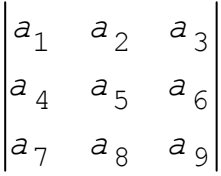 is equal to:
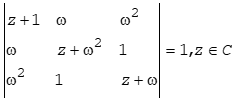 , where \( \omega \) and \( \omega^2 \) are the roots of \( x^2+x+1=0 \), is equal to ________.