34 questions from 2024
Let \( 3,\,7,\,11,\,15,\,\ldots,\,403 \) and \( 2,\,5,\,8,\,11,\,\ldots,\,404 \) be two arithmetic progressions. Then the sum, of the common terms in them, is equal to ______.
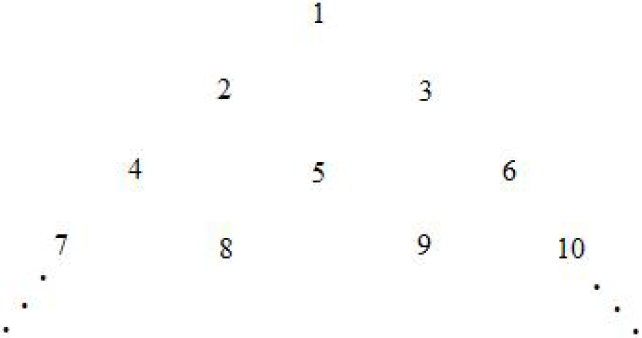
Let the positive integers be written in the form: If the \( k^{\text{th}} \) row contains exactly \( k \) numbers for every natural number \( k \), then the row in which the number \( 5310 \) will be, is _______.
Let \( S_n \) denote the sum of the first \( n \) terms of an arithmetic progression. If \( S_{10} = 390 \) and the ratio of the tenth and the fifth terms is \( 15 : 7 \), then \( S_{15} - S_{5} \) is equal to:
Let \( S_{n} \) be the sum to \( n \)-terms of an arithmetic progression \( 3, \, 7, \, 11, \, \ldots \). If \( 40 < \left( \dfrac{6}{n(n+1)} \displaystyle\sum_{k=1}^{n} S_{k} \right) < 42 \), then \( n \) equals ______.
The value of \( \dfrac{1\times 2^2 + 2\times 3^2 + \dots + 100\times (101)^2}{1^2\times 2 + 2^2\times 3 + \dots + 100^2\times 101} \) is:
Let the first three terms \( 2 \), \( p \) and \( q \), with \( q \neq 2 \), of a G.P. be respectively the \( 7^{\text{th}} \), \( 8^{\text{th}} \) and \( 13^{\text{th}} \) terms of an A.P. If the \( 5^{\text{th}} \) term of the G.P. is the \( n^{\text{th}} \) term of the A.P., then \( n \) is equal to:
If each term of a geometric progression \( a_{1},a_{2},a_{3},\ldots \) with \( a_{1}=\dfrac{1}{8} \) and \( a_{2}\neq a_{1} \), is the arithmetic mean of the next two terms and \( S_{n}=a_{1}+a_{2}+\cdots +a_{n} \), then \( S_{20}-S_{18} \) is equal to:
If \( 2\tan^2\theta-5\sec\theta-1 \) has exactly \( 7 \) solutions in the interval \(\displaystyle \left[0,\frac{n\pi}{2}\right] \) for the least value of \( n\in \mathbb{N} \), then \(\displaystyle \sum_{k=1}^{n} \frac{k}{2^{k}} \) is equal to:
The sum of the series \( \frac{1}{1-3\cdot 1^{2}+1^{4}} + \frac{2}{1-3\cdot 2^{2}+2^{4}} + \frac{3}{1-3\cdot 3^{2}+3^{4}} + \ldots \) up to \( 10 \) terms is:
For \( x \ge 0 \) the least value of \( K \), for which \( 4^{1+x}+4^{1-x},\; \dfrac{K}{2},\; 16^{x}+16^{-x} \) are three consecutive terms of an A.P., is equal to:
Let \( S_n \) denote the sum of first \( n \) terms of an arithmetic progression. If \( S_{20} = 790 \) and \( S_{10} = 145 \), then \( S_{15} - S_{5} \) is:
If \( 1 + \frac{\sqrt{3}-\sqrt{2}}{\sqrt{3}} + \frac{5-2\sqrt{6}}{18} + \frac{9\sqrt{3}-11\sqrt{2}}{36\sqrt{3}} + \frac{49-20\sqrt{6}}{180} + \ldots \) upto \( \infty = 2 + \left( \sqrt{\frac{b}{a}} + 1 \right) \log_{e}\!\left( \frac{a}{b} \right) \), where \( a \) and \( b \) are integers with \( \gcd(a,b)=1 \), then \( 11a + 18b \) is equal to \( \_\_\_\_\_\_\_\_ \).
If \( \log_{e}a, \log_{e}b, \log_{e}c \) are in an A.P. and \( \log_{e}a-\log_{e}2b, \log_{e}2b-\log_{e}3c, \log_{e}3c-\log_{e}a \) are also in an A.P., then \( a:b:c \) is equal to:
If three successive terms of G.P. with common ratio \( r\,(r>1) \) are the lengths of the sides of a triangle and \( [r] \) denotes the greatest integer less than or equal to \( r \), then \( 3[r]+[-r] \) is equal to __________.
If \( \frac{1}{\sqrt{1}+\sqrt{2}}+\frac{1}{\sqrt{2}+\sqrt{3}}+\ldots+\frac{1}{\sqrt{99}+\sqrt{100}} = m \) and \( \frac{1}{1\cdot 2}+\frac{1}{2\cdot 3}+\ldots+\frac{1}{99\cdot 100} = n \) then the point \( (m,n) \) lies on the line:
Let $A = \{n \in [100, 700] \cap \mathbb{N} : n \text{ is neither a multiple of } 3 \text{ nor a multiple of } 4\}$. Then the number of elements in $A$ is:
If the sum of the series \( \frac{1}{1 \cdot (1 + d)} + \frac{1}{(1 + d)(1 + 2d)} + \ldots + \frac{1}{(1 + 9d)(1 + 10d)} \) is equal to \( 5 \), then \( 50d \) is equal to:
An arithmetic progression is written in the following way The sum of all the terms of the \( 10^{\text{th}} \) row is __________.
Let \( a \) and \( b \) be two distinct positive real numbers. Let \( 11^{\text{th}} \) term of a GP, whose first term is \( a \) and third term is \( b \), is equal to \( p^{\text{th}} \) term of another GP, whose first term is \( a \) and fifth term is \( b \). Then \( p \) is equal to:
Let \( 3, a, b, c \) be in A.P. and \( 3, a - 1, b + 1, c + 9 \) be in G.P. Then, the arithmetic mean of \( a, b \) and \( c \) is:
Let \( a_{1}, a_{2}, a_{3}, \ldots \) be in an arithmetic progression of positive terms.Let \( A_{k} = a_{1}^{2} - a_{2}^{2} + a_{3}^{2} - a_{4}^{2} + \cdots + a_{2k-1}^{2} - a_{2k}^{2} \) If \( A_{3} = -153 \), \( A_{5} = -435 \) and \( a_{1}^{2} + a_{2}^{2} + a_{3}^{2} = 66 \), then \( a_{17} - A_{7} \) is equal to ____________.
Let the first term of a series be \( T_1 = 6 \) and its \( r^{\text{th}} \) term \( T_r = 3T_{r-1} + 6^r, \; r = 2, 3, \ldots, n \). If the sum of the first \( n \) terms of this series is \( \frac{1}{5}\left(n^2 - 12n + 39\right)\!\left(4\cdot 6^n - 5\cdot 3^n + 1\right) \), then \( n \) is equal to ________.
Let \( 2^{\text{nd}},8^{\text{th}} \) and \( 44^{\text{th}} \) terms of a non-constant A.P. be respectively the \( 1^{\text{st}},2^{\text{nd}} \) and \( 3^{\text{rd}} \) terms of a G.P.. If the first term of the A.P. is \( 1 \), then the sum of its first \( 20 \) terms is equal to:
Let \( \alpha = 1^2 + 4^2 + 8^2 + 13^2 + 19^2 + 26^2 + \ldots \) up to \( 10 \) terms and \( \beta = \displaystyle \sum_{n=1}^{10} n^4 \). If \( 4\alpha - \beta = 55k + 40 \), then \( k \) is equal to ________.
If \( 8 = 3 + \frac{1}{4}(3 + p) + \frac{1}{4^{2}}(3 + 2p) + \frac{1}{4^{3}}(3 + 3p) + \ldots , \; \infty \) , then the value of \( p \) is ________.
The number of common terms in the progressions \( 4, 9, 14, 19, \ldots \), up to \( 25^{\text{th}} \) term and \( 3, 6, 9, 12, \ldots \), up to \( 37^{\text{th}} \) term is:
The \( 20^{\text{th}} \) term from the end of the progression \(\displaystyle 20,\, 19\frac{1}{4},\, 18\frac{1}{2},\, 17\frac{3}{4},\, \ldots ,\, -129\frac{1}{4} \) is:
A software company sets up \( m \) number of computer systems to finish an assignment in \( 17 \) days. If \( 4 \) computer systems crashed on the start of the second day, \( 4 \) more computer systems crashed on the start of the third day and so on, then it took \( 8 \) more days to finish the assignment. The value of \( m \) is equal to:
If \( S(x)=(1+x)+2(1+x)^{2}+3(1+x)^{3}+\ldots+60(1+x)^{60},\; x\neq 0 \), where \( a,\; b\in \mathbb{N} \) then \( (a+b) \) equal to ______.
If in a G.P. of \( 64 \) terms, the sum of all the terms is \( 7 \) times the sum of the odd terms of the G.P., then the common ratio of the G.P. is equal to:
Let \( a, ar, ar^{2},\ldots \) be an infinite G.P. If \( \sum\limits_{n=0}^{\infty}ar^{n}=57 \) and \( \sum\limits_{n=0}^{\infty}a^{3}r^{3n}=9747 \), then \( a+18r \) is equal to
Let three real numbers \( a, b, c \) be in arithmetic progression and \( a + 1, b, c + 3 \) be in geometric progression. If \( a > 10 \) and the arithmetic mean of \( a, b \) and \( c \) is \( 8 \), then the cube of the geometric mean of \( a, b \) and \( c \) is:
If \(\displaystyle \left( \frac{1}{\alpha+1} + \frac{1}{\alpha+2} + \cdots + \frac{1}{\alpha+1012} \right) - \left( \frac{1}{2\cdot 1} + \frac{1}{4\cdot 3} + \frac{1}{6\cdot 5} + \cdots + \frac{1}{2024\cdot 2023} \right) = \frac{1}{2024} \), then \( \alpha \) is equal to _________.
In an increasing geometric progression of positive terms, the sum of the second and sixth terms is \( \frac{70}{3} \) and the product of the third and fifth terms is \( 49 \). Then the sum of the \( 4^{\text{th}} \), \( 6^{\text{th}} \) and \( 8^{\text{th}} \) terms is equal to:

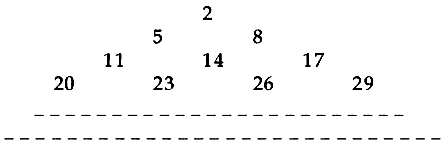 The sum of all the terms of the \( 10^{\text{th}} \) row is __________.