43 questions from 2023
For \( k \in \mathbb{N} \), if the sum of the series \(\displaystyle 1 + \frac{4}{k} + \frac{8}{k^{2}} + \frac{13}{k^{3}} + \frac{19}{k^{4}} + \ldots \) is \( 10 \), then the value of \( k \) is _______.
Let \( S=109+\dfrac{108}{5}+\dfrac{107}{5^{2}}+\ldots+\dfrac{2}{5^{107}}+\dfrac{1}{5^{108}} \). Then the value of \( \left(16S-(25)^{-54}\right) \) is equal to ______.
If \( \dfrac{1^{3} + 2^{3} + 3^{3} + \ldots \ \text{up to} \ n \ \text{terms}}{1.3 + 2.5 + 3.7 + \ \text{up to} \ n \ \text{terms}} = \dfrac{9}{5} \), then the value of of \( n \) is:
Let \( a_1 = b_1 = 1 \) and \( a_n = a_{n-1} + (n-1), b_n = b_{n-1} + a_{n-1}, \forall\, n \ge 2 \). If \( S = \ \displaystyle \sum_{n=1}^{10} \frac{b_n}{2^n} \) and \( T = \ \displaystyle \sum_{n=1}^{8} \frac{n}{2^{\,n-1}} \), then \( 2^7 (2S - T) \) is equal to ______.
Let \( a, b, c \) and \( d \) be positive real numbers such that \( a+b+c+d=11 \). If the maximum value of \( a^5 b^3 c^2 d \) is \( 3750\beta \), then the value of \( \beta \) is:
For the two positive numbers \( a, b \), if \( a, b \) and \( \frac{1}{18} \) are in a geometric progression, while \( \frac{1}{a} , 10 \) and \( \frac{1}{b} \) are in an arithmetic progression, then \( 16a + 12b \) is equal to ____.
Suppose \( a_{1}, a_{2}, 2, a_{3}, a_{4} \) be in an arithmetico-geometric progression. If the common ratio of the corresponding geometric progression is \( 2 \) and the sum of all \( 5 \) terms of the arithmetico-geometric progression is \( {49}/{2} \), then \( a_{4} \) is equal to ______.
The sum of all those terms, of the arithmetic progression \( 3,\,8,\,13,\,\ldots,\,373 \), which are not divisible by \( 3 \), is equal to ________.
Let the first term \( a \) and the common ratio \( r \) of a geometric progression be positive integers. If the sum of squares of its first three terms is \( 33033 \), then the sum of these three terms is equal to:
Let \( \{a_k\} \) and \( \{b_k\} , \ k \in e , \) be two G.P.s with common ratios \( r_1 \) and \( r_2 \) respectively such that \( a_1 - b_1 = 4 \) and \( r_1 < r_2 \). Let \( c_k = a_k + b_k , \ k \in \)\(\mathbb{N}\). If \( c_2 = 5 \) and \( c_3 = \frac{13}{4} \) then \( \displaystyle \sum_{k=1}^{\infty} c_k - (12a_6 + 8b_4) \) is equal to ________.
The \( 8^{\text{th}} \) common term of the series \(S_{1}=3+7+11+15+19+\ldots \), \( S_{2}=1+6+11+16+21+\ldots \) is __________.
Let \( < a_n > \)be a sequence such that \( a_1 + a_2 + \ldots + a_n = \dfrac{n^2 + 3n}{(n+1)(n+2)} \). If \( 28 \displaystyle\sum_{k=1}^{10} \dfrac{1}{a_k} = p_1 p_2 p_3 \ldots p_m \), where \( p_2, p_2, \ldots , p_m \) are the first \( m \) prime numbers, then \( m \) is equal to:
The \( 4^{\text{th}} \) term of GP is \( 500 \) and its common ratio is \( \frac{1}{m} \), \( m \in \mathbb{N} \). Let \( S_n \) denote the sum of the first \( n \) terms of this GP. If \( S_6 > S_5 + 1 \) and \( S_7 < S_6 + \frac{1}{2} \), then the number of possible values of \( m \) is ______.
Let \( a_1, a_2, a_3, \ldots, a_n \) be \( n \) positive consecutive terms of an arithmetic progression. If \( d > 0 \) is its common difference, then: \( \displaystyle \lim_{n \to \infty} \sqrt{\frac{d}{n}} \left( \frac{1}{\sqrt{a_1}+\sqrt{a_2}} + \frac{1}{\sqrt{a_2}+\sqrt{a_3}} + \ldots + \frac{1}{\sqrt{a_{n-1}}+\sqrt{a_n}} \right) \) is:
Let\( 0 < z < y < x\) be three real numbers such that $\dfrac{1}{x}, \dfrac{1}{y}, \dfrac{1}{z}$ are in an arithmetic progression and $x, \sqrt{2}y, z$ are in a geometric progression. If $xy + yz + zx = \dfrac{3}{\sqrt{2}} xyz$, then $3(x + y + z)^2$ is equal to________.
The sum of the first \( 20 \) terms of the series \( 5 + 11 + 19 + 29 + 41 + \ldots \) is:
Let \( a_{1}, a_{2}, \ldots, a_{n} \) be in A.P. If \( a_{5} = 2a_{7} \) and \( a_{11} = 18 \), then \( 12\!\left(\dfrac{1}{\sqrt{a_{10}}+\sqrt{a_{11}}} + \dfrac{1}{\sqrt{a_{11}}+\sqrt{a_{12}}} + \ldots + \dfrac{1}{\sqrt{a_{17}}+\sqrt{a_{18}}}\right) \) is equal to _____.
Let \( a_1,a_2,a_3,\ldots \) be an A.P. If \( a_7=3 \), the product \( a_1a_4 \) is minimum and the sum of its first \( n \) terms is zero, then \( n!-4a_{n(n+2)} \) is equal to:
If the sum of the series \( \left( \dfrac{1}{2} - \dfrac{1}{3} \right) + \left( \dfrac{1}{2^2} - \dfrac{1}{2 \cdot 3} + \dfrac{1}{3^2} \right) + \left( \dfrac{1}{2^3} - \dfrac{1}{2^2 \cdot 3} + \dfrac{1}{2 \cdot 3^2} - \dfrac{1}{3^3} \right) + \left( \dfrac{1}{2^4} - \dfrac{1}{2^3 \cdot 3} + \dfrac{1}{2^2 \cdot 3^2} - \dfrac{1}{2 \cdot 3^3} + \dfrac{1}{3^4} \right) + \ldots \) is \( \dfrac{\alpha}{\beta} \) , where \( \alpha \) and \( \beta \) are co-prime, then \( \alpha + 3\beta \) is equal to _________.
For three positive integers \( p,q,r \), \( x^{pq^{2}} = y^{qr} = z^{p^{2}r} \) and \( r=pq+1 \) such that \( 3, \; 3\log_{y}x, \; 3\log_{z}y, \; 7\log_{x}z \) are in A.P. with common difference \( \dfrac{1}{2} \). Then \( r-p-q \) is equal to:
If the sum and product of four positive consecutive terms of a G.P., are \( 126 \) and \( 1296 \), respectively, then the sum of common ratios of all such GPs is:
If \( a_n = \frac{-2}{4n^2 - 16n + 15} \), then \( a_1 + a_2 + \ldots + a_{25} \) is equal to:
Let \( a_{1},a_{2},a_{3},\ldots \) be a G.P. of increasing positive numbers. Let the sum of its \( 6^{\text{th}} \) and \( 8^{\text{th}} \) terms be \( 2 \) and the product of its \( 3^{\text{rd}} \) and \( 5^{\text{th}} \) terms be \( \dfrac{1}{9} \). Then \( 6(a_{2}+a_{4})(a_{4}+a_{6}) \) is equal to:
Let \( a_1,\, a_2,\, a_3, \ldots \) be a GP of increasing positive numbers. If the product of fourth and sixth terms is \( 9 \) and the sum of fifth and seventh terms is \( 24 \), then \( a_1 a_9 + a_2 a_4 a_9 + a_5 + a_7 \) is equal to ________.
If \( S_n = 4 + 11 + 21 + 34 + 50 + \dots \) to \( n \) terms, then \( \dfrac{1}{60}\,(S_{29} - S_{9}) \) is equal to:
The sum \( \displaystyle \sum_{n=1}^{\infty} \frac{2n^2 + 3n + 4}{(2n)!} \) is equal to:
The sum \( 1^{2}-2\cdot 3^{2}+3\cdot 5^{2}-4\cdot 7^{2}+5\cdot 9^{2}-\cdots+15\cdot 29^{2} \) is ________.
Let \( A_1, A_2, A_3 \) be the three A.P. with the same common difference \( d \) and having their first terms as \( A, A+1, A+2 \) respectively. Let \( a, b, c \) be the \( 7^{\text{th}}, 9^{\text{th}}, 17^{\text{th}} \) terms of \( A_1, A_2, A_3 \), respectively such that. If \( a = 29 \), then the sum of first \( 20 \) terms of an AP whose first term is \( c-a-b \) and common difference is \( \frac{d}{12} \), is equal to ________.
Let \( a_1 = 8 , a_2 , a_3 , \ldots , a_n \) be an A.P. If the sum of its first four terms is \( 50 \) and the sum of its last four terms is \( 170 \), then the product of its middle two terms is ________.
Number of \( 4 \)-digit numbers that are less than or equal to \( 2800 \) and either divisible by \( 3 \) or by \( 11 \), is equal to ____.
The sum to \( 10 \) terms of the series \( \dfrac{1}{1+1^{2}+1^{4}}+\dfrac{2}{1+2^{2}+2^{4}}+\dfrac{3}{1+3^{2}+3^{4}}+\ldots \) is:
Let \( a_{n} \) be the \( n \)th term of the series \( 5+8+14+23+35+50+\ldots \) and \( s_{n}=\displaystyle\sum_{k=1}^{n}a_{k} \). Then \( S_{30}-a_{40} \) is equal to:
If \( \gcd(m,n)=1 \) and \( 1^2-2^2+3^2-4^2+\ldots+(2021)^2-(2022)^2+(2023)^2=1012\, m^2 n \) then \( m^2-n^2 \) is equal to:
Let \( s_1, s_2, s_3, \ldots, s_{10} \) respectively be the sum to \( 12 \) terms of \( 10 \) A.P.s whose first terms are \( 1, 2, 3, \ldots, 10 \) and the common differences are \( 1, 3, 5, \ldots, 19 \) respectively. Then \( \displaystyle\sum_{i=1}^{10} s_i \) is equal to:
The sum of the common terms of the following three arithmetic progressions.\( 3, 7, 11, 15, \ldots, 399, \)\( 2, 5, 8, 11, \ldots, 359 \) and\( 2, 7, 12, 17, \ldots, 197, \)is equal to ______.
Among \( (S1) = \displaystyle\lim_{n \to \infty} \frac{1}{n^{2}} (2 + 4 + 6 + \ldots + 2n) = 1 \)\( (S2) =\displaystyle \lim_{n \to \infty} \frac{1}{n^{16}} (1^{15} + 2^{15} + 3^{15} + \ldots + n^{15}) = \frac{1}{16} \)
Let \( a, b, c>1 \), \( a^{3}, b^{3} \) and \( c^{3} \) be in A.P., and \( \log_{a} b, \log_{c} a \) and \( \log_{b} c \) be in G.P. If the sum of first \( 20 \) terms of an A.P., whose first term is \( \dfrac{a+4b+c}{3} \) and the common difference is \( \dfrac{a-8b+c}{10} \) is \( -444 \), then \( abc \) is equal to:
The sum to \( 20 \) terms of the series \( 2\cdot 2^{2}-3^{2}+2\cdot 4^{2}-5^{2}+2\cdot 6^{2}-\ldots \) is equal to _____.
Let \( x_{1}, x_{2}, \ldots, x_{100} \) be in an arithmetic progression, with \( x_{1} = 2 \) and their mean equal to \( 200 \). If \( y_{i} = i(x_{i}-i), 1 \le i \le 100 \), then the mean of \( y_{1}, y_{2}, \ldots, y_{100} \) is:
If \( a_{\alpha} \) is the greatest term in the sequence \( a_n=\dfrac{n^{3}}{n^{4}+147} \), \( n=1,2,3,\ldots \), then \( \alpha \) is equal to ________.
If \( (20)^{19} + 2(21)(20)^{18} + 3(21)^{2}(20)^{17} + \ldots + 20(21)^{19} = k(20)^{19} \), then \( k \) is equal to ______.
Let the positive numbers \( a_1,a_2,a_3,a_4 \) and \( a_5 \) be in a G.P. Let their mean and variance be \( \dfrac{31}{10} \) and \( \dfrac{m}{n} \) respectively, where \( m \) and \( n \) are co-prime. If the mean of their reciprocals is \( \dfrac{31}{40} \) and \( a_3+a_4+a_5=14 \), then \( m+n \) is equal to ____.
Let \( S_{K}=\dfrac{1+2+\ldots +K}{K} \) and \(\displaystyle \sum_{j=1}^{n} S_{j}^{2}=\dfrac{n}{A}(Bn^{2}+Cn+D) \), where \( A, B, C, D\in \mathbb{N} \) and \( A \) has least value. Then:

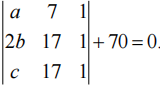 . If \( a = 29 \), then the sum of first \( 20 \) terms of an AP whose first term is \( c-a-b \) and common difference is \( \frac{d}{12} \), is equal to ________.