4 questions from 2023
Consider an experiment of tossing a coin repeatedly until the outcomes of two consecutive tosses are same. If the probability of a random toss resulting in head is \( \frac{1}{3} \), then the probability that the experiment stops with head is:
Let \( X \) be the set of all five digit numbers formed using \( 1, 2, 2, 2, 4, 4, 0 \). For example, \( 22240 \) is in \( X \) while \( 02244 \) and \( 44422 \) are not in \( X \). Suppose that each element of \( X \) has an equal chance of being chosen. Let \( p \) be the conditional probability that an element chosen at random is a multiple of \( 20 \) given that it is a multiple of \( 5 \). Then the value of \( 38p \) is equal to:
Paragraph-2
Consider the \( 6\times6 \) square in the figure. Let \( A_1, A_2, \ldots, A_{49} \) be the points of intersections (dots in the picture) in some order. We say that \( A_i \) and \( A_j \) are friends if they are adjacent along a row or along a column. Assume that each point \( A_i \) has an equal chance of being chosen.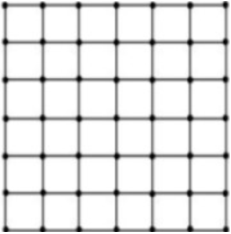
Two distinct points are chosen randomly out of the points \( A_1, A_2, \ldots, A_{49} \). Let \( p \) be the probability that they are friends. Then the value of \( 7p \) is:
Paragraph-2
Consider the \( 6\times6 \) square in the figure. Let \( A_1, A_2, \ldots, A_{49} \) be the points of intersections (dots in the picture) in some order. We say that \( A_i \) and \( A_j \) are friends if they are adjacent along a row or along a column. Assume that each point \( A_i \) has an equal chance of being chosen.
Let \( p_i \) be the probability that a randomly chosen point has \( i \) many friends, \( i=0,1,2,3,4 \). Let \( X \) be a random variable such that for \( i=0,1,2,3,4 \), the probability \( P(X=i)=p_i \). Then the value of \( 7E(X) \) is:
